General information & model overview
| Category | Specification Details |
|---|---|
| Model name | Mercedes-Benz Typ 770 / Grosser Mercedes (W07 & W150) |
| Family | Mercedes-Benz Typ 770 / “Grosser Mercedes” (Großer Mercedes) |
| Internal code | W07 (first-generation Typ 770) |
| Production years | Approximately 1930 – 1943/1944 (W07 1930–1938; W150 1938–early 1940s) |
| Manufacturer | Daimler-Benz AG, Untertürkheim |
| Market role | Ultra-luxury / state and ceremonial passenger car — flagship above mid-size and luxury eights such as the Typ Nurburg |
| Body focus of this entry | Family overview of both generations and major body styles |
| Layout | Front-engine, rear-wheel drive |
| Family overview | Typ 770 hub |
| Related bodies | W07 Cab A, Cab B, Cab C, Cab D, Cab F, Tourenwagen, Stadt Coupé; W150 Cab B, Cab D, Cab F, Tourenwagen |
| W07 programme scale | Approximately 117 W07-series cars built 1930–1938 (all bodies combined; individual body tallies are much smaller) |
Body & dimensions (W07 chassis class)
| Specification | Details |
|---|---|
| Wheelbase | Approximately 3,750 mm (about 148 in) |
| Overall length | Roughly 5,600 – 5,700 mm depending on body |
| Width | About 1,850 mm class |
| Height | About 1,800 – 1,830 mm class (body-dependent) |
| Track | About 1,500 mm front and rear (period figures) |
| Chassis | Boxed ladder frame; beam axles; semi-elliptic leaf springs |
| Coachwork | Factory-associated and specialist coachbuilt bodies on the long W07 chassis; exact fittings vary by order |
| Seating | Multi-seat formal layouts typical; exact count depends on body and partitions |
Engine specifications (W07 / M07 theme)
| Theme | Details |
|---|---|
| Configuration | Inline eight-cylinder petrol, overhead camshaft, aluminium pistons |
| Displacement | 7,665 cc (approximately 7.7 litres) |
| Output (naturally aspirated) | About 150 PS / 150 bhp (112 kW) at roughly 2,800 rpm |
| Output (with optional supercharger) | About 200 PS / 200 bhp (149 kW) at roughly 2,800 rpm when Roots-type blower engaged (typically full-throttle engagement) |
| Induction | Naturally aspirated base; optional Kompressor (770 K theme in collector language) |
| Character | Smooth multi-cylinder luxury power for formal mass — not a short-chassis sports special |
| Fuel & cooling | Period carburation; liquid cooling; thermal load under formal closed mass is a central ownership subject |
Drivetrain, chassis & brakes (W07)
| Category | Details |
|---|---|
| Gearbox | Four-speed manual; third direct, fourth overdrive-style ratio in period descriptions |
| Drive | Rear-wheel drive |
| Suspension | Solid beam axles, semi-elliptic leaf springs front and rear |
| Brakes | Servo-assisted mechanical brakes (period practice; not the later W150 hydraulic system) |
| Steering | Low-geared mechanical steering suited to formal parking and parade speeds |
Performance (approximate, condition-dependent)
| Measure | Details |
|---|---|
| Top speed (blown) | Up to about 160 km/h (99 mph) class quoted for supercharged cars under favourable conditions |
| Top speed (unblown) | Lower; formal body drag and gearing dominate |
| Use envelope | Ceremonial, diplomatic, and elite private transport — not modern high-speed dual carriageway use |
| Mass effect | Heavy coachwork and optional armour (where fitted later or specially) rewrite acceleration and braking demands |
W150 second generation — mechanical overview
| Theme | Details |
|---|---|
| Chassis code | W150 (1938–1943/44 family window) |
| Frame & suspension | Oval tube chassis; independent front; de Dion rear; coil springs |
| Engine | 7,665 cc inline eight (M150 theme); about 155 PS unblown / about 230 PS supercharged |
| Gearbox | Five-speed manual |
| Brakes | Hydraulic |
| Programme scale | About 88 cars |
| Body entries on Motor Wiki | Cabriolet B, Cabriolet D, Cabriolet F, Tourenwagen |
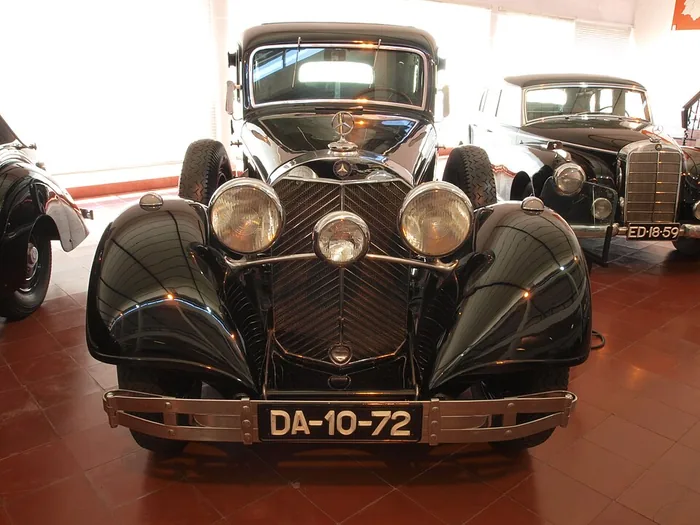
Image source: Wikimedia Commons
Mercedes-Benz Typ 770: the Grosser Mercedes flagship
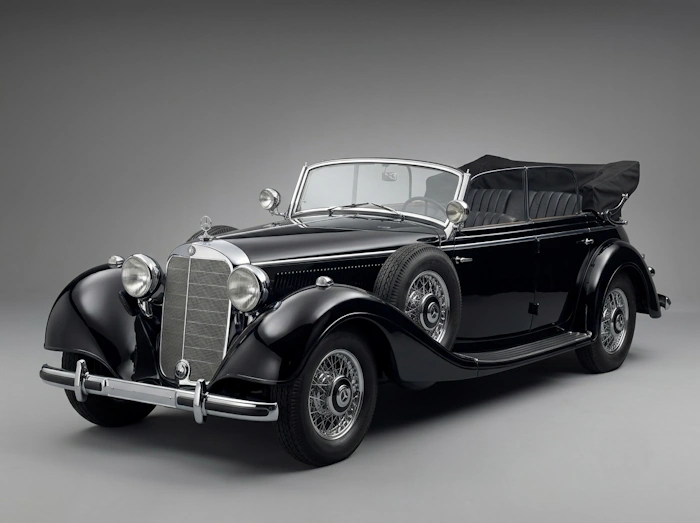
The Mercedes-Benz Typ 770, known in German as the Großer Mercedes and often written in English as Grosser Mercedes, was the company’s ultra-luxury flagship from 1930 into the early 1940s. Two generations cover that span: the W07 series of about 1930–1938 and the thoroughly revised W150 series from 1938. Combined production is on the order of roughly 205 cars—about 117 of the first generation and about 88 of the second—figures that place the 770 among the rarest large Mercedes passenger programmes of the interwar and wartime years.
This hub page maps both generations, the 7.7-litre eight-cylinder idea, and the open and closed body styles treated in detail on Motor Wiki. Body-specific entries cover W07 Cabriolet A, B, C, D, F, Tourenwagen, and Stadt Coupé, plus W150 Cabriolet B, D, F, and Tourenwagen.
In the Mercedes ladder the 770 sat above large luxury eights such as the Typ Nurburg and far above mid-size programmes. Supercharged sports cars of the Typ S / W06 culture shared a brand and an era of multi-cylinder engineering, but not the same brief. The Grosser’s job was formal presence, multi-seat capacity where ordered, and the ability to carry heads of state, institutional users, and private elites with eight-cylinder composure.
Development: W07 then W150
The W07 arrived as successor thinking to earlier large Mercedes luxury cars in the Typ 630 conversation. It used a long boxed chassis on beam axles and leaf springs, a 7,665 cc overhead-cam inline eight, and a four-speed gearbox with an overdrive-style fourth. Base output around 150 PS could rise to about 200 PS with an optional Roots supercharger engaged at full throttle. Dimensions were already enormous by passenger-car standards: wheelbase near 3.75 m and overall lengths commonly in the 5.6–5.7 m class depending on coachwork.
In 1938 the programme was rewritten as W150. The new chassis used oval-section tubes, independent front suspension, a de Dion rear axle, coil springs, and hydraulic brakes. The engine architecture remained a 7.7-litre eight but was revised to roughly 155 PS unblown and about 230 PS supercharged, with a five-speed gearbox. Wheelbase grew to about 3.88 m; overall length and width could stretch further still, especially on formal open bodies and special security cars. Price was often listed only on request—an honest signal of exclusivity rather than a catalogue commodity.
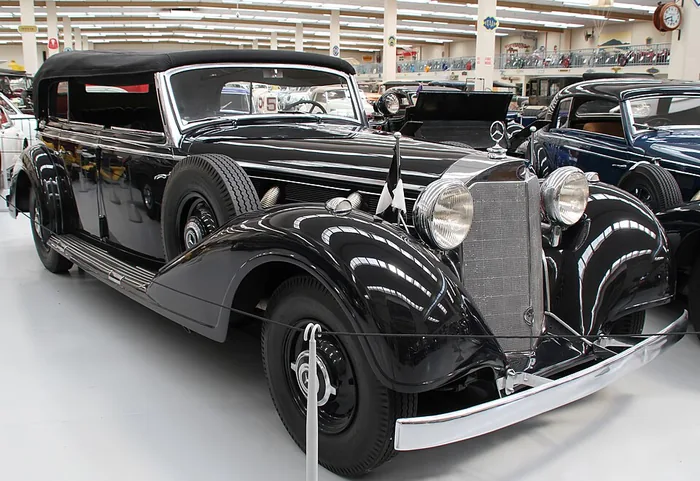
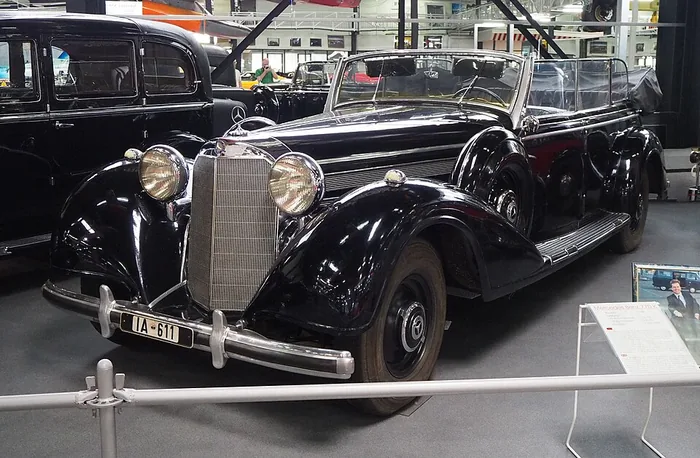
Both generations were coachwork-flexible. Pullman limousines, open tourers, and lettered cabriolets (A through F themes in period practice) allowed the same mechanical idea to serve closed formality, multi-seat open parade use, or more intimate open elegance. Exact door counts, partitions, and weather equipment must be read from the individual car.
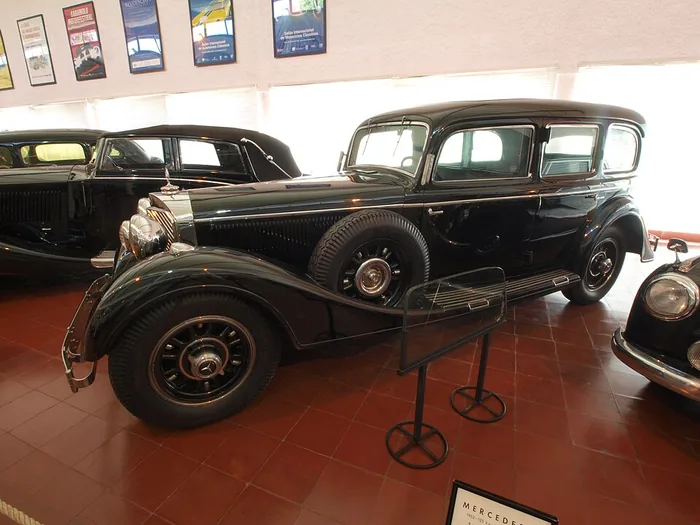
Image source: Wikimedia Commons
State, ceremonial, and private use
Grosser Mercedes cars were expensive tools of rank. Period and later documentation associate examples with presidential, imperial, papal, royal, and governmental users across several countries. During the late 1930s and early 1940s, W150 cars in particular appear in official German and allied state contexts, including armoured parade and security specifications on selected chassis. Encyclopedia treatment of that history should stay factual: these were official transport machines, not sports trophies, and surviving cars require careful provenance research rather than rumour.
Private elite ownership also existed. The car’s social meaning is multi-cylinder ceremony and long-wheelbase presence. Comparing a 770 unfavourably with a short-chassis Kompressor sports car misses the product definition. Comparing it with a Nurburg eight is closer in luxury intent but still understates the 770’s scale and exclusive production numbers.
How to use this Motor Wiki cluster
Start here for generation differences and mechanical baselines. Choose a W07 body page when the car is first-generation (leaf-spring beam-axle chassis, four-speed, 1930–1938 window). Choose a W150 body page when the car is second-generation (oval tube, IFS/de Dion, hydraulic brakes, five-speed). Within each generation, letter codes describe open arrangements more than modern trim packages: A and B lean toward more compact open social cuts; C, D, and F move toward larger formal open multi-seat ceremony; Tourenwagen emphasises open multi-seat touring/parade utility; Stadt Coupé is a closed formal expression on the W07.
Always verify supercharger fitment, armour, and coachbuilder origin on the vehicle and its papers. Production across both generations is so small that every documented survivor matters for the historical record.
Ownership: strengths and things to watch
Strengths
- Complete family map — both generations and main body styles linked from one hub.
- Clear mechanical split — W07 leaf-spring versus W150 oval-tube explained in one place.
- Production context — programme-scale rarity (~117 + ~88) without forcing one body to carry the whole story.
- Research navigation — letter codes and generation order for cataloguing survivors.
Things to watch
- Caption errors — open Grossers are widely mis-labelled across generations online.
- Provenance myths — famous-user claims need chassis documents, not paint stories.
- Over-generalisation — a tourer is not a Cabriolet F; closed cars are not “lesser” automatically.
- Parts reality — no hub page replaces specialist support for any physical car.
Sibling map
Open and closed W07 pages cover Cabriolet A through F, Tourenwagen, and Stadt Coupé. W150 pages cover Cabriolet B, D, F, and Tourenwagen. Read generation first, letter second.
Legacy
The Typ 770 programme is the clearest pre-war statement that Mercedes-Benz would build ultra-luxury passenger cars in tiny numbers for formal and institutional clients. Its importance is not volume; it is the technical and social ceiling of the brand before and during the early 1940s.
Use this hub to separate W07 from W150 before reading any body page. Confusing leaf-spring first-generation cars with oval-tube second-generation cars is the most common error in casual captions. Keeping that distinction clean is the hub’s main long-term value.
Leave a Reply
You must be logged in to post a comment.