General information & model overview
| Category | Specification Details |
|---|---|
| Model name | 1939 Mercedes-Benz “Grosser Mercedes” Cabriolet F (W150) |
| Family | Mercedes-Benz Typ 770 / “Grosser Mercedes” second generation |
| Internal code | W150 |
| Production years | Approximately 1939 – 1943 (W150 Cabriolet F theme; very small production) (chassis programme into early 1940s; last bodies delivered into 1944 in family tallies) |
| Manufacturer | Daimler-Benz AG |
| Market role | Ultra-luxury / state and ceremonial flagship; most expensive German passenger car class of its moment, often priced “on request” |
| Body focus of this entry | Cabriolet F — largest formal open Pullman-oriented body on W150; among the rarest open styles |
| Layout | Front-engine, rear-wheel drive |
| Predecessor generation | W07 Typ 770 (1930–1938) — see Typ 770 hub |
| Related W150 bodies | Cab B, Cab D, Cab F, Tourenwagen |
| W150 programme scale | Approximately 88 W150-series cars (all bodies combined) |
Body & dimensions (W150 chassis class)
| Specification | Details |
|---|---|
| Wheelbase | Approximately 3,880 mm (about 153 in) |
| Overall length | Roughly 6,000 – 6,500 mm depending on body and equipment |
| Width | About 2,100 – 2,500 mm class depending on body and armour packages |
| Height | About 1,900 mm class |
| Chassis | Oval-section tube frame; independent front suspension; de Dion rear axle; coil springs |
| Brakes | Hydraulic brakes (advance over W07 mechanical servo system) |
| Special equipment | Selected cars ordered with armour glass, steel plating, and related security fittings — verify on the individual vehicle |
Engine specifications (W150 / M150 theme)
| Theme | Details |
|---|---|
| Configuration | Inline eight-cylinder petrol, related architecture to W07 M07 but revised |
| Displacement | 7,665 cc |
| Output (naturally aspirated) | About 155 PS / 155 bhp (116 kW) at roughly 3,000 rpm |
| Output (supercharged) | About 230 PS / 230 bhp (172 kW) at roughly 3,200 rpm with blower |
| Special high-output theme | Literature notes rare twin-supercharged high-power cars (very small numbers) — individual verification required |
| Top speed class | Around 170 km/h quoted for typical supercharged cars; higher figures claimed for rare high-output versions |
Drivetrain (W150)
| Category | Details |
|---|---|
| Gearbox | Five-speed manual; fourth direct, fifth overdrive-style in period descriptions |
| Drive | Rear-wheel drive |
| Suspension | Independent front; de Dion rear; coil springs |
| Brakes | Hydraulic drums suited to very high mass when well maintained |
1939 Mercedes-Benz “Grosser Mercedes” Cabriolet F: body identity on the W150 Grosser chassis
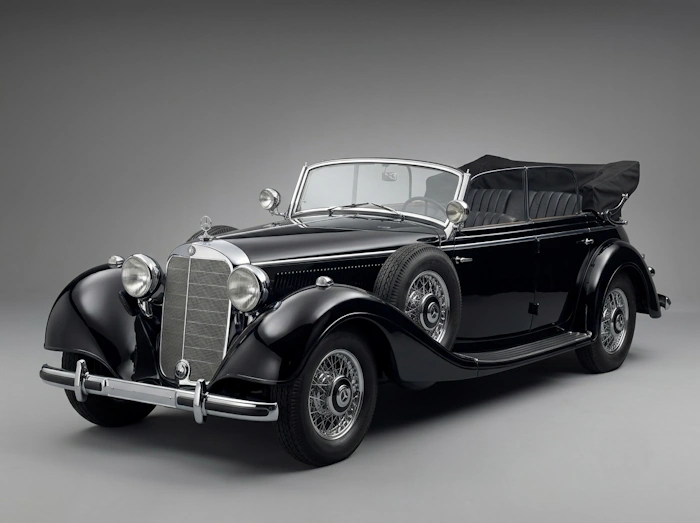
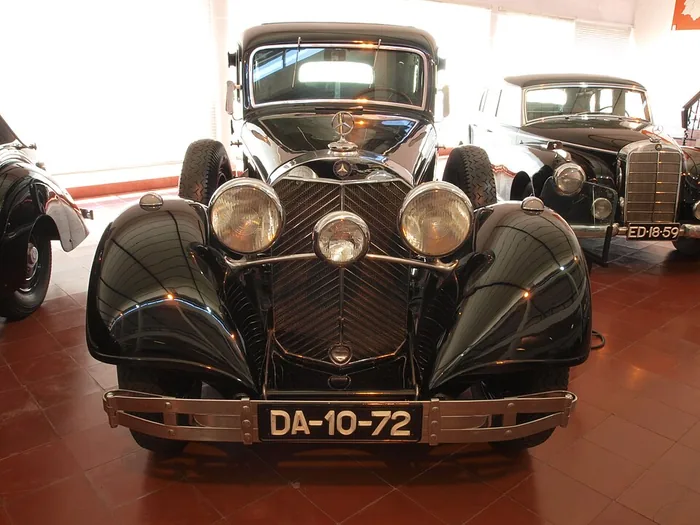
The 1939 Mercedes-Benz Grosser Mercedes Cabriolet F on the W150 chassis is the second-generation programme’s largest formal open expression. Literature and specialist tallies treat Cabriolet F as one of the rarest W150 body styles—on the order of only a handful of cars in some counts—within an already tiny total of about 88 W150 chassis. Exact numbers should be checked against current manufacturer and club research for any specific car.
Mechanicals are the revised W150 package: oval-tube chassis, independent front suspension, de Dion rear, coil springs, hydraulic brakes, five-speed gearbox, and the 7,665 cc eight with about 155 PS unblown or about 230 PS supercharged. Full generation context lives on the Typ 770 hub.
Related W150 open bodies: Cabriolet B, Cabriolet D, Tourenwagen. First-generation counterpart: W07 Cabriolet F.
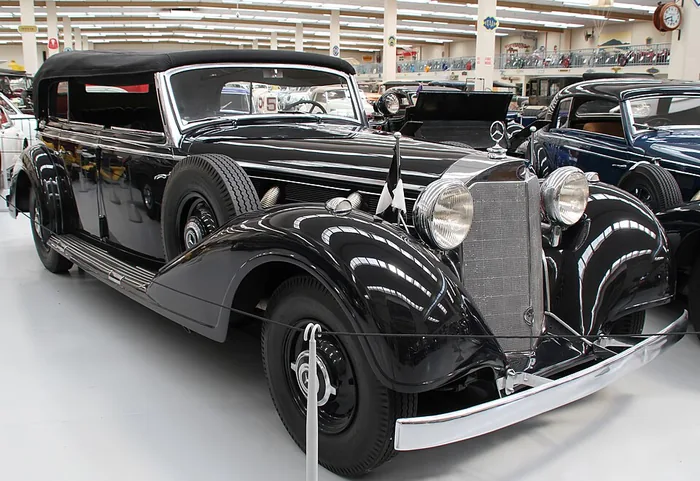
Image source: Wikimedia Commons
Design and coachwork
Design continues the Pullman open ceremony idea on a longer, more modern chassis. Overall length can exceed six metres depending on body and equipment. The folding top and multi-seat rear compartment dominate both visual identity and ownership cost.
Some W150 cars were ordered with security equipment—armour glass, steel plating, special tyres—that further increases mass and changes recommended operating speeds. Not every Cabriolet F is armoured; verify on documents and physical inspection.
Brightwork, interior timber, and leather or cloth trims signal state-class finish. Restorations must decide whether to preserve wartime or post-war finishes when both exist in a car’s history.
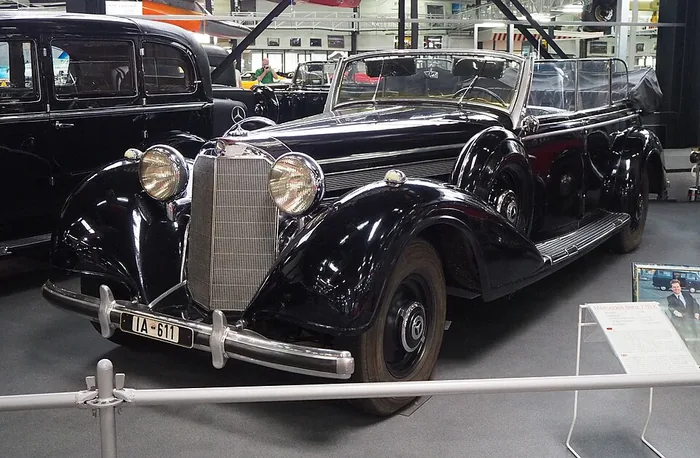
Image source: Wikimedia Commons
Mechanical basis and driving character
The W150 chassis is more sophisticated than the W07: hydraulic brakes and independent front suspension improve control authority on paper, but mass still rules. Drivers must plan early, especially with a full formal cabin.
Five-speed gearing and stronger supercharged output make decisive formal progress more available than on early unblown cars, yet modern dual carriageways remain inappropriate as a design use case.
Cooling, fuel quality, and tyre condition decide whether a rare F is a runner or a static exhibit. Specialist workshops familiar with large 1930s Mercedes eights are essential.
Collecting and documentation
Cabriolet F rarity means each documented car is a primary source. Auction and private-sale claims should be checked against chassis registers. Historical associations with official users require careful, non-sensational documentation.
Insurance, transport, and storage costs are museum-level. Acquisition without a conservation plan is incomplete.
Ownership: strengths and things to watch
Strengths
- Rarest open W150 formal cut — primary-source status for the generation.
- Later chassis features — oval tube, IFS, de Dion, hydraulic brakes when healthy.
- Strong supercharged output class — revised 7.7-litre theme.
Things to watch
- Hydraulic condition — beauty without brakes is unsafe.
- Security equipment mass — armour changes tyres and speeds if present.
- Public pressure — do not drive for crowds before the car is ready.
- Documentation custody — split wartime/post-war layers carefully.
Sibling comparisons
Among W150 open bodies, F is the most extreme formal cabriolet. D is large multi-seat open ceremony; B is typically less Pullman-extreme; Tourenwagen is multi-seat open visibility. W07 Cabriolet F is first-generation only.
Legacy
W150 Cabriolet F pairs maximum open formality with the second-generation chassis. Extreme rarity makes every documented example a primary source for late-1930s flagship practice.
Hydraulic brakes and oval-tube structure are part of that legacy only when they are maintained; beauty without stopping power is incomplete history.
Leave a Reply
You must be logged in to post a comment.