General information & model overview
| Category | Specification Details |
|---|---|
| Model name | Mercedes-Benz “Grosser Mercedes” Cabriolet F (W07) (1931–1938) |
| Family | Mercedes-Benz Typ 770 / “Grosser Mercedes” (Großer Mercedes) |
| Internal code | W07 (first-generation Typ 770) |
| Production years | Approximately 1931 – 1938 within the W07 programme |
| Manufacturer | Daimler-Benz AG, Untertürkheim |
| Market role | Ultra-luxury / state and ceremonial passenger car — flagship above mid-size and luxury eights such as the Typ Nurburg |
| Body focus of this entry | Cabriolet F — largest formal Pullman-oriented open body on W07 |
| Layout | Front-engine, rear-wheel drive |
| Family overview | Typ 770 hub |
| Related bodies | Cab A, Cab B, Cab C, Cab D, Cab F, Tourenwagen, Stadt Coupé |
| W07 programme scale | Approximately 117 W07-series cars built 1930–1938 (all bodies combined; individual body tallies are much smaller) |
Body & dimensions (W07 chassis class)
| Specification | Details |
|---|---|
| Wheelbase | Approximately 3,750 mm (about 148 in) |
| Overall length | Roughly 5,600 – 5,700 mm depending on body |
| Width | About 1,850 mm class |
| Height | About 1,800 – 1,830 mm class (body-dependent) |
| Track | About 1,500 mm front and rear (period figures) |
| Chassis | Boxed ladder frame; beam axles; semi-elliptic leaf springs |
| Coachwork | Factory-associated and specialist coachbuilt bodies on the long W07 chassis; exact fittings vary by order |
| Seating | Multi-seat formal layouts typical; exact count depends on body and partitions |
Engine specifications (W07 / M07 theme)
| Theme | Details |
|---|---|
| Configuration | Inline eight-cylinder petrol, overhead camshaft, aluminium pistons |
| Displacement | 7,665 cc (approximately 7.7 litres) |
| Output (naturally aspirated) | About 150 PS / 150 bhp (112 kW) at roughly 2,800 rpm |
| Output (with optional supercharger) | About 200 PS / 200 bhp (149 kW) at roughly 2,800 rpm when Roots-type blower engaged (typically full-throttle engagement) |
| Induction | Naturally aspirated base; optional Kompressor (770 K theme in collector language) |
| Character | Smooth multi-cylinder luxury power for formal mass — not a short-chassis sports special |
| Fuel & cooling | Period carburation; liquid cooling; thermal load under formal closed mass is a central ownership subject |
Drivetrain, chassis & brakes (W07)
| Category | Details |
|---|---|
| Gearbox | Four-speed manual; third direct, fourth overdrive-style ratio in period descriptions |
| Drive | Rear-wheel drive |
| Suspension | Solid beam axles, semi-elliptic leaf springs front and rear |
| Brakes | Servo-assisted mechanical brakes (period practice; not the later W150 hydraulic system) |
| Steering | Low-geared mechanical steering suited to formal parking and parade speeds |
Performance (approximate, condition-dependent)
| Measure | Details |
|---|---|
| Top speed (blown) | Up to about 160 km/h (99 mph) class quoted for supercharged cars under favourable conditions |
| Top speed (unblown) | Lower; formal body drag and gearing dominate |
| Use envelope | Ceremonial, diplomatic, and elite private transport — not modern high-speed dual carriageway use |
| Mass effect | Heavy coachwork and optional armour (where fitted later or specially) rewrite acceleration and braking demands |
Mercedes-Benz “Grosser Mercedes” Cabriolet F: body identity on the W07 Grosser chassis
The Grosser Mercedes Cabriolet F is the most ceremonial open expression commonly associated with the W07 Typ 770: a large formal Pullman-oriented cabriolet for multi-seat open state and elite social use. If Cabriolet A is the intimate open cut of the family, Cabriolet F is the open carriage end of the same spectrum.
Notable survivors and period associations include formal open cars linked in literature to high-status private and institutional owners; every such claim requires chassis-level verification. Mechanically the car remains a W07 7.7-litre eight on the long leaf-spring chassis — see the hub.
Compare with Cabriolet D for related large formal open use and with the Tourenwagen for open multi-seat utility with a less cabriolet-formal emphasis.
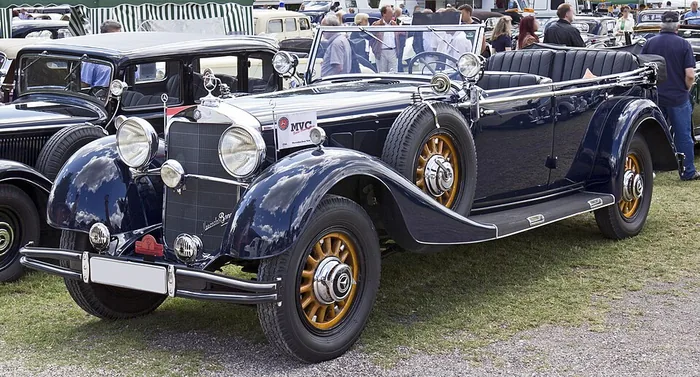
Image source: Wikimedia Commons
Design and coachwork
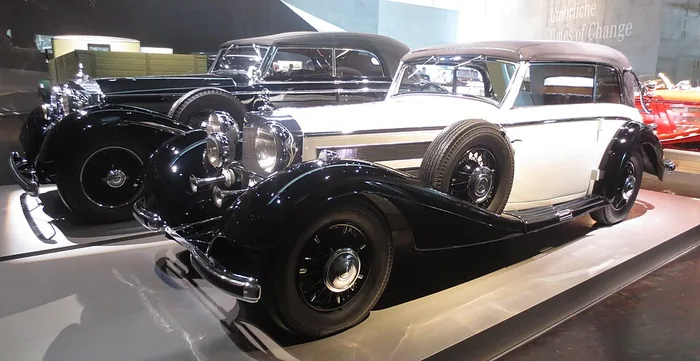
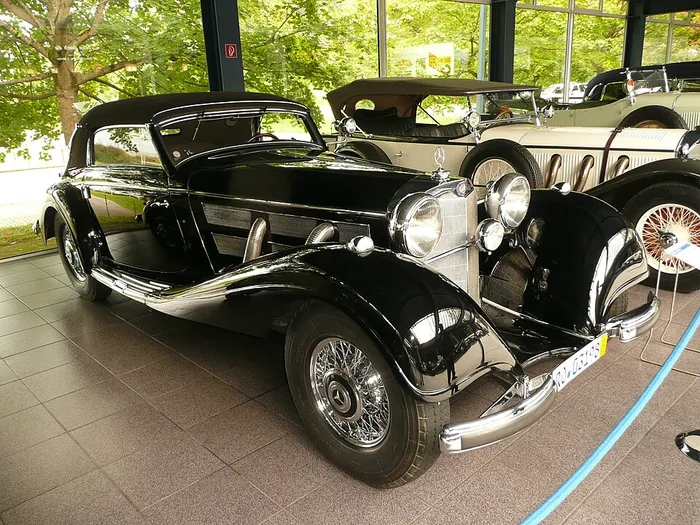
Visual grammar is maximum formal length and open-air presence: long engine bay, tall formal cabin when the top is raised, and a folding top structure engineered for a wide rear compartment. Brightwork and interior richness signal rank.
The top assembly is a major engineering object in its own right. Irons, fabric, and seals dominate long-term cost. A car without a correct top is incomplete as a Cabriolet F regardless of engine health.
Closed-top photographs can understate scale; side profiles with the top down show why the F letter exists—open ceremony on flagship mechanicals.

Image source: Wikimedia Commons
Mechanical basis and driving character
Driving a Cabriolet F is chauffeur-culture more than owner-driver sport. Steering effort, brake planning, and passenger comfort define competence. Supercharged examples add reserve power for formal progress, not circuit behaviour.
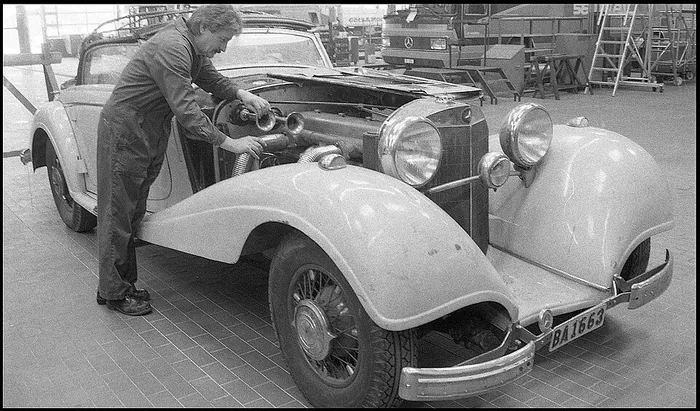
Under full load the mechanical limits of drums, tyres, and cooling become obvious. Maintenance schedules must assume ceremonial use patterns: low average speed, high idle time, high thermal stress.
Do not confuse W07 Cabriolet F with the later W150 Cabriolet F; chassis, brakes, and gearbox generations differ.
Collecting and documentation
Cabriolet F cars sit at the top of open Grosser collecting interest. Provenance, originality of coachwork, and supercharger status dominate value discussions. Specialist museums and private collections are the realistic homes for coherent examples.
Storage must be climate-aware and spacious. Moving these cars for events requires planning comparable to other large pre-war state cars.
Ownership: strengths and things to watch
Strengths
- Maximum W07 open ceremony — Pullman-oriented cabriolet presence.
- Highest educational impact — scale is immediately obvious to visitors.
- Archival importance — few cars; each file matters.
Things to watch
- Logistics — storage, transport, and workshop access before purchase.
- Top completeness — without irons/fabric, F identity collapses.
- Generation mix-ups — W150 F is a different chassis.
- Security and handling — crowds and brightwork risk at shows.
Sibling comparisons
Cabriolet F is the W07 open ceremonial ceiling. D is the nearest multi-seat open neighbour; Tourenwagen shares visibility goals with different equipment; A/B are less extreme open cuts. Do not equate with W150 Cabriolet F without chassis checks.
Legacy
Cabriolet F is the open ceremonial ceiling of the W07 programme. Few bodies make the scale of Typ 770 as obvious. Stewardship, not casual collecting, is the realistic modern role.
Separate W07 F identity carefully from later W150 F cars in every caption and insurance file.
Leave a Reply
You must be logged in to post a comment.