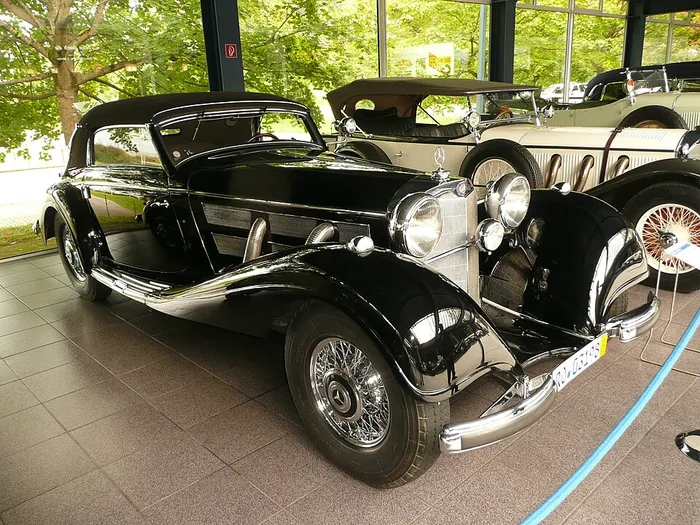
General information & model overview
| Category | Specification Details |
|---|---|
| Model name | Mercedes-Benz Typ 500 K Cabriolet C (W29) (1934–1936) |
| Internal code | W29 |
| Series | Mercedes-Benz Typ 500 K |
| Production years | Approximately 1934 – 1936 within Typ 500 K production |
| Manufacturer | Daimler-Benz AG (Untertürkheim chassis; Sindelfingen special coachwork for many catalogue bodies) |
| Body focus of this entry | Cabriolet C — multi-seat open convertible cut intermediate in the letter map between intimate A and high-volume B formality |
| Layout | Front-engine, rear-wheel drive |
| Programme context | About 342 Typ 500 K cars of all bodies were built 1934–1936 within the W29 line that later continues as 540 K |
| Related W29 bodies | 500 K Cabriolet B, 540 K Cabriolet A, 500 K Sport-Limousine, 500 K Luxus-Roadster |
| Notes | Cabriolet C is less numerous in public discussion than Cab B; letter identity must be verified on doors, seats, and top geometry |
Body & dimensions
| Specification | Details |
|---|---|
| Wheelbase class | Longer multi-seat packaging often associated with ~3,290 mm class literature for B/C multi-seat bodies — approximate; verify on car |
| Construction | Separate chassis with long-bonnet W29 proportions; exact length and mass depend on coachwork |
| Family equipment themes | Hydraulic brakes; independent front suspension lineage shared with related mid-1930s Mercedes sports/GT cars; 12-volt electrical system on the W29 generation |
| Coachwork source | Sindelfingen special body department for many catalogue and special styles; individual fittings vary by order |
Engine specifications (500 K)
| Theme | Details |
|---|---|
| Configuration | Inline eight-cylinder petrol with Roots-type supercharger (Kompressor) engagement under high load |
| Displacement | Approximately 5,018 cc (about 5.0 litres) |
| Output (approximate) | About 100 PS without blower; about 160 PS with supercharger engaged (period class figures — verify on the car) |
| Character | Grand-touring supercharged eight: multi-cylinder smoothness with blower reserve for open roads of the mid-1930s |
| Induction | Naturally aspirated cruise; blower engagement typically associated with decisive throttle demand rather than permanent boost |
Drivetrain, chassis & performance (approximate)
| Category | Details |
|---|---|
| Gearbox | Manual multi-speed (four-speed common; higher-count options appear in period literature for some cars) |
| Brakes | Hydraulic drums — advanced for large supercharged Mercedes of the era when maintained |
| Suspension | Independent front suspension theme of the W29 line; period rear axle practice |
| Electrical system | 12-volt generation standard on W29 family cars |
| Top speed class | Body- and gearing-dependent; treat published figures as approximate envelopes, not modern cruise targets |
500 K Cabriolet C: intermediate multi-seat open letter
The Mercedes-Benz Typ 500 K Cabriolet C is a multi-seat open convertible on the five-litre W29 chassis that sits in the letter map between intimate A-type cuts and the better-known multi-seat B. It uses the same approximately 5,018 cc supercharged eight — about 100 PS unblown and about 160 PS blown in period class language — under open coachwork whose seating and top geometry define C-letter practice rather than a different engine programme.
Primary comparison is the more numerous Cabriolet B. Closed multi-seat contrast appears on the Sport-Limousine. Luxury open extremes include the Luxus-Roadster.
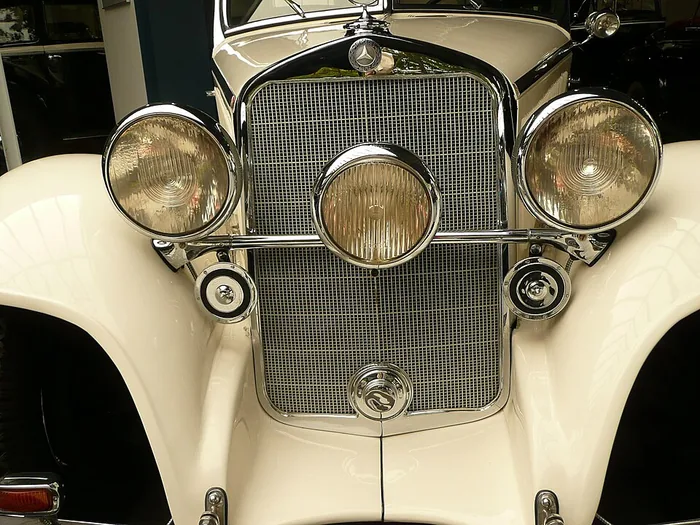
Image source: Wikimedia Commons
Understanding C among W29 open letters
Mercedes cabriolet letters organise coachwork arrangements. Collectors who only know “Cab B” as the default open 500 K miss real order differences that affect seating, top size, and social use. C-type cars deserve their own captions so they are not absorbed into B by laziness or into roadster language by marketing.
1. Production scale
Within roughly 342 five-litre cars, all open styles remain exclusive. Cab B was the commercial backbone; Cab C is less often discussed in popular sources. Scarcity of discussion is not the same as non-existence — surviving examples and factory records still define the type.
2. Packaging
Like many multi-seat B/C bodies, C often associates with longer formal packaging near the ~3,290 mm class in secondary literature. Verify on the car. Do not import sports-roadster packaging claims without evidence.
3. Identification discipline
Door arrangement, rear seat access, and top-iron layout are primary. Seller language is secondary. Period photographs of the specific chassis help more than generic brochure art.
Design of the C-letter open body
Expect multi-seat open formality with a substantial folding top and long-bonnet eight-cylinder presence. Exact rear compartment geometry and side-window treatment can differ from B in ways that matter to specialists even when casual viewers see “another open 500 K.” Interiors should match mid-1930s high-end open practice.
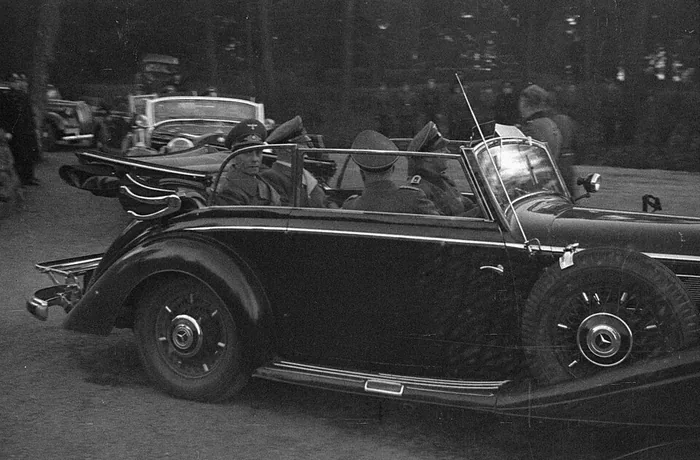
Image source: Wikimedia Commons
1. Top geometry differences
Compare top landings, rear window treatment, and iron stack against documented B and C examples. Small differences are identity signals, not trivia.
2. Seating map
Confirm how many adults the rear compartment truly seats and how they enter. Multi-seat claims without measurement are weak ownership data.
3. Brightwork and formality level
C-type formality is social open touring, not pure sports special theatre. Restoration ethics should respect that intermediate formal path.
Driving a multi-seat open C on five litres
Driving character matches other multi-seat open 500 K cars: deliberate steering, blower reserve under load, hydraulic drums, independent front suspension when healthy, and open-air noise that rises with speed. Passenger load changes braking points and cooling demand.
1. Social-use thermal load
Urban traffic with rear passengers stresses cooling. Service the radiator and related systems before any public demonstration of period performance claims.
2. Top-up acoustics
With the top raised, wind drops and mechanical voice becomes clearer. Gearbox and blower drive noises are diagnostic; do not mask them with radio fantasies the car never had.
3. Tyres and four-up mass
Load ratings and tyre age are safety-critical. Multi-seat open cars encourage full occupancy; the chassis must be prepared for that reality.
4. Blower discipline
Use the Kompressor for decisive load on suitable roads. Constant engagement for effect is hard on the five-litre system and unnecessary for ordinary touring.
Ownership of a 500 K Cabriolet C
Ownership risk centres on identity more than on mechanical novelty. Engines and chassis follow family practice; coachwork letter is the differentiator. A purchase should treat letter verification as a first-order task equal to compression tests.
- Distinct multi-seat open letter — not automatically Cab B, not a roadster.
- Five-litre Kompressor powertrain — shared family performance class when healthy.
- Social open capacity — real multi-seat use when correctly specified.
- Mis-caption risk — C cars get sold as B or as generic open 500 K.
- Top and wood costs — multi-seat open structure remains expensive to restore correctly.
- Documentation gaps — rarer public discussion means fewer comparative photos; primary papers matter more.
Commission an independent coachwork opinion that has seen multiple lettered W29 opens. Pair that with a mechanical survey covering blower, hydraulics, and cooling. Do not rely on a single auction description for letter identity.
Sibling comparisons
Choose Cabriolet C when the car’s multi-seat open cut matches C-letter hard points. Choose Cabriolet B for the better-known multi-seat open backbone. Choose 540 K Cabriolet A for later intimate open letter practice. Choose Sport-Limousine for closed multi-seat weather security. Luxury open alternative: Luxus-Roadster.
Building a C-letter evidence file
Because Cabriolet C is less discussed than Cab B, owners should assemble an evidence file early: measurements, photographs of top geometry, seat layouts, door details, and any factory or registration papers. That file protects the car against future mis-captioning and supports insurance and sale processes when public comparables are scarce in online databases.
1. Geometry pack
Photograph the car from standard angles with the top up and down. Note rear-window shape, iron landing points, and door shut lines. Compare privately with trusted specialist references rather than with random online images of other lettered cars that may themselves be mis-captioned as B or as generic open 500 K.
2. Mechanical baseline
Record compression, oil pressure, blower engagement behaviour, and brake performance after a professional service. C-letter identity does not change the need for sound five-litre systems; it only changes how the coachwork is described in the file header and in future public captions.
3. Use and storage
Multi-seat open storage rules apply: humidity control, careful top position, and pest management. If the car will carry passengers, confirm rear frames and tyre ratings. If it will be mostly two-up, still maintain the rear compartment against moisture under unused cushions that hide floor problems for years.
A well-kept evidence file turns a scarce public profile into an advantage: the car’s story becomes primary-source driven rather than dependent on auction copy that might have called it a B for convenience. That is how intermediate open letters stay visible in the long W29 record.
Legacy
The 500 K Cabriolet C keeps the open letter map three-dimensional. Without C, popular history jumps from A-type intimacy to B-type volume and ignores intermediate formal open orders. Accurate C-letter captions protect a real coachwork choice inside the five-litre years of the W29 programme.
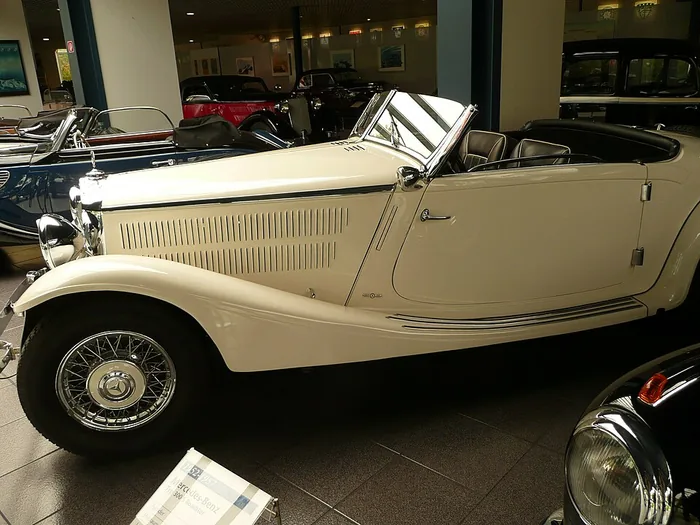
Leave a Reply
You must be logged in to post a comment.