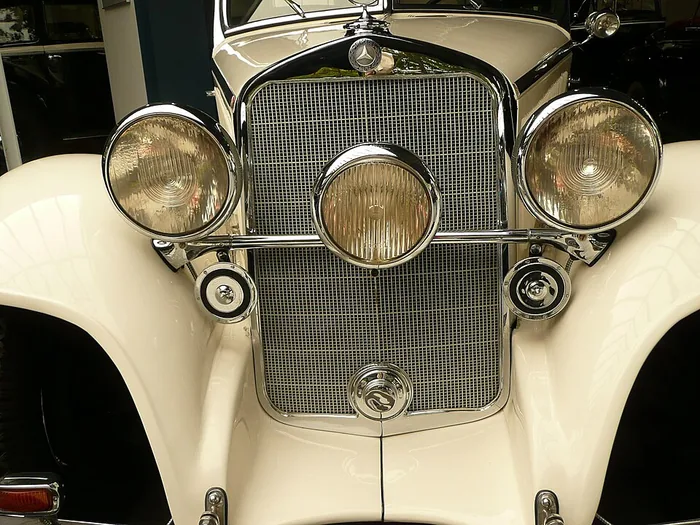
General information & model overview
| Category | Specification Details |
|---|---|
| Model name | Mercedes-Benz Typ 500 K Sport-Limousine (W29) (1935) |
| Internal code | W29 |
| Series | Mercedes-Benz Typ 500 K |
| Production years | Within Typ 500 K production 1934–1936; 1935 representative mid-window for closed sport-limousine commissions |
| Manufacturer | Daimler-Benz AG (Untertürkheim chassis; Sindelfingen special coachwork for many catalogue bodies) |
| Body focus of this entry | Sport-Limousine — closed multi-seat sporting saloon/limousine on the five-litre 500 K chassis |
| Layout | Front-engine, rear-wheel drive |
| Programme context | About 342 Typ 500 K cars of all bodies were built 1934–1936 within the W29 line that later continues as 540 K |
| Related W29 bodies | 540 K Sport-Limousine Spezial, 500 K Cabriolet B, 500 K Cabriolet C, 500 K Spezial-Roadster |
| Notes | Closed multi-seat 500 K bodies are far less common in public imagery than Cab B or roadsters; documentation is essential |
Body & dimensions
| Specification | Details |
|---|---|
| Wheelbase class | Longer multi-seat packaging often associated with ~3,290 mm class literature — approximate; verify on the vehicle |
| Construction | Separate chassis with long-bonnet W29 proportions; exact length and mass depend on coachwork |
| Family equipment themes | Hydraulic brakes; independent front suspension lineage shared with related mid-1930s Mercedes sports/GT cars; 12-volt electrical system on the W29 generation |
| Coachwork source | Sindelfingen special body department for many catalogue and special styles; individual fittings vary by order |
Engine specifications (500 K)
| Theme | Details |
|---|---|
| Configuration | Inline eight-cylinder petrol with Roots-type supercharger (Kompressor) engagement under high load |
| Displacement | Approximately 5,018 cc (about 5.0 litres) |
| Output (approximate) | About 100 PS without blower; about 160 PS with supercharger engaged (period class figures — verify on the car) |
| Character | Grand-touring supercharged eight: multi-cylinder smoothness with blower reserve for open roads of the mid-1930s |
| Induction | Naturally aspirated cruise; blower engagement typically associated with decisive throttle demand rather than permanent boost |
Drivetrain, chassis & performance (approximate)
| Category | Details |
|---|---|
| Gearbox | Manual multi-speed (four-speed common; higher-count options appear in period literature for some cars) |
| Brakes | Hydraulic drums — advanced for large supercharged Mercedes of the era when maintained |
| Suspension | Independent front suspension theme of the W29 line; period rear axle practice |
| Electrical system | 12-volt generation standard on W29 family cars |
| Top speed class | Body- and gearing-dependent; treat published figures as approximate envelopes, not modern cruise targets |
500 K Sport-Limousine: closed multi-seat grand touring on five litres
The Mercedes-Benz Typ 500 K Sport-Limousine is a closed multi-seat body on the first W29 supercharged chassis. It uses the approximately five-litre inline eight with Roots blower — about 100 PS unblown and about 160 PS blown in period figures — under a sporting saloon envelope rather than open coachwork. For clients who needed rear passengers and weather security, it was a more practical path than a Spezial-Roadster without abandoning Kompressor prestige.
Later closed multi-seat specials continue on 540 K as the Sport-Limousine Spezial. Open multi-seat siblings on 500 K include Cabriolet B and Cabriolet C.
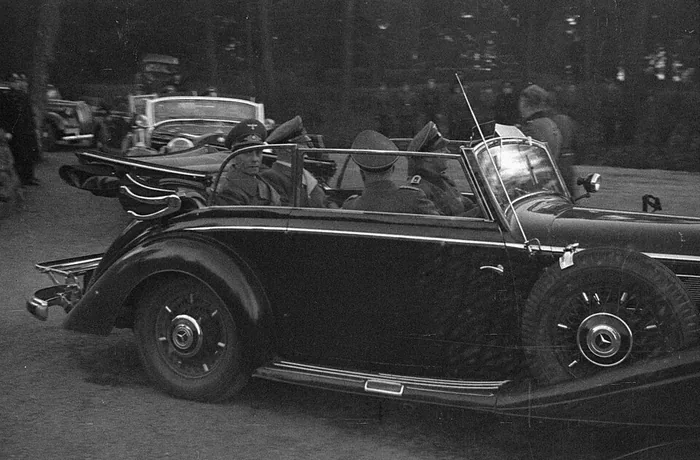
Image source: Wikimedia Commons
Why closed multi-seat 500 K cars existed
Open bodies dominate surviving photographs because they look dramatic and sold well among fashion-conscious clients. Closed multi-seat cars served different needs: winter climates, formal social use, and luggage with passengers. Within the roughly 342 five-litre cars, they remain a minority worth separate study so the family history is not reduced to roadsters alone.
1. Sport-limousine intent
“Sport” here describes lower, more athletic closed proportions than the heaviest formal limousines, not a separate competition engine. Powertrain baselines stay those of the 500 K tables.
2. Packaging and wheelbase class
Multi-seat closed cars often align with the longer packaging class near ~3,290 mm in secondary literature. Confirm measurement on the car before repeating any figure in a catalogue description.
3. 1935 mid-programme placement
Mid-1930s commissions sit after the 1934 launch of 500 K and before the 540 K displacement step. Equipment and trim can still vary car to car.
Design of the five-litre sport limousine
Long bonnet, enclosed cabin, and multi-door or multi-seat access define the type. Glass area is greater than on a two-seat coupé; roof length is greater than on many open sports specials. Interior wood, cloth or leather, and hardware quality track original order and restoration ethics.
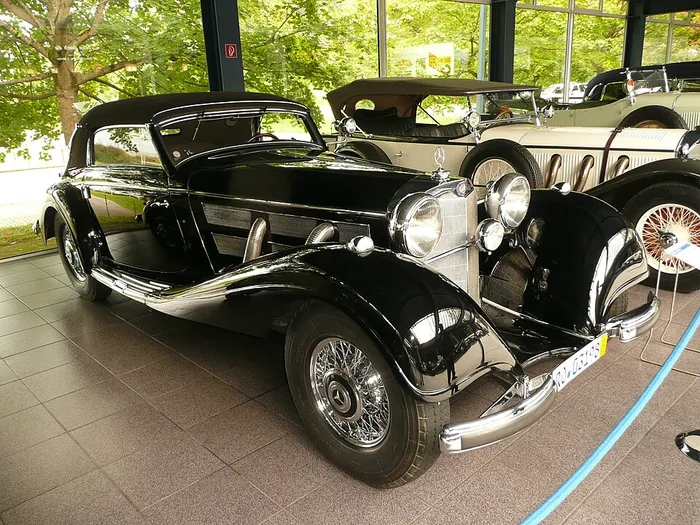
Image source: Wikimedia Commons
1. Sealing and quietness
Door seals, window channels, and roof edges decide whether the cabin feels solid or drafty. Hardened rubber is a predictable age failure; incorrect modern seals change door shut lines.
2. Rear compartment use
Verify real rear seating geometry. Some cars prioritise luggage; others prioritise passengers. Do not assume a uniform layout from generic “limousine” language.
3. Formal presence without parade excess
Sport limousine specials can look purposeful rather than ceremonial. Brightwork density should match that middle brief rather than copying either roadster chrome drama or state-car excess.
Driving character closed on five litres
Mass is higher than a roadster. Acceleration with blower engaged is still period-strong, but thermal load and brake duty rise with passengers and luggage. The cabin can be calmer than open siblings when seals work; mechanical noise then becomes more noticeable.
1. Cooling under closed mass
Traffic and hill work heat the five-litre eight thoroughly. Radiator core condition, fan, and coolant chemistry are first-line ownership tools.
2. Hydraulic brakes and load
Hydraulic drums help when fluid and linings are correct. Multi-seat load means earlier braking points than empty open-car demonstration videos suggest.
3. Steering and length
Placement skill matters in modern traffic. Independent front suspension improves low-speed control relative to older solid-axle large Mercedes when bushings and geometry are sound.
4. Blower with passengers
Full-load engagement with a full cabin should be planned on suitable roads. The machinery does not know the difference between empty glamour runs and loaded tours; the driver must.
Ownership of a 500 K Sport-Limousine
Market attention is softer than for roadsters, which can be an advantage for serious custodians and a risk for under-researched purchases. Closed structure hides rot; multi-seat interiors hide water damage under carpets and rear cushions.
- Year-round multi-seat use potential — practical relative to open specials of the same chassis.
- Five-litre Kompressor identity — foundational W29 powertrain class.
- Lower public hype than roadsters — sometimes better for careful ownership, sometimes worse for documentation recovery.
- Roof and pillar corrosion — inspect invasively, not cosmetically.
- Identity blur with later 540 K closed cars — verify displacement and chassis codes.
- Parts logistics — glass, seals, and interior wood can outlast engine rebuild invoices in cost and time.
Structure a purchase around a closed-body survey and a full mechanical survey. Photographs of a shiny exterior never substitute for roof-edge probing and brake-system testing.
Sibling comparisons
Choose the 500 K Sport-Limousine for closed multi-seat five-litre formality. Choose 540 K Sport-Limousine Spezial for the later larger-displacement closed multi-seat path. Choose Cabriolet B or Cabriolet C for open multi-seat social use. Choose Spezial-Roadster for open sporting extremes.
Living with a closed five-litre multi-seat car
Day-to-day custody of a 500 K Sport-Limousine differs from roadster ownership. Soft-top storage rituals give way to roof-edge monitoring, glass-channel maintenance, and interior climate control. The car can be more usable across seasons, but only if seals and drainage work. A closed body that traps moisture is worse for wood and metal than a well-managed open car in dry storage.
1. Seasonal checklist
Before wet seasons, verify drain paths, door bottoms, and carpet edges. After storage, check for rodent damage in insulation and wiring. The 12-volt system rewards clean grounds; closed cars can hide corrosion at bulkhead pass-throughs that open scuttles expose earlier to a careful eye.
2. Multi-passenger preparation
If rear seats will be used, confirm seat frames and tyre load ratings for real occupancy. Do not treat empty-car brake feel as proof of four-up capability. Service hydraulics with load in mind, and re-check pedal firmness after the first careful loaded outing rather than assuming a single empty test suffices.
3. Documentation recovery
Closed multi-seat 500 K cars often have thinner public photo trails than roadsters. Recover private archives, registration history, and specialist notes early. Market undervaluation relative to open specials can mean fewer published comparables; primary papers become even more important when auction databases are quiet.
Owners who accept the quieter public profile of the Sport-Limousine often find a more sustainable relationship with the car: fewer event pressures, more genuine touring when systems are sound, and a clearer sense that W29 history includes closed multi-seat duty as well as open fashion photography.
Legacy
The 500 K Sport-Limousine documents that supercharged W29 grand touring was not only an open-air fashion. Closed multi-seat cars carried the five-litre Kompressor eight through weather and social duty that roadsters could not. Keeping their captions accurate preserves a fuller map of the roughly 342 five-litre cars and the wider W29 programme that followed.
Leave a Reply
You must be logged in to post a comment.