General information & model overview
| Category | Specification Details |
|---|---|
| Model name | Mercedes-Benz Typ 540 K Sport-Limousine Spezial (W29) (1937) |
| Internal code | W29 |
| Series | Mercedes-Benz Typ 540 K |
| Production years | Associated with 540 K production mid-to-late 1930s; 1937 representative for sport-limousine special commissions |
| Manufacturer | Daimler-Benz AG (Untertürkheim chassis; Sindelfingen special coachwork for many catalogue bodies) |
| Body focus of this entry | Sport-Limousine Spezial — closed multi-seat sporting saloon/limousine special on 540 K |
| Layout | Front-engine, rear-wheel drive |
| Programme context | About 419 Typ 540 K cars of all bodies in the late-1930s W29 continuation; combined 500 K + 540 K chassis on the order of roughly 760 units |
| Related W29 bodies | 540 K Spezial-Coupé, 500 K Sport-Limousine, 540 K Cabriolet B, 540 K Spezial Roadster |
| Notes | Closed multi-seat W29 specials are rarer than Cab B open cars; sport-limousine specials sit between formal sedans and pure two-door coupés |
Body & dimensions
| Specification | Details |
|---|---|
| Wheelbase class | Often longer formal multi-seat packaging (literature frequently associates multi-seat closed bodies with ~3,290 mm class — approximate; verify on car) |
| Construction | Separate chassis with long-bonnet W29 proportions; exact length and mass depend on coachwork |
| Family equipment themes | Hydraulic brakes; independent front suspension lineage shared with related mid-1930s Mercedes sports/GT cars; 12-volt electrical system on the W29 generation |
| Coachwork source | Sindelfingen special body department for many catalogue and special styles; individual fittings vary by order |
Engine specifications (540 K)
| Theme | Details |
|---|---|
| Configuration | Inline eight-cylinder petrol with Roots-type supercharger engagement |
| Displacement | Approximately 5.4 litres (growth from the 500 K five-litre theme) |
| Output (approximate) | About 115 PS without blower; about 180 PS with supercharger engaged (period class figures) |
| Character | Stronger blown grand-touring eight than 500 K; long-chassis luxury performance rather than pure short-chassis racing special |
| Induction | Unblown running for ordinary road work; Kompressor for high-load acceleration and period high-speed touring |
Drivetrain, chassis & performance (approximate)
| Category | Details |
|---|---|
| Gearbox | Manual multi-speed (four-speed common; higher-count options appear in period literature for some cars) |
| Brakes | Hydraulic drums — advanced for large supercharged Mercedes of the era when maintained |
| Suspension | Independent front suspension theme of the W29 line; period rear axle practice |
| Electrical system | 12-volt generation standard on W29 family cars |
| Top speed class | Body- and gearing-dependent; treat published figures as approximate envelopes, not modern cruise targets |
540 K Sport-Limousine Spezial: closed multi-seat performance formality
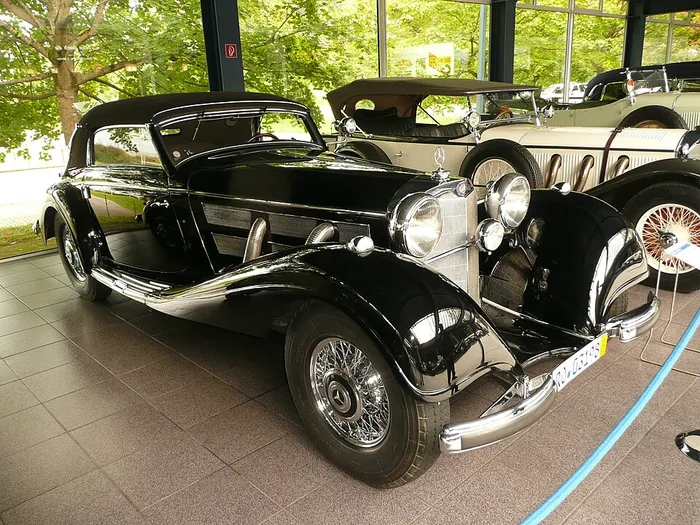
The Mercedes-Benz Typ 540 K Sport-Limousine Spezial is a closed multi-seat interpretation of the W29 supercharged grand tourer. Unlike the two-door Spezial-Coupé, the sport limousine brief prioritises enclosed multi-passenger capacity with sporting stance rather than pure two-seat privacy. Unlike open Cabriolet B, it abandons soft-top complexity for year-round formal enclosure on the 5.4-litre blown eight.
Earlier five-litre closed multi-seat context appears on the 500 K Sport-Limousine page. Open sporting extremes remain under Spezial Roadster.
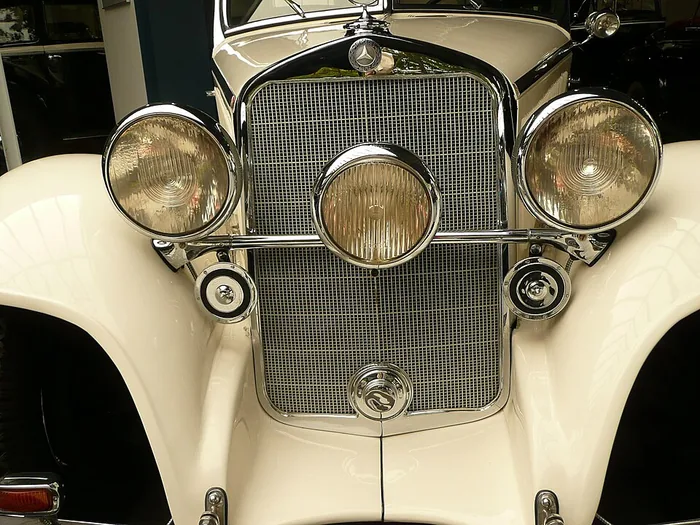
Image source: Wikimedia Commons
Programme role of the sport limousine special
Most W29 production volume among open styles went to Cabriolet B. Closed multi-seat specials were ordered by clients who wanted Kompressor prestige without open-car maintenance, yet still preferred a sporting saloon outline over the heaviest formal limousines. Numbers are small; each car tends to be highly individual in glass, trim, and seating detail.
1. “Sport” as coachwork intent
Sport-limousine language in this era signals lower, more athletic closed proportions than a pure formal Pullman, not a separate racing engine. The 540 K powertrain remains the grand-touring supercharged eight of the family tables.
2. Wheelbase and packaging
Multi-seat closed bodies often sit on the longer formal packaging class discussed near ~3,290 mm in secondary sources. Confirm on the car. Do not assume roadster-class rearward packaging simply because the word “sport” appears in the body name.
3. 1937 association
Using 1937 as a representative year helps place the body in the mid-540 K wave. Individual chassis may date differently; always prefer factory records over marketing-year shortcuts.
Design of the closed multi-seat special
Exterior form balances long-bonnet eight-cylinder presence with a longer cabin and more glass than a two-door coupé. Pillars, rear quarter treatment, and luggage accommodation vary by commission. Interiors may include full rear seating, division options on some formal cars, and higher trim density than open sports specials.
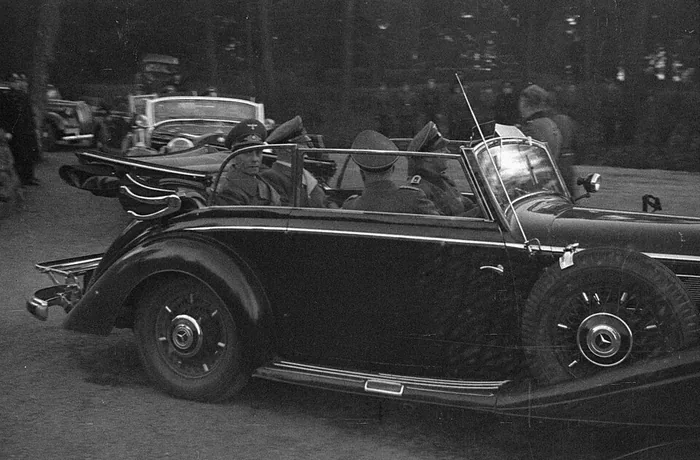
Image source: Wikimedia Commons
1. Glass area and structure
More glass means more channel and seal maintenance. Water ingress at rear quarters and roof edges is a classic closed-body failure mode after decades of rubber hardening.
2. Door count and access
Verify how many doors the car actually has and how rear passengers enter. Marketing photos of other closed W29 bodies should not substitute for inspection of the example under review.
3. Brightwork and formal presence
Sport-limousine specials can carry more formal chrome and trim than roadsters while still reading lower than ceremonial Pullmans. Restoration ethics should respect that middle path rather than forcing either pure sports or pure state-car gloss.
Driving a closed multi-seat 540 K
Mass is typically higher than a roadster. The roughly 115/180 PS unblown/blown class must move more bodywork and passengers. Cabin quietness can be superior when seals and insulation are sound; heat soak in traffic remains a constant for large eights. Hydraulic brakes need full service capacity for the extra weight.
1. Thermal load
Closed multi-seat cars trap more heat around the bulkhead and under the rear floor in slow work. Radiator condition, fan efficiency, and correct coolant are primary ownership tools, not afterthoughts.
2. Ride and load
With rear passengers and luggage, spring rates and damper condition matter. Period tyres must carry the real load, not a brochure two-up figure.
3. Gearbox and blower coordination
Multi-speed manuals of the era reward smooth timing. Blower engagement under passenger load should be planned, not improvised mid-corner.
4. Compared with open siblings
Wind noise disappears; mechanical noise and gear whine may become more noticeable. The driving mood is formal grand touring rather than open-air spectacle.
Ownership for sport-limousine specials
Buyers often undervalue closed multi-seat W29 cars relative to roadsters, then discover that structure, glass, and interior wood are equally specialised. Documentation still matters: rare closed specials are also subject to rebody stories, just less publicly celebrated ones.
- Year-round usability — fixed roof and multi-seat capacity suit climate and social use that roadsters cannot match.
- 540 K blown eight — same late Kompressor performance class as open siblings when healthy.
- Quieter cabin potential — when seals and insulation are correct.
- Hidden structure risk — more pillars and roof area to hide rot than a roadster reveals.
- Identity confusion — sport limousine, formal limousine, and coupé labels get mixed; use hard points and papers.
- Higher mass effects — brakes, tyres, and cooling work harder than on lighter open specials.
Plan ownership around a closed-body survey (roof, pillars, floors) and a mechanical survey (blower, cooling, hydraulics) as two equal workstreams. Cosmetics alone never prove a healthy sport limousine special.
Sibling comparisons
Choose Sport-Limousine Spezial for closed multi-seat sporting formality on 540 K. Choose Spezial-Coupé for two-door closed special privacy. Choose Cabriolet B for multi-seat open use. Choose 500 K Sport-Limousine for the five-litre closed multi-seat predecessor theme. Open extremes: Spezial Roadster.
Closed multi-seat survey discipline
Evaluating a 540 K Sport-Limousine Spezial requires tools and patience that open-car inspections sometimes skip. Roof rails, pillar bases, rear-quarter voids, and bulkhead joints hide moisture for decades. A torch, a moisture meter where appropriate, and willingness to lift carpets matter more than polished wheel discs in the first hour of viewing a closed multi-seat special.
1. Glass and seal map
Walk every glass channel with the doors open and closed. Note binding, light gaps, and water stains on headlinings. Closed multi-seat cars live or die on seal condition; temporary silicone fixes are not a long-term strategy for a 5.4-litre grand tourer that will see real weather.
2. Rear cabin load reality
Sit in the rear seats with doors shut. Check headroom, footwells, and whether the cabin was ordered for passengers or for luggage. Sport-limousine specials vary; your use case must match the car’s actual geometry rather than a brochure ideal drawn from another closed W29 body.
3. Thermal and brake planning
Closed multi-seat mass raises cooling and brake duty. Budget a radiator and hydraulic service early. Do not schedule long multi-passenger tours until both systems have been proven under load. The stronger 540 K blower makes this more important, not less, because available power tempts later braking and longer climbs.
Custodians who enjoy closed multi-seat 540 K cars often value quieter year-round touring over open-air spectacle. That preference is historically legitimate. Keeping the car’s captions accurate — sport limousine special, not generic saloon, not coupé — protects the middle path that Sindelfingen built for those clients in the late 1930s.
Legacy
The 540 K Sport-Limousine Spezial keeps the W29 map honest: not every supercharged Mercedes of the era was a roadster. Closed multi-seat specials carried clients and luggage at high period speeds under a solid roof, using the same Kompressor eight that made open cars famous. Remembering them accurately prevents the family history from collapsing into a single silhouette.
Leave a Reply
You must be logged in to post a comment.