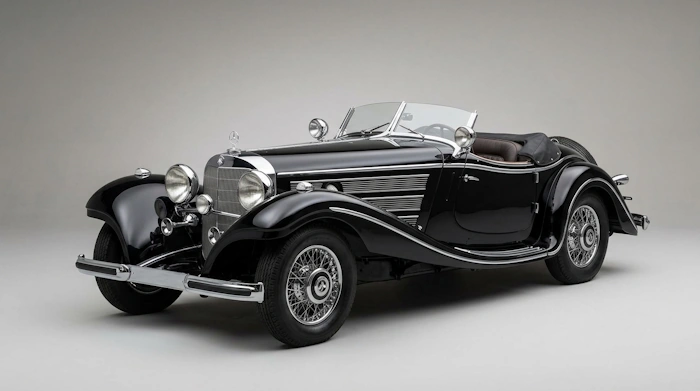
General information & model overview
| Category | Specification Details |
|---|---|
| Model name | Mercedes-Benz Typ 540 K Spezial Roadster (W29) (1937) |
| Internal code | W29 |
| Series | Mercedes-Benz Typ 540 K |
| Production years | Associated with mid-to-late 540 K production; 1937 is a representative high-visibility year for Spezial Roadster imagery and deliveries |
| Manufacturer | Daimler-Benz AG (Untertürkheim chassis; Sindelfingen special coachwork for many catalogue bodies) |
| Body focus of this entry | Spezial Roadster — rare sporting open two-seat-oriented special roadster on 540 K |
| Layout | Front-engine, rear-wheel drive |
| Programme context | About 419 Typ 540 K cars of all bodies in the late-1930s W29 continuation; combined 500 K + 540 K chassis on the order of roughly 760 units |
| Related W29 bodies | 540 K Cabriolet A, 500 K Spezial-Roadster, 500 K Luxus-Roadster, 540 K Spezial-Coupé |
| Notes | Spezial Roadsters are among the rarest and most pursued W29 open bodies; authenticity and originality disputes are common in the market |
Body & dimensions
| Specification | Details |
|---|---|
| Wheelbase class | Sports-package association common for roadster types (often discussed near ~2,980 mm class packaging literature); confirm exact chassis layout on the vehicle |
| Construction | Separate chassis with long-bonnet W29 proportions; exact length and mass depend on coachwork |
| Family equipment themes | Hydraulic brakes; independent front suspension lineage shared with related mid-1930s Mercedes sports/GT cars; 12-volt electrical system on the W29 generation |
| Coachwork source | Sindelfingen special body department for many catalogue and special styles; individual fittings vary by order |
Engine specifications (540 K)
| Theme | Details |
|---|---|
| Configuration | Inline eight-cylinder petrol with Roots-type supercharger engagement |
| Displacement | Approximately 5.4 litres (growth from the 500 K five-litre theme) |
| Output (approximate) | About 115 PS without blower; about 180 PS with supercharger engaged (period class figures) |
| Character | Stronger blown grand-touring eight than 500 K; long-chassis luxury performance rather than pure short-chassis racing special |
| Induction | Unblown running for ordinary road work; Kompressor for high-load acceleration and period high-speed touring |
Drivetrain, chassis & performance (approximate)
| Category | Details |
|---|---|
| Gearbox | Manual multi-speed (four-speed common; higher-count options appear in period literature for some cars) |
| Brakes | Hydraulic drums — advanced for large supercharged Mercedes of the era when maintained |
| Suspension | Independent front suspension theme of the W29 line; period rear axle practice |
| Electrical system | 12-volt generation standard on W29 family cars |
| Top speed class | Body- and gearing-dependent; treat published figures as approximate envelopes, not modern cruise targets |
540 K Spezial Roadster: the high-style open special
The Mercedes-Benz Typ 540 K Spezial Roadster is the sporting open special that most people picture when they think of pre-war supercharged Mercedes grand tourers. Long bonnet, dramatic wings, and a low open cabin sit on the W29 chassis with the larger 5.4-litre blown eight. Production of true Spezial Roadsters was tiny; each surviving car is a research object as well as a machine.
This entry focuses on the 540 K roadster path. Compare with the five-litre 500 K Spezial-Roadster, the more formal 500 K Luxus-Roadster, and the intimate convertible 540 K Cabriolet A.
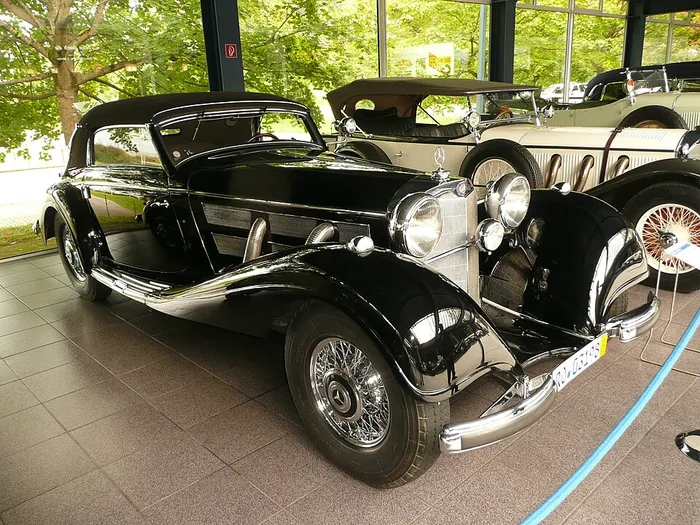
Image source: Wikimedia Commons
Where the Spezial Roadster sits in the family
Across roughly 419 Typ 540 K cars of all bodies, only a handful of Spezial Roadster-style specials exist in literature and surviving registers. Combined with the earlier 500 K roadster specials, the open “spezial” theme remains a thin slice of the roughly 760-chassis W29 total. That scarcity, plus photogenic coachwork, has made the roadster the public face of the line — and the most frequently mis-labelled.
1. Spezial versus catalogue open letters
Cabriolet A, B, and C are letter-coded convertible programmes. The Spezial Roadster is a special sporting open style with its own proportion language: lower, more dramatic, and less multi-seat social than Cab B. Do not use “roadster” as a synonym for every open 540 K.
2. 1937 as a reference window
Many well-known photographs and deliveries cluster around the mid-to-late 1930s. Treating 1937 as a representative association year is useful for readers; exact build dates still require chassis-level proof for any individual car.
3. Sports packaging
Roadster types are often linked to the more rearward-set W29 sports package discussed near the ~2,980 mm wheelbase class in secondary literature. Measure and document; do not rely on side photos alone.
Design language of the sporting open special
The silhouette is defined by bonnet length, wing sweep, and a cabin that reads as two-seat theatre. Weather equipment exists but is secondary to style: many roadsters were ordered for fair-weather display and high-speed touring rather than all-season commuting. Brightwork, screen rake, and spare-wheel treatment vary by order and later restoration fashion.
1. Proportion discipline
Correct roadster identity lives in door cut, cowl height, and deck shape as much as in badges. A rebody that “looks roadster-like” can still be wrong in hard points. Compare against documented siblings before accepting a glamorous outline.
2. Interior and controls
Instruments, steering-wheel type, and seat construction should match period high-end open practice. Over-modernisation of pedal pads, wiring, and switchgear is common; originality scores fall quickly when show convenience replaces period detail.
3. Weather gear honesty
Some roadsters carry more complete tops than others. Catalogue claims and as-found equipment may differ. Record what the car has rather than what a brochure ideal suggests.
Driving character of a blown open special
With roughly 115 PS unblown and about 180 PS blown, the 540 K roadster can feel urgent for its era when the blower engages. Open air multiplies the sense of speed; mass and period brakes still demand early decisions. Independent front suspension and hydraulic drums help when healthy; they do not rewrite physics.
1. High-load blower discipline
Prolonged full-load engagement for spectacle is hard on oil, bearings, and the drive system. Use the Kompressor as a performance tool, then return to unblown cruise for ordinary miles.
2. Chassis feedback
A well-sorted roadster communicates length and mass clearly. Steering is deliberate. Road surfaces of the 1930s differ from modern motorways; tyre choice and pressure matter more than cosmetic polish for safe use.
3. Heat, fuel, and open-cabin ventilation
Engine heat washes back into an open cockpit more than into a closed coupé. Fuel quality and cooling system condition are primary technical concerns after any storage period.
Ownership and authenticity for Spezial Roadsters
The market premium on Spezial Roadsters makes authenticity the first ownership topic, not the last. Chassis numbers, body tags, period photographs, and expert review should precede emotional purchase decisions. A correct mechanical 540 K with wrong coachwork is a different car from a documented special roadster.
- Iconic open W29 identity — the body style that defines public memory of the family when correctly identified.
- 540 K performance class — stronger blown eight than the 500 K predecessor when maintained.
- Extreme rarity — tiny production means each car’s paper trail matters disproportionately.
- Rebody and fantasy risk — glamorous outlines attract fabricated histories; demand primary documents.
- Soft-top and wood expense — open structure can fail invisibly under show paint.
- Specialist dependency — blower, chassis, and coachwork work need W29-experienced shops.
If you intend real road use, budget for tyres, brakes, and cooling before concours detailing. If the car is a static museum piece, humidity control and documented storage still protect originality better than continuous polish.
Sibling comparisons
Choose the Spezial Roadster for maximum sporting open presentation on 540 K. Choose Cabriolet A for a more complete formal convertible. Choose 500 K Spezial-Roadster for the five-litre predecessor theme. Choose Luxus-Roadster when the open brief was more luxury than stripped sports. Closed late alternative: Spezial-Coupé.
Research method for a Spezial Roadster claim
Because Spezial Roadster values sit at the top of the W29 open market, research method is part of ownership ethics. Begin with primary documents: chassis cards, body numbers, period delivery photographs, and specialist register notes. Secondary websites and auction adjectives come last, not first. A disciplined file protects both buyer and seller when the silhouette alone is worth more attention than the paperwork.
1. Proportion audit
Measure cowl height, door cut, and deck shape against documented siblings rather than against a mental image of how a 540 K should look. Many wrong bodies are beautiful. Beauty is not proof. A proportion audit that fails should stop the purchase process even if the engine bay is correct and the paint is fresh.
2. Mechanical honesty
A documented roadster with a tired blower is still a roadster; an undocumented outline with a perfect engine is not automatically a Spezial Roadster. Prioritise identity, then plan mechanical work. The reverse order funds the wrong car at the wrong price and wastes specialist hours on a coachwork problem that cosmetics cannot solve.
3. Use envelope after acquisition
Once authenticity is accepted, set a realistic use envelope: short demonstration runs, careful tyre and brake maintenance, and storage that protects open woodwork. The car’s public fame does not require continuous public use. Conservation miles and occasional correct running preserve more originality than aggressive show circuits that punish soft structure.
Owners who treat the Spezial Roadster as a research object first and a status object second tend to make better decisions about paint, plating, and interior replacement. The silhouette is famous; the individual car’s paper trail is what makes that fame historically legitimate for the next generation of W29 researchers.
Legacy
The 540 K Spezial Roadster is the W29 body’s most famous silhouette and one of its scarcest realities. Accurate history depends on resisting the urge to call every handsome open 540 K a Spezial Roadster. When documentation, proportion, and chassis package agree, the car stands as a peak of Sindelfingen open special work on the supercharged grand-touring chassis of the late 1930s.
Leave a Reply
You must be logged in to post a comment.