General information & model overview
| Category | Specification Details |
|---|---|
| Model name | Mercedes-Benz Typ 500 K Spezial-Roadster (W29) (1936) |
| Internal code | W29 |
| Series | Mercedes-Benz Typ 500 K |
| Production years | Within Typ 500 K production 1934–1936; 1936 is a late-window year for five-litre Spezial-Roadster deliveries before/around the 540 K transition |
| Manufacturer | Daimler-Benz AG (Untertürkheim chassis; Sindelfingen special coachwork for many catalogue bodies) |
| Body focus of this entry | Spezial-Roadster — rare sporting open special roadster on the five-litre 500 K chassis |
| Layout | Front-engine, rear-wheel drive |
| Programme context | About 342 Typ 500 K cars of all bodies were built 1934–1936 within the W29 line that later continues as 540 K |
| Related W29 bodies | 540 K Spezial Roadster, 500 K Luxus-Roadster, 500 K Cabriolet B, 500 K Autobahnkurier |
| Notes | Five-litre Spezial-Roadsters are extremely rare; they precede and inform the later 540 K roadster legend |
Body & dimensions
| Specification | Details |
|---|---|
| Wheelbase class | Sports-package association common for roadster types (~2,980 mm class packaging often cited — approximate; verify on car) |
| Construction | Separate chassis with long-bonnet W29 proportions; exact length and mass depend on coachwork |
| Family equipment themes | Hydraulic brakes; independent front suspension lineage shared with related mid-1930s Mercedes sports/GT cars; 12-volt electrical system on the W29 generation |
| Coachwork source | Sindelfingen special body department for many catalogue and special styles; individual fittings vary by order |
Engine specifications (500 K)
| Theme | Details |
|---|---|
| Configuration | Inline eight-cylinder petrol with Roots-type supercharger (Kompressor) engagement under high load |
| Displacement | Approximately 5,018 cc (about 5.0 litres) |
| Output (approximate) | About 100 PS without blower; about 160 PS with supercharger engaged (period class figures — verify on the car) |
| Character | Grand-touring supercharged eight: multi-cylinder smoothness with blower reserve for open roads of the mid-1930s |
| Induction | Naturally aspirated cruise; blower engagement typically associated with decisive throttle demand rather than permanent boost |
Drivetrain, chassis & performance (approximate)
| Category | Details |
|---|---|
| Gearbox | Manual multi-speed (four-speed common; higher-count options appear in period literature for some cars) |
| Brakes | Hydraulic drums — advanced for large supercharged Mercedes of the era when maintained |
| Suspension | Independent front suspension theme of the W29 line; period rear axle practice |
| Electrical system | 12-volt generation standard on W29 family cars |
| Top speed class | Body- and gearing-dependent; treat published figures as approximate envelopes, not modern cruise targets |
500 K Spezial-Roadster: five-litre open special before the 540 K legend
The Mercedes-Benz Typ 500 K Spezial-Roadster is the five-litre sporting open special of the W29 family. It carries the approximately 5,018 cc supercharged inline eight — about 100 PS unblown and about 160 PS blown in period class language — under dramatic roadster coachwork. Later 540 K roadsters expanded displacement and output; the 500 K roadster established the visual and social template.
Compare with the later 540 K Spezial Roadster, the more luxury-oriented 500 K Luxus-Roadster, and the high-volume open Cabriolet B.
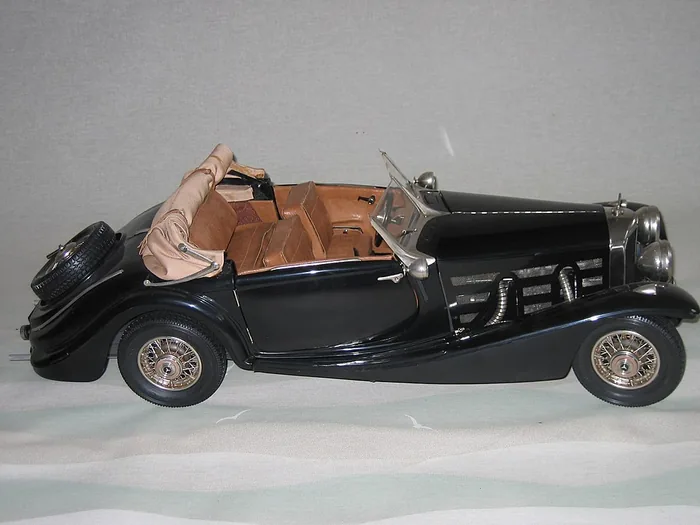
Image source: Wikimedia Commons
500 K context and the roadster minority
About 342 Typ 500 K cars of all bodies were built from 1934 to 1936. Most were not Spezial-Roadsters. Cabriolet B absorbed the bulk of open social demand. Spezial-Roadsters and other extreme specials occupied the thin upper edge of the coachwork map, alongside rarities such as the Autobahnkurier.
1. Why five-litre roadsters matter
They prove that the famous long-bonnet open special was not invented only with the 5.4-litre car. Collectors who only study 540 K imagery miss the earlier mechanical and design steps that made the later cars possible.
2. 1936 as a late 500 K window
By 1936 the programme was approaching the 540 K transition. Late 500 K specials can sit close in time to early 540 K cars; identity still rests on engine and chassis documentation, not on a single model-year slogan.
3. Sports packaging
As with later roadsters, literature often associates Spezial-Roadster types with sports-package layout near the ~2,980 mm class. Treat that as a research hint, then measure the car.
Design of the five-litre Spezial-Roadster
Proportions emphasise bonnet length, wing drama, and a low open cabin. Detail differences from later 540 K roadsters exist in brightwork, screen, and fittings across individual commissions. Assuming every roadster outline is interchangeable between 500 K and 540 K erases real coachwork history.
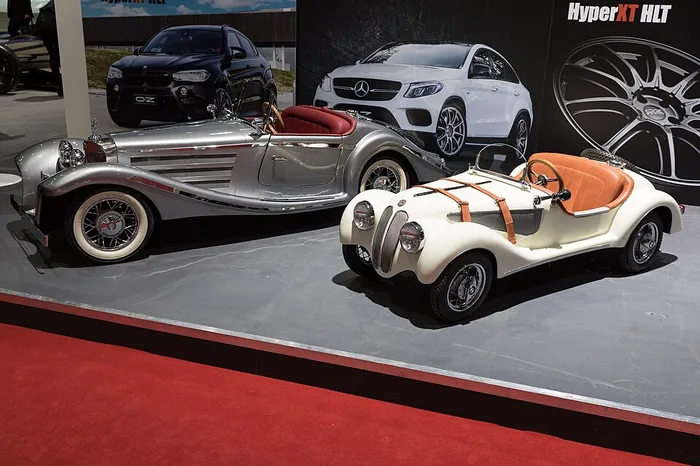
Image source: Wikimedia Commons
1. Hard points over glamour
Door shut lines, cowl height, and deck geometry decide identity more reliably than paint colour. A glamorous restoration can hide wrong hard points; a careful survey looks past gloss.
2. Weather equipment reality
Roadsters vary in how complete their tops and side equipment are. Record the as-found system. Do not invent a catalogue ideal that the car never had.
3. Interior materials
Leather, wood, and instruments should read mid-1930s high-end open, not modern show-car fashion. Wiring and switchgear originality are useful authenticity signals.
Driving the five-litre blown open special
Output sits below the later 540 K class figures, but the character is the same family: multi-cylinder smoothness, blower reserve under load, long-car mass, hydraulic drums, and independent front suspension when healthy. Open air still multiplies perceived speed. Period tyres and early braking remain the safety envelope.
1. Blower use on 500 K
Engagement under high load is the design intent. Constant full-load demonstration is hard on the Roots drive and lubrication system. Service the blower path with the same seriousness as the engine proper.
2. Chassis manners
Expect deliberate steering and significant length in traffic. The sports package may improve weight distribution relative to some formal multi-seat cars; it does not create a short-chassis sports car of W06 culture.
3. Cooling and fuel after storage
Five-litre eights still overheat when radiators are blocked and thermostats are wrong. Open storage can introduce moisture into electrical systems; 12-volt W29 electrics need clean grounds and sound wiring before any demonstration run.
Ownership of a 500 K Spezial-Roadster
Rarity is higher than market awareness of five-litre versus 5.4-litre distinctions. Some sellers blur 500 K and 540 K roadster language for convenience. Buyers must verify displacement, chassis codes, and body identity independently.
- Foundational open special identity — five-litre root of the W29 roadster legend.
- Kompressor eight character — ~100/160 PS class when correctly maintained.
- Extreme scarcity — tiny subset of ~342 five-litre cars.
- Label confusion with 540 K — demand engine and chassis proof, not silhouette alone.
- Open structure costs — wood and top irons can dominate the budget after purchase.
- Parts and expertise — fewer specialists than for post-war Mercedes; plan logistics early.
A sound ownership plan pairs documentary research with a mechanical plan for blower, brakes, and cooling. Cosmetic excellence without those three is incomplete for road use.
Sibling comparisons
Choose the 500 K Spezial-Roadster for five-litre sporting open special identity. Choose 540 K Spezial Roadster for the later larger-displacement roadster path. Choose Luxus-Roadster for a more luxury-leaning open 500 K theme. Choose Cabriolet B for multi-seat open social use. Extreme closed-streamline contrast: Autobahnkurier.
Five-litre roadster documentation and use
A 500 K Spezial-Roadster purchase should open with displacement verification and chassis documentation before any discussion of paint colour or chrome density. Five-litre and 5.4-litre open specials can look similar to non-specialists; the paper trail and engine identity separate them. Sellers who resist documentation requests are providing useful information of their own about risk.
1. Engine and chassis confirmation
Record numbers carefully, photograph castings and plates, and cross-check with independent specialists familiar with W29 series cars. Do not accept silhouette alone as proof of 500 K Spezial-Roadster status. The five-litre story deserves the same authenticity discipline applied to later 540 K roadsters, because the market sometimes collapses both into one glamorous label.
2. Open structure before glamour
Probe floors, scuttle, and top mounts. A correct five-litre roadster with soft structure is still a long restoration; an incorrect outline with hard structure is a different historical problem. Structure and identity must both pass before mechanical polish becomes the main spend on the ownership calendar.
3. Running plan
After a successful survey, plan fuel-system cleaning, cooling service, and brake work before public roads. The roughly 100/160 PS class figures are period language, not a modern performance guarantee on old tyres and tired hydraulics. Short, correct runs beat long, under-prepared demonstrations that risk rare open coachwork.
The five-litre Spezial-Roadster’s legacy is foundational: it shows that the open-special template existed before the larger engine. Owners who keep that chronological fact visible in captions help the wider W29 map stay legible for researchers who start from 540 K imagery and work backward.
Legacy
The 500 K Spezial-Roadster anchors the open-special story of the W29 family in the five-litre years. Without it, the later 540 K roadster appears as if from nowhere. With accurate captions and careful chassis work, it remains one of the most important minority bodies in the roughly 760-car combined programme.
Five-litre open specials at the end of 500 K production
1936 marks both late 500 K output and the arrival of 540 K displacement growth. A Spezial-Roadster badged or documented as 500 K should be checked carefully against engine capacity and chassis records so it is not casually relabelled as a 540 K for marketing. The five-litre blown eight remains a serious grand-touring unit; it does not need inflation of identity to matter historically.
Service the blower drive and lubrication on a calendar, not only when noise appears. Open cars that sit often seize small mechanisms that are expensive on W29 hardware.
Photograph the supercharger housing and drive before any major engine work so later specialists can see as-found hardware rather than only the rebuilt assembly.
Leave a Reply
You must be logged in to post a comment.