General information & model overview
| Category | Specification Details |
|---|---|
| Model name | Mercedes-Benz Typ 500 K Autobahnkurier (W29) (1934) |
| Internal code | W29 |
| Series | Mercedes-Benz Typ 500 K |
| Production years | Associated with early Typ 500 K production from 1934; only a handful of Autobahnkurier-style cars (literature often cites on the order of about 4–6) |
| Manufacturer | Daimler-Benz AG (Untertürkheim chassis; Sindelfingen special coachwork for many catalogue bodies) |
| Body focus of this entry | Autobahnkurier — extreme-rarity streamlined closed special coupé/fastback theme for high-speed period touring |
| Layout | Front-engine, rear-wheel drive |
| Programme context | About 342 Typ 500 K cars of all bodies were built 1934–1936 within the W29 line that later continues as 540 K |
| Related W29 bodies | 500 K Spezial-Roadster, 540 K Spezial-Coupé, 500 K Sport-Limousine, 500 K Cabriolet B |
| Notes | Among the rarest W29 bodies; Autobahnkurier examples are research and museum-class objects with extreme authenticity sensitivity |
Body & dimensions
| Specification | Details |
|---|---|
| Wheelbase class | Special streamlined package on W29 chassis; exact wheelbase and layout must be verified per car (sports-package associations appear in some discussions — treat as approximate) |
| Construction | Separate chassis with long-bonnet W29 proportions; exact length and mass depend on coachwork |
| Family equipment themes | Hydraulic brakes; independent front suspension lineage shared with related mid-1930s Mercedes sports/GT cars; 12-volt electrical system on the W29 generation |
| Coachwork source | Sindelfingen special body department for many catalogue and special styles; individual fittings vary by order |
Engine specifications (500 K)
| Theme | Details |
|---|---|
| Configuration | Inline eight-cylinder petrol with Roots-type supercharger (Kompressor) engagement under high load |
| Displacement | Approximately 5,018 cc (about 5.0 litres) |
| Output (approximate) | About 100 PS without blower; about 160 PS with supercharger engaged (period class figures — verify on the car) |
| Character | Grand-touring supercharged eight: multi-cylinder smoothness with blower reserve for open roads of the mid-1930s |
| Induction | Naturally aspirated cruise; blower engagement typically associated with decisive throttle demand rather than permanent boost |
Drivetrain, chassis & performance (approximate)
| Category | Details |
|---|---|
| Gearbox | Manual multi-speed (four-speed common; higher-count options appear in period literature for some cars) |
| Brakes | Hydraulic drums — advanced for large supercharged Mercedes of the era when maintained |
| Suspension | Independent front suspension theme of the W29 line; period rear axle practice |
| Electrical system | 12-volt generation standard on W29 family cars |
| Top speed class | Body- and gearing-dependent; treat published figures as approximate envelopes, not modern cruise targets |
500 K Autobahnkurier: streamlined rarity on the five-litre W29
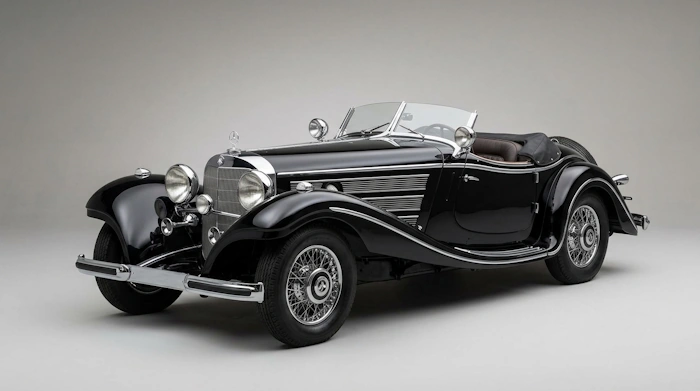
The Mercedes-Benz Typ 500 K Autobahnkurier is among the rarest coachwork themes in the W29 family. Built in only a handful of examples — literature often places the count around four to six cars — it is a streamlined closed special intended for high-speed period touring on the expanding German Autobahn network. Mechanically it rests on the five-litre supercharged inline eight: about 100 PS unblown and about 160 PS with Roots blower engaged in period class figures.
Compare with more numerous open styles such as Cabriolet B, sporting open extremes such as the Spezial-Roadster, and later closed specials such as the 540 K Spezial-Coupé.
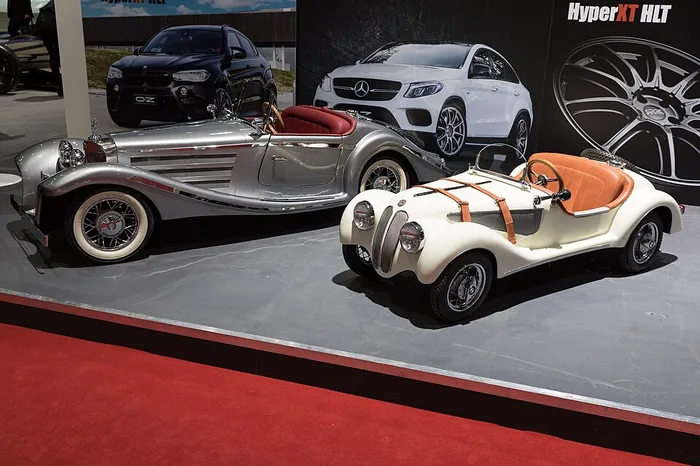
Image source: Wikimedia Commons
Why the Autobahnkurier existed
The early 1930s saw new high-speed road infrastructure and a fashion for aerodynamic closed forms among European prestige makers. The Autobahnkurier name signals that brief: a fast, enclosed courier-touring special rather than a multi-seat social cabriolet. Within roughly 342 five-litre cars, only a few took this extreme streamline path.
1. Rarity class
Even among exclusive W29 bodies, Autobahnkurier counts sit at the bottom. Every surviving car is a primary historical object. Casual “Autobahnkurier-style” rebody claims deserve maximum scepticism.
2. 1934 association
Linking the type to the 1934 launch window of 500 K places it at the start of the W29 story. Individual chassis still require documents; the year label is a research anchor, not a substitute for plates and archives.
3. Not a volume product
Unlike Cab B, the Autobahnkurier was never the commercial backbone. It was a showcase and special-order extreme. Programme understanding needs both the volume open cars and these outliers.
Design of the streamlined special
Streamline closed form replaces open drama with continuous roof and carefully managed rear profiles. Glass shapes, fender integration, and tail treatment differ sharply from conventional cabriolets. Interior packaging may prioritise two primary travellers and luggage for high-speed touring rather than multi-row social seating.
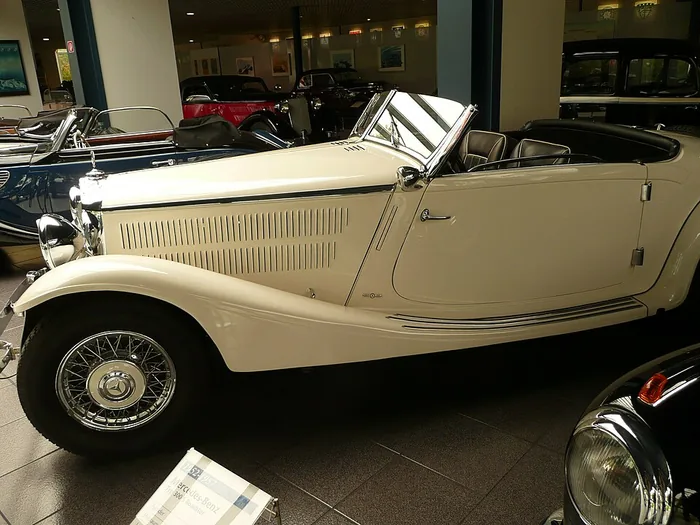
Image source: Wikimedia Commons
1. Aerodynamic intent versus modern aero
Period streamline is a design language and a speed-oriented philosophy of the 1930s, not a modern wind-tunnel product. Judge it against contemporary specials, not against 21st-century Cd figures.
2. Structure and panels
Complex curves hide corrosion and previous accident repair. Panel continuity and roof structure deserve invasive inspection. Perfect paint on wrong metal is a known risk class for ultra-rare specials.
3. Brightwork restraint
Some streamline specials use cleaner brightwork than formal open cars. Forcing heavy chrome fashion onto a streamline body can fight the original design intent.
Driving character of a five-litre streamline special
Closed form can reduce wind noise relative to open roadsters at speed, while mass and cooling still define limits. Blower engagement remains a high-load tool. Hydraulic brakes and independent front suspension help when healthy. The Autobahnkurier’s reputation for high-speed touring is period context, not a licence for modern unrestricted motorway behaviour without correct tyres, brakes, and preparation.
1. Cooling at sustained speed
Long high-speed runs of the era heated large eights thoroughly. Radiator capacity, oil condition, and correct mixture matter more than cosmetic streamline shine.
2. Cabin heat and ventilation
Closed streamline cabins can run hot in traffic. Ventilation hardware should work; sealed show cars that never move air are poor road tools.
3. Chassis package confirmation
Some discussions link specials to sports packaging. Measure and document the individual car. Do not assume every Autobahnkurier shares identical hard points without evidence.
4. Compared with open siblings
Open roadsters sell glamour; the Autobahnkurier sells enclosed speed-era modernity. Driving mood is long-distance closed touring, not open-air spectacle.
Ownership of an Autobahnkurier-class car
Ownership is conservation first. Values, insurance, and public interest track authenticity more tightly than for Cab B. A wrong body on a correct 500 K chassis is a different historical object from a documented Autobahnkurier.
- Extreme rarity — handful-class production within an already exclusive programme.
- Historical streamline significance — documents 1930s high-speed closed special culture on W29.
- Five-litre Kompressor basis — shared family powertrain when correctly maintained.
- Authenticity pressure — rebody and fantasy risk is maximal at this rarity level.
- Panel and structure complexity — streamline forms hide expensive problems.
- Museum-class support needs — storage, security, and specialist conservation exceed ordinary classic-car norms.
Any transfer of ownership should involve marque experts, archival checks, and a mechanical survey that assumes nothing from glamour photographs. Driving should be secondary to conservation until structure and systems are proven.
Sibling comparisons
Choose Autobahnkurier only when documentation supports the streamline special identity. Choose Spezial-Roadster for open sporting extremes. Choose Sport-Limousine for more conventional closed multi-seat formality. Choose Cabriolet B for multi-seat open social use. Later closed special contrast: 540 K Spezial-Coupé.
Conservation protocol for handful-class specials
An Autobahnkurier-class 500 K is closer to a museum conservation problem than to a normal classic-car hobby loop. Movement, photography, and mechanical running should all be planned against a written conservation protocol. Impulse demonstration runs for visitors are how rare streamline panels and original interiors accumulate irreversible damage that polish cannot undo.
1. Access and handling
Limit who opens doors, sits inside, and moves the car. Soft gloves for brightwork, controlled jacking points, and documented transport plans reduce cumulative wear. Streamline panels are not casual push-points for event staff unfamiliar with the body, and roof edges are not convenient lean rails during photography sessions.
2. Environment
Stable temperature and humidity protect complex closed curves and interior materials. Avoid storage that cycles wet and dry against metal and wood interfaces. Pest control is mandatory; closed specials offer nesting voids that open cars sometimes expose earlier to inspection, so closed rarities need scheduled interior checks even when the exterior looks perfect.
3. Running policy
If the car runs, set criteria: brake capability, tyre age, cooling proof, and a short route without public pressure. If it does not run, document static conservation clearly so future custodians understand the choice. Either path is legitimate; unplanned half-running without brake or cooling proof is not a conservation strategy.
The Autobahnkurier’s value to history is highest when its rarity is respected in daily handling. Owners and institutions who publish accurate captions and refuse fantasy rebody stories do as much for the W29 record as any mechanical polish applied to the five-litre eight beneath the streamline shell.
Legacy
The 500 K Autobahnkurier is a reminder that W29 coachwork reached beyond open fashion into extreme streamline experiments. With only a handful built, each car carries outsized weight in the historical record. Accurate captions and careful conservation keep that extreme corner of the five-litre story from dissolving into generic “500 K special” language.
Leave a Reply
You must be logged in to post a comment.