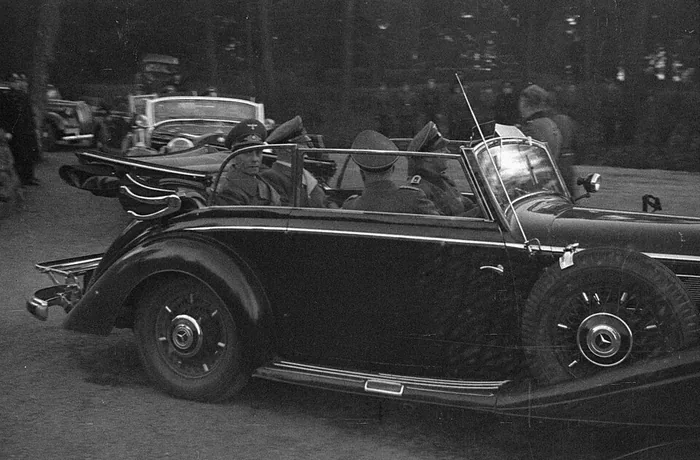
General information & model overview
| Category | Specification Details |
|---|---|
| Model name | 1936 Mercedes-Benz Typ 540 K Cabriolet B (W29) |
| Internal code | W29 |
| Series | Mercedes-Benz Typ 540 K |
| Production years | From the 540 K introduction period around 1936 into later multi-seat open production on the larger-displacement W29 chassis |
| Manufacturer | Daimler-Benz AG (Untertürkheim chassis; Sindelfingen special coachwork for many catalogue bodies) |
| Body focus of this entry | Cabriolet B — multi-seat formal open convertible on the 540 K chassis (continuation of the most common open style into the 5.4-litre era) |
| Layout | Front-engine, rear-wheel drive |
| Programme context | About 419 Typ 540 K cars of all bodies in the late-1930s W29 continuation; combined 500 K + 540 K chassis on the order of roughly 760 units |
| Related W29 bodies | 500 K Cabriolet B, 540 K Cabriolet A, 540 K Spezial Roadster, 540 K Sport-Limousine Spezial |
| Notes | Cabriolet B remains the commercial open backbone into 540 K years; absolute numbers still tiny within ~419 Typ 540 K cars of all bodies |
Body & dimensions
| Specification | Details |
|---|---|
| Wheelbase class | Longer multi-seat packaging often associated with ~3,290 mm class literature for B-type multi-seat bodies — approximate; verify on car |
| Construction | Separate chassis with long-bonnet W29 proportions; exact length and mass depend on coachwork |
| Family equipment themes | Hydraulic brakes; independent front suspension lineage shared with related mid-1930s Mercedes sports/GT cars; 12-volt electrical system on the W29 generation |
| Coachwork source | Sindelfingen special body department for many catalogue and special styles; individual fittings vary by order |
Engine specifications (540 K)
| Theme | Details |
|---|---|
| Configuration | Inline eight-cylinder petrol with Roots-type supercharger engagement |
| Displacement | Approximately 5.4 litres (growth from the 500 K five-litre theme) |
| Output (approximate) | About 115 PS without blower; about 180 PS with supercharger engaged (period class figures) |
| Character | Stronger blown grand-touring eight than 500 K; long-chassis luxury performance rather than pure short-chassis racing special |
| Induction | Unblown running for ordinary road work; Kompressor for high-load acceleration and period high-speed touring |
Drivetrain, chassis & performance (approximate)
| Category | Details |
|---|---|
| Gearbox | Manual multi-speed (four-speed common; higher-count options appear in period literature for some cars) |
| Brakes | Hydraulic drums — advanced for large supercharged Mercedes of the era when maintained |
| Suspension | Independent front suspension theme of the W29 line; period rear axle practice |
| Electrical system | 12-volt generation standard on W29 family cars |
| Top speed class | Body- and gearing-dependent; treat published figures as approximate envelopes, not modern cruise targets |
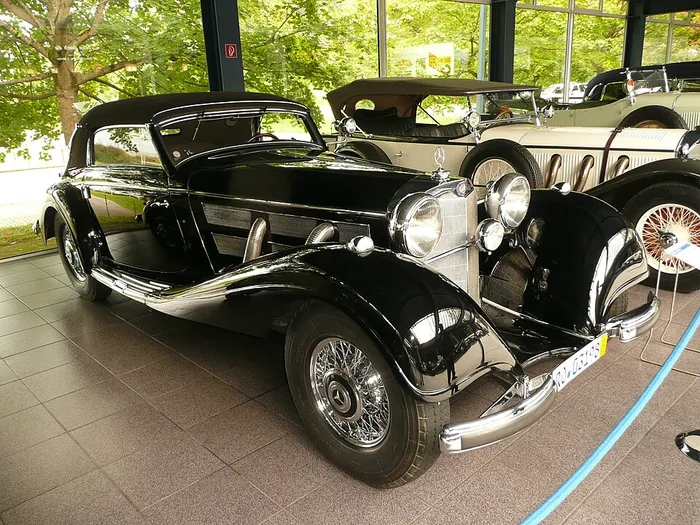
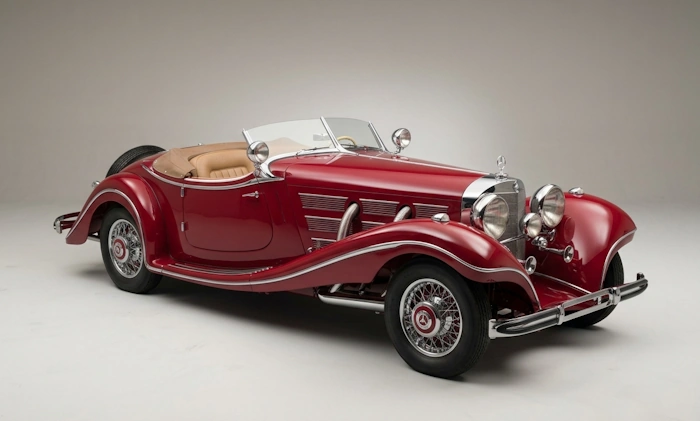
1936 540 K Cabriolet B: multi-seat open on the larger blown eight
The 1936 Mercedes-Benz Typ 540 K Cabriolet B continues the multi-seat formal open path of the W29 family onto the larger approximately 5.4-litre supercharged chassis. Period class output rises to about 115 PS unblown and about 180 PS with blower engaged. The coachwork brief remains social open formality: rear seating, a large folding top, and long-bonnet presence — not pure roadster theatre.
Five-litre predecessor: 500 K Cabriolet B. Intimate late open alternative: Cabriolet A. Sporting open extreme: Spezial Roadster. Closed multi-seat special: Sport-Limousine Spezial.
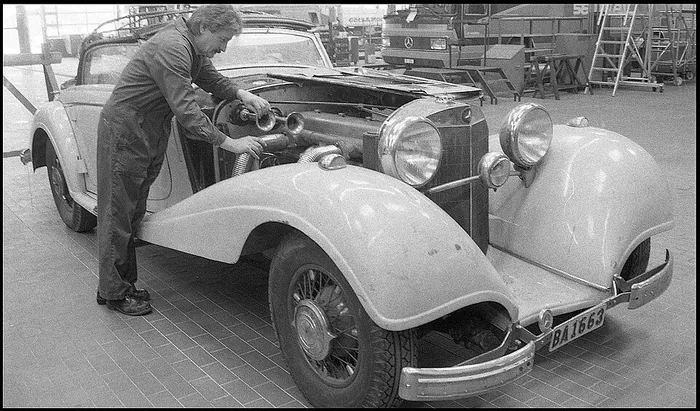
Image source: Wikimedia Commons
From 500 K to 540 K without abandoning Cab B
When Daimler-Benz moved the W29 supercharged grand tourer from roughly five litres to roughly 5.4 litres around 1936, multi-seat open demand did not disappear. Clients who had ordered Cab B for social capacity still wanted that arrangement with the stronger engine. Across about 419 Typ 540 K cars of all bodies, Cab B remained a central open style even as absolute totals stayed exclusive.
1. What changes with 540 K
Displacement and blown output rise. Chassis family themes — hydraulic brakes, independent front suspension lineage, 12-volt electrics — continue. Body letter still means coachwork, not a separate sports chassis code by itself.
2. What stays multi-seat open
Rear seating, large top, and formal open social use remain the B-letter brief. Do not caption every open 540 K as a roadster simply because the engine is larger.
3. 1936 as introduction window
Using 1936 frames the displacement step for readers. Individual cars may date later in 540 K production; chassis documents still rule.
Design of multi-seat open 540 K
Silhouette language continues long wings, long bonnet, and multi-seat open cabin. Detail evolution in brightwork, screen, and interior materials appears across the late 1930s. Top scale remains large; restoration cost tracks that scale.
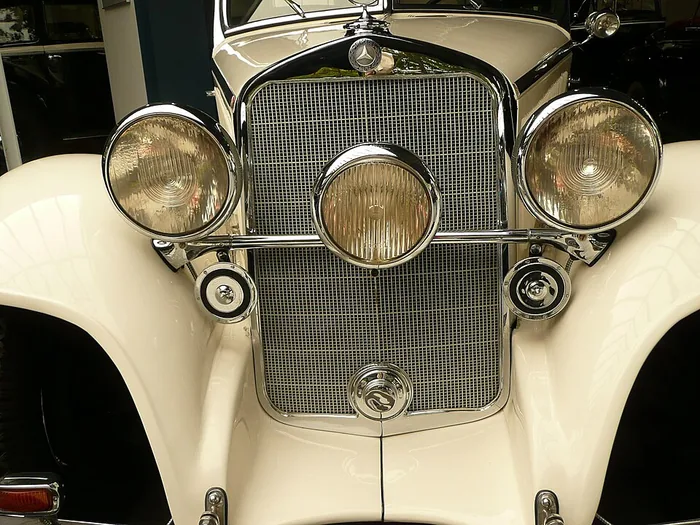
Image source: Wikimedia Commons
1. Top and rear seat package
Inspect irons, fabric, and rear compartment access as one system. Multi-seat open cars fail ownership budgets here more often than in engine bays that look impressive at shows.
2. Formal open presence
Cab B is social arrival and touring, not stripped special display. Keep restoration ethics on that path unless period evidence for the specific car says otherwise.
3. Versus A and roadster cuts
A-type intimacy and Spezial Roadster drama serve different clients. B is the multi-seat open reference. Mixing hard points across those styles in a “restomod” sense destroys historical identity.
Driving the 5.4-litre multi-seat open
Stronger blown output than 500 K does not cancel mass. Four-up use still demands excellent brakes and tyres. Open air multiplies speed sensation; hydraulic drums and independent front suspension improve control relative to older large Mercedes when maintained. Cooling under traffic load remains a primary technical theme.
1. Blower with passengers
About 180 PS class engagement under load is more forceful than five-litre figures. Plan engagement on suitable roads; do not improvise with a full rear seat as entertainment.
2. Brake and tyre margins
Hydraulic systems must be leak-free and correctly adjusted. Period-correct load-rated tyres are safety equipment, not dress-up.
3. Top-up touring
Raised-top multi-seat cruising is realistic for formal weather protection; seals and side equipment must work. Lowered-top use is fair-weather social theatre.
4. Compared with five-litre Cab B
Drivers familiar with 500 K Cabriolet B will recognise the multi-seat open manners and notice the stronger blown reserve. Chassis family behaviour remains long-car grand touring, not short sports special lightness.
Ownership of a 540 K Cabriolet B
Market attention on 540 K open cars is high. Cab B examples still require letter verification against A-type and roadster mis-selling. Mechanical costs track the larger blown eight; coachwork costs track multi-seat tops.
- Multi-seat open 540 K identity — social backbone of later W29 open production.
- Stronger Kompressor class — ~115/180 PS period figures when healthy.
- Continuity with five-litre Cab B culture — clear family comparison path.
- Large top restoration costs — multi-seat fabric and irons dominate many budgets.
- Letter and body confusion — confirm B hard points against A and roadster specials.
- Cooling and brake duty under load — four-up use exposes weak systems quickly.
Structure ownership around humidity control, a specialist open-coachwork relationship, and a mechanical shop experienced with Roots blowers on large Mercedes eights. Treat every “540 K cabriolet” caption as incomplete until letter and seating are proven.
Sibling comparisons
Choose 540 K Cabriolet B for multi-seat open use on the larger engine. Choose 500 K Cabriolet B for the five-litre multi-seat open predecessor. Choose Cabriolet A for intimate open letter practice. Choose Spezial Roadster for sporting open extremes. Closed multi-seat: Sport-Limousine Spezial.
Transition-era ownership on the larger open multi-seat car
Owning a 540 K Cabriolet B from the displacement-step years means balancing multi-seat open coachwork costs with the stronger blown eight’s service needs. The car invites social use; the machinery demands preparation before social use becomes routine. Treating 1936 as a symbolic introduction year is fine for narrative; treating every maintenance decision as chassis-specific is mandatory for safety and originality.
1. Load-first service order
Order work as brakes, tyres, cooling, then blower and engine detail, then cosmetics. Multi-seat open 540 K cars punish owners who reverse that order for show deadlines. Four adults and luggage expose weak hydraulics faster than empty parade laps reveal them, and the roughly 180 PS blown class makes late braking more tempting than on five-litre cars.
2. Comparing notes with five-litre Cab B
Drivers and restorers who know the five-litre Cab B will transfer many coachwork lessons and must recalibrate thermal and performance expectations for the larger engine. Share parts knowledge carefully; not every five-litre fitting is identical on later cars. Label spares by chassis and engine family to avoid silent interchange mistakes in the workshop.
3. Public description standards
When exhibiting or listing the car, state Cabriolet B, 540 K, and multi-seat open intent explicitly. Avoid roadster shortcuts. Mention approximate packaging class only if measured on that car. Accurate public language multiplies the educational value of every appearance and reduces the noise of generic 540 K cabriolet captions online.
A 540 K Cab B that is maintained as a multi-seat open grand tourer — not as a faux special roadster and not as a neglected common cabriolet — preserves the social backbone of later W29 open production in running, documentable form for the next custodian who inherits both the car and its paper trail.
Legacy
The 1936 540 K Cabriolet B shows that when the W29 engine grew, multi-seat open social demand grew with it rather than vanishing into roadster mythology. It is the later-generation reference for formal open family use on the supercharged grand-touring chassis, and it anchors the open letter map for the roughly 419-car 540 K portion of the combined programme.
Leave a Reply
You must be logged in to post a comment.