General information & model overview
| Category | Specification Details |
|---|---|
| Model name | Mercedes-Benz “Grosser Mercedes” Cabriolet D (W07) (1932–1938) |
| Family | Mercedes-Benz Typ 770 / “Grosser Mercedes” (Großer Mercedes) |
| Internal code | W07 (first-generation Typ 770) |
| Production years | Approximately 1932 – 1938 within the W07 programme |
| Manufacturer | Daimler-Benz AG, Untertürkheim |
| Market role | Ultra-luxury / state and ceremonial passenger car — flagship above mid-size and luxury eights such as the Typ Nurburg |
| Body focus of this entry | Cabriolet D — large formal multi-door / multi-seat open body on W07 |
| Layout | Front-engine, rear-wheel drive |
| Family overview | Typ 770 hub |
| Related bodies | Cab A, Cab B, Cab C, Cab D, Cab F, Tourenwagen, Stadt Coupé |
| W07 programme scale | Approximately 117 W07-series cars built 1930–1938 (all bodies combined; individual body tallies are much smaller) |
Body & dimensions (W07 chassis class)
| Specification | Details |
|---|---|
| Wheelbase | Approximately 3,750 mm (about 148 in) |
| Overall length | Roughly 5,600 – 5,700 mm depending on body |
| Width | About 1,850 mm class |
| Height | About 1,800 – 1,830 mm class (body-dependent) |
| Track | About 1,500 mm front and rear (period figures) |
| Chassis | Boxed ladder frame; beam axles; semi-elliptic leaf springs |
| Coachwork | Factory-associated and specialist coachbuilt bodies on the long W07 chassis; exact fittings vary by order |
| Seating | Multi-seat formal layouts typical; exact count depends on body and partitions |
Engine specifications (W07 / M07 theme)
| Theme | Details |
|---|---|
| Configuration | Inline eight-cylinder petrol, overhead camshaft, aluminium pistons |
| Displacement | 7,665 cc (approximately 7.7 litres) |
| Output (naturally aspirated) | About 150 PS / 150 bhp (112 kW) at roughly 2,800 rpm |
| Output (with optional supercharger) | About 200 PS / 200 bhp (149 kW) at roughly 2,800 rpm when Roots-type blower engaged (typically full-throttle engagement) |
| Induction | Naturally aspirated base; optional Kompressor (770 K theme in collector language) |
| Character | Smooth multi-cylinder luxury power for formal mass — not a short-chassis sports special |
| Fuel & cooling | Period carburation; liquid cooling; thermal load under formal closed mass is a central ownership subject |
Drivetrain, chassis & brakes (W07)
| Category | Details |
|---|---|
| Gearbox | Four-speed manual; third direct, fourth overdrive-style ratio in period descriptions |
| Drive | Rear-wheel drive |
| Suspension | Solid beam axles, semi-elliptic leaf springs front and rear |
| Brakes | Servo-assisted mechanical brakes (period practice; not the later W150 hydraulic system) |
| Steering | Low-geared mechanical steering suited to formal parking and parade speeds |
Performance (approximate, condition-dependent)
| Measure | Details |
|---|---|
| Top speed (blown) | Up to about 160 km/h (99 mph) class quoted for supercharged cars under favourable conditions |
| Top speed (unblown) | Lower; formal body drag and gearing dominate |
| Use envelope | Ceremonial, diplomatic, and elite private transport — not modern high-speed dual carriageway use |
| Mass effect | Heavy coachwork and optional armour (where fitted later or specially) rewrite acceleration and braking demands |
Mercedes-Benz “Grosser Mercedes” Cabriolet D: body identity on the W07 Grosser chassis
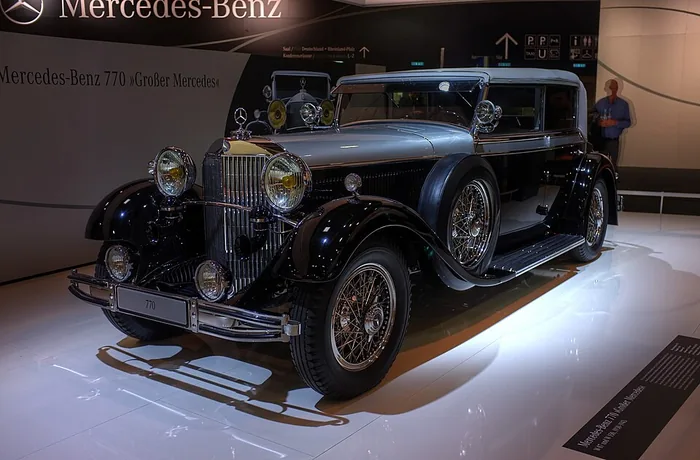
The Grosser Mercedes Cabriolet D on the W07 chassis is a large formal open body for multi-seat ceremonial and social use. In Mercedes open-body language of the period, D typically signals four-door or strongly multi-seat formal convertible character relative to A/B intimacy. On the Typ 770 it is one of the principal open formal faces of the first-generation flagship.
Shared W07 mechanicals: 7,665 cc OHC eight, about 150/200 PS unblown/blown, four-speed gearbox, 3.75 m wheelbase boxed chassis — full detail on the Typ 770 hub.
Related large open styles: Cabriolet F, Tourenwagen; more compact open: A, B, C.
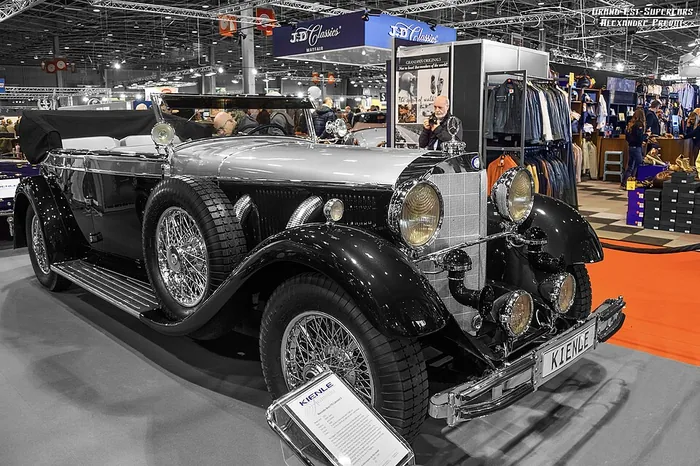
Image source: Wikimedia Commons
Design and coachwork
Design emphasis is multi-seat open formality: long sides, substantial folding top structure, and a cabin that can carry guests or official parties. Weather equipment is part of the mission, not an accessory.
Mass is higher than lighter open cuts. That mass rewrites brake fade risk, tyre load, and cooling demand. Restorations that prioritise paint over structure and top mechanics miss the functional product.
Partitions, jump seats, and rear compartment fittings appear on some formal open orders; verify rather than assume a single interior template.
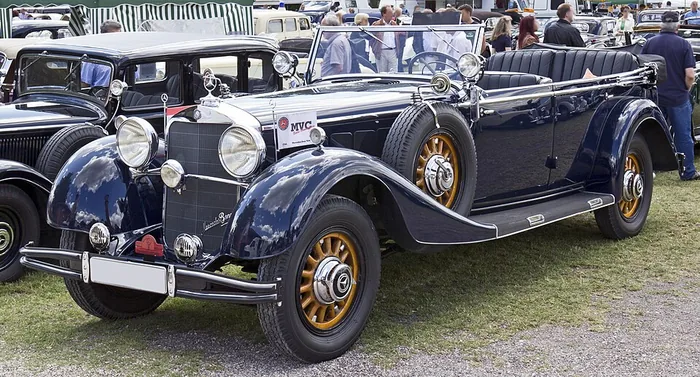
Image source: Wikimedia Commons
Mechanical basis and driving character
On the road the Cabriolet D is a formal carriage that happens to be open. Progress is touring-paced. Supercharged power helps with gradients and decisive overtaking in period terms; it does not create modern sports dynamics.
Full passenger loads change handling and stopping distances. Test and evaluate with realistic weight. Mechanical servo brakes must be excellent before public use.
Parade and ceremonial itineraries suit the machine better than long high-speed modern routes. Secondary roads in good condition and conservative averages are the correct modern pattern.
Collecting and documentation
Formal open multi-door Grossers attract strong historical interest and equally strong restoration bills. Factor top, wood, and brightwork into any acquisition budget before paint.
Document identity carefully against Cabriolet F claims; letter misattribution is common in secondary descriptions.
Ownership: strengths and things to watch
Strengths
- Ceremonial multi-seat open role — core public image of open Grossers.
- Strong documentary trails — large open cars appear often in period photos.
- Complete W07 powertrain story — unblown and optional Kompressor themes.
Things to watch
- Top and rear wood — multi-door open mass multiplies cost.
- Brake fade with full cabin — period drums need excellent condition.
- D vs F paperwork — sales copy often exaggerates letter.
- Post-event grit — clean floor channels after processions.
Sibling comparisons
Cabriolet D is large multi-seat open ceremony on W07. F is usually more Pullman-extreme; A/B are more compact open cuts; Tourenwagen emphasises visibility over cabriolet formality. Confirm generation before comparing to any W150 D.
Legacy
Cabriolet D embodies multi-seat open ceremony on the first Grosser generation. Public imagination often treats “open Grosser” as this kind of car, which is why accurate D documentation matters for the whole family.
Conservation of tops and rear compartments is the practical legacy: without those assemblies, the ceremonial brief disappears.
Leave a Reply
You must be logged in to post a comment.