General information & model overview
| Category | Specification Details |
|---|---|
| Model name | Mercedes-Benz “Grosser Mercedes” Stadt Coupé (W07) (1933–1938) |
| Family | Mercedes-Benz Typ 770 / “Grosser Mercedes” (Großer Mercedes) |
| Internal code | W07 (first-generation Typ 770) |
| Production years | Approximately 1933 – 1938 within the W07 programme |
| Manufacturer | Daimler-Benz AG, Untertürkheim |
| Market role | Ultra-luxury / state and ceremonial passenger car — flagship above mid-size and luxury eights such as the Typ Nurburg |
| Body focus of this entry | Stadt Coupé — closed formal city / formal coupé body on W07 |
| Layout | Front-engine, rear-wheel drive |
| Family overview | Typ 770 hub |
| Related bodies | Cab A, Cab B, Cab C, Cab D, Cab F, Tourenwagen, Stadt Coupé |
| W07 programme scale | Approximately 117 W07-series cars built 1930–1938 (all bodies combined; individual body tallies are much smaller) |
Body & dimensions (W07 chassis class)
| Specification | Details |
|---|---|
| Wheelbase | Approximately 3,750 mm (about 148 in) |
| Overall length | Roughly 5,600 – 5,700 mm depending on body |
| Width | About 1,850 mm class |
| Height | About 1,800 – 1,830 mm class (body-dependent) |
| Track | About 1,500 mm front and rear (period figures) |
| Chassis | Boxed ladder frame; beam axles; semi-elliptic leaf springs |
| Coachwork | Factory-associated and specialist coachbuilt bodies on the long W07 chassis; exact fittings vary by order |
| Seating | Multi-seat formal layouts typical; exact count depends on body and partitions |
Engine specifications (W07 / M07 theme)
| Theme | Details |
|---|---|
| Configuration | Inline eight-cylinder petrol, overhead camshaft, aluminium pistons |
| Displacement | 7,665 cc (approximately 7.7 litres) |
| Output (naturally aspirated) | About 150 PS / 150 bhp (112 kW) at roughly 2,800 rpm |
| Output (with optional supercharger) | About 200 PS / 200 bhp (149 kW) at roughly 2,800 rpm when Roots-type blower engaged (typically full-throttle engagement) |
| Induction | Naturally aspirated base; optional Kompressor (770 K theme in collector language) |
| Character | Smooth multi-cylinder luxury power for formal mass — not a short-chassis sports special |
| Fuel & cooling | Period carburation; liquid cooling; thermal load under formal closed mass is a central ownership subject |
Drivetrain, chassis & brakes (W07)
| Category | Details |
|---|---|
| Gearbox | Four-speed manual; third direct, fourth overdrive-style ratio in period descriptions |
| Drive | Rear-wheel drive |
| Suspension | Solid beam axles, semi-elliptic leaf springs front and rear |
| Brakes | Servo-assisted mechanical brakes (period practice; not the later W150 hydraulic system) |
| Steering | Low-geared mechanical steering suited to formal parking and parade speeds |
Performance (approximate, condition-dependent)
| Measure | Details |
|---|---|
| Top speed (blown) | Up to about 160 km/h (99 mph) class quoted for supercharged cars under favourable conditions |
| Top speed (unblown) | Lower; formal body drag and gearing dominate |
| Use envelope | Ceremonial, diplomatic, and elite private transport — not modern high-speed dual carriageway use |
| Mass effect | Heavy coachwork and optional armour (where fitted later or specially) rewrite acceleration and braking demands |
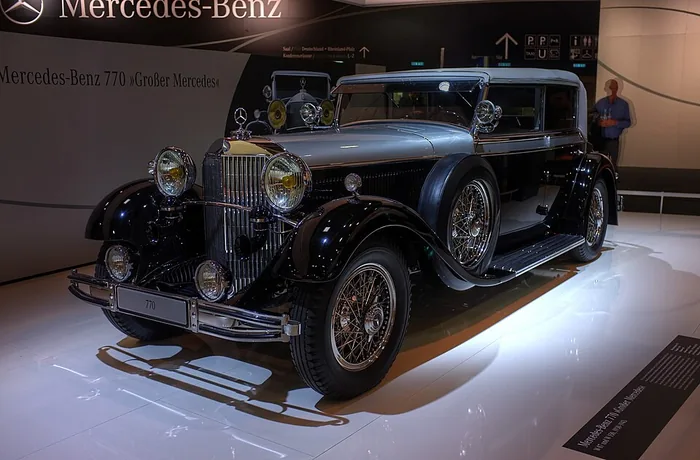
Mercedes-Benz “Grosser Mercedes” Stadt Coupé: body identity on the W07 Grosser chassis
The Grosser Mercedes Stadt Coupé is a closed formal body style on the W07 Typ 770 chassis, associated here with approximately 1933–1938. “Stadt” (city) signals a formal closed identity suited to urban ceremonial and private elite use, as distinct from open parade cabriolets and tourers. It remains a long-wheelbase flagship car, not a compact city runabout in the modern sense.
Shared mechanicals are the W07 7.7-litre eight with optional supercharger and four-speed gearbox — see the Typ 770 hub. Closed mass increases thermal and brake loads relative to lighter open bodies.
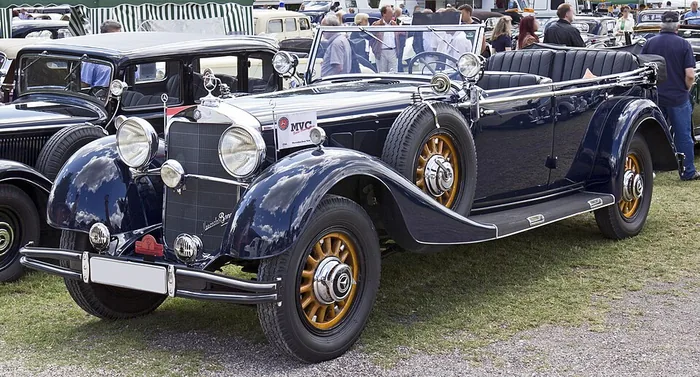
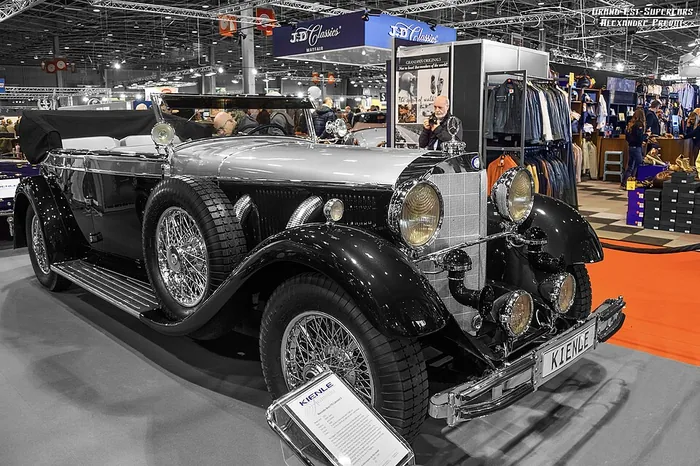
Open siblings for contrast: Cabriolet A, B, D, F, Tourenwagen.
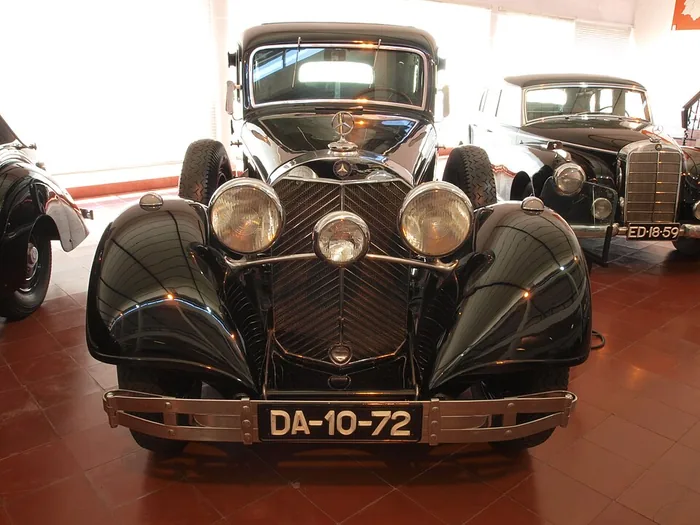
Image source: Wikimedia Commons
Design and coachwork
Design language is closed formality: fixed roof, formal glasshouse, and a cabin arranged for prestige rather than sporting intimacy. Exact two-door coupé versus related closed formal cuts should be confirmed on the individual car; period naming and later catalogue language can blur.
Interior quality, partition fittings if any, and rear compartment arrangement define whether a given car was a private formal coupé or closer to institutional closed transport. Wood framing under closed roofs hides moisture damage until late.
Exterior brightwork and paint schemes vary with original order. Over-restoration into modern mirror gloss can erase period formality; under-restoration leaves structural risk.
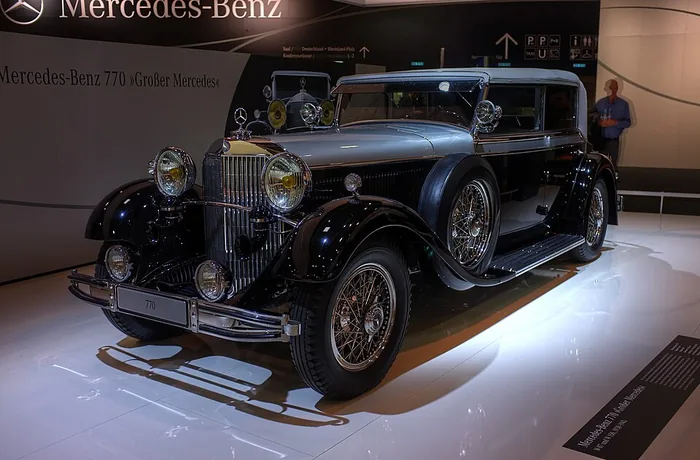
Image source: Wikimedia Commons
Mechanical basis and driving character
Closed Grossers are often the more usable formal cars in wet climates because they avoid soft-top complexity. They are not “easy” cars: mass, size, and mechanical brakes remain demanding.
Cooling in city traffic is a primary technical subject. A dark formal body at low speed on a hot day is a hard test for radiators and fans of period design.
Driving character is upright and deliberate. Supercharged cars add reserve; they do not create mid-size agility.
Collecting and documentation
Closed W07 cars can be undervalued relative to open parade glamour, yet they explain year-round flagship use. Documentation of body type is essential because closed Grossers are sometimes generically labelled “Pullman” without precision.
Pair research with the hub and at least one open body page to teach the full W07 spectrum.
Ownership: strengths and things to watch
Strengths
- Year-round closed formality — no soft-top as primary weather system.
- Balances the open narrative — shows Grosser prestige beyond parade convertibles.
- Potential museum practicality — indoor display without top drama.
Things to watch
- Hidden roof and sill rot — closed bodies conceal structure.
- City thermal load — low-speed formal use stresses cooling.
- Generic Pullman labels — confirm Stadt Coupé identity on papers.
- Undervaluation trap — cheap closed shells can still be structural projects.
Sibling comparisons
Stadt Coupé is the closed formal W07 expression. All open letter pages and the Tourenwagen show weather-exposed alternatives. For second-generation closed practice, return to the hub—W150 Motor Wiki body set here is open-focused.
Legacy
The Stadt Coupé proves the Grosser line was not only an open-air silhouette. Closed formal bodies carried the same eight-cylinder prestige through weather that defeated soft-tops.
For museums needing year-round exhibits, a sound closed W07 can be a more honest educational object than a glamorous open shell with terminal wood disease.
Leave a Reply
You must be logged in to post a comment.