General information & model overview
| Category | Specification Details |
|---|---|
| Model name | Mercedes-Benz Typ Nürburg / Typ Nurburg (W08 family), including Typ Nürburg 460 and later Typ Nürburg 500 / Typ 500 themes |
| Internal code | W08 |
| Production years | Approximately 1928 – 1939 (exact span depends on body style and market designation within the W08 programme) |
| Approximate production | On the order of roughly 3,800 units class for the overall Typ Nürburg programme (figures vary slightly by source and counting method) |
| Body style | Large luxury passenger car offered with closed Pullman limousine/sedan bodies, formal and social cabriolets, open tourers, and sporting roadster coachwork |
| Manufacturer | Daimler-Benz AG (Mercedes-Benz) |
| Name origin | Named after Nürburg in the Eifel, associated in period marketing with the Nürburgring region’s prestige and sporting geography (spelling Nürburg / Nurburg both appear in later English usage) |
| Market role | First Mercedes-Benz eight-cylinder passenger car — large luxury flagship for the late 1920s and 1930s, rivaling contemporary German luxury eights such as Horch rather than the supercharged sports S-series |
| Layout | Front-engine, rear-wheel drive |
| Key characteristics | Inline-eight petrol power (early ~4.6-litre / 18/80 PS class; later ~4.9-litre 500 theme); tall early “Hochbett” chassis evolving toward lower modern frames; coachbuilt luxury bodies across formal and open spectra |
| Engineering notes | Early development associated with Ferdinand Porsche’s passenger-car work at Daimler-Benz; later low-chassis updates linked with Hans Nibel’s engineering leadership |
Body & dimensions
| Specification | Details |
|---|---|
| Chassis concept | Separate ladder frame with catalogue and coachbuilt bodies; early tall overslung / Hochbett character later revised toward lower, more modern chassis proportions |
| Wheelbase class | Long luxury-class wheelbases suited to Pullman limousines, formal cabriolets, and multi-seat open bodies; exact figures vary by body and chassis revision |
| Overall length & mass | Large by period standards; closed Pullman and Cabriolet F bodies are especially long and heavy; roadster bodies reduce mass and visual bulk without changing the luxury-eight mechanical core |
| Seating | From intimate two-seat roadster layouts to six-seat formal open and closed Pullman arrangements depending on body |
| Body variety | Pullman limousine/sedan, Tourenwagen, Cabriolet C, Cabriolet D, Cabriolet F (Pullman cabriolet), Sport Roadster, and related formal open/closed styles |
| Construction | Period steel-and-wood composite coachwork practices; quality, originality, and structural health dominate collector value |
| Doors | Two- or four-door layouts (and multi-door formal open cars) depending on body letter and coachbuilder execution |
| Lighting & fittings | Period electrical lighting, formal exterior brightwork, and luxury interior trim; restorations must balance authenticity with safe wiring practice |
Engine specifications
| Theme | Details |
|---|---|
| Configuration | Inline eight-cylinder petrol engine (M08 family theme) — Mercedes-Benz’s first eight-cylinder passenger-car powerplant |
| Early displacement (460 theme) | Approximately 4622 cc — Typ Nürburg 460 / 18/80 PS class |
| Later displacement (500 theme) | Approximately 4918 cc — Typ Nürburg 500 / Typ 500 class with evolutionary updates |
| Output (period class) | Roughly 80 PS class for core naturally aspirated luxury ratings; some later supercharged options appear in period literature for selected late configurations — verify on the individual car |
| Induction | Primarily naturally aspirated luxury touring power; not the same product as the supercharged W06 sports family |
| Character | Smooth multi-cylinder refinement for heavy formal bodies; designed for dignity and sustained touring rather than short-chassis racing drama |
| Fuelling & cooling | Period carburettor equipment and liquid cooling; cooling system condition is critical on large, heavy coachwork in summer traffic |
| Contrast | Completely different mission from the supercharged Typ S / W06 sports line; closer in social role to top-tier German luxury eights than to SSK specials |
Drivetrain & transmission
| Category | Details |
|---|---|
| Drive layout | Front-engine, rear-wheel drive — standard for Mercedes luxury passenger cars of the era |
| Gearbox | Manual multi-speed transmission of period design; exact ratios and synchronization features depend on year and later repairs |
| Clutch | Mechanical clutch; smooth technique matters greatly under the mass of Pullman and formal open bodies |
| Final drive | Rear axle gearing oriented to dignified luxury touring rather than modern motorway cruise expectations |
| Ownership note | Driveline noise, oil leaks, and worn universal joints are common inspection themes on high-mileage or long-stored examples |
Chassis, brakes & structure (period construction)
| Category | Details |
|---|---|
| Frame evolution | Early tall Hochbett / overslung luxury chassis; later lower-chassis revisions modernise stance and road presence under Hans Nibel–era passenger engineering influence |
| Front suspension | Solid axle with leaf springs (period convention); damper type depends on original specification and restoration |
| Rear suspension | Live rear axle with leaf springs; ride quality depends heavily on spring condition, load, and tyre pressures |
| Steering | Mechanical steering box; low gearing and free play by modern standards if worn; heavy formal bodies demand strong arms at parking speeds |
| Brakes | Period drum brakes; stopping distances long by modern norms — linings, actuation hardware, and adjustment are safety-critical on multi-tonne luxury cars |
| Wheels & tyres | Wire or artillery-style wheels depending on specification; correct load-rated classic tyres are essential under limousine and Pullman cabriolet mass |
| Safety context | No modern crash structure or electronic aids; period lighting and brakes define the practical safety envelope |
Performance (period context)
| Category | Details |
|---|---|
| Power-to-weight reality | With roughly 80 PS class power and substantial luxury body mass, acceleration is leisurely by post-war standards; lighter roadster bodies feel livelier than Pullman limousines |
| Touring character | Smooth eight-cylinder progress on good roads; built for prestige touring and formal arrival rather than sporting lap times |
| Top speed class | Period luxury-car envelope — exact figures depend on gearing, body drag, chassis height, and condition; closed Pullman cars are not roadster-quick |
| Driving feel by body | Sedan/Pullman: formal isolation; Cabriolet D/F: social open dignity; Cabriolet C: more intimate open luxury; Sport Roadster: lightest sporting expression of the same luxury chassis idea |
| Comparison | Worlds apart from supercharged W06 sports cars; natural rival in the Horch 8 luxury segment rather than the SSK track special market |
Timeline & history
| Period | Development |
|---|---|
| Mid-1920s context | Daimler-Benz merger era; Mercedes-Benz needs a modern large luxury passenger statement beyond mid-size programmes such as the Typ Stuttgart |
| ~1928 | Typ Nürburg 460 / W08 launched as the first Mercedes-Benz eight-cylinder passenger car; closed sedan/Pullman identity establishes the range’s formal core — see 1928 Nurburg Sedan |
| Early development | Ferdinand Porsche’s passenger-car engineering influence frames the early eight-cylinder luxury programme |
| Late 1920s – early 1930s | Body catalogue expands: Cabriolet C, Cabriolet D, Sport Roadster, and related open styles |
| Chassis evolution | Tall early Hochbett stance gradually yields to lower, more modern chassis presentations under later engineering leadership associated with Hans Nibel |
| ~1930s mid programme | Typ Nürburg 500 / Typ 500 theme with ~4.9-litre eight continues the luxury line with evolutionary mechanical updates |
| 1933–1939 | Cabriolet F formal Pullman open luxury appears in later years; production continues toward the end of the decade |
| Concurrent contrast | Supercharged Typ S / W06 family occupies a different performance and cultural niche throughout |
| Afterlife | Surviving cars become major pre-war collector pieces: rare eight-cylinder Mercedes luxury history with dramatic body-style diversity |
Body styles & variants (family map)
| Theme | Details |
|---|---|
| Sedan / Pullman limousine | Closed formal core of the range and 1928 launch identity — Nurburg Sedan |
| Cabriolet C | More intimate open luxury expression (typically lighter social cut than D/F) — Cabriolet C W08 1928–1933 |
| Cabriolet D | Four-door formal social open luxury — Cabriolet D |
| Cabriolet F | Large formal Pullman-style cabriolet, later years, multi-seat open state car character — Cabriolet F |
| Sport Roadster | Two-seat sporting open expression of the W08 luxury chassis — Sport Roadster |
| Tourenwagen & others | Open touring and related catalogue or coachbuilt styles complete the practical luxury spectrum; identify body origin when documenting a car |
| Engine themes | 460 (~4.6 L / 18/80 PS class) and later 500 (~4.9 L) — mechanical evolution within one luxury family rather than separate sports programmes |
| Market rivals | German luxury eight-cylinder segment including Horch 8 class cars — prestige and multi-cylinder smoothness as selling points |
Safety & construction notes (classic-era context)
| Category | Details |
|---|---|
| Crash protection | Separate chassis and period body offer minimal modern crash energy management; low speeds and defensive driving are mandatory |
| Braking with mass | Heavy Pullman and formal open bodies magnify drum-brake limitations; early application on hills is non-negotiable |
| Lighting | Period headlamps are weak by modern standards; night driving on unlit roads is a specialist activity |
| Open-body risk | Soft tops are not safety cells; multi-passenger open cars increase responsibility for owner-drivers |
| Wood rot & corrosion | Door bottoms, sills, floor structures, and top irons hide expensive failures on luxury coachwork |
| Tyres | Load rating and age condition are critical under limousine mass and full passenger loads |
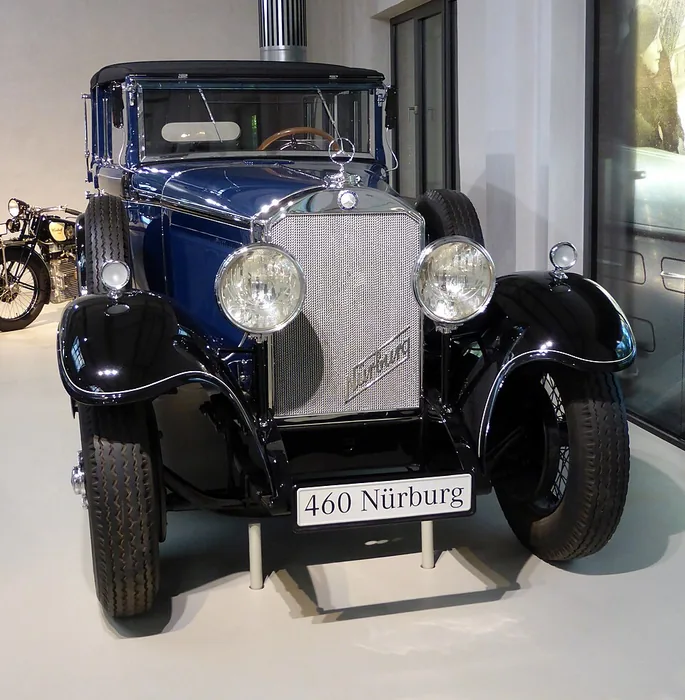
Typ Nurburg (W08): first Mercedes-Benz eight-cylinder passenger car family
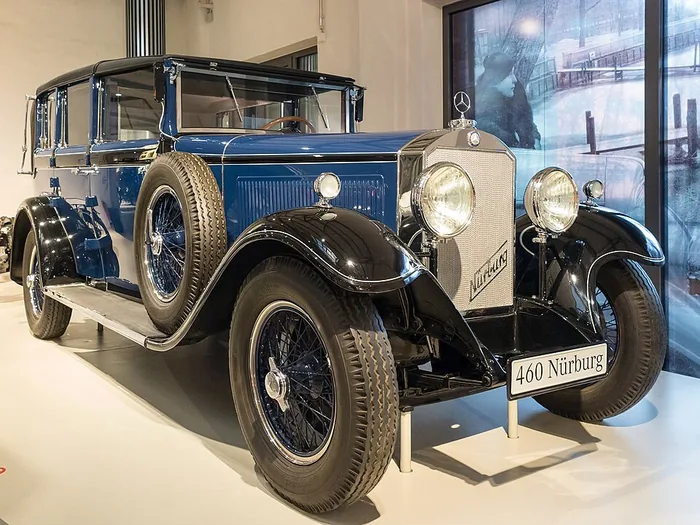
Image source: Wikimedia Commons
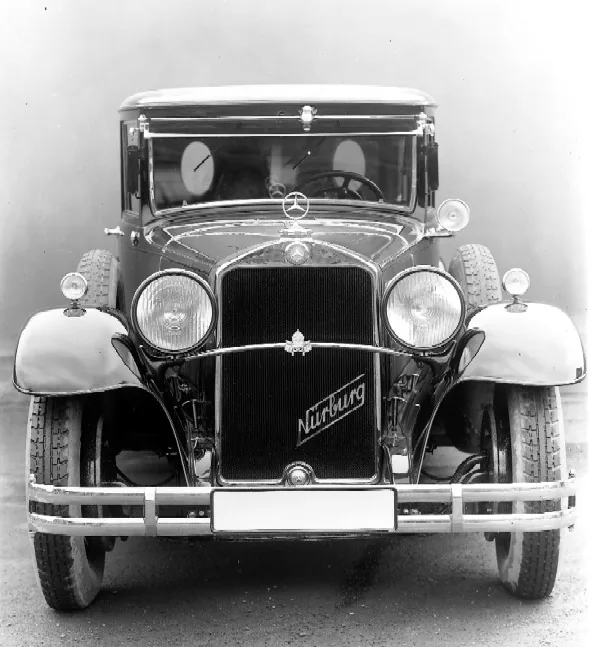
The Mercedes-Benz Typ Nurburg (also written Nürburg), internal series W08, was a large luxury passenger car family produced from about 1928 to 1939. It was the first Mercedes-Benz passenger model with an inline-eight engine. Approximate total production for the programme is on the order of 3,800 units, depending on counting method and literature.
The name refers to Nürburg in the Eifel. Period marketing associated the name with regional prestige; the car itself was a luxury touring and formal passenger product, not a circuit special. Spelling varies in English sources (Nurburg / Nürburg); the mechanical identity is W08.
This page is the family overview. Body-style entries on Motor Wiki cover the closed sedan/Pullman core and the main open subtypes: Sedan, Cabriolet C, Cabriolet D, Cabriolet F, and Sport Roadster.
Development and engineering context
In the late 1920s the German luxury market increasingly expected multi-cylinder smoothness, including inline eights. Mercedes-Benz, after the Daimler-Benz merger, needed a large passenger flagship that was not simply a sports model. The W08 answered that need as the brand’s first passenger eight.
Early development is associated with Ferdinand Porsche’s passenger-car work at the firm. Early chassis used a tall traditional luxury layout (often described as Hochbett / overslung character). Later revisions, associated with Hans Nibel’s passenger engineering leadership, lowered the car into a more modern stance while retaining the eight-cylinder luxury brief.
Early engine theme is Typ Nürburg 460 / 18/80 PS class with roughly 4.6 litres. Later Typ Nürburg 500 / Typ 500 themes use roughly 4.9 litres with evolutionary updates. Core ratings remain in roughly the 80 PS class for many naturally aspirated luxury versions. Some later literature mentions supercharged options on selected cars—verify on the individual vehicle. The programme’s historical centre of gravity is multi-cylinder luxury, not Kompressor sports culture.
That distinction must be stated early. In the same historical neighbourhood as the Nürburg sits the supercharged Typ S / W06 family, which dominates popular memory with Kompressor drama and sporting bodywork. The W08 occupies a different shelf. Its rivals are luxury eights such as contemporary Horch machines. Its virtues are smoothness, presence, and the ability to carry closed Pullman dignity or open formal theatre on a single mechanical idea.
Position in the Mercedes range
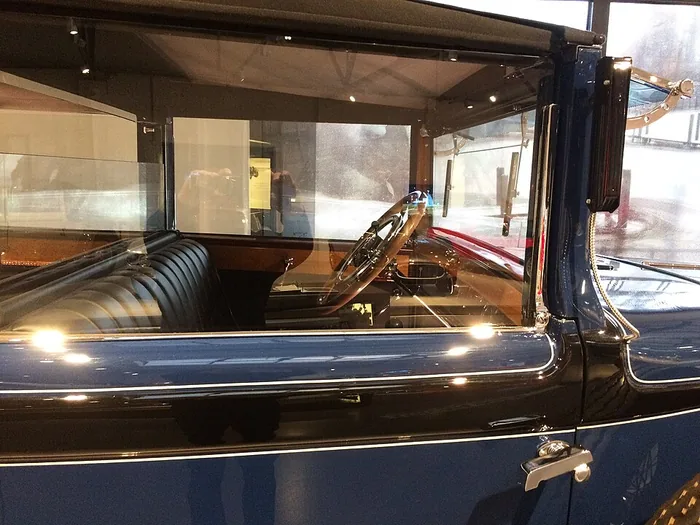
Image source: Wikimedia Commons
Relative to mid-size programmes such as the Typ Stuttgart and mid/upper sixes such as the Typ Mannheim, the Nurburg is larger, more multi-cylinder, and more formal in typical body programme.
Relative to the supercharged Typ S / W06 sports family, the Nurburg is a different product: luxury eight-cylinder passenger car versus Kompressor sports tourer/roadster culture. Set the Nürburg beside a mid-size Stuttgart and the difference is immediately social as well as mechanical. The Stuttgart line spoke to accessible Mercedes ownership. The W08 spoke to large-car households, diplomatic and industrial elites, hotels with porte-cochères, and customers who measured a car by how it arrived rather than how it cornered. That is the correct historical frame for reading every body style on this hub page.
Concurrent sports models shared a brand and an era, not a brief. Judging a Nurburg Pullman by S-series performance standards confuses two separate Mercedes strategies of the late 1920s and 1930s.
Engines: 460 and 500 themes
The 1928 launch identity is the Typ Nürburg 460 theme — approximately 4.6 litres and about eighty horsepower in period class language. Those figures look modest by later standards. Against heavy closed coachwork and period roads, they formed a serious multi-cylinder argument: more cylinders for smoothness, enough power for formal touring, and a clear brand statement that Mercedes-Benz passenger prestige now included an inline eight.
As the programme continued, cars participated in the roughly 4.9-litre Typ Nürburg 500 conversation. Displacement growth and evolutionary updates kept the luxury message current without converting the family into a sports line. Core ratings remain in a similar roughly eighty-horsepower class for many naturally aspirated versions. The story is refinement and catalogue modernity rather than a step-change into racing culture.
Under closed mass, cooling and mixture control are central ownership subjects. A dark limousine body in slow summer traffic is a demanding thermal load. Radiators, hoses, water pumps, and clean fuel systems decide whether a formal outing ends in composure or overheating. Ignition integrity on a long eight-cylinder engine rewards specialist attention. Supercharged sports culture belongs with the W06 line unless a specific car is documented otherwise.
Body map
Closed Pullman/sedan bodies were central to the launch identity and remain the formal core—see the Nurburg Sedan entry. They explain why the eight-cylinder programme existed at multi-year scale: year-round prestige transport, not only open summer imagery.
The Cabriolet C occupies a more intimate open niche. Relative to the larger formal open cars, it tends to read as a lighter social or owner-driver open luxury statement — still a W08, still about multi-cylinder grace, but with less Pullman bulk than the D or F themes.
The Cabriolet D is four-door formal open luxury for social touring. It is the body that says a household can invite guests into the open air without abandoning Mercedes dignity. Weather equipment is part of the mission, not an afterthought.
The Cabriolet F, associated especially with 1933–1939, is the large Pullman-style open car of the later years: multi-seat, formal, and almost state-carriage in open-air form. It is the most ceremonial open expression in this Motor Wiki family set.
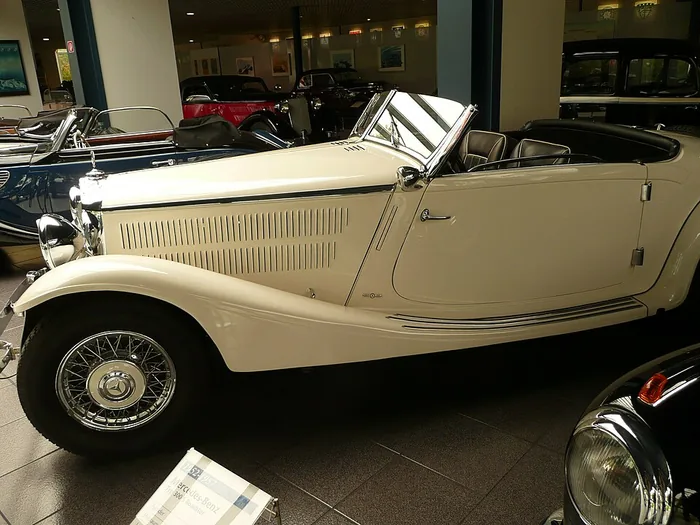
The Sport Roadster is the two-seat open expression of the same luxury chassis idea. It is still not an SSK. It is the sporting open cut of a luxury chassis — two-seat drama, lower visual mass, and the pleasure of eight-cylinder sound without the full supercharged sports mythology. Tourenwagen and other catalogue or coachbuilt styles complete the spectrum. Always identify the body on the car under inspection.
Chassis generations and driving character
On the family hub, the early tall Hochbett stance and later lower presentations are best read as programme-wide chassis generations, not as body-style fashion. Closed and open cars both appear in each stance era; the hub’s job is to keep that chronology visible before readers dive into a single coachwork page.
A Nurburg is a large period luxury car. Progress is touring-paced. Steering is slow by modern standards. Brakes are drums and need early application, especially on heavy Pullman and formal open bodies. Gearing suits early-1930s roads, not sustained modern high-speed dual carriageway use.
Empty or lightly loaded open cars feel freer than fully occupied limousines, but the mechanical envelope remains luxury-eight touring. Period lighting is weak. Night driving is specialist activity. Tyre load rating and age are critical under limousine mass. Supercharged W06 cars are a different noise, gearing, and maintenance culture.
Ownership and inspection
Strengths include historical importance as the first Mercedes passenger eight; wide body-style interest; and strong documentary value for interwar luxury study. Watch points: frame and coachwork wood; top assemblies on open cars; brake system health under real mass; cooling capacity; fuel system condition; electrical wiring; chassis height generation (early tall vs later lower); engine theme (460 vs 500); body originality and rebody history.
Running costs scale with size. Formal open tops and extensive brightwork are expensive to restore correctly. Storage must be dry and spacious. Specialist support is essential. These are not mainstream classic-car consumables objects. A polished exterior over a rotten understructure is a common pre-war luxury failure mode; invasive inspection of sills, floors, roof framing, and partition bases is mandatory on any serious purchase.
Market and collecting
Surviving W08 cars are major pre-war collectibles. Values depend on body style, chassis generation, engine theme, originality, and documentation. Formal open cars and roadsters often attract strong interest; coherent original closed cars remain historically central and can be relatively rational entries into W08 ownership in wet climates—still expensive, still large, but often more usable than multi-seat open tops with worn fabric.
Production across more than a decade means imperfect parts commonality. Serial interpretation and period options benefit from club and specialist literature beyond this overview. Fashion sometimes undervalues closed cars; that undervaluation misreads the programme. The sedan and Pullman are the reason the eight-cylinder passenger idea had scale.
Ownership: strengths and things to watch
Strengths
- First Mercedes passenger eight — foundational multi-cylinder luxury identity for the brand.
- Long body programme — closed formal core plus major open subtypes across roughly a decade.
- 460 and 500 themes — launch and evolutionary engine stories within one family.
- Historical centrality — explains large-car Mercedes prestige beyond sports specials.
- Intralinked subtype map — dedicated pages for sedan, Cabriolet C/D/F, and Sport Roadster.
Things to watch
- Mass and brakes — heavy closed and formal open cars need excellent drums and defensive driving.
- Hidden structure — wood, sills, and roof framing conceal failure under polished paint.
- Cooling in traffic — summer limousine use is a hard thermal test.
- Chassis generation and engine theme — tall early vs lower later; 460 vs 500 must match paperwork.
- Open-top costs — formal cabriolets and roadsters multiply weather-equipment bills.
- Expectation mismatch — not a Typ S substitute; leisurely luxury progress is correct behaviour.
Sibling comparisons
Choose the sedan / Pullman if the priority is closed luxury and the 1928 launch identity. Choose the Cabriolet C for intimate open luxury. Choose the Cabriolet D for four-door social open touring. Choose the Cabriolet F for later Pullman-scale open formality. Choose the Sport Roadster for two-seat open presentation on the same luxury-eight idea.
All are expressions of one W08 luxury eight. The mid-size Typ Stuttgart remains the accessible contrast below; the Typ Mannheim supplies mid/upper six context; the Typ S remains the supercharged sports contrast beside.
Legacy
The Typ Nurburg established that Mercedes-Benz passenger prestige could rest on an inline eight and a long body programme without depending on racing myth as the primary story. From early tall 460 cars to later lower 500-era machines, and from Pullman sedans to formal cabriolets and roadsters, the W08 maps how interwar German luxury passenger cars were offered in practice.
For research, treat this overview as the hub and the dedicated entries as spokes: Sedan, Cabriolet C, Cabriolet D, Cabriolet F, and Sport Roadster. Cross-check mechanical claims against chassis plates and period literature for the individual car. For ownership, treat any W08 as a large specialist historic car: inspection first, dry storage, correct tyres and brakes, and complete identity documentation.
Readers who only study open Nürburgs should still return to the closed story on this hub and on the sedan page. Multi-year production scale and commercial rivalry with other German prestige eights are easier to understand when closed formal cars are part of the map, not an afterthought to roadster glamour.
Keep the family map clear: one luxury eight, several social roles, and a clear separation from both mid-size programmes and supercharged sports lines. Maintained on specialist terms, surviving W08 cars continue to perform the role they were designed for—carrying eight-cylinder Mercedes prestige with formal composure rather than circuit drama.
Leave a Reply
You must be logged in to post a comment.