General information & model overview
| Category | Specification Details |
|---|---|
| Model name | Mercedes-Benz Typ Mannheim (W10 family), including Typ Mannheim 350 and Typ Mannheim 370 themes |
| Internal code | W10 (related sporting and special variants often catalogued under WS10 / 370 S themes) |
| Production years | Approximately 1929 – 1934 (exact span depends on engine theme and body style) |
| Predecessor | W03 / Typ 350 generation large touring cars |
| Body styles | Limousine/sedan, tourer, various cabriolets including Sport Cabriolet; open and closed catalogue and coachbuilt forms |
| Name origin | Named after Mannheim — the historic Benz city, signalling German industrial prestige rather than racing myth |
| Layout | Front-engine, rear-wheel drive |
| Key characteristics | Inline-six powered mid-to-upper touring car between accessible mid-size models and flagship eights; structure developed from Porsche-era work and refined under Hans Nibel |
| Market role | Comfortable multi-seat Mercedes for prosperous private and professional buyers — more substantial than Typ Stuttgart, less ceremonial than the eight-cylinder Typ Nurburg |
| Related open subtype | Typ Mannheim Cabriolet (W10) (1931–1933) |
Body & dimensions
| Specification | Details |
|---|---|
| Chassis concept | Separate frame with factory-associated catalogue bodies and coachbuilt open/closed styles; proportions and mass change markedly between limousine and Sport Cabriolet cuts |
| Wheelbase class | Touring-car wheelbases of the early 1930s mid/upper range; sporting short-chassis cuts (e.g. 370 S themes) feel tighter than formal limousines |
| Overall size | Clearly larger and more “grand” than mid-size Stuttgart-class cars; still more approachable than full Pullman Nurburg eights |
| Seating | Typically four to five or more in closed and formal open cars; Sport Cabriolet layouts prioritise two main seats with elegant open-air presentation |
| Doors | Two- or four-door arrangements depending on body (limousine vs cabriolet letter styles) |
| Construction | Period steel-and-wood composite coachwork; originality of body, top irons, and door structures dominates survival quality |
| Weather equipment | Closed cars for all-weather duty; cabriolets with period folding tops and side equipment — see dedicated Cabriolet entry |
Engine specifications (common variants)
| Theme | Engine | Displacement (approx.) | Power (period class) | Notes |
|---|---|---|---|---|
| Typ Mannheim 350 | M10 inline-6 petrol | ~3.4 L (often listed near 3,440–3,500 cc class) | ~70 PS class | Early W10 theme, 1929–1930 window in many catalogues |
| Typ Mannheim 370 | M10 II inline-6 petrol | ~3.7 L (~3,689–3,700 cc class) | ~75 PS class (often ~75 PS at ~3,200 rpm) | Core mid-programme six; basis for many limousines and cabriolets |
| 370 K / 370 S themes | Related 3.7 L six family | ~3.7 L | ~75 PS class (sporting chassis/body emphasis) | Sportier chassis or body presentation rather than a completely different power story |
| Later related eight (context) | M19 family inline-8 on related programmes (e.g. 380 S / W19 themes) | ~3.8 L class | Higher multi-cylinder prestige | Neighbourhood of the Mannheim story — verify on the individual car; not every W10 is an eight |
Exact power, displacement stamps, and induction details vary by year and chassis. Treat period plates and specialist documentation as authoritative for any one car.
Drivetrain & transmission
| Category | Details |
|---|---|
| Drive layout | Front-engine, rear-wheel drive |
| Gearbox | Manual multi-speed transmission of period design (typically four speeds in this class of Mercedes touring car) |
| Clutch | Mechanical clutch; smooth technique matters under formal body mass |
| Final drive | Rear axle gearing oriented to early-1930s touring speeds rather than modern dual-carriageway cruise |
| Character | Touring composure first — not a supercharged sports driveline like the Typ S / W06 family |
Chassis, brakes & structure
| Component | Specification |
|---|---|
| Frame | Separate ladder-type chassis; Porsche-origin structure refined under Hans Nibel’s passenger-car engineering influence |
| Front suspension | Solid axle with leaf springs (period convention) |
| Rear suspension | Live rear axle with leaf springs |
| Steering | Mechanical steering box; low gearing and free play by modern standards if worn |
| Brakes | Period drum brakes; stopping distances long by modern norms — linings and adjustment are safety-critical |
| Wheels & tyres | Wire or artillery-style wheels depending on specification; correct classic tyre sizes and load ratings matter under full passenger loads |
Performance (approximate figures)
| Metric | Approximate data |
|---|---|
| Power class | Roughly 70–75 PS for core six-cylinder Mannheim themes (period ratings) |
| Top speed class | Often quoted in the ~95–115 km/h region depending on engine theme, gearing, and body (closed limousines slower in practice than light open sports cabriolets) |
| 0–period cruising | Leisurely acceleration by modern standards; strength is smooth multi-cylinder progress, not sprint numbers |
| Driving character | Upright, deliberate, tour-oriented; Sport Cabriolet cuts feel livelier simply because mass and visual bulk fall |
Key timeline
| Period | Development |
|---|---|
| Late 1920s | W03/Typ 350 large touring idea needs a successor as Mercedes-Benz rebuilds a full passenger ladder after the Daimler-Benz merger |
| 1929 | Typ Mannheim / W10 appears — city-name prestige, six-cylinder touring mission |
| 1929–1930 | Mannheim 350 theme establishes the early 3.4-litre class |
| 1929–1934 | Mannheim 370 3.7-litre theme becomes the volume heart of the line |
| 1931–1933 | Open Sport Cabriolet and related cabriolet bodies peak in catalogue importance — see Cabriolet (W10) |
| Engineering thread | Porsche-era structure modified and modernised under Hans Nibel’s leadership |
| ~1934 | W10 Mannheim production window closes as newer model programmes take over the mid/upper touring slot |
Body styles & variants
| Theme | Description |
|---|---|
| Limousine / sedan | Closed practical core — family and professional all-weather use |
| Tourenwagen | Open multi-seat tourer for fair-weather social and long-distance open touring |
| Cabriolet / Sport Cabriolet | Open formal or sporting cuts; dedicated story: Typ Mannheim Cabriolet (W10) 1931–1933 |
| 370 S sporting themes | Shorter or sportier presentation on the 3.7-litre idea — still a touring car, not a W06 racer |
Safety & construction notes (classic-era context)
| Category | Details |
|---|---|
| Crash protection | Separate chassis and period body — minimal modern crash energy management; low speeds and defensive driving required |
| Brakes | Drum systems need excellent linings and early application, especially on descents with a full load |
| Lighting | Period headlamps are weak by modern standards |
| Open cars | Soft tops are not safety cells; weather and rollover risk are part of ownership honesty |
| Wood & corrosion | Door bottoms, sills, and floor structures hide expensive rot on coachbuilt survivors |
Typ Mannheim (W10): mid-to-upper six-cylinder touring between Stuttgart and Nürburg
The Mercedes-Benz Typ Mannheim, built roughly from 1929 to 1934 under the W10 family code, occupies the mid-to-upper touring tier of the early-1930s Mercedes passenger ladder. It was not designed to compete with supercharged sports cars. Its purpose was more specific: give prosperous private and professional buyers a six-cylinder Mercedes more substantial than the mid-size Typ Stuttgart, without the mass, cost, and ceremony of the eight-cylinder Typ Nürburg.
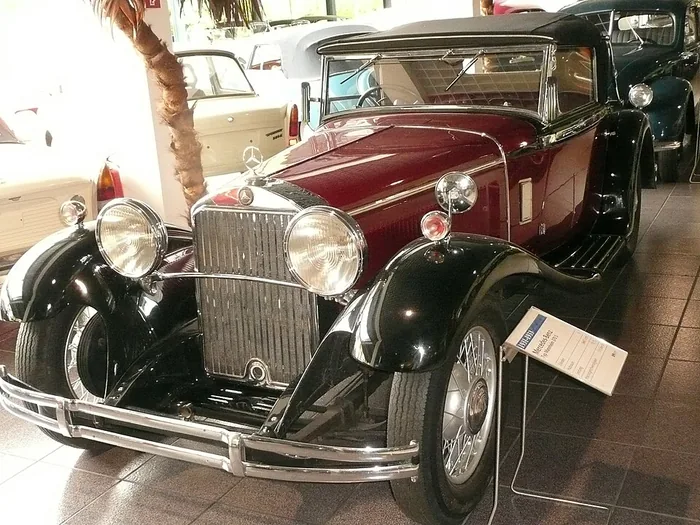
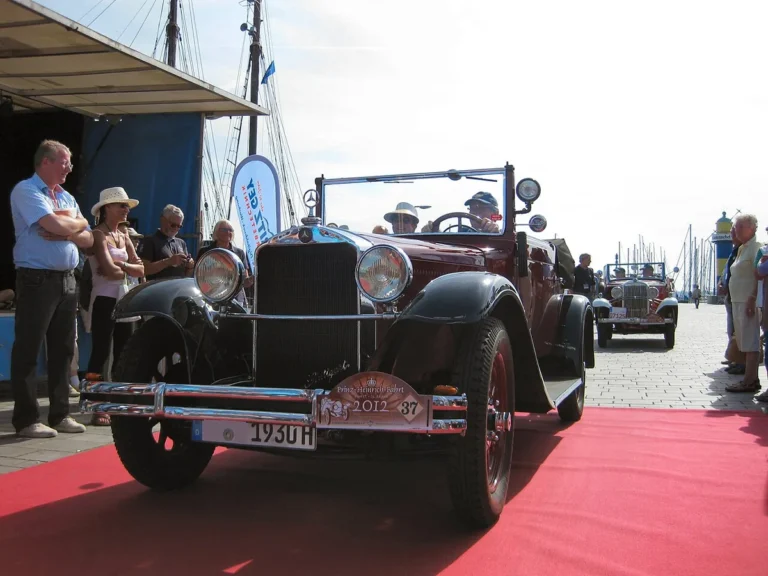
That middle catalogue position is easy to overlook in museum displays that favour extremes. It is where much of the real luxury market lived — one careful step above “enough,” not yet at flagship scale. Closed limousines, tourers, and open cabriolets all expressed the same mechanical idea in different social clothing. Open Sport Cabriolet bodies of the early 1930s are covered in detail on the dedicated Typ Mannheim Cabriolet (W10) 1931–1933 page.
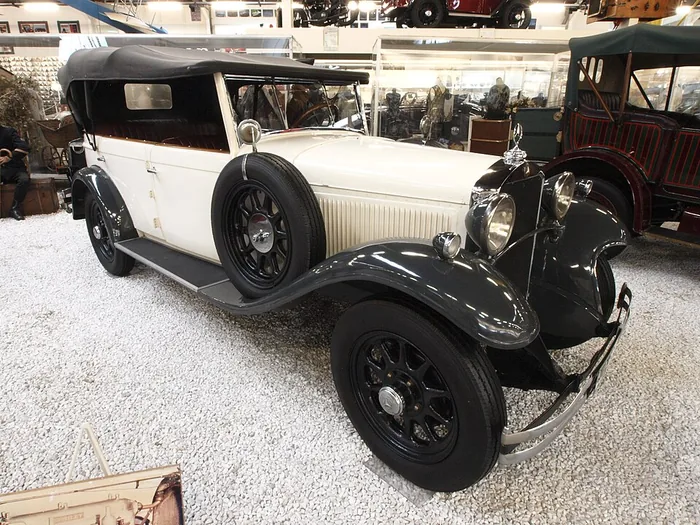
Image source: Wikimedia Commons
Why the name Mannheim matters
Mercedes-Benz used geography as brand language throughout this period. Stuttgart signalled the company home. Nürburg carried Eifel prestige associations. Mannheim points back to the Benz half of the Daimler-Benz merger — the city where Carl Benz’s industrial story is deeply rooted.
For a late-1920s buyer, that name did not mean “sports special.” It meant German industrial substance: a touring car with a civic title, a six-cylinder engine under the bonnet, and bodywork that looked correct outside a bank, a spa hotel, or a family house with a gravel drive.
The model replaced earlier large touring ideas such as the W03 / Typ 350 generation. Ferdinand Porsche’s structural thinking still informs the early architecture. Hans Nibel’s passenger-car leadership then steadies and modernises the idea as the early 1930s unfold. The dual authorship shows in the car’s personality: multi-cylinder touring ambition refined into something a household could live with.
Where Mannheim sits on the Mercedes map
Think of the early-1930s Mercedes passenger range as tiers rather than as a single flagship story.
On a lower tier sits the accessible mid-size world — Stuttgart-class cars for people who wanted the star without flagship bills. On the upper tier sits the Nürburg eight: long multi-cylinder formality, Pullman presence, Horch-class rivalry.
Mannheim sits between them. It is large enough to feel like a real touring Mercedes. It is not yet the full eight-cylinder flagship. That intermediate scale is why open Cabriolet versions remain persuasive today: they carry open-air elegance without requiring a supercharger narrative.
Place a Mannheim next to a Typ S and the difference is almost philosophical. The S-series is Kompressor sports performance. Mannheim is six-cylinder touring manners. Same era; different job.
Engines: 350, 370, and roughly seventy-five horsepower
The W10 story is primarily a six-cylinder story.
Early catalogues speak in Typ Mannheim 350 language — roughly 3.4 litres and about seventy horsepower in period rating class. The heart of the line becomes the Typ Mannheim 370: about 3.7 litres and roughly seventy-five horsepower, often quoted around 3,200 rpm. That is not a sports figure by modern standards. On 1930s roads, with leaf springs and drum brakes, it is a serious touring argument: enough torque character to move a formal body, enough smoothness to feel like a Mercedes of the mid/upper tier.
Sporting cuts such as 370 S themes do not invent a second engine universe. They change emphasis — shorter or lighter presentation, open coachwork, a more personal driving stance. Power still lives in the same mid-seventies PS neighbourhood.
Later multi-cylinder prestige programmes, including eight-cylinder neighbours in the broader early-1930s ladder, sit nearby in the catalogue. They are context, not a free pass to call every Mannheim an eight. Identify the engine on the plate of the car under inspection.
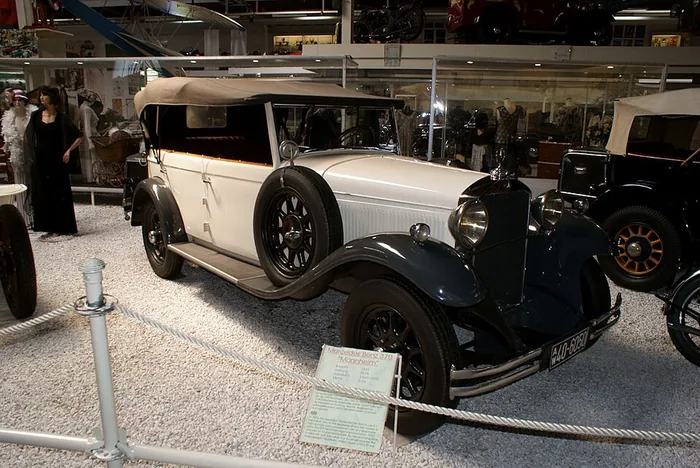
Image source: Wikimedia Commons
Driving character when the car is correctly prepared
A healthy Mannheim does not encourage haste. It asks the driver to match its tempo.
Steering is slow by modern standards. Gears reward patience. Brakes want early, progressive pressure. Visibility over a long bonnet and separate wings teaches placement more like a large period touring car than a modern hatchback. What returns is six-cylinder calm. The engine’s job is not to shock. It is to keep multi-seat mass moving with dignity.
Closed limousines feel formal and upright. Open cabriolets trade some silence for air and engine voice. Sport Cabriolet cuts feel freer simply because they carry less bulk — not because they secretly became race cars.
Top-speed talk in the roughly 95–115 km/h class (depending on theme and body) is a way to understand the envelope, not a challenge for a public dual carriageway. Period tyres, period brakes, and period mass write the real rules.
Bodies: how the same idea wears different social roles
Limousine and sedan bodies are the workday face of Mannheim — weather protection, professional arrivals, family touring with luggage.
Tourenwagen open cars are weekend and summer logic: more air, more dust, more of the road’s texture.
Cabriolets — especially the 1931–1933 open generation documented in the dedicated Cabriolet entry — are where the model’s open-air elegance becomes most obvious. Folding tops, brightwork, and open-air seating turn the mid/upper touring chassis into a body style people still stop to examine.
Coachbuilders and special commissions blur edges. Always ask what body the car actually wears, not only what the brochure family allows.
Chassis, brakes, and structure
The separate ladder frame derives from Porsche-era structural thinking and was refined under Nibel-era passenger engineering. Solid axles with leaf springs front and rear are conventional for the class. Mechanical steering boxes are low-geared; free play increases with wear. Drum brakes need excellent linings and early application, especially on descents with a full passenger load.
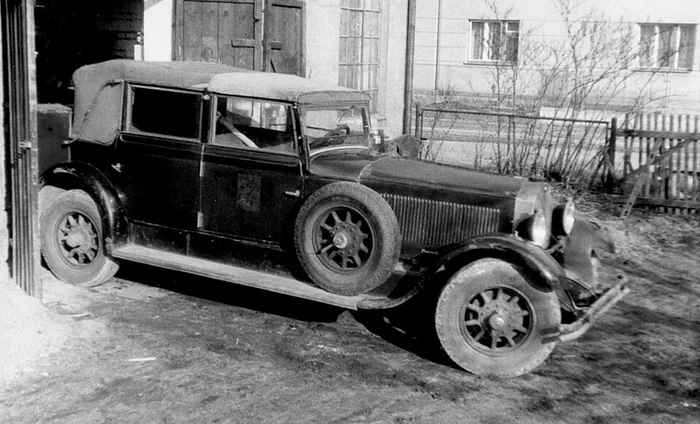
Wheels may be wire or artillery-style depending on specification. Correct classic tyre sizes and load ratings matter under full passenger loads. Coachwork uses period steel-and-wood composite practices; door bottoms, sills, and floor structures hide expensive rot on survivors that have lived damp lives.
Crash protection is minimal by modern standards. Separate chassis and period body offer little energy management. Defensive low-speed driving is mandatory. Period headlamps are weak; night driving is specialist activity. Soft tops on open cars are not safety cells.
Ownership today: strengths and things to watch
A Mannheim is a specialist pre-war Mercedes, but for some collectors a more usable specialist than a full Pullman eight. Parts and expertise still matter. Damp storage is the enemy. Wood in the body structure fails quietly before paint does.
Strengths
- Clear catalogue position — the intelligent middle between Stuttgart accessibility and Nürburg ceremony.
- Six-cylinder touring character — smoother and more substantial than smaller fours of earlier mid-size programmes.
- Open-car presence — cabriolet and Sport Cabriolet bodies deliver star presence without W06 Kompressor complexity.
- Documentary value — shows how Mercedes filled a real buyer ladder in the early 1930s.
Things to watch
- Brakes and mass — drum systems on touring bodies demand excellence.
- Coachwork integrity — sills, door bottoms, top irons, mismatched restorations.
- Cooling and fuel systems — summer traffic exposes tired radiators and neglected carburettors.
- Identity papers — engine theme (350 vs 370), chassis stamps, and body originality must agree.
- Expectation control — not a supercharged sports car; leisurely dignity is correct behaviour.
Development timeline in brief
In the late 1920s the W03 / Typ 350 large touring idea needed a successor as Mercedes-Benz rebuilt a full passenger ladder after the merger. In 1929 the Typ Mannheim / W10 appears with city-name prestige and a six-cylinder touring mission. The 1929–1930 window establishes the Mannheim 350 3.4-litre class. From 1929 through about 1934 the Mannheim 370 3.7-litre theme becomes the volume heart of the line. Around 1931–1933 open Sport Cabriolet and related cabriolet bodies peak in catalogue importance. Engineering continuity runs from Porsche-era structure through Nibel-era refinement. Around 1934 the W10 Mannheim production window closes as newer model programmes take over the mid/upper touring slot.
Collecting and inspection priorities
Buyers should begin with identity: chassis stamps, engine numbers, body tags, and period photographs should tell one coherent story. Engine theme (350 versus 370), year, and body style must align. “It looks like a Mannheim” is not provenance.
Then structure: wood rot in doors and scuttle, rust where mudguards meet frame, forced top mechanisms on open cars, improvised wiring. A shiny repaint can hide a tired skeleton. Then the systems that keep occupants safe: brakes, steering play, kingpins, tyre age, spring condition. A touring car that cannot stop cleanly is not a charming classic; it is a liability with a star on the radiator.
Compared with a Nürburg eight, a Mannheim can be simpler and somewhat more approachable as a first large pre-war Mercedes — still expensive, still specialist, still demanding dry storage and expert help. Compared with a Stuttgart-class car, it is larger, smoother, and more multi-cylinder in character. Compared with a Typ S or SSK, it is a different product entirely.
Legacy
Typ Mannheim rarely stars in racing documentaries. That is not a failure. It is evidence that Mercedes-Benz, in the years after the merger, understood something modern brands still struggle with: a range needs a middle that feels special without becoming unreachable.
For Motor Wiki readers, this page is the family map. For open-air detail, step into the Typ Mannheim Cabriolet (W10) 1931–1933. For the tiers above and below, keep Stuttgart and Nürburg open as neighbouring references. Together they explain how a three-pointed star could mean different lives — mid-size accessibility, mid/upper six-cylinder touring, eight-cylinder flagship formality — and still feel like one company.
The Mannheim’s lasting lesson is catalogue honesty. Not every Mercedes of the early 1930s needed to be a supercharged sports special or a Pullman eight. Many buyers needed a six-cylinder touring car with real presence, real multi-seat capacity, and real all-weather closed options. The W10 answered that need for roughly five years. Survivors — closed or open — remain useful teaching objects for anyone mapping how Daimler-Benz filled the space between everyday prestige and absolute flagship ceremony.
Maintain a Mannheim with the same priorities that protect other pre-war Mercedes: dry storage, correct tyres, excellent brakes, honest cooling, careful wood and electrical attention, and documentation of identity and body history. Driven at period averages on suitable roads, the Typ Mannheim still performs the role it was designed for — six-cylinder touring composure under a civic name that pointed back to Benz industrial roots and forward into the early-1930s Mercedes passenger ladder.
Leave a Reply
You must be logged in to post a comment.