General information & model overview
| Category | Specification Details |
|---|---|
| Model name | Mercedes-Benz Typ Stuttgart 260 Cabriolet A (W11) |
| Internal code | W11 (Cabriolet A body style on the Stuttgart 260 chassis programme) |
| Production years | Approximately 1929 – 1933/1934 within the broader Stuttgart 260 production window |
| Parent model | Mercedes-Benz Typ Stuttgart 260 (W11) |
| Predecessor context | Six-cylinder successor generation to the earlier Typ Stuttgart (W02) mid-size idea |
| Body style | Cabriolet A — sportier two-seat (or 2+ occasional) open body with folding top; open-air grand touring elegance rather than formal four-seat social cabriolet |
| Manufacturer | Daimler-Benz AG (Mercedes-Benz) |
| Engineering context | Hans Nibel era Mercedes passenger-car engineering climate of the late 1920s and early 1930s |
| Market role | Most intimate and sporting-elegant open face of the accessible Stuttgart 260 line — not a supercharged sports car |
| Layout | Front-engine, rear-wheel drive |
| Key characteristics | c. 2581 cc inline-six, about 50 PS at ~3400 rpm (period class); 4-speed manual; lighter, more personal open coachwork than limousines or Cabriolet D |
Body & dimensions
| Specification | Details |
|---|---|
| Body concept | Cabriolet A: compact passenger cell relative to formal four-seat open cars; emphasis on two primary seats and sporting elegance |
| Seating | Typically two seats; some arrangements allow occasional rear accommodation depending on exact coachwork |
| Wheelbase context | Shares the mid-size W11 chassis programme; exact catalogue dimensions depend on body execution |
| Overall length & mass | Generally shorter cabin story and lower mass than limousine or four-seat Cabriolet D bodies — important to the livelier feel |
| Top & weather gear | Folding cabriolet top with period side screens/weather equipment; designed for open-air touring with the ability to close against rain when fitted and maintained correctly |
| Doors | Usually two-door open layout suited to the intimate cabin |
| Construction | Period steel-and-wood composite coachwork; screen pillars, door bottoms, and top mechanism are critical inspection points |
| Contrast within family | Sportier and more personal than Cabriolet D; less stripped than the light Sportwagen theme |
Engine specifications
| Theme | Details |
|---|---|
| Configuration | Inline six-cylinder petrol, naturally aspirated (shared W11 Stuttgart 260 theme) |
| Displacement | Approximately 2581 cc |
| Output (period class) | About 50 PS at roughly 3400 rpm |
| Induction | Naturally aspirated — no Kompressor; not in the Typ S / W06 supercharged class |
| Character in this body | Same modest power as other 260s, but lower body mass makes throttle response and road pace feel more eager than in a heavy limousine |
| Fuelling & cooling | Period carburettor and liquid cooling; open-car duty cycles still demand healthy systems, especially in summer traffic with top raised |
Drivetrain & transmission
| Category | Details |
|---|---|
| Drive layout | Front-engine, rear-wheel drive |
| Gearbox | 4-speed manual of period design |
| Clutch | Mechanical clutch; technique matters for smooth urban and touring use |
| Final drive | Period rear-axle gearing for 1920s/1930s touring speeds |
| Driver impression | Shorter, lighter open body makes gear selection and engine note feel more “sports touring” without changing the underlying mid-size specification |
Chassis, brakes & structure (period construction)
| Category | Details |
|---|---|
| Frame | Separate ladder chassis of the W11 programme; open body mounts and scuttle stiffness are ownership concerns |
| Suspension | Solid front axle and live rear axle with leaf springs; damping condition strongly affects open-car shake and comfort |
| Steering | Mechanical steering box; worn joints are especially noticeable in a more intimate, sporting seating position |
| Brakes | Period drum brakes; lighter mass helps a little, but stopping distances remain long by modern norms |
| Open-structure notes | Absence of a full closed roof structure places more demand on scuttle, screen pillars, and door fit; rattles and flex are diagnostic clues |
| Wheels & tyres | Wire or period wheel styles; tyre condition is critical for the more enthusiastic road use Cabriolet A owners often prefer |
Performance (period context)
| Category | Details |
|---|---|
| Power-to-weight | Favourable relative to closed W11 bodies; still modest absolute power (~50 PS class) |
| Top speed class | Can feel livelier than the ~90 km/h closed-car mental model; exact figures depend on gearing, top position, and condition — not a supercharged sports envelope |
| Character | Open-air grand touring: wind, engine note, upright-to-sporting seating, and elegant progress rather than racing pace |
| Comparison | Sportier elegance than Cabriolet D; more finished weather equipment character than a pure Sportwagen; far below W06 Kompressor cars |
Timeline & history
| Period | Development |
|---|---|
| Pre-1929 | Earlier W02 Stuttgart establishes accessible mid-size Mercedes naming; six-cylinder fashion rises in the mid-size prestige band |
| ~1929 | Stuttgart 260 (W11) programme offers multiple bodies including sporting cabriolets |
| 1929–early 1930s | Cabriolet A bodies serve buyers wanting two-seat open elegance on the mid-size six chassis |
| Concurrent | Formal Cabriolet D and light Sportwagen occupy neighbouring niches on the same chassis idea |
| Sporting contrast | Supercharged Typ S / W06 line remains a different class entirely |
| ~1933–1934 | W11 production window closes; surviving Cabriolet A cars become rare open expressions of the accessible 260 story |
Body & variants notes
| Theme | Details |
|---|---|
| Cabriolet A identity | Two-seat (or 2+ occasional) sporting elegance; primary open “personal” body of the family |
| Sibling: Cabriolet D | Four-seat formal open touring with fuller social practicality — dedicated Cabriolet D entry |
| Sibling: Sportwagen | Lightest sporting open cut — Sportwagen entry |
| Sibling: limousine core | Closed bodies covered in the main Stuttgart 260 overview |
| Coachbuilt variation | Details of top, screen, and seating can vary; document exact body origin when valuing |
Safety & construction notes (classic-era context)
| Category | Details |
|---|---|
| Open-car protection | Minimal rollover protection; soft top offers weather shelter, not crash structure |
| Brakes & lighting | Period drums and lamps demand defensive driving; night open-air use is especially demanding |
| Top mechanism safety | Worn linkages and rotten wood in header rails can fail in use; inspect before road work |
| Tyres | High priority for any owner who enjoys the Cabriolet A’s more eager road manners |
| Seatbelts | Careful specialist retrofit can improve restraint if done without destroying historic integrity |
| Wood & corrosion | Screen pillars, door bottoms, and floor structures are classic open-car failure zones |
Stuttgart 260 Cabriolet A (W11): sporting open body on the six-cylinder mid-size chassis

Image source: Wikimedia Commons
The Mercedes-Benz Typ Stuttgart 260 Cabriolet A is an open body style on the W11 chassis, associated with the approximate production window 1929–1934 for the parent mechanical family. In period catalogue language, Cabriolet A denotes a more sporting, typically two-seat-oriented (or 2+ occasional) open layout with folding top, relative to the more formal multi-seat Cabriolet D.
Mechanical basis is the Stuttgart 260 six-cylinder touring car described on the parent W11 page: roughly 2.6 litres, about 50 PS class, rear-wheel drive, period manual gearbox. The cabriolet does not introduce a separate supercharged sports powertrain. It changes coachwork, mass, and use pattern.
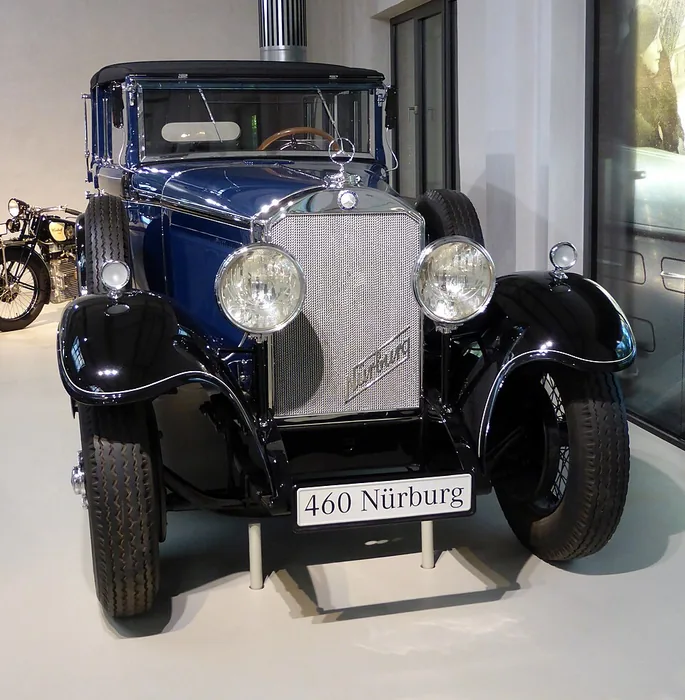
Related open styles on the same chassis include the Sportwagen. Earlier four-cylinder context: Typ Stuttgart W02. Supercharged sports contrast: Typ S / W06. Upper luxury contrast: Typ Nurburg.
Body definition and design
Cabriolet letter codes in period Mercedes catalogues describe formal open arrangements more than modern marketing trim levels. Cabriolet A, in general practice for this class, is the more intimate open cut: two main doors, emphasis on driver and front passenger, folding fabric top, and brightwork appropriate to a mid-size prestige open car of the early 1930s.
Exact seating and occasional rear space vary by catalogue year and coachbuilder. Some bodies offer limited rear accommodation; others are effectively two-seat. Identification must use body tags, period photographs, and chassis documentation rather than appearance alone. A repaint or later rebody can create a car that “looks like” a Cabriolet A without being one historically.
With the top raised, the silhouette becomes more formal and slightly heavier in visual bulk. With the top lowered, the cabin becomes open-air. Either way, proportions remain those of a mid-size touring chassis, not a short-wheelbase sports special. Separate wings, upright radiator shell, and period lighting place the car firmly in early-1930s Mercedes open design language.
Interior trim, door cards, and hardware should match the intimacy of the open cut. Over-restoration into modern show gloss can erase the quiet formality that made the body convincing; neglect turns wood and fabric into structural risk. Top irons, fabric condition, and weather equipment are part of the identity, not optional cosmetics.
Mechanical context

Image source: Wikimedia Commons
Engine, transmission, and chassis details match the W11 tables on the parent page and on this page’s specification block: naturally aspirated inline-six of about 2.6 litres, separate ladder frame, solid axles with leaf springs, mechanical steering, drum brakes. Power remains in the ~50 PS class. Top-speed envelope for light open bodies can feel freer than for heavy limousines, but mechanical limits are still those of a period mid-size six.
There is no factory Kompressor narrative comparable to the W06 sports line. Expectation control is part of correct ownership: the intended pleasure is open-air touring composure, not supercharged performance. Cooling and fuel systems remain critical. Open cars often see seasonal use and long storage; sediment, degraded fuel, and tired radiators are common issues when a car returns to the road after inactivity.
Drive layout and gearing follow period touring practice. Final-drive choices and tyre diameters affect how the car feels on modern secondary roads. None of those variables turn a Cabriolet A into a sports special of Typ S character.
Driving character
Compared with a closed Stuttgart 260, a sound Cabriolet A usually feels lighter and more vocal. Wind and engine noise increase. Steering and gearing remain deliberate. Brakes still require early application, especially in wet weather or with a passenger and luggage.
Fair-weather use is the realistic pattern. Period soft-tops and side equipment are not equivalent to a modern all-season convertible. Owners who plan storage, covers, and conservative weather decisions keep both the car and the coachwork in better condition. Road surfaces of the design era were uneven; ride quality depends heavily on spring condition, damper state where fitted, and tyre pressures.
Worn steering boxes and loose joints degrade precision quickly. Night driving is specialist activity: period lighting is weak. Wet cobbles and polished surfaces reduce grip on period-pattern tyres. The correct driving ethic is careful placement and early planning, not late braking and dramatic exits from junctions.
Market and collecting
Open bodies often attract stronger collector interest than plain closed cars of the same series, provided originality and documentation are sound. Thin paperwork under a beautiful open body is a common risk. Price should reflect provenance as well as cosmetics.
Compare with the Cabriolet D for multi-seat formal open use and with the Sportwagen for the lightest open emphasis on the W11 idea. Parent mechanical overview: Stuttgart 260 W11. For the four-cylinder ancestor and the sports extreme of the era, use the W02 Stuttgart and Typ S as context pages, not as mechanical twins.
Restoration of open coachwork is expensive when wood and weather gear are poor. A car that only photographs well can still be a major project. Factor total ownership cost, not only purchase price, before acquisition.
Ownership and inspection
Strengths include open-air presentation on a coherent mid-size six-cylinder chassis; clear family links for research; and a more approachable performance envelope than W06 sports cars. Watch points: top irons, fabric, and seals; wood in doors and scuttle; rust at wing and sill junctions; brake and steering condition; identity of chassis, engine, and body; previous restoration quality. A repaint can hide structural problems.
Parts and coachwork skills are specialist. Club and marque networks matter for correct trim and mechanical details. Budget for open-car maintenance is higher than for a simple closed body of the same series when tops and weather gear are worn. Storage between outings should be dry; long inactivity creates fuel, brake, and seal problems that appear on the first careful return to the road.
Ownership: strengths and things to watch
Strengths
- Intimate open identity — sporting Cabriolet A cut on a documented W11 six-cylinder chassis.
- Touring composure — open-air use without supercharged sports bills or temperament.
- Family context — clear links to closed W11 cars, Cabriolet D, and Sportwagen.
- Approachable envelope — calmer than W06 Kompressor specials of the same era.
- Research value — useful example of mid-size open prestige in the early 1930s Mercedes ladder.
Things to watch
- Top and weather gear — fabric, irons, and seals define both cost and usability.
- Wood and scuttle structure — open bodies hide rot until doors and screens misalign.
- Brakes and tyres — light feel does not remove period safety limits.
- Cooling after storage — seasonal use often means neglected fuel and radiators.
- Identity and rebody risk — appearance alone is not proof of Cabriolet A status.
- Expectation mismatch — not a short-chassis sports car and not a Typ S.
Sibling comparisons
Choose the Cabriolet A if the priority is intimate open elegance on the Stuttgart 260 chassis. Choose the Cabriolet D for formal multi-seat open touring. Choose the Sportwagen for the lightest open emphasis. Choose a closed W11 body if year-round practicality matters more than open-air presentation. Read the parent overview for engines, timeline, and closed-body context.
Legacy
The Cabriolet A is the sporting open face of the Stuttgart 260 programme. It shows how Mercedes offered open-air mid-size prestige without requiring the cost or temperament of supercharged sports models. Maintain it as a pre-war open touring car: dry storage, correct tyres, excellent brakes, careful top and wood work, and clear identity records.
For historical mapping, read this page together with the W11 hub and the other open subtypes. The shared six-cylinder chassis is the constant; body style is the variable that defines use and ownership cost. Against the earlier Typ Stuttgart (W02), the Cabriolet A demonstrates what six-cylinder smoothness added to open mid-size motoring. Against the Typ S line, it demonstrates what open elegance looked like when the brief stayed touring rather than Kompressor theatre.
Collectors who begin with closed bodies and later study a coherent Cabriolet A often gain a clearer understanding of the programme’s range. The open car is not a lesser sedan; it is a different social tool on the same mechanical idea. Keep that distinction, and the Cabriolet A remains a legible chapter in how Mercedes-Benz sold mid-size open prestige in the early 1930s.
Leave a Reply
You must be logged in to post a comment.