General information & model overview
| Category | Specification Details |
|---|---|
| Model name | Mercedes-Benz Typ S (Model S) |
| Internal code | W06 (start of the W06 supercharged sports series) |
| Production years | From 1927 (W06 series introduction); Typ S as the foundational long sporting chassis of the family |
| Body style | Sporting and luxury open bodies common (tourers, sports two- and four-seaters); coachbuilt variety around a long chassis |
| Design leadership context | Ferdinand Porsche era of engineering leadership influence at Mercedes-Benz in the mid-to-late 1920s |
| Layout | Front-engine, rear-wheel drive |
| Key characteristics | Supercharged inline-six of approximately 6.8 litres (often cited as 6,789 cc); roughly 120 PS unblown / about 180 PS with Kompressor engaged; long sporty chassis; “White Elephant” nickname in period and later lore |
| Family role | Predecessor and foundation for the Typ SS, short-wheelbase SSK, and lightened racing SSKL |
| Manufacturer | Daimler-Benz AG (Mercedes-Benz) |
Body & dimensions
| Specification | Details |
|---|---|
| Chassis character | Long sporty frame optimised for high-speed touring and sporting bodywork — longer than the later SSK short-chassis cars |
| Wheelbase | Long-wheelbase W06 sports configuration (exact catalogue figures vary by source listing; significantly longer than Super Sport Kurz derivatives) |
| Overall length | Imposing period sports-luxury length driven by long bonnet, radiator shell, and coachbuilt rear deck |
| Body styles | Open sporting bodies predominant in the model’s cultural image; closed or more formal coachwork possible depending on customer order |
| Seating | Typically two to four seats depending on body; sporting layouts prioritise driver and passenger experience |
| Construction | Separate chassis with lightweight-minded sporting coachwork for the era; still substantial mass by modern sports-car standards |
| Visual identity | Long bonnet, large radiator with three-pointed star, exposed exhaust themes on many cars, cycle or full wings depending on body |
Engine specifications
| Category | Details |
|---|---|
| Configuration | Inline six-cylinder petrol, SOHC-class architecture of the Mercedes supercharged sports family |
| Displacement | Approximately 6.8 litres; frequently cited as 6,789 cc |
| Output (unblown) | Approximately 120 PS without supercharger engagement |
| Output (with Kompressor) | Approximately 180 PS with supercharger engaged (period figures; individual cars and states of tune vary) |
| Supercharger | Roots-type Kompressor engaged by progressive throttle / kickdown-style extra throttle push in the Mercedes sports tradition of the era |
| Character | Vast low-end presence for the 1920s; explosive when the blower comes in; mechanical drama central to the appeal |
| Fuel & ignition | Period carburettion and ignition systems; expert setup essential for reliable dual-mode (blown/unblown) behaviour |
Drivetrain & transmission
| Category | Details |
|---|---|
| Drive layout | Front-engine, rear-wheel drive |
| Gearbox | 4-speed manual transmission |
| Clutch & technique | Period clutch; double-declutching and mechanical sympathy required for smooth operation on many restored cars |
| Final drive | Geared for high-speed sporting use relative to ordinary 1920s passenger cars |
| Power delivery | Driver-controlled supercharger engagement creates a two-stage personality: tourable when unblown, fierce when blown |
Chassis, brakes & structure
| Category | Details |
|---|---|
| Frame | Long ladder-type sporting chassis — the structural starting point of the W06 family |
| Suspension | Solid axles with leaf springs front and rear in period convention; damping by period friction or early hydraulic devices depending on car and restoration |
| Steering | Mechanical steering; substantial effort and low gearing by modern standards; high-speed stability was a design goal of the long chassis |
| Brakes | Large drum brakes for the era; still require early application at speed; linings and adjustment are safety-critical |
| Wheels & tyres | Large-diameter wire wheels common; period tyre technology limits ultimate grip versus modern rubber (many cars now on improved classic compounds) |
| Safety context | No modern occupant protection systems; speed capability exceeded period road safety infrastructure — skilled, defensive use mandatory |
Performance (period context)
| Category | Details |
|---|---|
| Power class | ~120 PS atmospheric / ~180 PS supercharged — formidable for a late-1920s road car |
| Top speed class | High for the era on open sporting bodies; exact figures depend on gearing, body, and blower use |
| Acceleration character | Strong mid-range when the Kompressor is engaged; the “kick” of blower entry is part of the legend |
| Comparison within family | Less extreme than short SSK or lightened SSKL; more grand and long-legged than the pure short racers |
| Nickname | “White Elephant” — reflecting size, cost, and imposing presence as much as pure racing minimalism |
Timeline & history
| Period | Development |
|---|---|
| Mid-1920s | Post-merger Mercedes-Benz consolidates engineering; Ferdinand Porsche’s leadership influence shapes ambitious sporting projects |
| 1927 | W06 Typ S introduced — long chassis, large supercharged six, open sporting luxury character |
| 1928 onward | Family expands: Typ SS (Super Sport) and short-wheelbase SSK (Super Sport Kurz) |
| 1931–1932 | Extreme lightened racing derivative SSKL (Super Sport Kurz Leicht) appears in tiny numbers |
| Afterlife | Typ S becomes the foundational chapter of one of the most celebrated pre-war Mercedes sports families; surviving cars are museum and concours centrepieces |
Variants within the W06 idea
| Model | Relationship to Typ S |
|---|---|
| Typ S (this entry) | Long sporting chassis; ~6.8 L; ~120/180 PS class; foundation of the line |
| Typ SS | Super Sport evolution; longer grand-touring sports character; larger output variants; production into early 1930s |
| SSK | Super Sport Kurz — shortened wheelbase for agility and racing; higher power tunes; roadster legend |
| SSKL | Super Sport Kurz Leicht — lightened, drilled-chassis racing extreme; rarest factory racing expression |
Safety & construction notes (classic-era context)
| Category | Details |
|---|---|
| Structure | Long separate chassis with sporting body; strength is longitudinal and mechanical, not modern crash-cell design |
| Brakes | Drums must be in perfect adjustment; high speed capability makes brake condition non-negotiable |
| Supercharger systems | Blower drive, clutches/engagement mechanisms, and lubrication need specialist care; failure modes can be expensive |
| Fuel load & fire risk | Large carburetted engines and period electrics demand meticulous maintenance and fire awareness |
| Occupant restraint | Period seats and no airbags; any belt retrofit must be engineered, not improvised |
| Road use | These cars can still reach speeds that outpace period brakes, tyres, and road design — self-discipline is the primary safety system |
The 1927 Mercedes-Benz Typ S (W06): foundation of the supercharged sports family
The Mercedes-Benz Typ S of 1927 marks the start of the W06 supercharged sports series. It combined a long sporting chassis with a large supercharged inline-six of roughly 6.8 litres — often quoted at 6,789 cc — and offered period power figures of about 120 PS without the blower and around 180 PS when the Roots-type Kompressor was engaged. It was not a small, nervous sports car. It was a grand, expensive machine that period observers and later writers nicknamed the White Elephant, a phrase that captures size, cost, and imposing presence as much as pure racing minimalism.
The Typ S also sits inside a precise historical moment. The Daimler-Benz merger of 1926 had created Mercedes-Benz as a unified industrial force. In the engineering offices, Ferdinand Porsche’s period of design leadership helped push ambitious sporting projects that would define the brand’s performance image for decades. The Typ S is the road-going expression of that ambition at full stretch: long bonnet, open sporting bodies common, four-speed manual, rear-wheel drive, and a supercharger the driver could summon with an extra push of the throttle.
From this car grew a family. The Typ SS refined the Super Sport idea. The SSK shortened the wheelbase into a more agile race-bred machine. The SSKL lightened the short car to an extreme few factories have ever matched. Understanding the Typ S is therefore not only about one model year. It is about learning the root vocabulary of an entire dynasty.
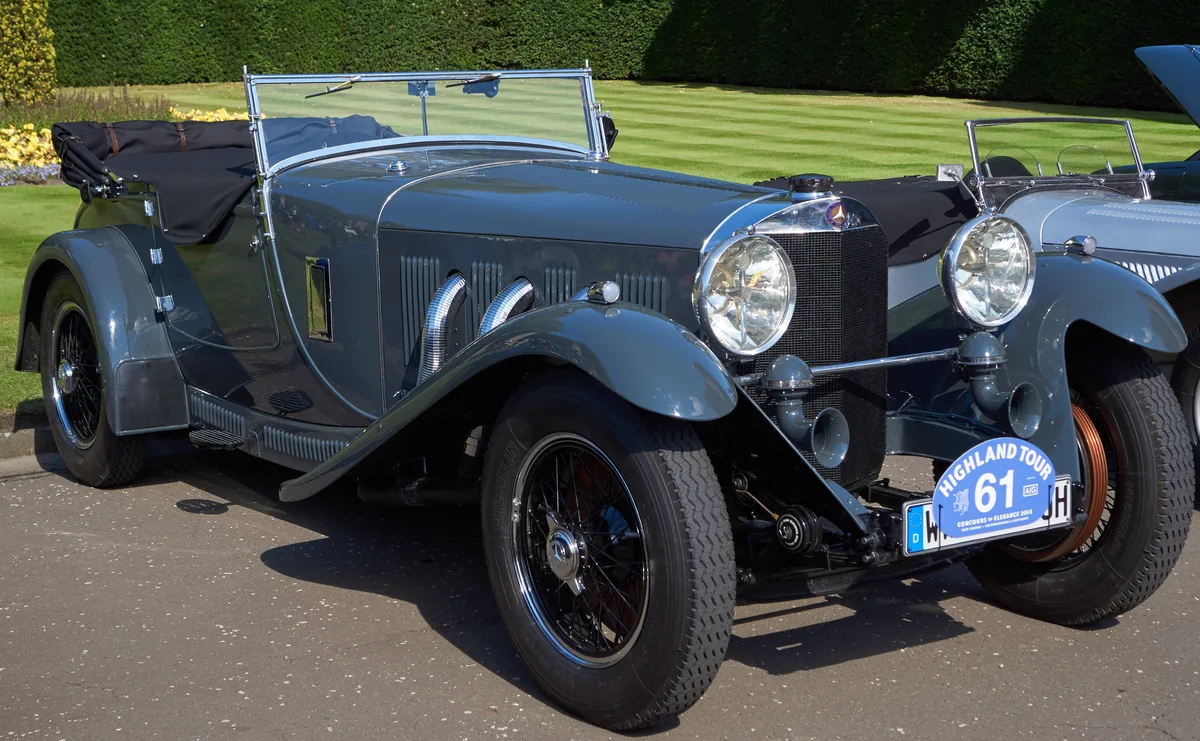
Image source: Wikimedia Commons
Engineering context: Kompressor and the long chassis
Supercharging at Mercedes in the 1920s was not a marketing sticker. The Roots-type Kompressor, driven so that it could be brought in under load, gave these large sixes a split personality. Unblown, the engine was already a big, torquey touring unit by period standards. Blown, it delivered a surge of power that owners and works drivers could use on mountain climbs, long straights, and race circuits alike. The extra throttle push that engaged the blower became part of Mercedes sports-car practice of the era — a physical gesture that separated casual progress from serious pace.
The long chassis was a deliberate choice. Length stabilised the car at speed, gave coachbuilders room for elegant proportions, and created the visual drama of a very long bonnet. It also made the Typ S more of a high-speed tourer and sporting luxury car than a tight hill-climb specialist. Later, when Mercedes wanted more agility for certain competitions, the answer was not to abandon the engine family but to cut the wheelbase — the path that leads to the SSK name, Super Sport Kurz.
Four speeds and rear-wheel drive completed a layout that needs no modern translation. What does need translation is the skill required. These gearboxes and clutches reward practiced hands. The brakes, though large for their day, operate in a world without ABS, without modern tyre compounds as standard factory equipment, and without the assumption that every road user can stop from high speeds in a few dozen metres. The Typ S is fast enough to humble drivers who treat it like a modern classic with power assistance and electronic safety nets.
Why the White Elephant nickname persists
Nicknames survive when they capture a truth. White Elephant suggests something magnificent, costly, and not entirely practical — a machine one keeps because it is extraordinary, not because it is thrifty. The Typ S was expensive to buy and expensive to run. It consumed fuel and tyres with little concern for economy. It demanded mechanical sympathy. Yet for the customers who could afford that cost structure, few machines on European roads offered the same combination of badge, blower, and long-chassis presence. The nickname is descriptive as much as critical. It is how memory holds a car that was never meant to be ordinary.
Design: proportion as product statement
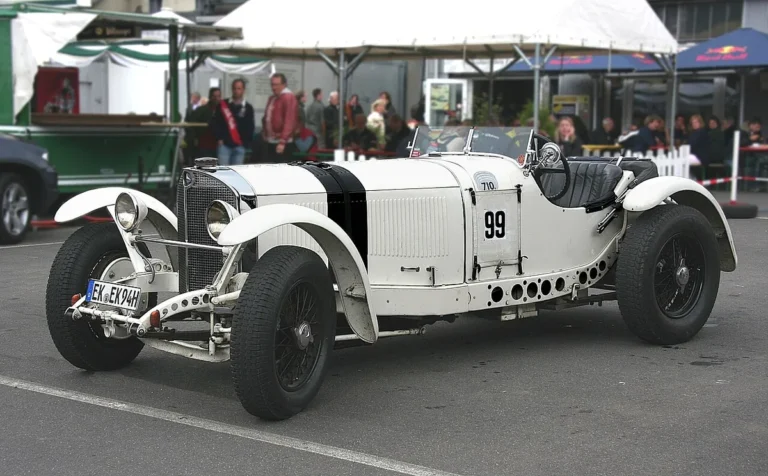
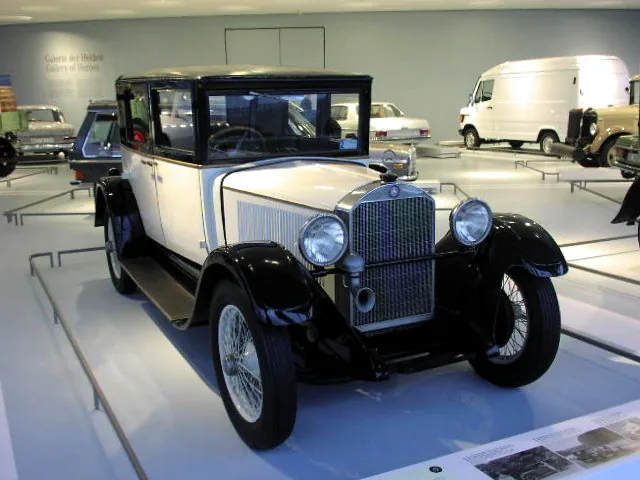
Stand beside a Typ S and the design argument is made without words. The radiator shell and star announce Mercedes. The bonnet length announces cylinders and supercharger. The open body — on so many of the cars that define the model in photographs — announces sport and status in equal measure. Wings, running boards, wire wheels, and dual spares (when fitted) complete a silhouette that later Art Deco and Streamline eras would refine but never quite replace as the archetypal late-1920s supercharged Mercedes look.
Coachbuilders and catalogue bodies varied the details: seat counts, screen designs, wing shapes, and whether the car leaned more toward gentleman’s tourer or pure sports two-seater. That variety means collectors must read each car as an individual. Chassis identity, engine identity, and body history can diverge across a century of rebuilds, rebodies, and restorations. The period photograph is the beginning of research, not the end of authentication.
Compared with the contemporary mid-size Typ Stuttgart, the Typ S is almost a different industry. The Stuttgart offered accessible four-cylinder motoring after the merger. The Typ S offered the merger’s sporting peak in road-car form. Both are Mercedes-Benz. Only one was ever going to be called a White Elephant.
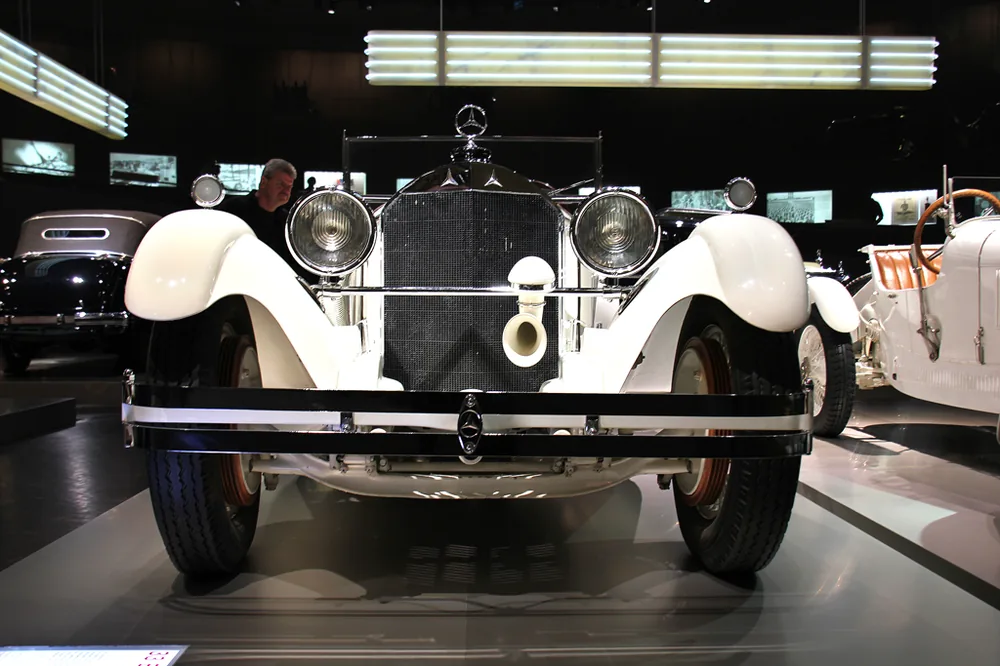
Image source: Wikimedia Commons
Driving character: two modes on one throttle
A supercharged Mercedes sports car of this family feels incomplete if described only by peak horsepower. The experience is sequential. First comes the unblown six — deep-chested, deliberate, already quicker than most traffic of the late 1920s. Then comes the blower, with its distinctive mechanical sound and the additional thrust that made mountain passes and long straights into serious high-speed work. That sequence is central to the car’s character. It is also mechanically demanding. Riding the Kompressor continuously as if it were a modern turbocharger in permanent boost is not how these systems were meant to live.
The long wheelbase filters some of the nervousness later short-chassis cars would amplify. Directional stability at speed was part of the brief. That does not make the Typ S easy. Steering effort, braking distances, and the need to plan overtaking manoeuvres on period roads remain serious. What the length does provide is a grand, long-legged gait that suits open-road touring between cities — the kind of journey that justified the car’s cost for wealthy private owners.
Racing and high-speed sporting use, meanwhile, proved the engine family’s competition potential and set up the shorter, lighter derivatives. The Typ S is both a road car and a prologue. Without it, the more famous short-chassis machines of the early 1930s have no parent.
Market position in period
Who bought a Typ S? Not the middle-class professional who might stretch to a Stuttgart. The Typ S customer had capital, social position, and often a taste for motorsport or at least for motorsport-adjacent prestige. Some cars lived as glamorous road machines. Others brushed against competition careers through privateer efforts or works interest in the broader W06 programme. The market was international in aspiration even when individual sales were carefully managed through Mercedes channels and coachbuilding relationships.
Price and exclusivity did the rest. These were never going to be numerous in the way of small family cars. Their cultural impact outstripped their production volume because newspapers, race reports, and society coverage amplified every appearance. That amplification continues today in museums and at major concours events, where a genuine Typ S can stop foot traffic as effectively as many later supercars.
Ownership and collecting notes
Strengths
- Foundational status — the root of the W06 supercharged sports family.
- Engineering interest — large six, driver-controlled Kompressor, long sporting chassis.
- Design presence — one of the defining silhouettes of pre-war motoring.
- Historical network — direct lineage to SS, SSK, and SSKL stories.
- Concours and museum demand — enduring cultural capital.
Things to watch
- Authenticity — chassis, engine, and body histories must be studied with specialist help.
- Supercharger condition — rebuild quality and correct engagement behaviour are central to value and reliability.
- Brake and steering geometry — high-speed capability makes mediocre mechanicals dangerous.
- Coachwork originality versus quality rebody — transparent documentation is essential either way.
- Operating costs — fuel, tyres, specialist labour, and insurance for a high-value historic asset.
- Driving skill gap — owners need practice or a professional familiarisation plan before public-road use.
- Storage and climate — large open cars and period materials demand proper housing.
Period roads, modern events
When new, the Typ S occupied roads that mixed cobbles, dust, early concrete, and alpine gradients with far less traffic density than a modern European motorway — and far fewer safety nets. Headlamps were dim. Signage was inconsistent. Medical response after an accident was slow. Drivers of means accepted those conditions as the price of speed and status. Understanding that context prevents anachronistic criticism and anachronistic bravado. The car is historically fast; the world around it was not designed for that speed as a default.
Period audiences experienced the Typ S through multiple channels: society pages, motorsport reports, factory publicity, and the simple spectacle of hearing a Kompressor on a mountain road. That multi-channel fame is why the model punches above its production volume in cultural memory. A car did not need to be common to be known; it needed to be seen in the right places by the right writers. The White Elephant nickname itself is evidence of conversation — people discussed these machines enough to label them.
Modern historic events recreate fragments of that world under controlled rules. Concours lawns emphasise originality and finish. Regularity rallies emphasise reliability and navigation. Demonstration runs emphasise sound and spectacle within safety envelopes that 1927 never imagined. A Typ S can succeed in more than one of those arenas if prepared correctly, but no single preparation suits all. Concours polish and hard rally miles pull in opposite directions. Owners must choose a primary mission and build the car — and their expectations — around it.
Technical support networks for such cars are global yet thin. Specialists who understand Roots supercharger clearances, period carburettion, and long-chassis geometry are not interchangeable with general classic-car garages. Shipping a component across a continent for correct rebuild is normal. That logistics reality should sit in the purchase budget beside the hammer price. The long bonnet is free to admire; the infrastructure that keeps it running is not.
Safety and construction notes for classic use
The long separate chassis provides longitudinal and mechanical strength, not a modern crash cell. Drum brakes must be in perfect adjustment; high-speed capability makes brake condition non-negotiable. Blower drive, engagement mechanisms, and lubrication need specialist care; failure modes can be expensive and unsafe at speed. Large carburetted engines and period electrics demand meticulous maintenance and fire awareness. Period seats and no airbags define the restraint environment; any belt retrofit must be engineered, not improvised. These cars can still reach speeds that outpace period brakes, tyres, and road design. Self-discipline is the primary safety system.
Legacy: the first chapter of Super Sport
Every family needs a first chapter that establishes tone. For Mercedes-Benz’s late-1920s and early-1930s supercharged sports cars, that chapter is the Typ S. It fixed the ingredients: W06 identity, vast inline-six, Roots supercharger, long sporting chassis, open-body glamour, and a performance envelope that ordinary traffic could not match. The later SS would push the Super Sport grand-touring idea further. The SSK would cut the wheelbase and raise the intensity. The SSKL would strip weight until the car became almost pure racing instrument. None of those sequels makes sense without the 1927 Typ S as the opening statement.
For encyclopaedic clarity, keep the essentials close: W06 series start in 1927; Ferdinand Porsche-era design leadership context; supercharged inline-six around 6.8 litres (often 6,789 cc); roughly 120 PS unblown and 180 PS with Kompressor; long sporty chassis; four-speed manual; rear-wheel drive; open sporting bodies common; White Elephant reputation; predecessor to the SS/SSK/SSKL family. Those facts describe not just a car, but the moment Mercedes-Benz announced that merger-era engineering could produce road cars of world-class sporting ambition.
Related Motor Wiki entries: Typ SS (1928–1933), SSK (1928), SSKL (1931–1932), the accessible contemporary Typ Stuttgart, and — for a modern large Mercedes contrast — the V-Class (W447). This model’s internal path is Mercedes-Benz Typ S (W06, 1927).
Leave a Reply
You must be logged in to post a comment.