General information & model overview
| Category | Specification Details |
|---|---|
| Model name | Mercedes-Benz SSK (Super Sport Kurz) |
| Internal code | W06 (short-wheelbase branch of the W06 family) |
| Production years | Approximately 1928 – 1932 |
| Name meaning | Super Sport Kurz — “short” wheelbase super sports Mercedes |
| Body style | Primarily open roadster / sporting two-seater forms; racing and road bodies around the short chassis |
| Design association | Ferdinand Porsche era association with the W06 supercharged sports programme |
| Layout | Front-engine, rear-wheel drive |
| Key characteristics | Shortened chassis versus Typ S / long Super Sport cars; ~7,069 cc SOHC inline-six with Roots supercharger; roughly 200–300 PS depending on tune; top speeds approaching the ~200 km/h class in suitable form; legendary roadster presence |
| Production scale | Very small; often cited around ~33 cars including related short cars (sources and counting methods vary — treat figures as indicative) |
| Racing note | Works and privateer success; Rudolf Caracciola among the names forever linked to SSK competition history |
Body & dimensions
| Specification | Details |
|---|---|
| Wheelbase concept | Shortened relative to Typ S and long SS cars — the “Kurz” that defines the model’s agility and visual punch |
| Overall character | Compact (for a seven-litre Mercedes) open sporting car with long bonnet still dominant but less grand-touring length than SS |
| Body styles | Roadster forms predominate in the legend; competition bodies and road-oriented open cars both appear in the model’s history |
| Seating | Typically two; pure sporting brief rather than family touring |
| Construction | Separate short chassis with lightweight-minded open coachwork for the era |
| Visual identity | Aggressive stance, massive radiator and bonnet, cycle or sporting wings, exposed mechanical drama |
| Contrast | Shorter and more nervous than Typ SS; less extreme than drilled-chassis SSKL |
Engine specifications
| Category | Details |
|---|---|
| Configuration | SOHC inline-six petrol with Roots-type supercharger |
| Displacement | Approximately 7,069 cc (~7.1 litres) |
| Output range | Roughly 200–300 PS depending on state of tune, blower use, and competition preparation |
| Supercharger operation | Roots Kompressor engaged by extra throttle push — driver-controlled boost on demand in the classic Mercedes sports manner |
| Unblown vs blown | Substantial power available even before full blower use; peak figures associated with supercharger engagement and racing tunes |
| Character | Brutal mid-range when blown; mechanical noise and presence central to the myth |
| Fuel & ignition | Period multi-carburettor / sports fuel systems and ignition; specialist setup mandatory on surviving cars |
Drivetrain & transmission
| Category | Details |
|---|---|
| Drive layout | Front-engine, rear-wheel drive |
| Gearbox | Manual gearbox in the W06 sports tradition (period multi-speed unit requiring skilled operation) |
| Clutch | Heavy-duty period clutch matched to supercharged torque |
| Final drive | Competition and road gearing options in period use; ratios chosen for circuit, hill-climb, or road depending on purpose |
| Traction reality | Narrow period tyres and vast torque demand throttle discipline; short wheelbase sharpens oversteer potential versus long SS cars |
Chassis, brakes & structure
| Category | Details |
|---|---|
| Frame | Shortened W06 sporting ladder chassis — stiffer-feeling and more agile than long-chassis siblings in period terms |
| Suspension | Solid axles and leaf springs; setup and damper condition critically affect high-speed manners |
| Steering | Direct mechanical steering for the era; feedback high, effort high, mistakes punished |
| Brakes | Large drum brakes; still the limiting factor when power and courage exceed lining capability |
| Wheels & tyres | Wire wheels; tyre technology of the late 1920s/early 1930s defines grip and wet behaviour |
| Path to SSKL | Further lightening and chassis drilling produce the SSKL racing extreme |
Performance (period context)
| Category | Details |
|---|---|
| Power class | 200–300 PS depending on tune — among the most potent road-racing cars of its day |
| Top speed | Up to the ~200 km/h class in suitable gearing and body form (conditions and individual cars vary) |
| Acceleration character | Explosive when the supercharger is engaged; short chassis makes the experience more intense than long SS touring |
| Racing relevance | Hill climbs, sports car races, and high-speed events; Caracciola and other drivers built legend in SSK machinery |
| Road manners | Usable as a road car by skilled owners, but fundamentally a short-chassis super sports machine, not a gentle tourer |
Timeline & history
| Period | Development |
|---|---|
| 1927 | Typ S establishes the long W06 supercharged sports template |
| 1928 | SSK (Super Sport Kurz) appears — short wheelbase for sharper sporting and racing use; SS long cars develop in parallel |
| 1928–1932 | Production and competition life of the SSK; multiple power tunes; international racing fame |
| 1931–1932 | SSKL lightened derivative pushes the short car concept to factory racing extremes |
| Afterlife | SSK becomes one of the most valuable and recognisable pre-war sports cars on earth; replicas and specials require careful authentication against genuine cars |
Variants & related short cars
| Theme | Details |
|---|---|
| Road-oriented SSK | Open roadster luxury-sports specification for private owners who wanted the short-chassis look and power |
| Competition SSK | Higher tunes toward the upper end of the 200–300 PS conversation; circuit and hill-climb preparation |
| Count of cars | Often cited near ~33 including related short cars; historians debate inclusion criteria — always verify individual chassis research |
| SSKL relationship | Not merely a trim; a lightened racing evolution with drilled chassis and extreme power-to-weight intent |
| Replicas / specials | Post-war recreations exist; market and historical value diverge sharply from documented original cars |
Safety & construction notes (classic-era context)
| Category | Details |
|---|---|
| Structure | Short separate chassis; open body offers no modern crash cell; speed capability is the dominant risk factor |
| Brakes | Drums must be impeccable; 200 km/h-class potential with 1930-era brakes demands extreme foresight |
| Supercharger | Engagement hardware, lubrication, and clearances are safety-adjacent: mechanical failure at speed is not a roadside inconvenience |
| Tyres | Correct classic high-speed-rated rubber (modern compounds designed for historic cars) is essential |
| Driver skill | The primary safety system; these cars were raced by professionals for good reason |
| Fire & fuel | Large fuel loads, period electrics, and supercharged engines require professional maintenance culture |
The Mercedes-Benz SSK (W06): Super Sport Kurz, 1928–1932
If the Typ S established the long-chassis supercharged sports template for Mercedes-Benz at the end of the 1920s, the SSK applied the same ambition to a shortened wheelbase. Super Sport Kurz — super sport, short — is one of the more transparent model names in automotive history. From roughly 1928 to 1932, Mercedes offered a shortened W06 chassis wrapped around a supercharged SOHC inline-six of about 7,069 cc, with power that ranged, depending on tune, from the region of 200 PS into figures approaching 300 PS in the fiercest competition states. In the right body and gearing, top speeds in the 200 km/h class were a realistic capability of the design, not a brochure fantasy.
The SSK is also a rarity in the strict sense. Production is often cited around thirty-three cars when related short cars are included, though historians argue about counting rules. What no serious observer disputes is scarcity. Combined with racing success — including the lasting association with Rudolf Caracciola — and a roadster form that has become one of the most recognisable pre-war sports silhouettes, the SSK became a defining Mercedes performance car of its era. This entry places it inside the W06 family, explains the short-chassis idea, and outlines ownership realities for a machine that is as much custodianship as driving.
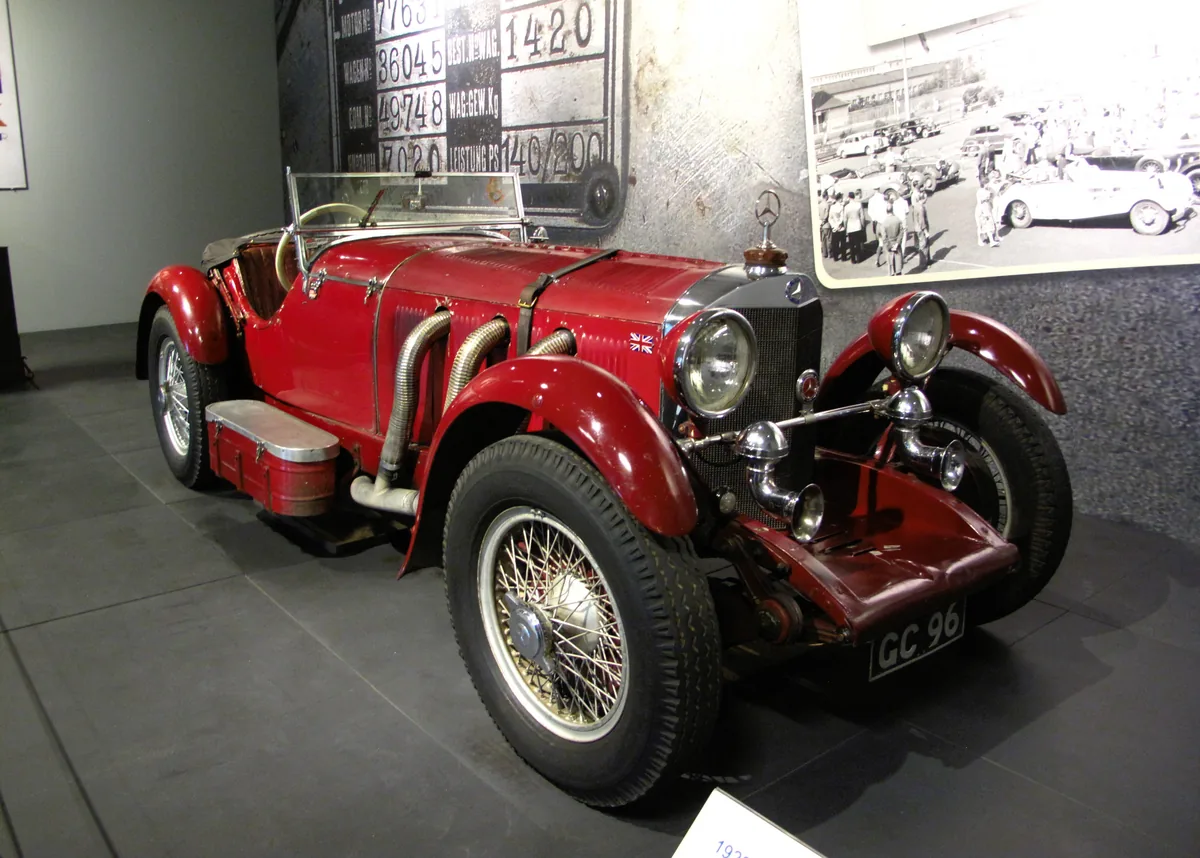
Image source: Wikimedia Commons
Why shorten a seven-litre super sports car?
Length had served the Typ S well for high-speed stability and grand proportions. Competition and the desire for a more agile private sports car pulled in another direction. A shorter wheelbase reduces polar moment in ways period engineers understood empirically even if they did not use modern vocabulary: the car changes direction more willingly, feels more compact on tight mountain roads and circuits, and presents a more aggressive visual stance. The cost is a less forgiving ride and a sharper breakaway character when supercharged torque overwhelms the rear tyres on period rubber.
Mercedes did not abandon the long car. The Typ SS continued the Super Sport grand-touring sports idea on a longer footprint. The SSK was the specialist: the short-chassis tool beside the long-chassis tourer. Customers and the works could choose the configuration that matched the job — open-road presence and multi-seat sporting luxury on one hand, pure short-chassis performance on the other.
Engineering association and the Kompressor
The SSK’s engineering sits inside the Ferdinand Porsche era of influence at Mercedes, the same broad chapter that shaped the W06 programme. The Roots supercharger, engaged with the familiar extra throttle push, remains the mechanical centre of the car. Unblown, the seven-litre six is already a large, powerful unit. Blown, it becomes a high-output period sports engine with a distinctive mechanical soundtrack that period spectators remembered and that modern demonstration audiences still gather to hear when a genuine car is run with skill and restraint.
That reputation can obscure practical truth. The SSK was not a toy. It was a large, complex machine that happened to be shorter than its siblings. Maintaining one in the early 1930s required wealth and access to skilled labour. Maintaining one now requires those same ingredients plus historical literacy and a realistic view of how few annual kilometres many such cars will cover.
Design: the roadster form
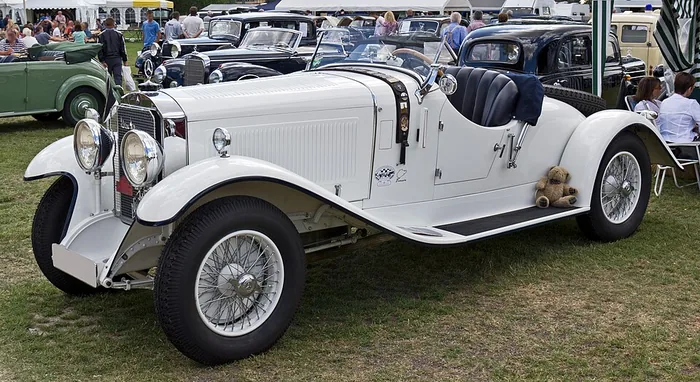
In reference photographs the SSK appears again and again as a roadster: low screen or none in competition trim, long bonnet still asserting the engine’s bulk, short tail, wire wheels, and a stance that looks purposeful even at rest. Full wings and more complete road equipment appear on cars meant for highway use; cycle wings and stripped bodies appear when the mission is lap time or hill-climb seconds. Either way, the proportions advertise the Kurz idea immediately to anyone who has stood next to a long SS or Typ S.
Details matter for authentication. Radiator shells, fuel fillers, instrument layouts, and body timberwork can reveal restoration philosophies. A car that looks perfect in photographs may be a meticulous original restoration, a quality rebody on a genuine chassis, or something more ambiguous. In a market this elevated, ambiguity is expensive. Specialist historians and marque experts are not optional accessories; they are part of due diligence.
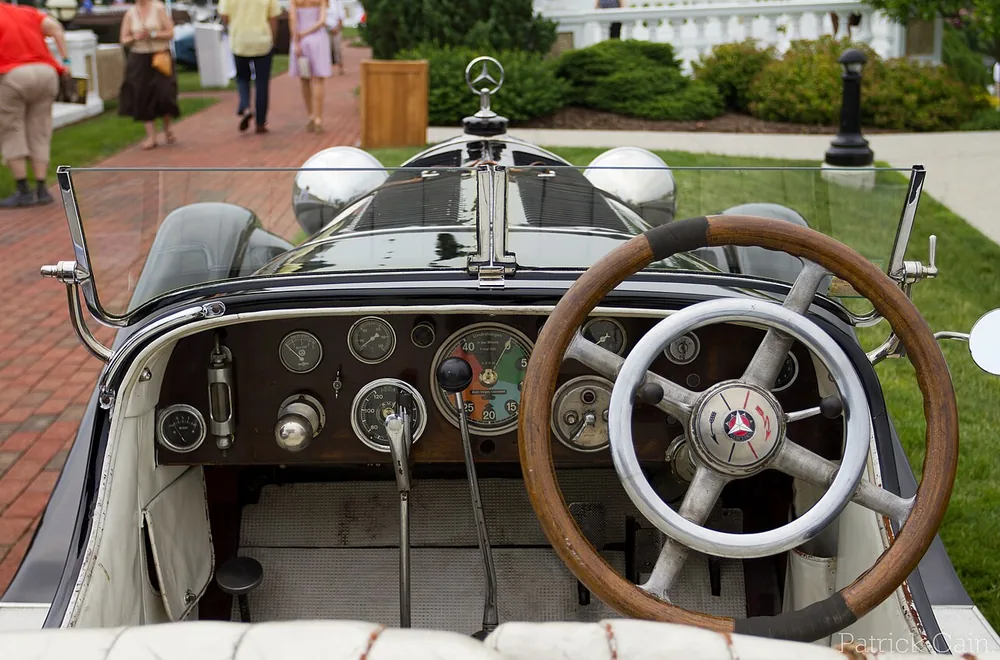
Image source: Wikimedia Commons
On the road and on the circuit
Driving an SSK well is a conversation with history and physics at once. The short chassis answers steering inputs more quickly than a long Super Sport car. The supercharger answers the throttle with a surge that period tyres only partly convert into forward motion if the surface is imperfect. Braking remains a drum-brake art: early, straight, and planned. Gear changes reward the double-declutch fluency that racing drivers of Caracciola’s generation took for granted and that modern dual-clutch natives must relearn.
In competition, the SSK collected results that turned machinery into lasting reputation. Hill climbs suited the power-to-grip equation. Sports car races suited the blend of speed and mechanical stamina when the car was properly prepared. Caracciola’s name is permanently linked to that story, but he was not alone; the SSK was a tool used by a generation of drivers who treated Mercedes supercharged cars as a serious choice when budget and entry lists allowed.
Top speed figures near 200 km/h should be read as class capability, not as a challenge for casual public-road use. Period brakes, period visibility, and period chassis dynamics make such velocities a specialist demonstration activity. The romance of the number matters less than the discipline around it.
Production rarity and the problem of counting
The often-cited figure of about thirty-three cars, including related short cars, is useful as a scale marker and dangerous as a slogan. Inclusion criteria differ: pure factory SSK designations, related short-chassis specials, cars later modified toward SSKL specification, and incomplete records all muddy simple tallies. What a buyer or historian needs is not a memorised total but a chassis-specific biography: when it was built, how it was bodied, how it was raced or road-registered, and what has happened to it since.
Rarity also explains the replica phenomenon. Few pre-war sports cars have inspired as many specials and recreations. Some are honest modern homages. Others have muddied the waters of identity. The existence of non-original cars does not diminish genuine SSKs; it raises the premium on paperwork, provenance, and expert consensus.
Ownership and collecting
Strengths
- Icon status — immediately recognisable peak of pre-war Mercedes sports design.
- Performance credibility — 200–300 PS class power and ~200 km/h potential in period context.
- Racing provenance potential — genuine competition history transforms cultural and market weight.
- Family completeness — the essential short-chassis chapter between Typ S/SS and SSKL.
- Driver engagement — few historic cars offer this level of mechanical complexity and feedback.
Things to watch
- Provenance — chassis and engine identity, period photographs, race records, and ownership chains.
- Replica risk — know exactly what you are buying; price accordingly.
- Supercharger and bottom-end health — rebuild quality defines reliability and safety.
- Brake and steering condition — non-negotiable before any demonstration.
- Body originality — transparent rebody history versus silent substitution.
- Insurance and storage — values demand institutional-grade care.
- Usability honesty — many SSKs will cover fewer annual kilometres than a modern classic; plan for that financially and practically.
Reading an SSK in photographs and in metal
Photographs of SSKs are highly persuasive. Low viewpoints emphasise the bonnet; sunlight catches wire wheels; a slight blur implies speed even when the car is parked. Learning to read beyond the image is a collector skill. Look at wing style and whether it matches claimed competition history. Look at windscreen height and seating position for road versus race intent. Look at fuel system plumbing and whether supercharger hardware appears complete and correctly routed. Look at tyre sizes relative to period practice and modern safety upgrades. None of these checks replace a physical inspection, but they prevent emotional purchases based on a single dramatic image.
In metal, the SSK is larger and more physically imposing than many expect from short in the name. Short is relative to the long Super Sport cars, not relative to a modern lightweight roadster. The cockpit can feel intimate; the mechanical mass ahead of the driver does not. Heat, noise, and vibration are part of correct operation, not signs that something is always wrong — though separating character from fault requires experienced ears. A first drive should be conducted with a specialist familiar with the individual car, on a quiet road, without audience pressure to perform.
Event culture around SSKs ranges from static elegance to selective historic competition. Not every chassis should be driven hard simply because the model raced in period. Originality, remaining fatigue life in components, and the irreplaceability of a given car all argue for restraint. Some owners commission exacting recreations for track use while preserving an original for display. That split strategy is expensive and, for cars this rare, sometimes the only responsible way to enjoy both demonstration and conservation.
Finally, the SSK must be placed beside its siblings without collapsing them into one myth. The Typ S is the long root. The Typ SS is the long Super Sport grand tourer. The SSK is the short-chassis star. The SSKL is the lightened extreme. Keeping those distinctions clear is how encyclopaedias, auction catalogues, and private collections avoid expensive confusion.
Safety and construction notes
The short separate chassis and open body offer no modern crash cell; speed capability is the dominant risk factor. Drum brakes must be impeccable; 200 km/h-class potential with early-1930s braking hardware demands extreme foresight. Supercharger engagement hardware, lubrication, and clearances are safety-adjacent: mechanical failure at speed is not a roadside inconvenience. Correct classic high-speed-rated rubber designed for historic cars is essential. Driver skill is the primary safety system; these cars were raced by professionals for good reason. Large fuel loads, period electrics, and supercharged engines require professional maintenance culture and fire awareness.
Legacy: the short car that fixed a look
The SSK’s legacy is visual as much as statistical. It fixed the image of the short, supercharged Mercedes roadster in the global imagination: long bonnet, short tail, star on a large radiator shell. It also fixed a performance argument — that shortening the W06 chassis was an effective way to turn grand sporting luxury into a more competition-focused tool — which the even rarer SSKL would carry to a drilled-chassis extreme.
Keep the encyclopaedic core close: Super Sport Kurz; 1928–1932; W06 short-wheelbase family; ~7,069 cc SOHC I6 supercharged; 200–300 PS depending on tune; Roots blower on extra throttle push; top speed up to ~200 km/h class; Porsche-era association; roughly ~33 cars often cited including related shorts; Caracciola and racing success; roadster form. Those facts describe a car that sits at the centre of Mercedes sports heritage and at the centre of any serious discussion of pre-war performance icons.
Related Motor Wiki entries: Typ S (1927), Typ SS (1928–1933), SSKL (1931–1932), Typ Stuttgart, and the modern contrast piece V-Class (W447). This model’s path is Mercedes-Benz SSK (W06, 1928).
Leave a Reply
You must be logged in to post a comment.