General information & model overview
| Category | Specification Details |
|---|---|
| Model name | Mercedes-Benz V-Class |
| Internal code | W447 (passenger MPV); related commercial model: Vito (W447 generation) |
| Production years | 2014 – present (facelifts approximately 2019 and 2023–2024 depending on market) |
| Body style | Premium large multi-purpose vehicle / people carrier; typically 6–8 seats depending on layout and market |
| Platform | VS20 architecture (shared foundation with the contemporary Vito commercial range) |
| Assembly | Primarily Vitoria-Gasteiz, Spain (Mercedes-Benz España) |
| Related models | Mercedes-Benz Vito (commercial); EQV battery-electric derivative; predecessor Viano (W639) |
| Layout | Front-engine; rear-wheel drive, front-wheel drive, or 4MATIC all-wheel drive depending on engine, year, and market |
| Key characteristics | Premium large MPV successor to the Viano era; three body lengths; dual sliding side doors; modular seating; diesel focus with later mild-hybrid diesels; luxury and shuttle positioning above pure commercial vans |
| Predecessor / successor | Succeeded the W639 Viano passenger range (2014 onward as V-Class); continuous updates rather than a clean sheet replacement within the W447 generation |
Body & dimensions
| Specification | Details |
|---|---|
| Body lengths (approx.) | Compact ~4,895 mm; Long ~5,140 mm; Extra-long ~5,370 mm (market naming and exact figures vary slightly by year and equipment) |
| Wheelbases | Approximately 3,200 mm (standard / long family) and 3,430 mm (extra-long family) |
| Overall width | Approximately 1,928–1,930 mm excluding mirrors (confirm market data for exact figure) |
| Overall height | Typically around 1,880–1,910 mm depending on suspension, roof rails, and wheel package |
| Doors | Two front hinged doors; dual power or manual sliding side doors; rear tailgate (passenger versions) |
| Seating | Configurable multi-row layouts; common 6-, 7-, or 8-seat arrangements with individual seats, benches, and lounge-style packages |
| Luggage / cabin volume | Highly variable with seats in or out; extra-long variants offer van-like rear volume when rearmost rows are removed or folded |
| Fuel tank | Typically around 70–80 litres class depending on market and drivetrain (confirm handbook / plate data) |
| Turning circle | Approximately 11.8 m class on shorter wheelbase versions; larger on extra-long models |
Engine specifications (common European-oriented variants)
| Engine family | Type | Approx. output range | Notes |
|---|---|---|---|
| OM651 2.1 / 2.2 CDI era | Inline-4 common-rail turbo diesel (early W447 years) | Typically from about 100 kW / 136 hp through higher outputs around 120–140 kW class depending on tune and year | Core early diesels for private, shuttle, and fleet use; strong mid-range torque for a large MPV |
| OM654 2.0 diesel (later years) | Inline-4 turbo diesel; later mild-hybrid (EQ Boost) versions on selected markets | Commonly quoted from roughly 120 kW / 163 hp class through higher outputs around 174–190+ kW depending on designation and year | Modern four-cylinder diesel family replacing older OM651 hardware; efficiency, refinement, and emissions focus; mild-hybrid assistance on later cars |
| EQV (related) | Battery-electric MPV derivative of the VS20 passenger concept | Electric motor outputs and ranges market-dependent; positioned as zero-tailpipe-emission premium people-mover | Not a conventional ICE V-Class engine, but the electric sibling in the same product space |
Exact power, torque, emissions, and gearbox pairings vary by model year, drive layout, and national homologation. Always treat handbook data for a specific vehicle as authoritative.
Drivetrain & transmission
| Category | Details |
|---|---|
| Drive layouts | Rear-wheel drive on many versions; front-wheel drive available on selected engines and markets; 4MATIC all-wheel drive on higher or traction-focused specifications |
| Automatic gearbox | Multi-speed automatics (including 7G-Tronic and later 9G-Tronic class units depending on year and engine) dominate the premium passenger V-Class experience |
| Manual gearbox | Offered on some earlier or lower commercial-adjacent specifications in certain markets; less common on heavily optioned private luxury cars |
| 4MATIC role | Improves traction in wet, snow, gravel approaches, and mountain access without turning the V-Class into an off-road vehicle |
| Mild hybrid | Later OM654-based versions can integrate EQ Boost-style electrical assistance for smoother stop-start, support under load, and emissions compliance |
Chassis & suspension
| Category | Details |
|---|---|
| Front suspension | Independent suspension tuned for comfort and stability under multi-passenger load |
| Rear suspension | Independent or semi-independent architecture depending on market and configuration; comfort-biased for long-distance shuttle duty |
| Steering | Electrically assisted power steering; light at parking speeds, stable at motorway pace |
| Brakes | Four-wheel discs with ABS, stability control, and a full suite of electronic assistance packages varying by year and trim |
| Ride philosophy | Premium MPV comfort first: isolation of road noise, composure with six to eight occupants, and confidence when towing or carrying luggage |
| Wheels & tyres | Typically 16–19 inch class depending on trim and package; larger alloys favour style and plant; smaller diameters can improve ride and winter practicality |
Performance (indicative)
| Category | Details |
|---|---|
| Acceleration | Stronger diesels accelerate a lightly loaded long-wheelbase car into the mid-to-high 9s / low 10s seconds class to 100 km/h; lower outputs and heavy occupancy slow the experience substantially |
| Top speed | Typically electronically limited or power-limited in the 180–210 km/h class depending on engine and gearing (market-dependent) |
| Character | Torque-led overtaking on dual carriageways; not a sports machine; refinement and cabin calm matter more than absolute sprint figures |
| Towing | Capable braked towing figures on suitably equipped versions (often multi-tonne class); always confirm the specific vehicle’s rating plate and handbook |
| Fuel economy | Modern four-cylinder diesels can return strong long-run figures for the vehicle size when driven steadily; urban and fully loaded use raise consumption sharply |
Timeline & history
| Period | Development |
|---|---|
| Pre-2014 | W639 Viano and Vito establish Mercedes large-van passenger packaging; brand seeks a more premium, car-like successor under the revived V-Class name |
| 2014 | W447 V-Class launches on VS20 architecture from Vitoria, Spain; three lengths; dual sliding doors; diesel-led powertrains; clear luxury-MPV positioning |
| ~2019 facelift | Exterior and interior refresh; equipment and assistance systems updated; powertrain portfolio evolves toward newer diesel hardware in progressive market phases |
| Late 2010s–early 2020s | EQV electric derivative expands the range into battery-electric premium people-moving; ICE V-Class continues as the core diesel luxury shuttle product |
| ~2023–2024 updates | Further exterior, cabin, and technology refreshes depending on market; mild-hybrid diesel emphasis strengthens on selected engines; digital cockpit and assistance suites modernised |
| Ongoing | V-Class remains Mercedes-Benz’s flagship large premium MPV for private luxury buyers, corporate shuttles, and high-end transfer fleets |
Trims, lines & packaging (indicative)
| Theme | Details |
|---|---|
| Base / entry lines | Functional multi-seat layouts, durable materials, essential assistance systems; suited to high-use family or light shuttle duty |
| Mid / Avantgarde-style themes | Richer cabin materials, more exterior chrome or design cues, upgraded audio and comfort options |
| AMG Line / design packages | Sportier exterior appearance, larger wheels, darker or more dynamic interior themes without transforming dynamics into a sports car |
| Exclusive / luxury lounge packages | Individual rear seats, tables, ambient lighting, high-grade leather or Nappa-class materials, privacy glass, and chauffeur-oriented equipment |
| Marco Polo camper derivatives | Related V-Class-based camper conversions (where marketed) add pop-top roofs and living modules; separate product logic from pure passenger V-Class |
Safety & construction notes
| Category | Details |
|---|---|
| Structural role | Passenger-car-level refinement goals on a van-derived large-MPV structure; extensive electronic stability and brake assistance as standard on modern cars |
| Assistance systems | Depending on year and options: adaptive cruise, active brake assist, lane keeping, blind-spot monitoring, 360° cameras, parking pilots, and traffic-sign recognition |
| Airbags & restraints | Multi-airbag strategy with seatbelt pretensioners and load limiters; ISOFIX / i-Size provisions on appropriate seats |
| Sliding-door safety | Power sliding doors with obstruction detection on equipped cars; important for family and kerbside transfer use |
| Used-car checklist | Verify airbag readiness lights, ADAS sensor alignment after windscreen or bumper work, healthy tyres matched across axles, and complete service history for diesel emissions hardware |
The Mercedes-Benz V-Class (W447): premium large MPV from 2014
The Mercedes-Benz V-Class of the W447 generation is the brand’s modern large multi-purpose vehicle for moving six, seven, or eight people with higher comfort and equipment levels than a pure commercial panel van. Launched in 2014 and continuously updated since, it sits at the top of Mercedes large people-movers. It is related to the contemporary Vito, built primarily in Vitoria-Gasteiz, Spain, and engineered on the VS20 platform — yet it is sold and trimmed as a premium passenger product rather than a pure fleet tool.
Where the earlier Viano (W639) established a luxurious Mercedes people-carrier on rear-drive van architecture, the W447 V-Class refined the package with more car-like design cues, a calmer cabin, and a clearer luxury-shuttle mission. In private hands it is a high-end family hauler. In corporate fleets it is an executive transfer vehicle. In both roles it relies on dual sliding doors, modular seating, three body lengths, and diesel torque suited to loaded motorway work.
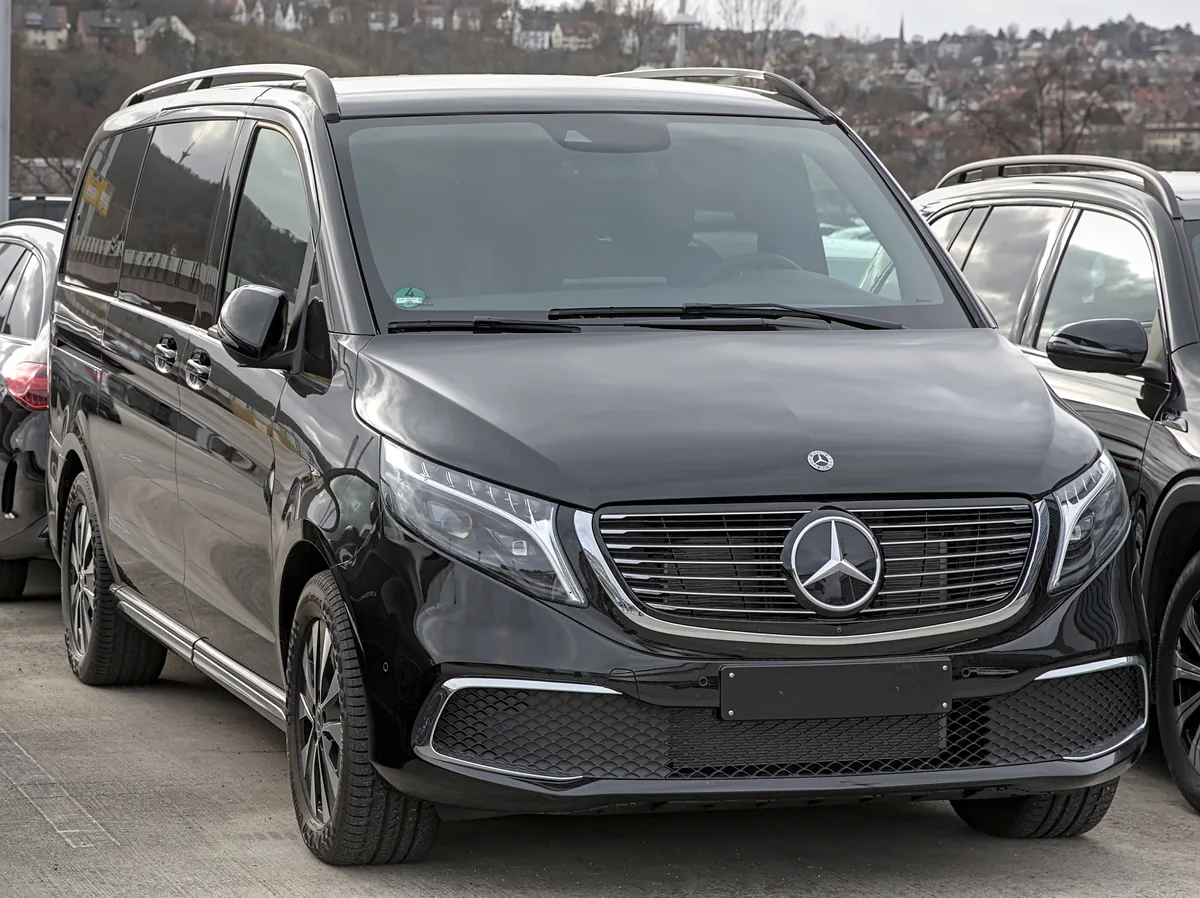
Image source: Wikimedia Commons
From Viano to V-Class: renaming the passenger flagship
Mercedes has long offered large passenger vans under more than one name. The first modern passenger-oriented V-Class of the late 1990s, the commercial Vito lineage, and the 2003–2014 Viano all explored different balances of badge prestige, seating flexibility, and van-derived packaging. By 2014 the company wanted a cleaner story: the passenger flagship would again be called V-Class, while Vito would remain the commercial sibling. The W447 generation is that story’s hardware.
The product brief was straightforward. Buyers wanted more isolation from road noise, better interior materials, stronger safety and assistance equipment, and exterior design that looked less like a work van parked outside a hotel. They also wanted the practical virtues that made the previous generation indispensable: dual sliding doors for kerbside loading, three lengths for different parking constraints, and a seating system that could switch from lounge layout to cargo mode without tools in some configurations.
Vitoria-Gasteiz in Spain remained the primary production home, continuing a Spanish assembly tradition for Mercedes large vans and passenger derivatives. That continuity matters for parts familiarity and for understanding why the V-Class feels like a European-engineered large MPV rather than a North American full-size van with a three-pointed star.
Three lengths, two wheelbases
Approximate overall lengths of about 4,895 mm, 5,140 mm, and 5,370 mm define the compact, long, and extra-long bodies. Wheelbases cluster around 3,200 mm and 3,430 mm. Those numbers determine whether the car will fit a multi-storey car park ramp, whether a third-row adult can sit without knees in the seatback ahead, and how the vehicle feels when turning into a city hotel forecourt. Turning circles sit around 11.8 m on shorter wheelbase versions and grow on extra-long models.
The short wheelbase is the most urban-friendly. The long and extra-long versions are where the V-Class earns its reputation as a genuine alternative to two cars or a minibus. Remove or fold rearmost seats and luggage volume becomes van-like. Keep them in and you can carry a full family plus luggage on a holiday run, or six executives with briefcases and coats, without the claustrophobia of a conventional MPV’s third row.
Design language: van proportions, passenger intent
Nobody confuses a V-Class with a C-Class saloon. The silhouette remains tall, long, and sliding-door practical. What W447 designers achieved was a more deliberate face: a wide grille with a large star, headlamp graphics that track contemporary Mercedes passenger cars, and side surfaces that reduce the pure slab-sided commercial look of older vans. Facelifts around 2019 and again in the 2023–2024 window tightened lighting signatures, revised bumpers, and refreshed wheel designs so the model stayed current beside newer E-Class and S-Class generations.
Inside, the mission is clearer still. Higher trims abandon hard-wearing fleet plastics for leather or high-grade synthetic upholstery, wood or open-pore trim, ambient lighting, and multi-zone climate control. Individual rear seats with armrests and tables turn the cabin into a lounge. Premium audio options, panoramic roofs, and privacy glass complete the private-hire and family-luxury story. Base cars remain more honest — durable, modular, and less glamorous — but even they aim higher than a pure panel-van conversion.
Compared with the compact experiment of the earlier Vaneo, the V-Class is a different product entirely: longer, heavier, more powerful, and aimed at buyers who already accept van dimensions if the cabin and badge justify them. Compared with the short-lived premium pickup experiment of the X-Class, the V-Class is a much more durable market idea — people-moving at this size has a steadier demand curve than lifestyle pickups in Europe.
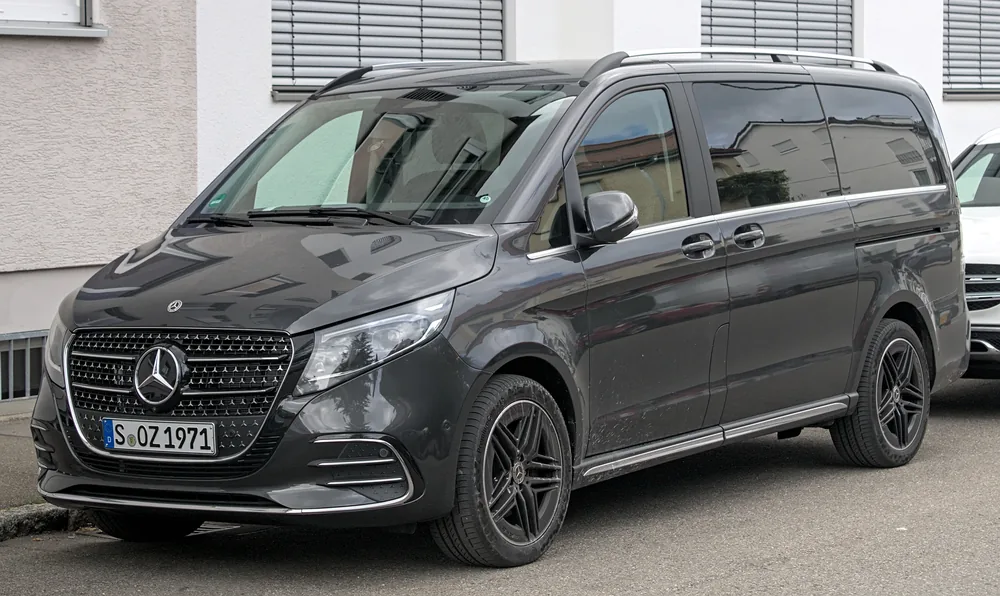
Image source: Wikimedia Commons
Powertrains: OM651 diesels to OM654 mild hybrids
Diesel is the V-Class’s native language in Europe. Early W447 cars used the OM651-generation four-cylinder common-rail turbodiesels already familiar across the Mercedes car and van range. Outputs typically spanned the mid-100 kW region upward depending on tune, with torque figures that matter more than peak horsepower when the cabin is full and the dual-carriageway slip road is short. These engines made the V-Class a natural long-distance shuttle: quiet enough at cruise once warm, strong in the mid-range, and economical when driven with a light foot.
Later years migrated toward the OM654 2.0-litre diesel family. That change was about more than a new code. Emissions regulations, refinement expectations, and the need for mild-hybrid assistance pushed Mercedes toward cleaner, more modern four-cylinder hardware. On selected later cars, mild-hybrid EQ Boost-style systems smooth stop-start events, fill torque holes under load, and help the large MPV meet regulatory targets without jumping fully into battery-electric territory. Drivers feel the benefit as a calmer low-speed character more than as a sporting surge. Common later outputs range roughly from 120 kW / 163 hp class through higher figures around 174–190+ kW depending on designation and year.
Transmission choice is usually automatic on private and premium cars. Multi-speed units — including 7G- and later 9G-class automatics depending on year and engine — suit the vehicle’s mission. Manual gearboxes appear more often on commercial-adjacent specifications. Drive layout is more varied than casual observers expect: rear-wheel drive remains a classic large-Mercedes van solution, front-wheel drive appears on selected configurations, and 4MATIC all-wheel drive is the winter and mountain option that many alpine and northern European buyers prioritise.
The EQV sibling
The EQV is not simply a V-Class with a different badge. It is the battery-electric expression of the same premium people-mover idea: dual sliding doors, multi-seat packaging, and a cabin that can serve family or executive transfer duty with zero local exhaust emissions. Range and charging behaviour matter more than diesel torque curves. For city hotel shuttles and regulated urban zones, the EQV is the logical evolution. For long mixed-motorway duty with heavy loads and limited charge infrastructure, many buyers still prefer a modern mild-hybrid diesel V-Class. The two products sit side by side rather than cancel each other out.
On the road: composure over drama
Drive a V-Class as if it were a sports saloon and you will misunderstand it. Drive it as a quiet, high-seating touring lounge and it makes sense. Steering is light for parking — essential with a five-metre-plus body and dual sliding doors in city streets — and stable enough at motorway speeds if the tyres are healthy and the load is balanced. Body roll exists; it is managed rather than eliminated. The point is not apex hunting. The point is that rear passengers can work on laptops or sleep without being tossed about.
Stronger diesels can accelerate a lightly loaded long-wheelbase car into the mid-to-high 9s / low 10s seconds class to 100 km/h; lower outputs and heavy occupancy slow the experience substantially. Top speeds typically sit in the 180–210 km/h class depending on engine and gearing. Ride quality depends heavily on wheel size, tyre sidewall, load, and suspension specification. Smaller wheels with more tyre often ride better on broken urban asphalt. Large AMG Line alloys look right outside a design hotel and can feel firmer over expansion joints. With six or seven adults aboard, the car often feels more settled than when empty — a common large-MPV trait.
Braking a fully laden extra-long V-Class requires planning that a compact hatchback never demands. Discs and electronics are up to the job when maintained, but brake wear is a real cost of high-mileage shuttle life. Anyone buying a used example with airport-transfer history should budget for pads, discs, and careful inspection of suspension bushes and dampers. Crosswinds on exposed motorways are noticeable; electronic stability systems and careful speed discipline are part of competent ownership.
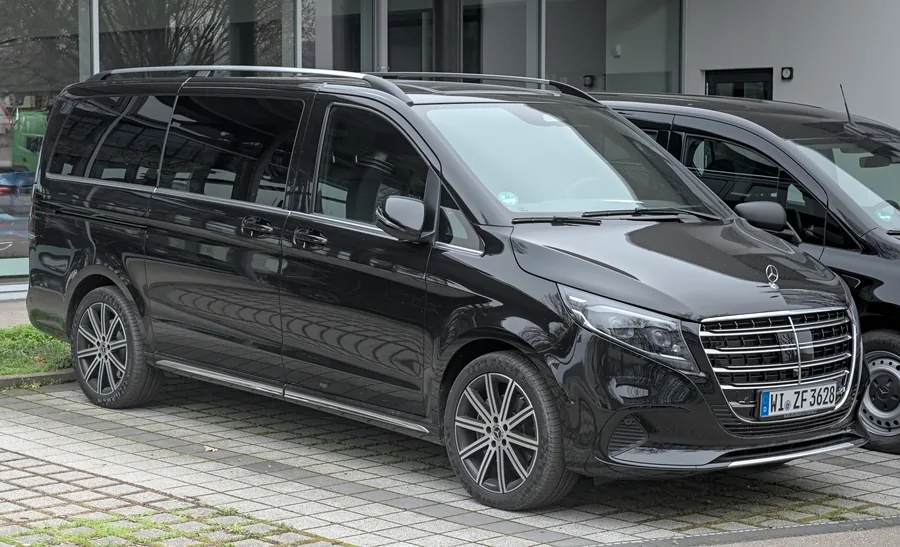
Image source: Wikimedia Commons
Market position
The V-Class sells into three overlapping audiences. Private buyers who refuse to choose between three-row practicality and Mercedes prestige form the first group. They may have previously considered large SUVs such as the GLS, then discovered that sliding doors and a flat load floor suit child seats and holiday luggage better than a high-riding crossover. Corporate and chauffeur operators form the second group: hotels, event companies, and executive transfer fleets that need a cabin passengers will not apologise for. The third group is mixed-use families and multi-generational households who need adult-friendly third rows more than they need off-road capability.
Competitors include large VW Multivan-type products, Toyota and other Asian people-movers in some markets, and luxury minibus conversions. The Mercedes advantage is brand halo, residual value in many European markets, and a dealer network that understands high-mileage commercial-adjacent cars even when the badge says V-Class rather than Vito. The disadvantage is purchase price and the running costs of a large, heavy, option-heavy vehicle. Tyres, brakes, diesel particulate filters, and AdBlue systems are not optional trivia on modern examples.
Facelifts and continuous improvement
Unlike a classic with a fixed three-year production window, the W447 V-Class has lived a long life of iterative improvement. The approximate 2019 facelift modernised exterior graphics and cabin equipment so the model would not look dated beside newer Mercedes passenger cars. Assistance systems advanced in parallel with the rest of the brand: better cameras, more capable adaptive cruise, and stronger active safety packages on cars ordered with the right options.
The 2023–2024 update cycle, market-dependent in exact content and timing, pushed digital interfaces, lighting design, and mild-hybrid diesel availability further forward. For used buyers, these refresh points matter. A pre-facelift car can still be excellent if maintained, but later cars often package newer multimedia, stronger ADAS, and cleaner powertrains that may be simpler to live with under tightening urban emissions rules. Always compare the specific equipment list rather than assuming every year is identical.
Ownership and buying notes
Strengths
- Genuine multi-adult packaging — especially on long and extra-long bodies with modular seating.
- Dual sliding doors — transformative for kerbside loading, child seats, and hotel drop-offs.
- Premium cabin potential — lounge packages and high-grade materials separate it from pure commercial vans.
- Diesel long-distance manners — torque and range suit motorway shuttle work when the engine is healthy.
- 4MATIC availability — useful traction without requiring a full SUV lifestyle.
- EQV path — battery-electric option for operators facing urban access rules.
Things to watch
- Service history depth — especially DPF, EGR, AdBlue, automatic gearbox, and timing-related items per engine family.
- Sliding door mechanisms — rollers, tracks, and power motors are high-use wear items.
- Rear air or comfort suspension (if fitted) — leaks and compressor issues are expensive on high-mileage cars.
- Seat rails and latch integrity — modular seats must lock positively; inspect every mounting point.
- ADAS calibration — windscreen replacements and bumper repairs require sensor alignment.
- Tyre and brake wear — budget for large-diameter, high-load rubber and frequent pad/disc cycles on shuttle cars.
- Accident history — large side panels and sliding-door apertures can hide previous repair quality issues.
- Electrics and infotainment — test every seat motor, table, climate zone, and camera before purchase.
Who the V-Class suits
The V-Class suits buyers who need real space for people first and image second — or who need both at once. It is ideal for large families who refuse a second car, for operators who move clients between airport and city, and for anyone who has outgrown conventional MPVs but does not want a full coachbuilt minibus. It is less ideal for drivers who want sporty handling, for households with tight parking constraints that cannot accept a five-metre body, or for buyers seeking a pure electric experience without considering the EQV specifically.
Relative to the older Viano, the W447 is quieter, better equipped, and more clearly luxury-oriented. Relative to the compact Vaneo, it is a different universe of size and mission. Relative to the X-Class pickup, it serves a more stable use case: moving people in comfort remains a core Mercedes commercial and private need.
Living with lengths, options, and real costs
Choosing among the approximate 4,895 mm, 5,140 mm, and 5,370 mm bodies is the decision that most shapes ownership. The compact length is easier in cities and multi-storey parks, yet it truncates luggage room when all seats are occupied. The long and extra-long cars unlock the full people-carrier promise and the shuttle business case, but they demand disciplined parking habits and careful measurement of home garages, gates, and underground ramps. Wheelbase choice is not only about rear legroom; it also changes turning circles, how the car sits in traffic queues, and how confidently a new driver places the nose and tail.
Options compound those choices. Power sliding doors are nearly essential for family and chauffeur use once experienced. Lounge seating packages transform rear-passenger perception but reduce maximum occupancy flexibility. Large alloy wheels please the eye and can degrade ride and increase tyre cost. Tow bars, bicycle carriers, and roof equipment matter for holiday users but add weight and noise. The wise approach is to buy the length you need every week and the options you will use every month — not the brochure configuration you will use twice a year.
Running costs deserve equal honesty. Fuel for a large diesel MPV is still substantial in urban stop-start work even when long-run motorway figures look respectable. Service intervals, AdBlue, brake replacements, and tyre sets sized for a heavy multi-seater add up. Insurance groups vary by engine, value, and use class; a private family car and a high-mileage transfer vehicle are not underwritten the same way. None of this makes the V-Class a bad purchase. It makes it a premium tool that should be costed like one, not like a compact hatchback that happens to wear a star.
For used shoppers, a thorough road test must include every sliding door cycle, every seat latch, dual-carriageway merging with a realistic load if possible, and a careful listen for driveline or suspension knocks over broken surfaces. A pre-purchase inspection by a Mercedes van or large-MPV specialist is money well spent. The W447 rewards diligent buyers with a cabin few rivals can match when specified well — and it punishes neglected examples with bills that erase any bargain price.
Legacy within the Mercedes large-MPV line
The W447 V-Class is not a limited-run halo model. It is a long-running product that has absorbed facelifts, powertrain changes, and an electric sibling while keeping the same essential promise: dual sliding doors, multi-length packaging, and a cabin that can feel like a lounge rather than a works van. In brand history it sits as the mature expression of ideas trialled through earlier V-Class and Viano generations — less experimental than the short-lived Vaneo, more passenger-focused than a pure Vito, and more commercially durable than lifestyle side projects such as the X-Class.
For encyclopaedic purposes, remember the key identifiers: internal code W447, VS20 platform, Vitoria assembly, lengths near 4,895 / 5,140 / 5,370 mm, wheelbases near 3,200 / 3,430 mm, OM651 then OM654 mild-hybrid diesels, RWD/FWD/4MATIC layouts, major refreshes around 2019 and 2023–2024, and the EQV as the battery-electric relative. Those facts frame a vehicle that, for many owners, is simply the most practical Mercedes they will ever buy — and for many passengers, a quiet way to travel eight-up without apology.
Further reading on related Motor Wiki entries includes the predecessor Mercedes-Benz Viano (2003–2014), the compact experiment Mercedes-Benz Vaneo (2001–2005), and the brand’s modern pickup outlier, the Mercedes-Benz X-Class (2017–2020). Within this site’s internal structure the present generation is also referenced as Mercedes-Benz V-Class (W447).
Leave a Reply
You must be logged in to post a comment.