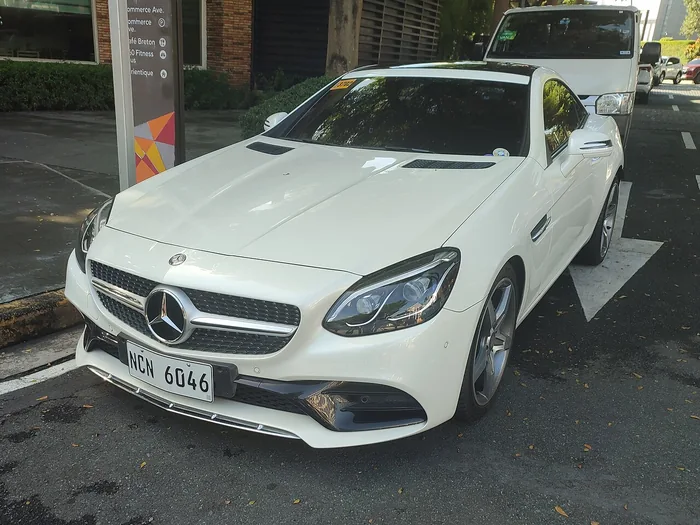
Identity, Model Codes and Market Position
| Category | Specification Details |
|---|---|
| Manufacturer | Mercedes-Benz (Daimler AG) |
| Model Name | SLC (marketing name from 2016 model year; previously SLK) |
| Internal Chassis Code | R172 (third-generation SLK/SLC platform) |
| Model Year Introduction | 2016 (facelift of 2011–2015 SLK R172) |
| Production Period | March 2016 – 2020 (final R172 production) |
| Assembly Plant | Bremen, Germany |
| Vehicle Class | Compact luxury roadster |
| Body Style | 2-door, 2-seat retractable hardtop convertible |
| Platform Architecture | Front-mid engine, rear-wheel drive; shared underpinnings with W204 C-Class |
| Key Market Variants (2016 MY) | SLC 180, SLC 200, SLC 250 d, SLC 300, SLC 43 AMG (market-dependent) |
| Predecessor | Mercedes-Benz SLK (R172, 2011–2015) |
| Successor | No direct successor; segment exited after 2020 |
Exterior Dimensions and Weights
| Category | Specification Details |
|---|---|
| Length | 4,133 mm (162.7 in) |
| Width (excl. mirrors) | 1,810 mm (71.3 in) |
| Width (incl. mirrors) | 1,997 mm (78.6 in) |
| Height | 1,299 mm (51.1 in) |
| Wheelbase | 2,430 mm (95.7 in) |
| Track Width, Front | 1,545 mm (60.8 in) |
| Track Width, Rear | 1,545 mm (60.8 in) |
| Front Overhang | 861 mm (33.9 in) |
| Rear Overhang | 842 mm (33.1 in) |
| Kerb Weight (DIN, SLC 300) | Approx. 1,535 kg (3,384 lb) |
| Kerb Weight (DIN, SLC 43) | Approx. 1,585 kg (3,494 lb) |
| Gross Vehicle Weight | Approx. 1,930 kg (4,255 lb) |
| Max Payload | Approx. 395 kg (871 lb) |
| Boot Capacity (roof up) | 225 L (7.9 cu ft) |
| Boot Capacity (roof down) | 135 L (4.8 cu ft) |
| Fuel Tank Capacity | 50 L (13.2 US gal) |
| Drag Coefficient (roof closed) | Cd 0.32 |
| Drag Coefficient (roof open) | Cd 0.36 |
Powertrain Specifications — Petrol Engines
| Category | Specification Details |
|---|---|
| Model | SLC 180 |
| Engine Code | M 270 DE 16 AL (M270 1.6 L turbo) |
| Displacement | 1,595 cc |
| Configuration | Inline-4, 16-valve DOHC, direct injection, single twin-scroll turbo |
| Max Power | 115 kW (156 PS / 154 hp) at 5,300 rpm |
| Max Torque | 250 Nm (184 lb-ft) at 1,250–4,000 rpm |
| Compression Ratio | 9.8:1 |
| Fuel Requirement | Premium unleaded (RON 95 min) |
| Emissions Standard | Euro 6 |
| Category | Specification Details |
|---|---|
| Model | SLC 200 |
| Engine Code | M 274 DE 20 AL (M274 2.0 L turbo) |
| Displacement | 1,991 cc |
| Configuration | Inline-4, 16-valve DOHC, direct injection, single twin-scroll turbo |
| Max Power | 135 kW (184 PS / 181 hp) at 5,500 rpm |
| Max Torque | 300 Nm (221 lb-ft) at 1,200–4,000 rpm |
| Compression Ratio | 9.8:1 |
| Fuel Requirement | Premium unleaded (RON 95 min) |
| Emissions Standard | Euro 6 |
| Category | Specification Details |
|---|---|
| Model | SLC 300 |
| Engine Code | M 274 DE 20 AL (higher-output calibration) |
| Displacement | 1,991 cc |
| Configuration | Inline-4, 16-valve DOHC, direct injection, single twin-scroll turbo |
| Max Power | 180 kW (245 PS / 241 hp) at 5,500 rpm |
| Max Torque | 370 Nm (273 lb-ft) at 1,300–4,000 rpm |
| Compression Ratio | 9.8:1 |
| Fuel Requirement | Premium unleaded (RON 95 min) |
| Emissions Standard | Euro 6 |
| Category | Specification Details |
|---|---|
| Model | SLC 43 (Mercedes-AMG) |
| Engine Code | M 276 DE 30 AL (M276 3.0 L biturbo V6) |
| Displacement | 2,996 cc |
| Configuration | 90° V6, 24-valve DOHC, direct injection, twin turbochargers |
| Max Power | 270 kW (367 PS / 362 hp) at 5,500–6,000 rpm |
| Max Torque | 520 Nm (384 lb-ft) at 2,000–4,200 rpm |
| Compression Ratio | 10.5:1 |
| Fuel Requirement | Premium unleaded (RON 98 recommended) |
| Emissions Standard | Euro 6 |
Powertrain Specifications — Diesel Engine
| Category | Specification Details |
|---|---|
| Model | SLC 250 d |
| Engine Code | OM 651 DE 22 LA (2.1 L twin-turbo diesel) |
| Displacement | 2,143 cc |
| Configuration | Inline-4, 16-valve DOHC, common-rail direct injection, twin turbo (sequential) |
| Max Power | 150 kW (204 PS / 201 hp) at 3,800 rpm |
| Max Torque | 500 Nm (369 lb-ft) at 1,600–1,800 rpm |
| Compression Ratio | 16.2:1 |
| Fuel Requirement | Diesel (EN 590) |
| Emissions Standard | Euro 6 (with AdBlue SCR) |
Transmissions and Driveline
| Category | Specification Details |
|---|---|
| Standard Transmission (SLC 180/200/250 d/300) | 9G-TRONIC 9-speed automatic (725.0) |
| Transmission (SLC 43) | 9G-TRONIC 9-speed automatic with AMG-specific calibration and shift paddles |
| Drive Type | Rear-wheel drive |
| Differential (Standard) | Open differential with electronic traction control (ASR/ESP) |
| Differential (SLC 43) | Electronically controlled limited-slip rear differential (AMG performance) |
| Start-Stop System | ECO start/stop standard on all variants |
| Shift Modes | C (Comfort), S (Sport), S+ (Sport Plus, SLC 43), M (Manual), E (Economy) |
Chassis, Steering, Brakes and Wheels
| Category | Specification Details |
|---|---|
| Front Suspension | MacPherson struts, aluminium lower control arms, coil springs, anti-roll bar |
| Rear Suspension | 5-link independent, aluminium links, coil springs, anti-roll bar |
| Damping (Standard) | Passive twin-tube dampers, comfort-oriented tuning |
| Damping (Optional) | DYNAMIC SELECT with adaptive damping (DYNAMIC BODY CONTROL) |
| Steering Type | Electromechanical power-assisted rack-and-pinion (speed-sensitive) |
| Steering Ratio | Variable ratio, approx. 14.5:1 on-centre |
| Turning Circle | 10.7 m (35.1 ft) kerb-to-kerb |
| Front Brakes (SLC 180/200/250 d/300) | Ventilated discs, 300 mm × 28 mm, single-piston floating calipers |
| Rear Brakes (SLC 180/200/250 d/300) | Solid discs, 278 mm × 9 mm, single-piston floating calipers |
| Front Brakes (SLC 43) | Ventilated discs, 340 mm × 30 mm, 4-piston fixed AMG calipers |
| Rear Brakes (SLC 43) | Ventilated discs, 300 mm × 22 mm, single-piston floating calipers |
| Parking Brake | Electric (EPB) with auto-hold function |
| Standard Wheel Size (SLC 180/200) | 17-inch 5-twin-spoke alloy, 225/45 R17 run-flat tyres |
| Standard Wheel Size (SLC 300) | 18-inch 5-twin-spoke alloy, 225/40 R18 front / 245/35 R18 rear run-flat |
| Standard Wheel Size (SLC 43) | 18-inch AMG 5-twin-spoke, 225/40 R18 front / 245/35 R18 rear run-flat |
| Optional Wheel Sizes | 18-inch and 19-inch designs (staggered fitment on rear-drive models) |
| Tyre Pressure Monitoring | Direct TPMS (individual wheel sensors) |
Performance Figures (Manufacturer Claims)
| Category | Specification Details |
|---|---|
| SLC 180 — 0–100 km/h | 8.6 s |
| SLC 180 — Top Speed | 220 km/h (137 mph) electronically limited |
| SLC 200 — 0–100 km/h | 7.3 s |
| SLC 200 — Top Speed | 235 km/h (146 mph) electronically limited |
| SLC 250 d — 0–100 km/h | 6.7 s |
| SLC 250 d — Top Speed | 240 km/h (149 mph) electronically limited |
| SLC 300 — 0–100 km/h | 5.8 s |
| SLC 300 — Top Speed | 250 km/h (155 mph) electronically limited |
| SLC 43 — 0–100 km/h | 4.7 s |
| SLC 43 — Top Speed | 250 km/h (155 mph) electronically limited |
| Retractable Hardtop Operation Time | Approx. 20 seconds (operable up to 40 km/h / 25 mph) |
Fuel Consumption and Emissions (NEDC Combined, Approximate)
| Category | Specification Details |
|---|---|
| SLC 180 — Combined | 5.6–5.9 L/100 km (42–40 mpg US); CO₂ 129–136 g/km |
| SLC 200 — Combined | 5.8–6.1 L/100 km (40–38 mpg US); CO₂ 133–140 g/km |
| SLC 250 d — Combined | 4.3–4.5 L/100 km (55–52 mpg US); CO₂ 113–118 g/km |
| SLC 300 — Combined | 6.1–6.4 L/100 km (38–37 mpg US); CO₂ 140–147 g/km |
| SLC 43 — Combined | 7.5–7.8 L/100 km (31–30 mpg US); CO₂ 172–179 g/km |
Standard and Key Optional Equipment (2016 Model Year)
| Category | Specification Details |
|---|---|
| Retractable Hardtop | Standard (vario-roof with insulated steel panels) |
| Magic Sky Control | Optional: electrochromic glass roof panel with variable tint (transparent to opaque) |
| AIRSCARF | Standard: neck-level heating integrated into head restraints |
| Infotainment | COMAND Online with 7-inch colour display, navigation, Bluetooth, USB, SD card |
| Audio (Standard) | 5-speaker system, 100 W |
| Audio (Optional) | Harman Kardon Logic 7 surround, 11 speakers, 400 W |
| Instrument Cluster | Analog dials with 5.5-inch colour TFT multi-function display |
| Climate Control | THERMOTRONIC dual-zone automatic |
| Seats (Standard) | ARTICO leather / DINAMICA microfibre, 4-way manual + electric height |
| Seats (Optional) | Nappa leather, 8-way power with memory, heating, ventilation |
| Steering Wheel | 3-spoke multifunction, leather; AMG performance wheel on SLC 43 |
| Lighting (Standard) | Halogen headlamps with LED daytime running lights |
| Lighting (Optional) | LED Intelligent Light System with adaptive highbeam assist |
| Keyless Entry/Go | Optional (KEYLESS-GO Comfort package) |
| Parking Assistance | PARKTRONIC front/rear sensors standard; Active Parking Assist optional |
| Reversing Camera | Optional |
| DYNAMIC SELECT | Standard (Eco, Comfort, Sport, Sport+, Individual) |
| Adaptive Damping | Optional (DYNAMIC BODY CONTROL) |
| AMG Styling Package | Optional on non-AMG models (bumpers, side skirts, 18-inch wheels) |
Safety and Driver Assistance Systems
| Category | Specification Details |
|---|---|
| Airbags | Dual front, side thorax/pelvis (integrated in seats), windowbags (head/thorax) |
| Roll-Over Protection | Automatic deployable roll bars behind rear head restraints |
| Electronic Stability | ESP with ASR, ABS, BAS, EBD, hill-start assist |
| Brake Assist | BAS PLUS (situational, with radar) |
| Collision Prevention | COLLISION PREVENTION ASSIST PLUS (standard): visual/audible warning, autonomous partial braking |
| Blind Spot Assist | Optional (active with brake intervention) |
| Lane Keeping Assist | Optional (active with steering intervention) |
| Adaptive Cruise Control | Optional (DISTRONIC PLUS with Steer Assist and Stop&Go Pilot) |
| Traffic Sign Assist | Optional (speed limit recognition) |
| Attention Assist | Standard (drowsiness detection) |
| Tyre Pressure Monitoring | Standard (direct) |
| Euro NCAP Rating (R172 platform) | 5 stars (2011 test, valid for facelift) |
Model Range, Pricing Context and Market Notes (2016 MY)
| Category | Specification Details |
|---|---|
| Naming Change | SLK renamed SLC to align with SUV nomenclature (GLC, GLE) and denote C-Class-based roadster |
| Facelift Highlights | New front/rear bumpers, diamond-block grille, LED DRL signatures, revised tail-lamps, updated engines, 9G-TRONIC standard |
| Key Competitors (2016) | BMW Z4 (E89), Audi TT Roadster (8S), Porsche Boxster (981), Jaguar F-Type Convertible |
| US Market Lineup | SLC 300 (sole 4-cyl), SLC 43 AMG; SLC 180/200/250 d not offered |
| UK/EU Pricing Position (2016) | SLC 180 from ~£31k; SLC 300 ~£40k; SLC 43 ~£52k (OTR, approx.) |
| Production End | April 2020 (Final Edition models offered in some markets) |
| Special Editions | Final Edition (2020): unique paint, badging, Nappa leather, 18-inch AMG wheels |
Model identity
The 2016 Mercedes-Benz SLC marked a mid-life renaming and facelift of the third-generation R172 roadster, which had debuted as the SLK in 2011.
The badge change from SLK to SLC was more than cosmetic; it aligned the two-seat convertible with Mercedes’ revised nomenclature where “SL” denotes the roadster lineage and “C” signals its C-Class underpinnings, mirroring the GLC SUV’s positioning.
For the 2016 model year, the range comprised four-cylinder petrol models SLC 180, SLC 200 and SLC 300, a four-cylinder diesel SLC 250 d, and the range-topping Mercedes-AMG SLC 43 with a biturbo V6.
All variants received the new 9G-TRONIC nine-speed automatic transmission as standard, replacing the previous 7G-TRONIC Plus unit.
Development
1. Platform Continuity and Facelift Scope
The R172 architecture carried over unchanged in its fundamental hardpoints: the front-mid engine layout, rear-wheel drive, aluminium-intensive front suspension.
And five-link rear axle remained identical to the 2011 SLK. Development resources were therefore directed at powertrain refinement, transmission calibration and exterior detailing rather than structural revision.
The 9G-TRONIC gearbox, already deployed in the W205 C-Class, brought wider ratio spread and lower friction, improving both acceleration response and highway fuel economy across the range.
2. Engine Portfolio Rationalisation
Mercedes streamlined the engine line-up around the modular M274 four-cylinder family (1.6 L and 2.0 L) and the OM651 diesel, dropping the naturally aspirated 1.8 L CGI unit from the pre-facelift SLK 200.
The M276 3.0 L biturbo V6 in the SLC 43 replaced the earlier M276 3.5 L V6, delivering more torque at lower revs while meeting Euro 6 emissions. This rationalisation reduced complexity and allowed a single transmission housing to serve all variants.
3. Chassis and Electronic Refinements
The DYNAMIC SELECT system gained an “Individual” mode allowing drivers to mix steering weight, throttle mapping, shift points and damping (on adaptive-equipped cars) independently. The electromechanical steering rack received revised software for more linear build-up of effort, addressing a common critique of the early R172.
Brake discs on the SLC 43 grew to 340 mm with four-piston calipers, while standard models retained the 300 mm front / 278 mm rear setup with revised pad compounds for better initial bite.
Design
1. Exterior Evolution
The facelift introduced a diamond-block grille with a single louvre — a direct visual link to the contemporary AMG GT — flanked by reshaped headlamps with distinctive LED daytime-running signatures. The front bumper gained larger outer air intakes and a more pronounced splitter.
At the rear, the tail-lamps adopted a flatter, horizontal LED graphic and the bumper incorporated diffuser-style elements with integrated twin tailpipes (round on four-cylinders, trapezoidal on the SLC 43). New 17- to 19-inch wheel designs completed the update.
The vario-roof mechanism, a hallmark since the original 1996 SLK, was unchanged in operation but benefited from improved sealing and insulation.
2. Interior Updates
Inside, the dashboard architecture remained familiar but received new trim finishes: open-pore wood, aluminium longitudinal grain.
And carbon-fibre options depending on specification. The COMAND Online system migrated to a higher-resolution 7-inch display with faster processor and Apple CarPlay / Android Auto readiness (via later software updates).
The analogue instrument cluster retained its classic three-dial layout but the central TFT screen expanded to 5.5 inches with richer graphics. Seat designs were updated with new stitching patterns and the option of two-tone Nappa leather.
3. Magic Sky Control and AIRSCARF
Magic Sky Control, the electrochromic glass panel that switches from transparent to dark at the touch of a button, remained a standout feature.
It allows occupants to enjoy an open-air sensation with the roof closed, blocking 99.5 % of UV and up to 92 % of solar heat gain in opaque mode.
AIRSCARF, the neck-level heating system integrated into the head restraints, became standard across the range for 2016, extending top-down usability deep into cooler months. Both systems draw minimal electrical power and operate silently.
Engines and performance
1. Four-Cylinder Petrol Range
The 1.6 L M270 in the SLC 180 produces 156 PS and 250 Nm, sufficient for relaxed cruising but lacking urgency for spirited driving. The 2.0 L M274 in the SLC 200 adds 28 PS.
And 50 Nm, transforming the character with a broader torque plateau from 1,200 rpm.
The SLC 300’s higher-output calibration of the same 2.0 L unit delivers 245 PS and 370 Nm, enabling a sub-6-second 0–100 km/h time and strong mid-range flexibility.
All three engines feature direct injection, twin-scroll turbocharging and CAMTRONIC variable valve lift on the intake side, contributing to smooth power delivery and respectable efficiency.
2. Diesel Offering
The SLC 250 d uses the familiar OM651 2.1 L twin-turbo diesel with 204 PS and a hefty 500 Nm from just 1,600 rpm. In a light roadster.
This torque figure feels abundant, making the diesel a compelling long-distance tourer with claimed combined consumption in the low 4 L/100 km range.
The sequential turbo layout minimises lag, and the 9G-TRONIC keeps the engine in its sweet spot. Refinement is strong for a four-cylinder diesel, though some vibration permeates the steering column at idle.
3. AMG V6 Flagship
The SLC 43 AMG sits at the top of the range, powered by the M276 DE30 LA 3.0 L biturbo V6 producing 367 PS at 5,500–6,000 rpm and 520 Nm from 2,000–4,200 rpm.
This engine, shared with the C 43 4MATIC, propels the roadster from 0–100 km/h in 4.7 seconds and on to an electronically limited 250 km/h. The 9G-TRONIC transmission features AMG-specific shift logic.
With shorter shift times, a double-declutch function in Sport+ mode and a Race Start launch control routine.
Unlike its larger AMG GT siblings, the SLC 43 retains rear-wheel drive only, saving weight and preserving the traditional roadster balance. The AMG Ride Control sports suspension lowers the body by 10 mm.
Firms damping rates and adds a selectable Comfort mode that remains compliant on broken surfaces.
A mechanical limited-slip differential is standard, sharpening corner exit traction. The AMG performance exhaust system includes electronically controlled flaps, offering a restrained note in Comfort and a pronounced V6 bark under load.
Visual differentiation is subtle: twin chrome tailpipes, 18-inch AMG five-twin-spoke wheels, red brake calipers and discreet “V6 BITURBO” badges on the front wings.
Driving character
Steering and chassis balance
The direct-steer system varies its ratio from 16:1 at centre to 13:1 at lock, delivering precise turn-in without nervousness on motorways. Weight builds naturally with lock and lateral acceleration, transmitting clear feedback about front-axle grip levels.
The front-mid engine position, combined with a near 50:50 weight distribution, yields neutral handling that transitions predictably into mild oversteer when provoked. The limited-slip differential on the SLC 43 and optional on other models enhances this adjustability, allowing controlled power-on rotation.
Body control is well managed; the retractable hardtop adds structural rigidity that benefits both ride quality and handling consistency, with minimal scuttle shake even on deteriorated pavement.
Ride quality and refinement
Standard steel springs with passive dampers strike a compliant balance for daily use, absorbing expansion joints and potholes without excessive float.
The AMG Ride Control system broadens the envelope: Comfort mode matches the standard setup for suppleness, while Sport and Sport+ progressively firm the damping for reduced body motion during spirited driving.
Wind noise with the roof closed is remarkably low for a compact roadster, thanks to the multi-layer fabric headliner and precise sealing of the three-section hardtop. At 100 km/h, conversation at normal volume remains effortless.
With the roof stowed, the standard wind deflector and AIRSCARF system create a calm bubble at speeds up to 120 km/h, extending open-air usability well beyond fair-weather days.
Transmission behaviour
The 9G-TRONIC excels in its ability to keep the engine in its optimal operating range. In Comfort, it upshifts early and holds high gears to minimise fuel consumption and noise.
Manual shifts via the steering-wheel paddles are executed swiftly, with rev-matching on downshifts in Sport and Sport+ modes. The torque converter locks up early, delivering a direct mechanical feel once underway.
The transmission’s wide ratio spread — 9.15 overall — allows a short first gear for launch response and a tall ninth gear for relaxed highway cruising at low engine speeds. The stop-start system operates smoothly, restarting the engine imperceptibly when the brake is released.
Ownership notes
Strengths
- Retractable hardtop provides coupe-like refinement and security without sacrificing open-top experience
- 9G-TRONIC transmission delivers both efficiency and responsive performance across all engine variants
- Strong residual values supported by Mercedes-Benz brand equity and limited direct competition in the premium compact roadster segment
- Comprehensive dealer network and widespread parts availability simplify maintenance
- AIRSCARF and Magic Sky Control extend seasonal usability significantly
- Galvanised body structure and high-quality materials resist corrosion well
Things to watch
- OM651 diesel timing chain tensioner can wear prematurely; listen for cold-start rattle and verify service history
- M274 four-cylinder camshaft adjuster solenoids may fail, triggering check-engine lights and limp-home mode
- 9G-TRONIC transmission conductor plate (internal wiring harness) can develop faults, causing harsh shifts or gear selection issues
- Retractable hardtop mechanism requires periodic lubrication of rails and seals; neglected units may bind or leak
- Magic Sky Control panel delamination reported on early units; replacement is costly if out of warranty
- Run-flat tyres transmit more road noise and ride harshness; many owners switch to conventional tyres with a mobility kit
- Battery management system can be sensitive to short-trip driving; regular longer runs or a maintenance charger preserves battery health
Legacy
The 2016 SLC represented the final evolution of a lineage that began with the 1996 SLK, a car that created the premium compact roadster segment.
Over two decades and three generations, the formula remained consistent: a retractable hardtop, rear-wheel drive, and a focus on year-round usability.
The R172 chassis, introduced in 2011 and facelifted as the SLC in 2016, refined this concept to its peak — lighter, stiffer, more efficient, and better equipped than any predecessor.
Yet the market shifted. Consumer preferences migrated toward crossovers and SUVs, while electrification pressures reshaped product portfolios.
Mercedes-Benz confirmed in 2019 that the SLC would not receive a direct successor, ending a 23-year chapter.
The final “Final Edition” models, produced in 2020, served as a dignified epilogue.
Today, the SLC occupies a sweet spot in the used market: modern enough for daily reliability, analogue enough to deliver a pure driving experience, and rare enough to hold enthusiast appeal.
It stands as the last of its kind — a compact Mercedes roadster powered solely by combustion engines, built without compromise for the open road.
Leave a Reply
You must be logged in to post a comment.