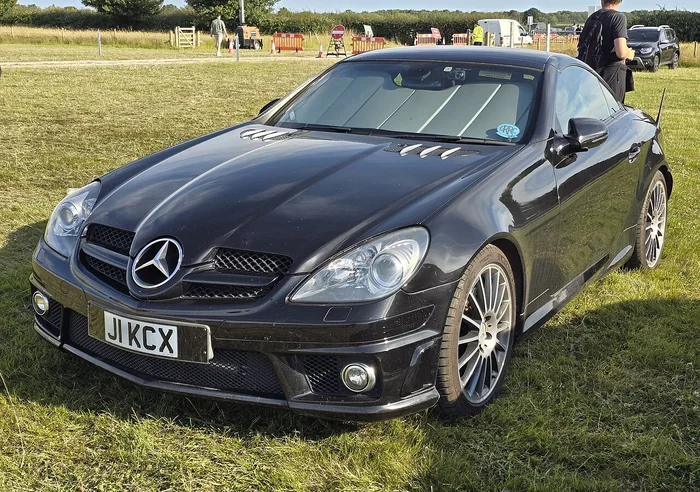
Vehicle Identity
| Category | Specification Details |
|---|---|
| Model Code | R171 — Internal chassis designation |
| Sales Designation | SLK 55 AMG |
| Model Year | 2008 — Part of 2005–2011 production run; 2008 received minor updates (facelift arrived MY2009) |
| Body Style | 2-Door Compact Luxury Roadster — Retractable Hardtop (Vario-Roof) |
| Assembly Location | Bremen, Germany |
| Platform | Modified W203 (C-Class) Floorpan — Shortened wheelbase, specific suspension geometry |
Dimensions & Weight
| Category | Specification Details |
|---|---|
| Wheelbase | 2,430 mm (95.7 in) |
| Length | 4,087 mm (160.9 in) |
| Width (excl. mirrors) | 1,780 mm (70.1 in) |
| Width (incl. mirrors) | 1,990 mm (78.3 in) |
| Height | 1,301 mm (51.2 in) |
| Front Track | 1,524 mm (60.0 in) |
| Rear Track | 1,516 mm (59.7 in) |
| Curb Weight (DIN) | 1,595 kg (3,516 lbs) — With all fluids, 90% fuel, no driver |
| Gross Vehicle Weight (GVWR) | 1,930 kg (4,255 lbs) |
| Max Payload | ~335 kg (739 lbs) |
| Weight Distribution (F/R) | 51.5% / 48.5% — Near-ideal for front-mid engine layout |
| Trunk Volume (Roof Up) | 225 L (7.9 cu ft) |
| Trunk Volume (Roof Down) | 165 L (5.8 cu ft) — Mechanism intrudes significantly into cargo space |
| Fuel Tank Capacity | 70 L (18.5 US gal) — Includes ~8 L reserve |
| Drag Coefficient (Cd) | 0.32 (Top Up) / 0.35 (Top Down) |
Powertrain – Engine (M113 E55)
| Category | Specification Details |
|---|---|
| Engine Code | M113.989 — Naturally Aspirated V8; Hand-built “One Man, One Engine” philosophy |
| Configuration | 90° V8, Aluminum Block & Heads |
| Displacement | 5,439 cc (5.4 L / 331.9 cu in) |
| Bore x Stroke | 97.0 mm x 92.0 mm (3.82 x 3.62 in) — Undersquare design for torque |
| Compression Ratio | 11.0 : 1 — Requires 98 RON (Premium) fuel |
| Valvetrain | SOHC, 3 Valves per Cylinder (2 Intake, 1 Exhaust) — 24 Valves Total; Hydraulic Lash Adjusters |
| Fuel System | Bosch ME 2.8 Sequential Multi-Port Injection (PFI) — Returnless fuel system |
| Ignition | Coil-on-Plug (8 Individual Coils) — Ion-current knock detection |
| Lubrication | Dry Sump (Integrated Oil Tank in Engine) — Critical for lateral G-force oil starvation prevention |
| Max Power (DIN/ISO) | 265 kW (360 PS / 355 hp) @ 5,750 rpm |
| Max Torque (DIN/ISO) | 510 Nm (376 lb-ft) @ 4,000 rpm — Broad plateau from 2,750–5,000 rpm |
| Specific Output | 66.3 hp/L — Respectable for NA V8 of era |
| Redline / Rev Limiter | 6,800 rpm / 7,000 rpm |
| Engine Oil Capacity | 8.5 L (9.0 qts) — Mobil 1 0W-40 / 5W-40 (MB 229.5 spec) |
| Coolant Capacity | ~14.5 L — Genuine MB Coolant (Blue concentrate) |
Transmission & Driveline
| Category | Specification Details |
|---|---|
| Transmission Type | 7G-Tronic (722.9) 7-Speed Automatic — Torque Converter; No manual option offered |
| Gear Ratios | 1st: 4.377 / 2nd: 2.859 / 3rd: 1.921 / 4th: 1.368 / 5th: 1.000 / 6th: 0.820 / 7th: 0.728 |
| Reverse Ratio | 3.416 |
| Final Drive Ratio | 3.27 (Standard) / 3.46 (Optional AMG Performance Package) — 3.27 standard for 2008 US spec |
| Drive Type | Rear-Wheel Drive (RWD) |
| Differential | AMG Mechanical Limited-Slip Differential (LSD) — 30% Lock-up (Acceleration) / 30% Lock-up (Deceleration) |
| Driveshaft | Two-piece Aluminum/Steel Hybrid — Center support bearing |
| Shift Modes | C (Comfort), S (Sport), M (Manual) — Steering wheel paddles standard |
Chassis & Suspension
| Category | Specification Details |
|---|---|
| Front Suspension | AMG 3-Link Aluminum Wishbones — Anti-dive geometry; Aluminum knuckles |
| Rear Suspension | AMG 5-Link Independent (Multi-Link) — Aluminum subframe; Separate spring/damper layout |
| Springs | AMG Progressive Rate Coil Springs — Lowered ~10-15mm vs. standard SLK |
| Dampers | AMG Gas-Pressurized Monotube Shocks — Fixed rate (Non-adaptive standard); Sport-tuned valving |
| Anti-Roll Bars | Front: 32.5 mm (Hollow) / Rear: 22 mm (Solid) — Increased stiffness vs. base models |
| Steering Type | Speed-Sensitive Hydraulic Power Assist (Servotronic) — Recirculating Ball (Not Rack & Pinion) |
| Steering Ratio | 16.5:1 (Variable) |
| Turns Lock-to-Lock | 2.7 |
| Turning Circle | 10.6 m (34.8 ft) — Curb-to-curb |
| BRAKES (AMG High-Performance Compound System) | |
| Front Rotors | 360 mm x 32 mm (14.2 in) Internally Vented, Cross-Drilled — 2-Piece Floating Rotors (Aluminum Hat + Iron Ring) |
| Front Calipers | 6-Piston Fixed Aluminum Monobloc (AMG Branded) — Painted Silver/Red; “AMG” Script |
| Rear Rotors | 330 mm x 22 mm (13.0 in) Internally Vented, Cross-Drilled — 1-Piece Cast Iron |
| Rear Calipers | 1-Piston Floating (Sliding) with Integrated Parking Brake |
| Brake Booster | Tandem Vacuum Assist (Electronic Brake Force Distribution – EBD) |
| Parking Brake | Mechanical Drum-in-Hat (Integrated in Rear Rotor) — Cable actuated |
| Tire Pressure Monitoring | Direct System (Sensors in Valve Stems) — Displays individual pressures in cluster |
| WHEELS & TIRES (Standard US Spec) | |
| Wheel Design | AMG 5-Spoke Light Alloy (Code 781) — Staggered Fitment |
| Front Wheels | 8.5 J x 18 ET 41 |
| Rear Wheels | 9.5 J x 18 ET 33 |
| Front Tires | 245/40 R18 93Y XL — Michelin Pilot Sport PS2 / Continental SportContact 5 / Bridgestone Potenza RE050A (OE varied) |
| Rear Tires | 265/35 R18 93Y XL — Staggered setup prohibits rotation |
| Spare Tire | TIREFIT Mobility Kit (Sealant + Compressor) — No spare well due to roof mechanism/battery location |
| PERFORMANCE FIGURES (Manufacturer Claims) | |
| 0–60 mph (0–96 km/h) | 4.7 – 4.9 seconds — Dependent on surface/temp; 3.46 diff drops ~0.2s |
| 0–100 km/h (0–62 mph) | 4.9 seconds |
| 0–160 km/h (0–100 mph) | ~11.5 seconds |
| 1/4 Mile (400m) | ~13.1 – 13.3 sec @ 108–110 mph |
| Top Speed (Electronically Limited) | 250 km/h (155 mph) |
| Top Speed (Delimited / Perf. Pkg) | ~275–280 km/h (171–174 mph) — Aerodynamically limited by lift at high speed |
| Lateral Accel (Skidpad) | ~0.95 – 0.98 g — On OE tires |
| Braking 70–0 mph | ~155–160 ft |
| Fuel Economy (EPA 2008 Adjusted) | 14 City / 21 Highway / 16 Combined mpg |
| CO2 Emissions (EU Cycle) | ~320 g/km |
Exterior & Body
| Category | Specification Details |
|---|---|
| Roof Type | Vario-Roof (3-Piece Retractable Hardtop) — Electro-hydraulic operation |
| Roof Operation Time | ~22 Seconds (Open/Close) — Operable up to ~40 km/h (25 mph) |
| Roof Material | Steel Outer Panel / Aluminum Structure / Mg Headliner — Includes integrated glass rear window with defroster |
| Body Panels | Steel (Doors, Fenders) / Aluminum (Hood, Trunk Lid) — Hood features “Powerdomes” (non-functional styling) |
| Aerodynamics | AMG Front Splitter, Side Skirts, Rear Apron w/ Diffuser — Unique to 55 AMG; Flat underbody paneling |
| Exhaust | Dual Dual (4 Outlets) Polished Stainless Steel — AMG “Trumpet” Tips; Flapper valves in rear mufflers (Sport mode) |
| Headlights | Bi-Xenon (D2S) with Dynamic Cornering Lights — Standard; Headlamp washing system standard |
| Taillights | LED Tail/Brake Lights / Incandescent Turn/Reverse — Distinctive “C-Shape” LED signature |
| Mirrors | Power Folding, Heated, Auto-Dim (Driver), Memory — Aluminum mirror bases (AMG specific) |
Interior & Comfort
| Category | Specification Details |
|---|---|
| Seats | AMG Performance Sport Seats (Fixed Backrest Bolsters) — Integrated Headrests; More aggressive bolstering than 350/280 |
| Seat Upholstery | Nappa Leather (Standard) / Designo Leather (Option) — Perforated centers; Contrast stitching (Silver/Red) |
| Seat Adjustment | 10-Way Power (Driver/Pass) + 4-Way Lumbar + Memory (Driver) — Easy Entry/Exit steering column linked |
| Heating / Ventilation | Seat Heating Standard / Airscarf (Neck Heat) Optional — Airscarf integrated into headrest |
| Steering Wheel | AMG Performance Steering Wheel (Flat Bottom, Thick Rim) — Aluminum Shift Paddles; Perforated Leather Grip Areas |
| Trim | AMG Carbon Fiber / Piano Lacquer Black / Aluminum — Carbon Fiber standard on 2008 MY |
| Instrument Cluster | AMG Specific: White Face, Red Needles, 320 km/h Speedo — Center LCD for trip computer / gear indicator |
| Infotainment | COMAND APS (NTG2.5) w/ 6.5″ Screen — HDD Navigation (DVD Map), CD/DVD, SD Card, Bluetooth (Phone only), harman/kardon Logic7 (11 Spkr, 450W) Opt |
| Climate Control | THERMATIC Dual-Zone Automatic — Microfilter (Charcoal) |
| Aircap / Airscarf | Aircap (Draft Stop) Standard / Airscarf Optional — Aircap deploys automatically with roof down > 60 km/h |
| Storage | Glovebox (Cooled), Center Console Bin, Door Pockets — No rear seats; Parcel shelf behind seats |
Safety & Driver Assistance
| Category | Specification Details |
|---|---|
| Airbags | Dual Front (Adaptive), Side Thorax (Seat), Window Curtain (Door-mounted) — Knee airbags not equipped |
| Stability Control | ESP (Electronic Stability Program) w/ ASR/ABD — 3-Stage: On / Sport Handling Mode (ESP SPORT) / Off |
| Traction Control | ASR (Acceleration Slip Regulation) — Integrated into ESP |
| Braking Aids | BAS (Brake Assist System), ABS, EBD |
| Structural | High-Strength Steel Cell; Roll-over Bars (Pop-up behind seats) — Deploy in 0.25s if rollover detected |
| Tire Pressure Monitor | Direct (Individual Pressure Readout) |
| Anti-Theft | ATA (Anti-Theft Alarm) w/ Tow-Away Protection / Immobilizer — Keyless Go (Optional) |
| ISOFIX | Not Available (2-Seater) |
| KEY OPTIONS & PACKAGES (2008 MY Highlights) | |
| P30 AMG Performance Package | 3.46 Rear Axle Ratio, Speed Limiter raised to 280 km/h, AMG Track Pace (Data Logging), Specific Suspension Tuning — Highly Desirable |
| AMG Performance Studio | Matte Paint, Forged Wheels (19″), Carbon Ceramic Brakes (CCB), Alcantara Wheel/Roof, Performance Exhaust — Very Rare / Expensive |
| Lighting Package | Bi-Xenon w/ Active Curve Illumination + Intelligent Light System (ILS) — ILS adds: Cornering, Fog, Highway, Country modes |
| Parktronic | Front & Rear Parking Sensors — Visual/Audible |
| Rear View Camera | Integrated in COMAND Screen — Rare on 2008 |
| Bang & Olufsen BeoSound | 14 Speakers, 1000W, Digital Signal Processing — Extremely Rare Option |
| Designo Packages | Exclusive Leather Colors (Classic Red, Cashmere, Porcelain), Matching Trim, Carpets — Custom Order |
| 19″ AMG Twin 5-Spoke Wheels | Code 786 / 787 (Forged Optional) — Requires lower profile tires (245/35 / 265/30) |
| Carbon Ceramic Brakes (CCB) | 390mm Front / 360mm Rear; 6-Pot Front / 4-Pot Rear — Gold Calipers; Massive Unsprung Weight Savings |
Model identity
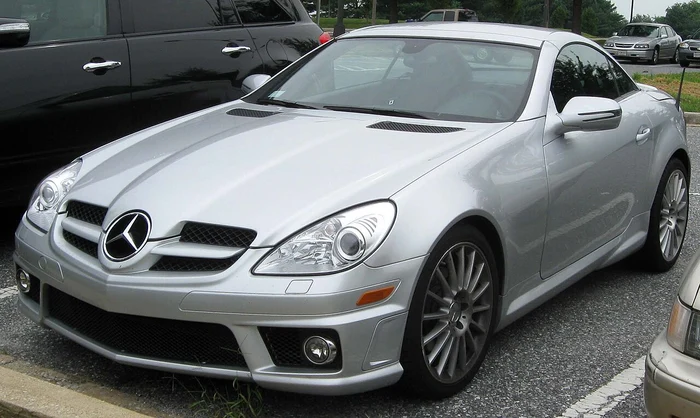
There is a specific breed of automobile that doesn’t just occupy a segment—it creates its own gravitational pull. The 2008 Mercedes-Benz SLK 55 AMG is precisely that machine. In an era where the compact roadster class was defined by the Mazda MX-5’s lightweight purity on one end and the Porsche Boxster’s mid-engine balance on the other, Mercedes-AMG (still technically a wholly owned subsidiary tuning house at the time, not yet a full GmbH) dropped a hand-built, 5.4-liter naturally aspirated V8 into the nose of the R171.
It was an act of delightful, glorious overengineering.
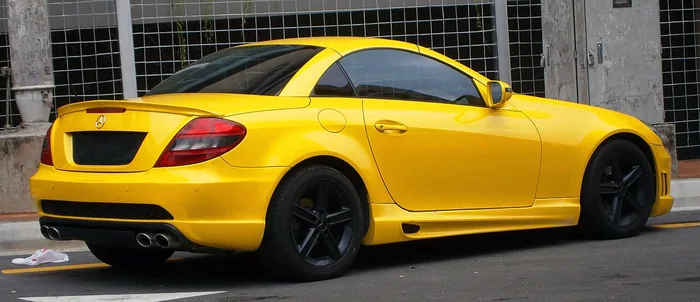
Image source: Wikimedia Commons (user Aero777)
Development
To understand the SLK 55, you have to look at the R170 predecessor. The original SLK 32 AMG (2001–2004) was a supercharged screamer, a brute-force solution to the “more power” question. But the R171 chassis, launched for the 2005 model year, was a quantum leap in rigidity and sophistication. It was the first SLK to feel like a genuine shrunken SL, utilizing a high-strength steel monocoque that allowed the Vario-Roof—a three-piece, electro-hydraulic folding metal top—to operate without turning the chassis into a wet noodle.
AMG’s brief for the R171 flagship was simple on paper, monumental in execution: fit the M113 V8. The engine bay of the R170 was tight; the R171’s was tighter, designed around four and six-cylinder architectures. The engineers in Affalterbach didn’t just shoehorn it in; they rewrote the front-end architecture. The radiator was angled, the cooling stack reconfigured, and a dry-sump lubrication system was made standard—not as a track-day bragging right, but a necessity to prevent oil starvation during the high lateral loads this short-wheelbase car could generate.
Engines and performance
The 2008 model year represents the swan song for the M113 engine family in the SLK. This wasn’t the new direct-injection M156 6.2L found in the CLK 63 or C 63; it was the proven, port-injected, three-valve SOHC legend. In the SLK 55, it produced 360 PS (355 hp) and 510 Nm (376 lb-ft).
On paper, the numbers look modest by modern turbocharged standards. In the flesh, the character is irreplaceable. There is no lag, no artificial torque curve sculpted by a wastegate actuator. The response is instantaneous, linear, and accompanied by a soundtrack that is purely mechanical induction noise and exhaust resonance—amplified by the AMG-specific airbox and the flapper-valve exhaust that opens a direct path at higher loads.
It revs to 6,800 rpm with a metallic, purposeful snarl, delivering its peak torque at a low 4,000 rpm, making the car devastatingly effective in the mid-range where street driving actually happens.
1. Transmission
Purists often lament the lack of a manual transmission. In 2008, AMG’s philosophy was binary: torque converter autos for V8s, DCTs (eventually) for track weapons. The 7G-Tronic (722.9) here is a known quantity—smooth, efficient, and geometrically spaced. In “C” mode, it short-shifts aggressively for economy; in “S” or “M,” it holds gears to redline and blips downshifts with satisfying authority.
The steering-wheel-mounted aluminum paddles are large, fixed, and tactile. Is it a dual-clutch? No. Does it suit the GT-nature of the SLK? Absolutely. The torque converter soaks up the V8’s low-end grunt off the line, delivering consistent 0-60 mph times in the 4.7-second range—supercar territory in 2008.
Chassis and driving character
1. Suspension and traction
With a wheelbase of just 2,430 mm (95.7 inches), the SLK 55 rotates with a keenness that belies its ~1,600 kg curb weight. The AMG suspension geometry—specific aluminum control arms, 10-15mm lower ride height, stiffer progressive springs, and monotube dampers—transforms the R171 from a boulevard cruiser into a genuine canyon carver.
The steering remains a hydraulic recirculating ball setup (Servotronic). While the Boxster S of the same era offered rack-and-pinion precision, the Mercedes system offers something rarer today: texture. You feel the road texture, the camber changes, and the limit of the front Michelin Pilot Sports through the thick, flat-bottomed AMG rim. It requires more arm input in tight hairpins, but the feedback fidelity is high.
2. Steering and brakes
The standard Mechanical Limited-Slip Differential (approx. 30% lock) is the unsung hero. It allows the 55 to put power down aggressively out of corners, rotating the rear on throttle if provoked, but remaining predictable and catchable. The optional AMG Performance Package (P30), identifiable by the 3.46:1 rear axle ratio (vs. standard 3.27) and a raised limiter to 280 km/h, is the holy grail for enthusiasts today.
It sharpens the gearing just enough to make the V8 feel perpetually “on the boil” without ruining highway cruising.
3. Brakes
The standard AMG compound braking system is formidable: 360mm cross-drilled, two-piece floating front rotors clamped by six-piston monobloc calipers. They are fade-resistant, progressive, and offer immense bite. For the 0.1% of owners who tracked these cars, the Carbon Ceramic (CCB) option (Code B07) was available—390mm fronts, 360mm rears, gold calipers, and a massive reduction in unsprung mass. Today, a CCB-equipped SLK 55 is a unicorn.
Design: retractable hardtop
No discussion of the R171 is complete without the roof. The three-piece steel/aluminum/magnesium hardtop folds into the trunk in 22 seconds. It is a marvel of packaging, but it dictates the car’s proportions. With the roof up, the SLK 55 is a remarkably quiet, weather-tight coupe with a usable (if shallow) trunk. With the roof down, the trunk volume halves, and the rear deck rises high, affecting rearward visibility.
However, Mercedes solved the turbulence issue better than anyone with Aircap. A small lip extends from the top of the windshield frame, and a deployable deflector rises from the rear headrests. Together, they create a massive, calm bubble of air at 80 mph, allowing conversation at normal volumes. Add the optional Airscarf (neck-level heating integrated into the headrests), and the top-down season extends deep into November.
Interior and equipment
Stepping into the 2008 cabin is a masterclass in late-2000s Mercedes solidity. The doors close with a authoritative thunk. The standard AMG Performance seats are the highlight—deeply bolstered, fixed-back buckets (integrated headrests) trimmed in Nappa leather with contrasting silver or red stitching. They hold you during lateral acceleration but remain comfortable for 500-mile stints.
The dashboard architecture is driver-centric, dominated by the three large analog vents and the COMAND 2.5 infotainment system (6.5-inch screen, HDD nav, 6-disc DVD changer in the glovebox). It looks dated now—no CarPlay, no touchscreen—but the rotary controller is ergonomically perfect for driving. The optional harman/kardon Logic7 system remains one of the best OEM audio setups ever fitted to a convertible, utilizing the windshield header and seat structures for imaging.
Carbon fiber trim was standard on the 55 (optional on lesser models), and the AMG instrument cluster—white faces, red needles, 320 km/h speedometer—signals intent immediately.
Related models
Other Motor Wiki entries in this SLK AMG cluster:
Legacy
The 2008 SLK 55 AMG sits in a unique historical sweet spot. It was the last SLK to feature a naturally aspirated V8 (the R172 SLK 55 switched to the twin-turbo M157 5.5L). It was built during the “One Man, One Engine” era where every M113 received a plaque on the intake manifold bearing the builder’s signature.
Today, it occupies a strange valuation valley. It is too new to be a classic, too old to be “modern,” and too heavy to be a pure sports car. But for the driver who wants a daily-driveable, top-down GT car with a hand-built V8, a metal roof, hydraulic steering, and zero turbo lag, there is genuinely nothing else like it on the market. It doesn’t ask you to compromise. It asks you to enjoy the engineering.
Verdict: The 2008 SLK 55 AMG is not a track toy. It is a scalpel in a tuxedo—precise when you need it, comfortable when you don’t, and powered by an engine architecture that the industry has largely abandoned. It remains one of the most characterful, complete, and sonically glorious roadsters Mercedes-AMG has ever produced.
Leave a Reply
You must be logged in to post a comment.