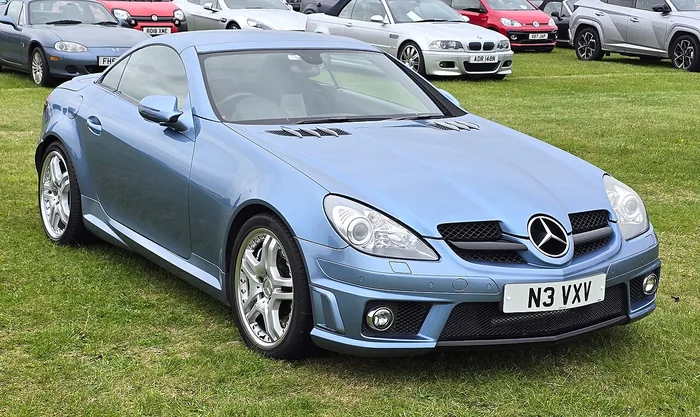
Vehicle Identity
| Category | Specification Details |
|---|---|
| Model Code | C171 (R171 Platform) | Internal designation: W171 for roadster |
| Sales Designation | SLK 55 AMG Black Series — “Black Series” denotes track-focused, limited-run variant |
| Model Year | 2006 (Production: 06/2005 – 06/2006) — Single model year production run |
| Body Style | 2-Door Retractable Hardtop Roadster — Vario-Roof mechanism retained (steel panel) |
| Assembly Plant | Bremen, Germany (Body/Chassis) / Affalterbach, Germany (AMG Final Assembly) — “One Man, One Engine” philosophy applied at Affalterbach |
| VIN Prefix | WDB 171… — Specific AMG codes in VDS section |
Production & Exclusivity
| Category | Specification Details |
|---|---|
| Total Global Production | ~600 – 700 Units (Exact figures vary by registry; commonly cited ~680) — Extremely rare; not officially sold in USA/Canada (Grey market only) |
| Primary Markets | Europe (Germany, UK, France, Italy), Japan, Middle East, Australia — Right-hand drive produced for UK/Japan/Australia |
Dimensions & Weight
| Category | Specification Details |
|---|---|
| Length | 4,087 mm (160.9 in) — Identical to standard SLK 55 AMG |
| Width (excl. mirrors) | 1,780 mm (70.1 in) — Widened front track via specific offset wheels |
| Width (incl. mirrors) | 1,945 mm (76.6 in) |
| Height | 1,303 mm (51.3 in) — Lowered suspension reduces height vs standard |
| Wheelbase | 2,430 mm (95.7 in) |
| Front Track | 1,542 mm (60.7 in) — Widened by ~26mm vs standard SLK 55 via wheel offset |
| Rear Track | 1,530 mm (60.2 in) — Widened by ~26mm vs standard SLK 55 via wheel offset |
| Dry Weight (DIN) | 1,415 kg (3,120 lbs) — ~25 kg (55 lbs) lighter than SLK 55 AMG |
| Curb Weight (EU / Fluids + 75kg driver) | ~1,490 kg (3,285 lbs) |
| Weight Distribution (F/R) | 51.5 / 48.5 % — Near-ideal balance for FR layout |
| Gross Vehicle Weight (GVW) | 1,795 kg (3,957 lbs) |
| Max Roof Load | 50 kg (110 lbs) — Vario-roof mechanism limits load |
| Drag Coefficient (Cd) | 0.32 (Top up) / 0.35 (Top down) — Slightly higher than coupe due to roof seams |
| Frontal Area (A) | 2.15 m² |
Powertrain – Engine (M113 E55 Ml Amg)
| Category | Specification Details |
|---|---|
| Engine Type | 90° V8, Naturally Aspirated, DOHC 24V — Hand-built in Affalterbach; “One Man, One Engine” plaque on engine |
| Displacement | 5,439 cc (5.4 L / 332 cu in) — Bore x Stroke: 97.0 mm x 92.0 mm |
| Block Material | Aluminum-Silicon (Alusil) Cylinder Liners — No cast iron liners; lightweight, low friction |
| Head Material | Aluminum Alloy — 3 Valves per cylinder (2 Intake, 1 Exhaust) |
| Compression Ratio | 11.3 : 1 — High compression for NA response |
| Valvetrain | Chain-driven DOHC, 3V/cyl, Bucket Tappets — Single overhead cam per bank technically (simulated DOHC via single cam with rocker arms for exhaust) – Correction: M113 is SOHC 3V per bank (2 intake, 1 exhaust). 24 Valves total. |
| Variable Valve Timing | None (Fixed Cam Timing) — M113 lacks VVT; relies on displacement and intake manifold tuning |
| Intake System | AMG Specific “Ram-Air” Carbon Fiber Airbox — Unique to Black Series; conic filter, carbon ducting from front grille, resonance flap |
| Throttle Body | Electronic Drive-by-Wire (Single Throttle Body) — Magnesium intake manifold (2-stage variable length on some M113, but fixed on 55 AMG) |
| Fuel System | Sequential Multi-Point Injection (Bosch ME 2.8) — High-flow injectors (specific part # vs standard 55) |
| Fuel Requirement | 98 RON / 93 AKI (Premium Unleaded) — Knock sensor calibration aggressive |
| Engine Oil Capacity | 8.5 Liters (9.0 US qts) — Dry sump style capacity; wet sump system with baffled pan |
| Oil Cooling | Engine Oil-to-Coolant Heat Exchanger + Front Mounted Oil Cooler — Additional cooler critical for track use |
| PERFORMANCE (Manufacturer Claims) | |
| Max Power | 400 PS (294 kW / 395 hp) @ 6,100 rpm — +10 PS over standard SLK 55 AMG (390 PS) |
| Specific Output | 73.5 PS / Liter — Exceptional for NA V8 of era |
| Max Torque | 520 Nm (384 lb-ft) @ 4,000 rpm — +10 Nm over standard; flat curve 3,000–5,000 rpm |
| 0–100 km/h (0–62 mph) | 4.6 Seconds — Limited by RWD traction off the line |
| 0–200 km/h (0–124 mph) | ~16.5 Seconds |
| 0–400 m (1/4 Mile) | ~12.8 – 13.0 Seconds @ ~175 km/h (109 mph) — Dependent on surface/tires |
| Top Speed (Electronic Limiter) | 250 km/h (155 mph) — Standard German “Gentleman’s Agreement” limiter |
| Top Speed (Derestricted) | ~275 – 280 km/h (171 – 174 mph) — Drag limited (high Cd with roof up) |
Transmission
| Category | Specification Details |
|---|---|
| Type | AMG SPEEDSHIFT 5G-TRONIC (5-Speed Automatic) — 722.6 Reinforced; No 7G-Tronic (7-speed) yet |
| Torque Converter | Lock-up in Gears 2–5 — Faster lock-up calibration vs standard |
| Shift Modes | C (Comfort), S (Sport), M (Manual) — “S” mode holds gears to redline; faster shifts |
| Shift Speed (S/M Mode) | ~150–200 ms — Significantly reduced vs standard (35% faster claimed) |
| Gear Ratios | 1st: 3.59 — 2nd: 2.19 — 3rd: 1.41 — 4th: 1.00 — 5th: 0.83 — R: 3.16 |
| Final Drive Ratio | 3.27 : 1 (Optional 3.46:1 available via AMG Performance Studio) — Shorter than standard 2.85:1 for acceleration |
| Differential | AMG Mechanical Limited-Slip Differential (LSD) — 25% Lock-up (Coasting) / 45% Lock-up (Acceleration) — Torque-sensing (Torsen-type) — Specific to Black Series |
| Paddle Shifters | Fixed Aluminum Paddles (Mounted on column) — Non-rotating with wheel; Magnesium option exists |
Chassis & Suspension
| Category | Specification Details |
|---|---|
| Front Suspension | Double Wishbone (4-Link), Aluminum Control Arms — AMG Specific Geometry (Camber, Caster, Toe) |
| Rear Suspension | 5-Link Independent, Aluminum/Steel Mix — AMG Specific Geometry; Increased Negative Camber |
| Springs | AMG Specific Coil Springs (Red Paint Mark) — ~30% Stiffer Rate vs SLK 55 AMG; Lowered 10mm Front / 10mm Rear |
| Dampers | AMG Tuned Monotube Gas Pressure (Bilstein) — Fixed Valving (Non-Adjustable); Specific “Black Series” tune – High Low-Speed Compression |
| Anti-Roll Bars | **Front: 32.5 mm (Solid) — Rear: 22.0 mm (Hollow)** — Significantly thicker vs Standard SLK 55 (F: 28.5 / R: 19.5) |
| Chassis Bracing | Carbon Fiber Strut Tower Brace (Engine Bay) — Visible Carbon Weave; Structural rigidity + aesthetics |
| Aluminum Underbody Brace (Front Subframe) | Connects front lower control arm mounts |
| Rear Shelf Brace (Behind Seats) | Box-section steel; ties rear shock towers/bulkhead |
| Ride Height (Unladen) | ~110 mm Front / ~115 mm Rear (Approx.) — ~10-15mm lower than standard SLK 55 AMG |
Steering
| Category | Specification Details |
|---|---|
| Type | Hydraulic Power Assisted Rack & Pinion (Servotronic) — Speed-sensitive assist; No Electric Assist (EPS) |
| Ratio | Variable Ratio (approx. 15.5:1 center) — Quickened vs standard |
| Turns Lock-to-Lock | 2.7 |
| Turning Circle | 10.6 m (34.8 ft) — Curb-to-curb |
Braking System
| Category | Specification Details |
|---|---|
| Front Brakes | 360 mm x 32 mm Internally Vented & Grooved Discs — 2-Piece Floating Rotors (Aluminum Hat + Iron Ring) |
| Front Calipers | AMG 6-Piston Fixed Monobloc Aluminum Calipers — Painted High-Gloss Black with “AMG” lettering |
| Rear Brakes | 330 mm x 22 mm Internally Vented & Grooved Discs — 2-Piece Floating Rotors |
| Rear Calipers | AMG 4-Piston Fixed Monobloc Aluminum Calipers — Painted High-Gloss Black |
| Parking Brake | Mechanical Drum-in-Hat (Integrated in Rear Rotor) — 180 mm Drum diameter; Cable operated |
| Brake Lines | Steel Braided Flex Lines (Front & Rear) — Standard equipment; reduced expansion |
| Brake Fluid | DOT 4+ (Low Viscosity) — High boiling point for track |
| ABS/ESP | ESP with “Sport Handling” Mode — Two-stage: ON / Sport Handling / OFF (Long press) — Threshold braking optimized |
Wheels & Tires (Staggered Fitment)
| Category | Specification Details |
|---|---|
| Wheel Design | AMG 10-Spoke Forged Aluminum (Code 787) — Magnesium Forged Optional (Code 788 – Extremely Rare) |
| Wheel Finish | Matte Black (Standard) / High-Sheen Black (Optional) — Center Lock Look (5-Bolt Pattern) |
| Front Wheels | 8.5 J x 18 ET 37 — Wider offset pushes track out |
| Rear Wheels | 9.5 J x 18 ET 32 |
| Front Tires | 225/40 ZR 18 (92Y) XL — Michelin Pilot Sport 2 (N0 / N1 Homologation) |
| Rear Tires | 245/35 ZR 18 (92Y) XL — Michelin Pilot Sport 2 (N0 / N1 Homologation) |
| Spare Tire | TIREFIT Mobility Kit (Sealant + Compressor) — No spare well due to Vario-roof mechanism / battery location |
| TPMS | Indirect (ABS Wheel Speed Sensor based) — No direct pressure sensors in valves |
Exterior & Aerodynamics
| Category | Specification Details |
|---|---|
| Front Bumper / Splitter | AMG Black Series Specific — Larger air intakes; Integrated Carbon Fiber Front Splitter (Structural) |
| Hood | Carbon Fiber (CFRP) with Powerdomes — ~4.5 kg lighter than steel; Twin nostrils for engine breathing; Clear coat only (Visible weave) |
| Front Fenders | Carbon Fiber (CFRP) Widebody — +26 mm Width per side; Integrated side vent (functional, extracts wheel well pressure) |
| Roof | Steel Vario-Roof (Retractable Hardtop) — Not Carbon Fiber; Mechanism adds weight high up |
| Side Skirts | Carbon Fiber (CFRP) — Extended profile; reduces lift |
| Rear Diffuser | Carbon Fiber (CFRP) — Functional underbody exit; Central dual exhaust exit |
| Rear Spoiler | Fixed Carbon Fiber (CFRP) “Ducktail” Spoiler — Mounted to trunk lid; Adjustable Gurney flap (3 positions) via bolts |
| Mirror Housings | Carbon Fiber (CFRP) — Matte finish standard |
| Exhaust Tips | Quad Round Chrome (Black Chrome Optional) — Integrated into diffuser; Active flap control (vacuum) |
| Glass | Green-Tinted Heat-Insulating — Windshield: Laminated; Side/Rear: Tempered |
| Paint Colors (Standard) | Designo Graphite (Matte/Non-Metallic Black) — Exclusive to Black Series; No cost option |
| Paint Colors (Optional) | Designo Magno Cashmere White (Matte), Designo Magno Alanite Grey (Matte), Standard Metallics — Matte paints require specific care (no wax, hand wash only) |
Interior & Equipment
| Category | Specification Details |
|---|---|
| Seats | AMG Performance Bucket Seats (Fixed Backrest) — Carbon Fiber Shell (CFRP); Manual Slide/Recline (Tilt forward for rear access) |
| Seat Upholstery | Black Dinamica Microfiber (Suede-like) / Black Leather Bolsters — Red Contrast Stitching Standard; “AMG” Embossed Headrests |
| Seat Belts | Red Seat Belts — Unique to Black Series |
| Steering Wheel | AMG Performance Steering Wheel — Flat Bottom; Alcantara/Dinamica Grip; Red 12 O’Clock Mark; Carbon Fiber Bezel; Paddle Shifters |
| Instrument Cluster | AMG Specific — White Face Gauges; Red Needles; “BLACK SERIES” Startup Logo; Oil Temp / Boost (N/A) Gauges |
| Center Console | Carbon Fiber Trim (Standard) — Extended to door pulls and dash inserts |
| Door Panels | Dinamica Inserts / Leather / Carbon Fiber Pulls — Weight savings vs standard leather |
| Floor Mats | Black Velour with Red Binding / “Black Series” Logo |
| Pedals | Aluminum/Stainless Steel Sports Pedals — Rubber studs |
| Audio/COMAND | COMAND APS (NTG2) — 6.5″ Color Screen; Navigation; CD Changer (Glovebox); Bose Sound System Standard |
| Climate Control | THERMOTRONIC Dual Zone Automatic |
| Safety | Dual Front Airbags; Side Thorax Airbags (Seat mounted); Windowbags (A-pillar); NECK-PRO Head Restraints — ESP, ABS, BAS, ASR Standard |
Fuel & Fluids
| Category | Specification Details |
|---|---|
| Fuel Tank Capacity | 60 Liters (15.9 US Gal) — Small tank = limited range (~350-400 km spirited) |
| Coolant Capacity | ~12.5 Liters — 50/50 MB Coolant / Water |
| Transmission Fluid | ~9.0 Liters (Total) / ~4.5 Liters (Drain/Refill) — MB Sheet 236.14 / 236.15 (Blue) |
| Rear Diff Fluid | 1.0 Liter — MB Sheet 235.7 (Hypoid Gear Oil) + LSD Additive |
Key Options (Codes)
| Category | Specification Details |
|---|---|
| 788 | Magnesium Forged Wheels (Matte Black) — Saves ~8 kg unsprung mass vs Forged Alu |
| 242 | AMG Performance Studio Package — Includes 3.46:1 Diff, Derestricted Top Speed (280 km/h), Track Calibration |
| 536 | AMG Track Pace / Data Logging — Pre-wiring / SD Card slot in glovebox (Retrofit via dealer) |
| 810 | Harman Kardon Logic7 (Standard is Bose) — Rarely optioned over Bose |
| 873 | Heated Seats — Adds weight; often deleted by purists |
| 413 | Panoramic Roof (Glass sections in Hardtop) — Adds weight high up; rarely specified |
| AMG Performance Studio: Fire Extinguisher (2kg) | Mounted in passenger footwell (Dealer fitted accessory) |
Model identity
There is a specific kind of madness required to take a retractable-hardtop roadster—a chassis architecture defined by compromise, scuttle shake, and a high center of gravity—and decide it needs to be a hardcore track weapon. In 2005, AMG possessed exactly that madness. The result was the SLK 55 AMG Black Series (C171), a car that remains one of the most contradictory, fascinating, and brutally effective machines to ever wear the three-pointed star.
Development
To understand the Black Series, you have to understand AMG circa 2005. This was the twilight of the “analog” AMG era—hand-built, naturally aspirated V8s, hydraulic steering, and five-speed automatics—before the turbocharged, all-wheel-drive, dual-clutch future arrived. The standard SLK 55 AMG was already a riot: a 390-hp V8 shoehorned into a tiny wheelbase. But it was a grand tourer at heart. It had leather, it had a Bose system, it had a roof that folded in 22 seconds.
The Black Series program, spearheaded by then-AMG CEO Volker Mornhinweg and chief engineer Bernd Ramler, asked a simple question: What if we stripped the GT away and left only the Racer?
The answer wasn’t just a parts-bin special. It was a holistic re-engineering of the C171 platform. The mandate was weight reduction and aerodynamic efficiency, but the roof had to stay. The Vario-roof mechanism—heavy, complex, and structurally vital—was the elephant in the room. Rather than delete it (which would require a total chassis redesign), AMG worked around it, attacking mass everywhere else.
Engines and performance
1. Engine and power delivery
Under the carbon-fiber hood—vented, naturally, to extract high-pressure air from the engine bay—sat the M113 5.5-liter V8. This was the last hurrah for the naturally aspirated “55” motor before the M156 6.2L took over. In Black Series trim, the engineers squeezed 400 PS (395 hp) and 520 Nm (384 lb-ft) from the 5.4L unit.
Ten horsepower doesn’t sound like much on paper. But the character changed entirely. The standard SLK 55 breathed through a relatively restrictive airbox. The Black Series received a bespoke carbon-fiber intake tract—a “ram-air” system fed by a dedicated duct in the front bumper, complete with a resonance flap that opened at high RPM.
2. Character and response
The throttle response became instantaneous, violent even. The exhaust note, routed through a bespoke four-pipe system with active flaps, lost the civilized burble and gained a guttural, metallic race-car howl that reverberated off the carbon fiber rear diffuser.
It was mated exclusively to the 5G-Tronic 5-speed automatic. No manual, no dual-clutch. But AMG’s “Speedshift” calibration here was arguably the best torque-converter tuning they ever did. Shifts in ‘S’ or ‘M’ mode slammed home with a physical thump, holding gears to the 6,800 rpm limiter with zero hesitation. The shorter 3.27:1 final drive (optional 3.46:1) turned the gearbox into a catapult. 0–100 km/h arrived in 4.6 seconds—limited entirely by rear traction on the 245-section rear Michelins.
Chassis and driving character
This is where the Black Series earned its name. AMG didn’t just lower springs; they rewrote the geometry.
1. Widebody
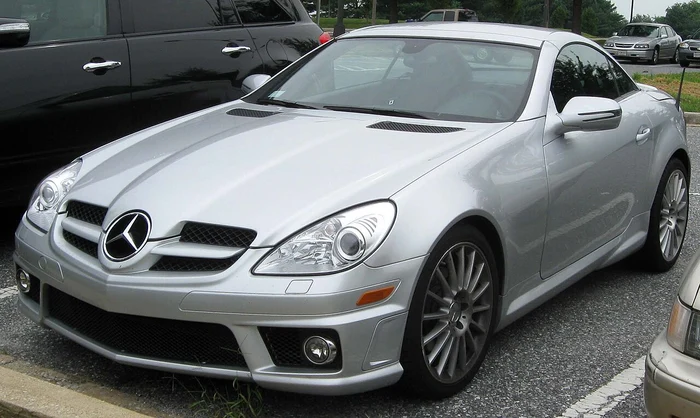
The front and rear fenders are carbon fiber, widened by 26mm per axle. This wasn’t just for show; it allowed a massive increase in track width without changing suspension hard points, utilizing unique wheel offsets (ET37/ET32) on forged 18-inch wheels.
2. Springs & Bars
Spring rates jumped roughly 30%. But the real magic was the anti-roll bars: 32.5mm solid front, 22mm hollow rear. This distribution cured the standard car’s terminal understeer. The Black Series turns in. The front end bites with a precision that feels more like a 911 GT3 than a Mercedes roadster.
3. Bracing
The carbon strut brace in the engine bay isn’t decorative. Combined with the aluminum front underbody brace and the rear bulkhead brace, the torsional rigidity of the open-top structure approached coupe levels. The scuttle shake was banished; the chassis communicated every ripple of asphalt through the Alcantara steering wheel.
4. Brakes
Six-piston front / four-piston rear monobloc calipers clamping two-piece floating rotors (360mm/330mm). They were fade-resistant, modulable, and powerful enough to trigger the ABS on cold tires at 200 km/h. The brake pedal feel—firm, short travel, linear—remains a benchmark for hydraulic systems.
Interior and equipment
Climbing over the wide carbon-fiber door sill into the fixed-back bucket seats is an event. The seats are the stars: carbon-fiber shells trimmed in Dinamica (suede) with red stitching. They hold you in the car, not on it. The steering wheel—flat-bottomed, thick-rimmed, trimmed in the same grippy microfiber with a red 12-o’clock marker—frames the white-faced instruments perfectly.
It is sparse, but not stripped. You still have COMAND navigation, Bose audio, dual-zone climate control, and the party trick: the roof still folds. Watching the complex steel origami disappear into the trunk while you grip a carbon wheel is a cognitive dissonance unique to this car. But the trunk space? Gone. The battery lives there now (relocated from the engine bay for weight distribution), and the roof mechanism eats the rest. This is a two-seater for two people with toothbrushes, not suitcases.
Driving character
On the road, the SLK 55 Black Series is intense. The ride is uncompromising—broken pavement transmits sharp impacts through the carbon seats directly to your spine. The turning circle is wide, the visibility over the rear haunches is poor, and the fuel tank is tiny (60L), demanding frequent stops.
But on a smooth, winding road—or better yet, a track—the contradictions vanish. The mechanical LSD (25/45% lock) allows you to dictate the exit angle with your right foot. The steering, hydraulic and heavy, loads up progressively, telling you exactly when the front 225s are about to give up. You can place the nose with millimetric precision. The V8 torque fills every corner exit, the carbon intake snarling inches from your ears.
It feels analog in a way modern cars simply cannot replicate. No torque vectoring by braking, no active anti-roll bars, no electric steering calibration menus. Just mass, leverage, grip, and 400 horses managed by your right foot and a mechanical diff.
Related models
Other Motor Wiki entries in this SLK AMG cluster:
Legacy
With roughly 680 units built globally—never officially sold in North America—the SLK 55 Black Series was an instant collectible. It was the first “Black Series” roadster (preceded only by the SLK 32 AMG “Black Series” concept that never produced, and followed by the CLK 63 Black Series).
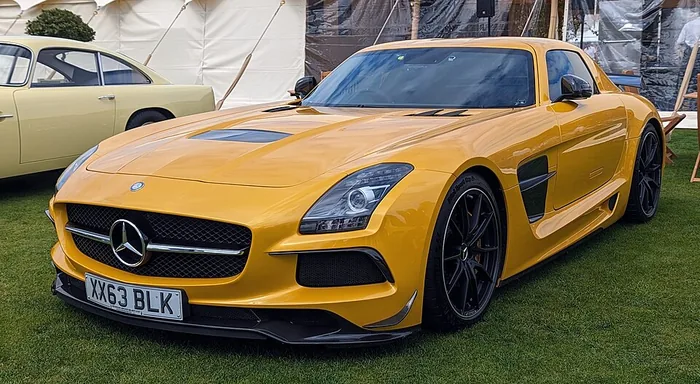
Today, it sits in a unique valuation stratum. It is more valuable than the CLK 63 Black Series, often rivalling the SLS Black Series. Why? Because it represents the absolute peak of the “Old AMG” philosophy applied to the most unlikely platform. It is a naturally aspirated, hydraulic-steering, torque-converter V8 roadster with a carbon widebody and a mechanical LSD.
It shouldn’t work. A heavy folding roof, a short wheelbase, a five-speed auto. But AMG made it work through sheer engineering force of will. The SLK 55 AMG Black Series isn’t just a spec sheet winner; it is a visceral, loud, uncomfortable, and utterly glorious reminder that sometimes, the best cars are the ones that refuse to compromise on the driving experience.
Leave a Reply
You must be logged in to post a comment.