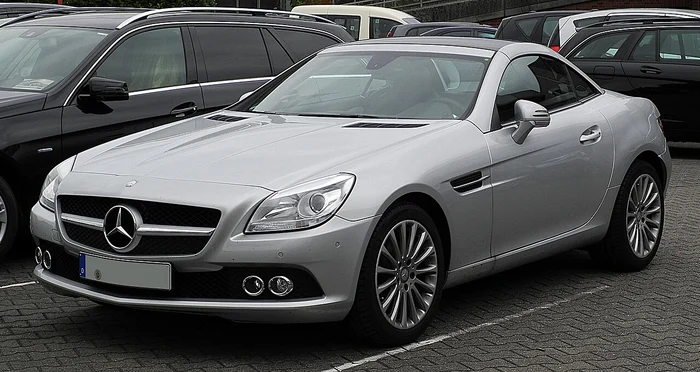
General information & model overview
| Category | Specification Details |
|---|---|
| Model name | 2011 Mercedes-Benz SLK Roadster |
| Internal code | R172 |
| Manufacturer | Mercedes-Benz (Daimler AG); assembled at Bremen, Germany |
| Production window | 2011–2020 (renamed SLC-Class from the 2016 facelift; this entry focuses on the 2011 launch SLK period) |
| Body style | Two-door, two-seat roadster with retractable hardtop (Vario roof) |
| Layout | Front-engine, rear-wheel drive |
| Platform links | Related to Mercedes-Benz C-Class (W204) architecture themes |
| Designer (period) | Il-hun Yoon among exterior design credits for the production form |
| Predecessor | R171 SLK / 2004 R171 launch |
| Name meaning | SLK = sportlich, leicht, kurz (sporty, light, short) |
Body & dimensions
| Category | Specification Details |
|---|---|
| Wheelbase | About 2,484 mm (97.8 in) |
| Overall length | About 4,135 mm (162.8 in) |
| Overall width | About 1,816 mm (71.5 in) |
| Overall height | About 1,300 mm (51.2 in) |
| Roof | Two-piece metal Vario roof; optional panoramic glass; optional Magic Sky Control electrochromic tint |
| Construction | Steel body with high-strength steels; fully retractable hardtop roadster |
| Seating | Two seats only |
Engine specifications (common variants)
| Theme | Details |
|---|---|
| Launch petrol fours | SLK 200 BlueEFFICIENCY ~184 PS (1.8 turbo M271); SLK 250 BlueEFFICIENCY ~204 PS (1.8 turbo) |
| Launch V6 | SLK 350 BlueEFFICIENCY ~306 PS (3.5-litre M276 V6) |
| Diesel (from ~2012) | SLK 250 CDI ~204 PS / 500 Nm (2.1-litre OM651 twin-turbo diesel) — first diesel SLK |
| AMG petrol V8 | SLK 55 AMG ~422 PS / 540 Nm (5.5-litre M152 V8 with cylinder deactivation; sales from 2012) |
| Later SLC range note | From 2016 facelift: SLC naming, revised engines including twin-turbo AMG SLC 43 V6 replacing the V8 in many markets |
Drivetrain & transmission
| Category | Specification Details |
|---|---|
| Manual | 6-speed manual on selected four-cylinder models |
| Automatic | 7G-Tronic Plus seven-speed automatic (launch); later 9G-Tronic on facelift/SLC cars |
| Drive | Rear-wheel drive only |
| Start/stop | ECO start/stop across the engine range |
Chassis, suspension & brakes
| Component | Specification |
|---|---|
| Suspension theme | Front strut / multi-link rear sports chassis; optional Dynamic Handling package; AMG sports suspension on 55 AMG |
| Steering | Direct-steer options with variable assistance |
| Brakes | Ventilated discs; larger AMG brakes on SLK 55 |
| Signature comfort | Airscarf neck-level heating in headrests (carried and refined from R171) |
Performance (approximate)
| Metric | Approximate data |
|---|---|
| SLK 200 class | About 7.0–7.3 s to 100 km/h; top speed near 239 km/h |
| SLK 250 / 250 CDI | About 6.6–6.7 s to 100 km/h |
| SLK 350 | About 5.6 s to 100 km/h; limited ~250 km/h |
| SLK 55 AMG | About 4.6 s to 100 km/h; limited up to ~280 km/h with package |
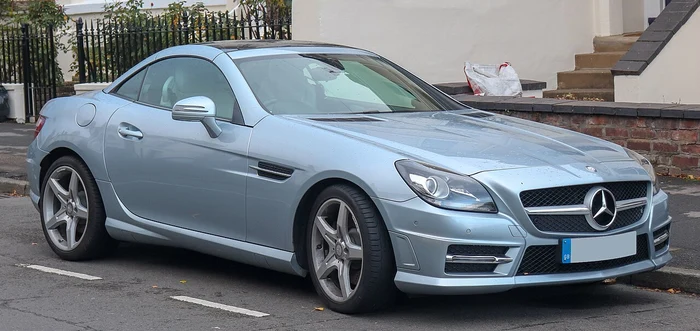
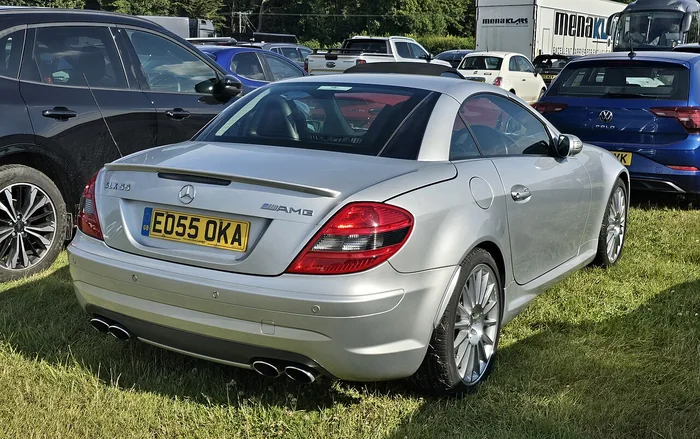
Image source: Wikimedia Commons
What the 2011 SLK Roadster (R172) is
The 2011 Mercedes-Benz SLK Roadster is the third generation of Mercedes’ compact two-seat hardtop roadster. Internal code R172, it succeeds the R171 and was launched publicly in early 2011 with dealer deliveries from spring 2011. It keeps the defining SLK idea — a short rear-drive roadster with a folding metal roof that behaves like a coupe when closed — and adds modern turbo four-cylinder efficiency, the first factory diesel SLK, optional Magic Sky Control glass, and later an AMG V8 peak before the 2016 rename to SLC-Class.
This entry focuses on the 2011-launch SLK identity. Facelift SLC naming, Final Edition closure in 2020, and AMG SLC 43 twin-turbo V6 cars are later chapters of the same R172 shell.
Development and design language
Mercedes presented the car in Stuttgart in January 2011 and at the Geneva Motor Show. Exterior design continues R170/R171 roadster proportions but refreshes the nose with a more upright grille language that period coverage linked to both historic 190 SL cues and contemporary SLS/CLS family graphics. The cabin is a two-seat driver-oriented cockpit with optional COMAND multimedia, Airscarf, and high-grade trim packages including Edition 1 launch cars.
1. Vario roof and Magic Sky Control
The two-piece metal roof remains the product’s practical differentiator versus fabric-top rivals. Options include body-colour roof, panoramic dark glass, and Magic Sky Control: electrochromic glass that switches from clear to tinted at a switch, reducing heat load without a physical blind.
2. Airscarf and open-air usability
Neck-level heated air from the headrests, introduced on the previous generation, remains a signature open-top comfort feature. Combined with a windblocker and solid structure, the R172 is intended as a four-season roadster for owners who use the car as a second vehicle rather than a pure summer toy.
3. Chassis and steering
Wheelbase grows versus R171. Dynamic Handling packages, direct steering, and AMG chassis hardware on the 55 AMG move the car toward sharper response while retaining grand-touring road manners on the base cars.
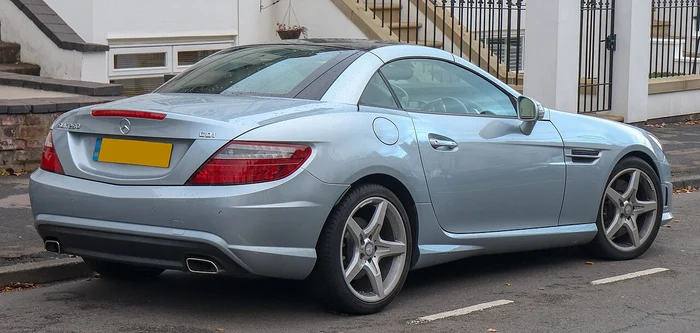
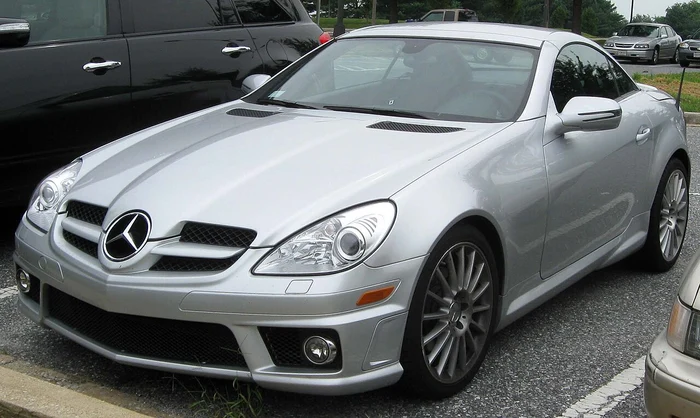
Image source: Wikimedia Commons
Engines and market position
Launch petrol power focused on turbocharged four-cylinders (SLK 200 and 250 BlueEFFICIENCY) and a 306 PS 3.5-litre V6 SLK 350. From 2012 the SLK 250 CDI brought a 204 PS / 500 Nm diesel into the class for the first time — useful for high-mileage European buyers. The SLK 55 AMG used a 422 PS naturally aspirated 5.5-litre V8 with cylinder deactivation, one of the last NA V8 AMG roadsters of its type before biturbo sixes dominated the facelift era.
1. Transmissions
Six-speed manuals remained available on some fours; automatics used 7G-Tronic Plus at launch. Facelift SLC cars later adopted 9G-Tronic widely. AMG used SPEEDSHIFT Plus 7G-Tronic.
2. Efficiency framing
BlueEFFICIENCY branding, start/stop, and diesel torque were part of Mercedes’ early-2010s efficiency push without abandoning rear-drive sports-car packaging. Real-world economy still depends heavily on open-roof use and driving style.
3. How it sits versus neighbours
Versus the contemporary SL, the SLK is shorter, cheaper, and more everyday. Versus BMW Z4 and Audi TT Roadster rivals, it emphasises hardtop security, brand prestige, and comfort features such as Airscarf over pure lightweight sports-car purity.
Ownership notes
1. Roof mechanism and seals
Inspect roof operation, drain channels, and rear-window seals. Hydraulic or electric roof faults and water ingress are the classic hardtop-roadster ownership themes.
2. Engines and electronics
Turbo fours, OM651 diesels, M276 V6s, and M152 V8s each have known specialist service themes (timing, injectors, balance shafts, oil consumption patterns depending on unit). Verify service history with SLR/SLK-capable workshops — SLK electronics and COMAND modules also age.
3. Facelift identity
From 2016 the car is marketed as SLC. Confirm badges, lights, and engine codes when documenting a late R172 so it is not confused with an early 2011 SLK in sales descriptions.
Magic Sky Control and the glass roof path
Beyond the painted metal Vario roof, R172 buyers could specify panoramic glass or Magic Sky Control. The electrochromic panel changes opacity electrically, cutting solar load when parked or cruising in bright sun without deploying a mechanical blind. That feature is one of the clearest technology differentiators versus both R171 and contemporary fabric-top rivals. Failures are uncommon but expensive; verify operation during any pre-purchase inspection and check for moisture between glass layers.
Edition 1 and AMG Line packages layered styling, suspension, and interior materials on the same architecture. US and European option lists differed in diesel availability and transmission defaults, so market of origin matters when reading a build sheet.
AMG SLK 55 and the end of the NA V8 roadster chapter
The SLK 55 AMG’s M152 5.5-litre V8 with cylinder deactivation delivered about 422 PS while claiming improved part-load efficiency versus a constantly firing eight. Combined with SPEEDSHIFT Plus, torque-vectoring brake functions, and large brakes, it was the performance ceiling of the early R172. After the SLC facelift, Mercedes shifted the hot model to a twin-turbo V6 AMG SLC 43 in most markets — a different character: more mid-range, less naturally aspirated drama. Collectors who want the last compact NA V8 Mercedes roadster specifically hunt early SLK 55 cars.
How R172 compares inside the compact roadster set
Against the previous R171, the R172 is quieter, more efficient in four-cylinder form, and more electronic. Against the full-size SL of the same era, it is shorter, lighter in spirit, and cheaper to run, but less of a long-distance grand tourer in rear seat terms — it has none. BMW’s Z4 and Audi’s TT Roadster offered different balances of handling purity and quattro practicality; Mercedes sold hardtop security, brand cachet, and comfort systems such as Airscarf.
Legacy
The 2011 R172 SLK is the mature third-generation compact Mercedes hardtop roadster: turbo efficiency, first diesel SLK, Magic Sky Control, and a final naturally aspirated AMG V8 chapter before the SLC rename and eventual 2020 end of the line. Durable facts: R172, Bremen build, Vario roof, rear-wheel drive, launch from 2011, family production through 2020 under SLK then SLC names.
For the earlier compact-roadster story see the 1996 R170 and 2004 R171. For the mid-century spiritual ancestor of the short Mercedes open two-seater, see the 190 SL Roadster.
Leave a Reply
You must be logged in to post a comment.