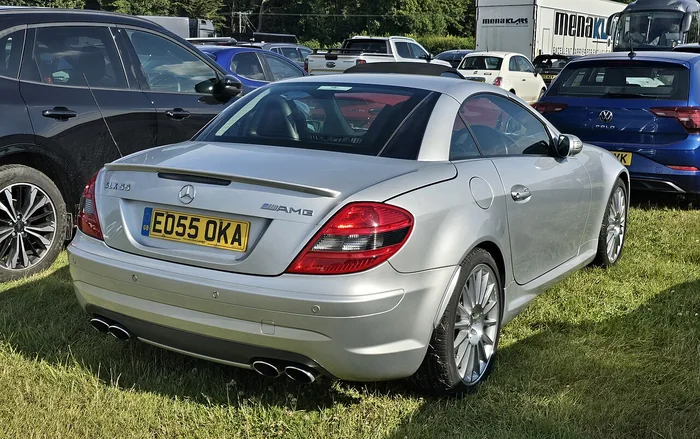
Note: Specifications reflect standard European “Launch Edition” configuration (Model Code 171.473). US-market figures (Model Year 2005 launch) are noted where they differ significantly.
Vehicle Identity
| Category | Specification Details |
|---|---|
| Model Designation | SLK 55 AMG |
| Internal Chassis Code | R171 (Model 171.473) |
| Sales Designation (US) | 2005 Model Year (Launched late 2004) |
| Production Period | June 2004 – February 2008 |
| Assembly Plant | Bremen, Germany (Body/Assembly); AMG Affalterbach (Engine Build) |
| Body Style | 2-Door, 2-Seater Compact Luxury Roadster |
| Roof Mechanism | Electro-hydraulic Vario-Roof (Retractable Hardtop – RHT) |
| Platform Architecture | Modified W203 (C-Class) Front Subframe / W211 (E-Class) Rear Suspension Architecture |
Dimensions & Weight
| Category | Specification Details |
|---|---|
| Length | 4,087 mm (160.9 in) |
| Width (excl. mirrors) | 1,780 mm (70.1 in) |
| Width (incl. mirrors) | 1,977 mm (77.8 in) |
| Height (Roof Closed) | 1,301 mm (51.2 in) |
| Wheelbase | 2,430 mm (95.7 in) |
| Track Width (Front) | 1,524 mm (60.0 in) |
| Track Width (Rear) | 1,524 mm (60.0 in) |
| Ground Clearance | ~115 mm (4.5 in) |
| Drag Coefficient (Cd) | 0.32 (Roof Closed) / 0.38 (Roof Open) |
| Frontal Area | 2.12 m² |
| DIN Curb Weight (EU) | 1,555 kg (3,428 lbs) |
| Curb Weight (US Spec) | ~1,595 kg (3,516 lbs) – heavier bumpers, reinforced structure |
| Permissible Gross Weight | 1,880 kg (4,145 lbs) |
| Max Payload | ~325 kg (716 lbs) |
| Weight Distribution (F/R) | 51.5% / 48.5% (Driver only) |
| Trunk Volume (Roof Up) | 208 Liters (7.3 cu ft) |
| Trunk Volume (Roof Down) | 160 Liters (5.6 cu ft) |
| Fuel Tank Capacity | 70 Liters (18.5 US gal) – incl. ~10L Reserve |
Powertrain – Engine (M113 E55)
| Category | Specification Details |
|---|---|
| Engine Code | M113.989 (Hand-built at AMG Affalterbach – “One Man, One Engine”) |
| Engine Family | M113 (SOHC 3-Valve V8) |
| Configuration | 90° V8, Aluminum Block & Heads |
| Displacement | 5,439 cc (331.9 cu in) |
| Bore x Stroke | 97.0 mm x 92.0 mm (3.82 x 3.62 in) |
| Compression Ratio | 10.7 : 1 |
| Valvetrain | SOHC per bank, 3 Valves per Cylinder (2 Intake, 1 Exhaust), Roller Rockers, Hydraulic Lifters |
| Fuel System | Bosch ME 2.8 Sequential Multi-Port Fuel Injection (Returnless Fuel System) |
| Ignition | Coil-on-Plug (8 Individual Ignition Coils) |
| Lubrication | Dry Sump (Dual scavenging pumps + pressure pump) – Critical for lateral G stability |
| Cooling | High-capacity water pump, Map-controlled thermostat, Auxiliary electric water pump (after-run) |
| Max Power (DIN/ISO) | 265 kW (360 PS / 355 hp) @ 5,750 rpm |
| Max Torque (DIN/ISO) | 510 Nm (376 lb-ft) @ 2,750–4,000 rpm |
| Specific Output | 66.2 hp/Liter |
| Power-to-Weight (DIN) | 4.32 kg/hp (Excellent for 2004) |
| Redline / Rev Limiter | 6,500 rpm / 6,800 rpm (Fuel Cut) |
| Engine Oil Capacity | 8.5 Liters (9.0 US qts) – Synthetic 0W-40 / 5W-40 (MB 229.5) |
| Emissions Standard | EU4 / LEV (US) / ULEV (CA/NY) |
Transmission
| Category | Specification Details |
|---|---|
| Type | AMG SpeedShift 5G-Tronic (5-Speed Automatic) – No Manual Option Offered |
| Torque Converter | Lock-up Clutch (Engages 2nd–5th gear) |
| Shift Modes | C (Comfort) / S (Sport) / M (Manual) via Steering Wheel Buttons |
| Shift Logic (S/M) | Reduced shift times (~30% faster), Rev-matched downshifts, Holds gears to redline |
| Gear Ratios | 1st: 3.59 — 2nd: 2.19 — 3rd: 1.41 — 4th: 1.00 — 5th: 0.83 — Rev: 3.16 |
| Final Drive Ratio | 3.27 : 1 (Shorter than SLK 350’s 2.87 for acceleration) |
| Oil Capacity | ~9.5 Liters (ATF MB 236.14 / Shell ATF 134 / Fuchs ATF 3353) |
Drivetrain & Chassis
| Category | Specification Details |
|---|---|
| Drive Layout | Front-Mid Engine, Rear-Wheel Drive (FMR) |
| Differential | AMG Mechanical Limited-Slip Differential (LSD) – 25% Lock-up (Torque Sensing) |
| Driveshaft | Two-piece Hollow Aluminum with Center Support Bearing |
| Front Suspension | Double Wishbone (Aluminum) – Forged Lower Arms, Pressed Upper Arms, Anti-Dive Geometry |
| Rear Suspension | 5-Link Multi-Link (Steel/Aluminum Hybrid) – Separate Spring/Damper, Toe-Control Link |
| Springs | AMG Specific Progressive Rate Coil Springs (Lowered ~10-15mm vs SLK 350) |
| Dampers | AMG Tuned Gas-Pressure Monotube (Bilstein/Sachs) – Firmer Valving, Unique Pistons |
| Anti-Roll Bars | Front: 32mm (Solid) — Rear: 22mm (Hollow) – Thicker than standard R171 |
| Steering System | Speed-Sensitive Hydraulic Power Assisted (Servotronic) – Recirculating Ball |
| Steering Ratio | 16.5 : 1 (Variable Ratio Rack) |
| Turning Circle (Curb-to-Curb) | 10.6 m (34.8 ft) |
| Steering Turns (Lock-to-Lock) | 2.8 |
| BRAKES (AMG High-Performance Compound System) | |
| Front Rotors | 360 mm x 32 mm Internally Vented, Cross-Drilled, 2-Piece Floating (Aluminum Hat) |
| Front Calipers | 6-Piston Fixed Aluminum Monoblock (AMG/Brembo) – “Silver” Painted, AMG Logo |
| Front Pads | High-Friction Compound (Low Dust/Noise optimized for street) |
| Rear Rotors | 330 mm x 22 mm Internally Vented, Cross-Drilled, 1-Piece Cast Iron |
| Rear Calipers | 4-Piston Fixed Aluminum Monoblock |
| Parking Brake | Mechanical Drum-in-Hat (Integral inside Rear Rotor Hub) – Separate from Hydraulic Calipers |
| Brake Booster | Tandem Diaphragm, Vacuum Assisted |
| ABS / ESP | Bosch ESP 8.0 (3-Channel ABS / Yaw Control) – ASR (Traction Control) – BAS (Brake Assist) – ESP Defeatable via Dash Switch (Hold 5s for Full Off) |
Wheels & Tires (Standard Launch Spec)
| Category | Specification Details |
|---|---|
| Wheel Design | AMG 5-Spoke Light Alloy (Code 781) – Forged? No, Low-Pressure Cast Aluminum |
| Front Wheels | 8.0 J x 18 ET 41 |
| Rear Wheels | 9.0 J x 18 ET 32 (Staggered Fitment) |
| Front Tires | 225/40 ZR 18 (92Y XL) – Continental SportContact 2 / Michelin Pilot Sport PS2 / Bridgestone Potenza RE050A |
| Rear Tires | 245/35 ZR 18 (92Y XL) – Staggered widths prevent rotation |
| Tire Pressure Monitoring | Indirect (ABS Wheel Speed Based) – No Valve Stem Sensors (US got Direct TPMS later) |
| Spare Tire | TIREFIT Mobility Kit (Sealant + Compressor) – No Spare Well (Occupied by Hydraulics/Battery) |
| Optional Wheels | 18″ AMG Twin 5-Spoke (Code 785) / 18″ AMG Multi-Spoke (Code 791) – Same Staggered Sizes |
Performance (Manufacturer Claims / Tested)
| Category | Specification Details |
|---|---|
| 0–100 km/h (0–62 mph) | 4.9 Seconds |
| 0–60 mph | 4.7 – 4.8 Seconds (Car & Driver / Road & Track) |
| 0–160 km/h (0–100 mph) | ~11.5 Seconds |
| 1/4 Mile (400m) | 13.2 – 13.4 Seconds @ 106–108 mph |
| Top Speed (Electronic Limiter) | 250 km/h (155 mph) |
| Top Speed (Derestricted) | ~275–280 km/h (171–174 mph) – Limited by Drag/Gearing |
| Braking 100–0 km/h | ~34–35 Meters (112 ft) |
| Lateral Acceleration (Skidpad) | 0.92 – 0.95 g (Depends on Tire Spec) |
| Fuel Consumption (NEDC Combined) | 12.5 L/100km (22.5 mpg Imp / 18.8 mpg US) |
| Fuel Consumption (EPA Combined – US) | 16 mpg City / 23 mpg Hwy / 19 mpg Combined |
| CO2 Emissions | 298 g/km |
Exterior Features & Lighting
| Category | Specification Details |
|---|---|
| Headlamps | Bi-Xenon (D2S) with Dynamic Curve Illumination (Active Light System) + Halogen High Beam Assist |
| Daytime Running Lights | Integrated in Headlamp Housing (Low Beam / Xenon at Reduced Voltage) |
| Fog Lamps | Front: Halogen (Integrated in Lower Bumper) — Rear: Single Driver Side (LED on Facelift ’08) |
| Turn Signals | Front: Amber (In Headlamp) — Side: Amber (On Fenders) — Rear: Red (US) / Amber (EU) |
| Mirrors | Electrically Adjustable, Heated, Aspherical (Driver), Auto-Dim (Optional), Body Color Housings |
| Wipers | Rain Sensor Standard, Heated Washer Jets, Single Arm Monoblade (Driver Side Bias) |
| Exhaust | AMG Dual-Dual Polished Stainless Tips (Rectangular) – Flapper Valve Control (Vacuum Actuated) |
| Badging | “V8 BITURBO” Absent (N/A) – “SLK 55 AMG” Rear, “AMG” Front Fender Vents (Non-Functional Styling), Engine Cover Badge |
| Body Kit | Unique Front Splitter, Side Sills, Rear Diffuser (Aerodynamically Functional – Downforce) |
Interior & Comfort
| Category | Specification Details |
|---|---|
| Seats | AMG Performance Seats (Standard) – Deep Bolsters, Integrated Headrests, “AMG” Embossed |
| Seat Adjustment | 4-Way Power (Height, Recline, Fore/Aft) + Manual Thigh Support Extender — Lumbar: 4-Way Power |
| Upholstery (Standard) | Nappa Leather (Perforated Centers) – Colors: Black, Classic Red, Silverstone, Cashmere Beige |
| Upholstery (Optional) | Designo Nappa / Alcantara Roof Liner |
| Steering Wheel | AMG 3-Spoke Flat Bottom (Leather/Alcantara) – Shift Buttons (Aluminum), 12 o’clock Mark (Optional) |
| Instrument Cluster | AMG Specific – White Face, Red Needles, 300 km/h Speedo, Oil Temp / Oil Pressure Gauges (Center) |
| Trim | AMG Carbon Fiber (Standard) / Optional: Birdseye Maple, Piano Lacquer, Carbon/Alcantara |
| Infotainment | COMAND APS (NTG1) – 6.5″ Color LCD (Non-Touch), GPS Nav, CD Drive (Dash), Cassette (Optional), Bose/Logic7 |
| Audio (Standard) | Bose AMG Sound System – 8 Speakers + Subwoofer (In Parcel Shelf), DSP, Speed Volume |
| Audio (Optional) | Harman Kardon Logic 7 – 11 Speakers, Dolby Pro Logic II, 450W |
| Climate Control | THERMOTRONIC Dual-Zone Automatic – Charcoal Filter, Sun Sensor, Residual Heat |
| Wind Management | AIRSCARF (Neck-Level Heating – Standard) – Integrated in Seat Headrests |
| Roof Operation | Vario-Roof – 22 Seconds Open/Close (Up to 40 km/h / 25 mph), 3-Piece Mechanism, 1.8L Hydraulic Fluid |
| Key | SmartKey (Infrared Remote + Mechanical Flip Key) – Keyless Go (Optional) |
Safety & Driver Assistance
| Category | Specification Details |
|---|---|
| Airbags | Dual Front (Adaptive Two-Stage), Side Thorax (Seat Mounted), Windowbags (Curtain – In Headliner) |
| Structure | High-Strength Steel Cell, Roll-Over Protection (Fixed Roll Hoops behind Seats + Pyrotechnic Deployable) |
| Active Safety | ESP, ASR, BAS, ABS, EBD, Hill Start Assist (via ESP), Tire Pressure Monitor (Indirect) |
| Lighting Safety | Adaptive Brake Lights (Flashing under Hard Braking), Cornering Fog Lamps |
| Security | Electronic Immobilizer (EWS), Anti-Theft Alarm (Interior Motion / Tow Sensor), Locking Wheel Bolts |
Optional Equipment (Key Factory Options)
| Category | Specification Details |
|---|---|
| Code 030 | AMG Performance Studio Package (Black Series Style Aero – Rare/Dealer Fit Often) |
| Code 219 | Keyless Go (Passive Entry/Start) |
| Code 234 / 238 | Bi-Xenon w/ Active Curve Lights (Standard on 55 in EU, Opt US) |
| Code 248 | Heated Seats (Standard in Cold Climates) |
| Code 277 | AIRSCARF (Standard on 55 in most markets) |
| Code 481 | Parktronic (Front/Rear Ultrasonic Sensors) |
| Code 532 | Harman Kardon Logic 7 Surround Sound |
| Code 550 / 551 | COMAND APS Navigation (Standard EU / Opt US Early) |
| Code 611 | Fire Extinguisher (EU Requirement) |
| Code 785 / 791 | Alternate 18″ Wheel Designs |
| Code 873 | Designo Leather Package (Extended Leather Dash/Door Panels) |
| Code 972 | AMG Track Pace / Performance Media (Dealer Retrofit Later) |
Maintenance Intervals (Fss – Flexible Service System)
| Category | Specification Details |
|---|---|
| Service A (Minor) | 1 Year / 13,000 mi (21,000 km) – Oil/Filter, Checks, Reset Counter |
| Service B (Major) | 2 Years / 26,000 mi (42,000 km) – Service A + Brake Fluid, Cabin Filter, Spark Plugs (Every 2nd B) |
| Spark Plugs (NGK ILFR6A / Bosch FR7HC+) | Every 52,000 mi / 80,000 km / 4 Years |
| Brake Fluid (DOT 4+) | Every 2 Years |
| Coolant (MB 325.0/326.0) | 15 Years / 250,000 km (Long Life) |
| Transmission Fluid (ATF) | Officially “Lifetime” – Best Practice: Change every 60k-80k km / 40k-50k mi |
| Rear Diff Fluid (Hypoid GL-5 / MB 235.7) | Officially “Lifetime” – Best Practice: Change every 60k km / 40k mi |
| Roof Hydraulic Fluid (MB 343.0) | Inspect Level Yearly / Change if Contaminated |
| Serpentine Belt / Tensioner | Inspect 60k mi / Replace 100k mi / 7 Years |
Model identity
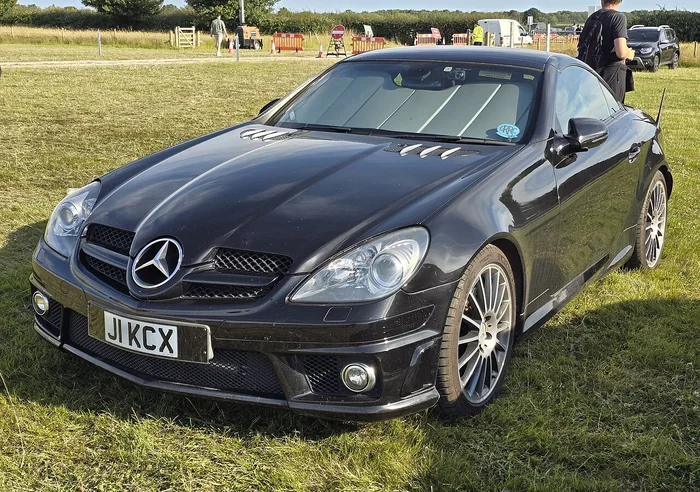
When the original R170 SLK launched in 1996, it invented the “compact luxury roadster” segment. It was a style icon, a triumph of packaging with its Vario-Roof, but dynamically? It was a grand tourer in sports car clothing. The chassis was soft, the steering numb, and the supercharged four- and six-cylinder engines, while torquey, lacked the visceral soul of a true sports car.
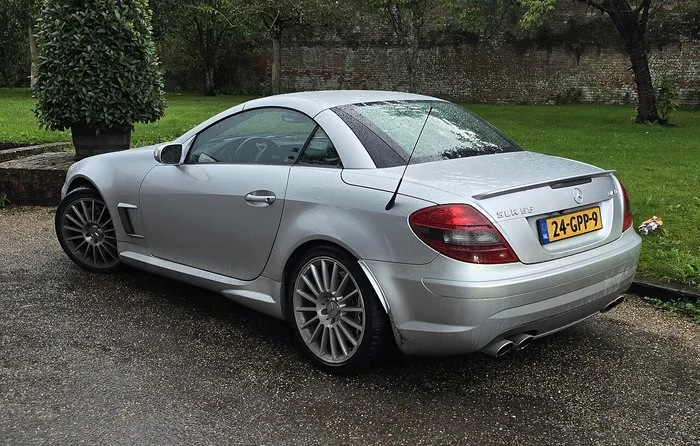
Image source: Wikimedia Commons (user Calreyn88)
Development
By the early 2000s, the competition had sharpened their knives. The Porsche Boxster S (986) offered mid-engine balance. The BMW Z4 (E85) brought raw, edgy dynamics. The Audi TT Roadster offered all-weather traction.
Mercedes needed an answer that wasn’t just “more power.” They needed credibility. Enter AMG.
By 2004, AMG was no longer just a tuner; it was a wholly owned subsidiary, fully integrated into the Mercedes development cycle. The R171 platform—debuting for the 2005 model year—was engineered from the outset to accept a V8. The front subframe, the cooling packaging, the electrical architecture, even the transmission tunnel: all were pre-stressed for the M113. This wasn’t a shoehorn job; it was a premeditated strike.
Engines and performance
1. Engine and power delivery
The headline act was the engine. In an era rapidly pivoting toward forced induction (the supercharged M112 V6 in the SLK 32 AMG predecessor, the incoming turbocharged N54 from BMW), the SLK 55 AMG stood defiant with a 5.4-liter naturally aspirated V8.
Hand-built at the AMG manor in Affalterbach under the “One Man, One Engine” philosophy, each M113.989 carried a plaque on the intake manifold bearing the builder’s signature. It was a dry-sump masterpiece—a rarity in a road car at this price point. Two scavenge pumps and a pressure pump ensured oil starvation was impossible, even under the sustained 1.0+ lateral G the chassis could generate.
2. Character and response
This wasn’t just marketing; it allowed the engineers to mount the engine lower and further back (front-midship), optimizing the polar moment of inertia.
The numbers—360 PS (355 hp) and 510 Nm (376 lb-ft)—looked modest on paper next to a 997 Carrera S or a Corvette Z06. But the delivery was the revelation. Peak torque arrived at a lazy 2,750 rpm and held flat until 4,000 rpm. There was no lag, no step-in surge, just a linear, relentless shove accompanied by a soundtrack that was 50% mechanical induction roar and 50% polished exhaust note.
The flapper valves in the quad tips stayed shut at part-throttle for civility, but past 4,000 rpm, they snapped open, transforming the cabin into a concert hall for eight cylinders.
3. Transmission
Here is where the “purist” argument fractures. The only transmission offered was the 5G-Tronic 5-speed automatic with AMG SpeedShift programming.
Why no manual? Officially: the M113’s torque curve (and the dry sump packaging) made fitting a viable manual gearbox a nightmare for the tunnel space and driveshaft angles. Unofficially: the take-rate on the SLK 32 AMG manual was abysmal, and the 5G-Tronic with a lock-up torque converter was genuinely faster in a straight line.
Was it a tragedy? On a back road, perhaps. The torque converter, even locked up, dampens the immediate connection between right foot and rear tire. The gearchanges in ‘S’ or ‘M’ mode were crisp—AMG claimed a 30% reduction in shift time over standard Mercedes calibrations—but they lacked the mechanical intimacy of a short-throw shifter.
However, as a grand touring instrument, the auto was superior. It allowed the V8 to lope at 2,000 rpm on the autobahn, returning reasonable economy, then instantly drop two cogs for an overtake without the driver lifting a hand from the wheel. The steering-wheel-mounted shift buttons (aluminum, tactile, satisfying) were among the first implementations that actually worked intuitively.
Chassis and driving character
1. Suspension and traction
The R171 SLK 55 wasn’t just an SLK 350 with a V8. The track width was widened by 27 mm at the front and 36 mm at the rear via unique forged control arms and rear knuckles. This wasn’t just for the staggered 18-inch wheels (225/40 front, 245/35 rear); it fundamentally altered the roll center geometry and reduced load transfer.
The suspension utilized the standard R171 double-wishbone front / 5-link rear architecture, but AMG specified unique progressive-rate springs, thicker anti-roll bars (32mm front solid, 22mm rear hollow), and bespoke Bilstein/Sachs monotube dampers with specific valving. The steering remained hydraulic Servotronic (recirculating ball, not rack-and-pinion)—a choice criticized for lack of feel compared to the Boxster’s rack, but one that offered immense stability and filtering of road noise on broken pavement.
2. Steering and brakes
The mechanical Limited-Slip Differential (LSD) was the unsung hero. A 25% lock-up torque-sensing unit (likely ZF-sourced), it transformed exit traction. You could feed power in early—mid-corner—and the diff would shunt torque to the loaded outside rear, rotating the car on the throttle. It made the SLK 55 adjustable in a way the open-diff SLK 350 never was.
The brakes were massive: 360mm 6-piston front / 330mm 4-piston rear fixed calipers. They were fade-resistant, modulation was excellent, and the pedal feel—firm, short travel—was benchmark stuff for 2004. The parking brake, cleverly hidden as a drum-in-hat inside the rear rotor, preserved the clean look of the monoblock calipers.
Design: retractable hardtop
The defining feature of the R170 carried over, evolved. The three-piece retractable hardtop (Vario-Roof) operated in 22 seconds. It added ~80 kg over a soft-top, mostly high up, which hurts center of gravity. But structurally, it turned the roadster into a coupe. Torsional rigidity was exceptional (approx. 11,000 Nm/deg), meaning the chassis didn’t scuttle shake on rough roads—a chronic issue for the Boxster of that era.
With the roof up, the SLK 55 was a quiet, weather-proof GT car with a drag coefficient of 0.32. With the roof down, the AIRSCARF system (standard on the 55) blew warm air from the seat headrests onto your neck, extending the top-down season deep into autumn. It was a gimmick that worked brilliantly.
Interior and equipment
Slide into the AMG Performance seats—deep bolsters, integrated headrests, superb lumbar support—and you sit in the car, not on it. The driving position is near-perfect: low hips, pedals aligned, wheel telescoping far enough for long legs.
The materials were peak early-2000s Mercedes: thick, grainy Nappa leather, real aluminum switchgear, the satisfying thunk of the door catch. The center stack was dominated by the COMAND APS (NTG1) system—a 6.5-inch pop-up screen controlled by a rotary dial. It looks dated now (no touchscreen, no CarPlay), but the logic was deep, the GPS fast for its time, and the Bose/Logic 7 audio sounded fantastic with the roof up or down.
The instrument cluster was a highlight: white-faced gauges with red needles, a 300 km/h speedometer, and—crucially—analog Oil Temperature and Oil Pressure gauges nested in the center. In a modern car, these are buried in menus. Here, they were front and center, a constant reminder that this was a hand-built engine requiring mechanical sympathy during warm-up.
Ownership notes
- Roof Hydraulics: The pump and rams will leak eventually. Budget for reseals.
- ABC? No, Conventional Suspension: A blessing. No Active Body Control nightmares.
- Rust: Check rear wheel arches, door bottoms, and the roof mechanism cassettes.
- Run-Flats: Ditch them immediately for Michelin Pilot Sport 4S or Continental ExtremeContact. The ride quality and steering feel transformation is night-and-day.
- Transmission Fluid: Ignore “Lifetime Fill.” Change it every 40k miles with the filter.
The 2004 SLK 55 AMG wasn’t the sharpest track tool of its generation. It was heavier than a Boxster, less rev-happy than a Z4 M, and lacked a manual gearbox. But as a total automobile—a machine that could devour a mountain pass at 8/10ths with the LSD working its magic, then cruise the autobahn at 155 mph in air-conditioned silence with a hardtop overhead—it was peerless.
It represents the moment AMG transitioned from “hot rodder” to “OEM performance benchmark.” It is a V8 symphony with a retractable roof, a hand-built engine signature on the manifold, and a usability that modern performance cars, with their rock-hard suspensions and tablet dashboards, have largely forgotten. It is, quite simply, the last of the analog AMG roadsters. And that makes it special.
Related models
Other Motor Wiki entries in this SLK AMG cluster:
Legacy
Launched in Europe mid-2004 and hitting US dealers as a ’05 model, the SLK 55 AMG was priced aggressively—roughly $55k-$60k USD. It undercut the Boxster S and the BMW Z4 M Roadster (which arrived a year later with the high-strung S54) significantly, while offering more torque, a hardtop, and a badge that carried immense cachet.
Critics loved the engine and the noise. They criticized the automatic-only gearbox, the recirculating ball steering feel, and the run-flat tires (standard on US cars) which transmitted harsh impacts to the cabin. Car and Driver famously placed it 2nd in a comparison test behind the Boxster S, citing the Porsche’s superior steering and manual gearbox, but calling the Mercedes “the better car for the real world.”
Production Numbers: Roughly 10,000–11,000 units globally over its 2004–2008 run. Low enough to be rare, high enough to be findable.
Collector position
Two decades on, the R171 SLK 55 AMG occupies a unique niche. It is the last naturally aspirated V8 SLK (the R172 successor went twin-turbo V6, then turbo-4). It is the last SLK with hydraulic steering. It is the last SLK built before the infotainment screens took over the dashboard.
It avoids the complexity of the later M157 twin-turbo V8s (timing chain issues, turbo heat soak) and the earlier M112 supercharged V6s (intercooler pump failures, heat soak). The M113 is bulletproof—200k+ miles is routine with oil changes. The 5G-Tronic, while not a dual-clutch, is robust and rebuildable.
Leave a Reply
You must be logged in to post a comment.