General Information & Identification
| Category | Specification Details |
|---|---|
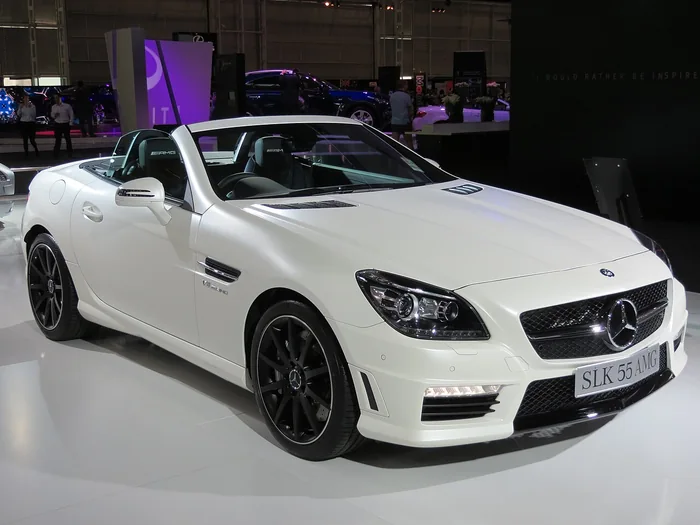
| Model Series | R172 (Facelift of R171; first all-new SLK since 2004) |
| Sales Designation | SLK 55 AMG |
| Internal Model Code | 172.473 |
| Production Period | March 2011 – August 2015 (2012 Model Year: ~July 2011 – June 2012) |
| Assembly Plant | Bremen, Germany |
| Body Style | 2-door, 2-seater Retractable Hardtop Roadster (Varrio-Roof) |
| Platform Architecture | Front-mid engine, Rear-wheel drive (FR) |
| Chassis Construction | High-strength/Ultra-high-strength steel monocoque; Aluminum hood, trunk lid, doors, front fenders |
| Vehicle Class | Compact Luxury Sports Car / Roadster (S-segment) |
| Successor | Mercedes-AMG SLC 43 (R172 Facelift, 2016) |
Dimensions & Weights
| Category | Specification Details |
|---|---|
| Wheelbase | 2,430 mm (95.7 in) — +70mm vs R171 |
| Length | 4,134 mm (162.8 in) |
| Width (excl. mirrors) | 1,810 mm (71.3 in) — +37mm vs R171 |
| Width (incl. mirrors) | 2,001 mm (78.8 in) |
| Height (Roof Closed) | 1,303 mm (51.3 in) |
| Height (Roof Open) | 1,298 mm (51.1 in) |
| Track Width (Front) | 1,548 mm (60.9 in) |
| Track Width (Rear) | 1,538 mm (60.6 in) |
| Ground Clearance | ~110 mm (4.3 in) — Unladen |
| Drag Coefficient (Cd) | 0.32 (Roof Closed) / 0.36 (Roof Open) — Impressive for a roadster |
| Frontal Area (A) | 2.18 m² |
| Cd × A | 0.698 m² |
| Curb Weight (DIN / EU) | 1,595 kg (3,516 lbs) — With fluids, 90% fuel, 75kg driver |
| Gross Vehicle Weight (GVWR) | 1,910 kg (4,211 lbs) |
| Max Payload | ~315 kg (694 lbs) |
| Weight Distribution (F/R) | 51% / 49% — Near-perfect balance |
| Trunk Volume (Roof Up) | 225 L (7.9 cu ft) — Includes ski-bag passthrough |
| Trunk Volume (Roof Down) | 165 L (5.8 cu ft) — Partition must be deployed |
| Fuel Tank Capacity | 70 L (18.5 US gal) — Including ~10 L reserve |
Powertrain: Engine (M152 DE55)
| Category | Specification Details |
|---|---|
| Engine Code | M152 (Naturally Aspirated V8) |
| Engine Family | M152 (Bespoke AMG 5.5L V8; distinct from M273/M157) |
| Configuration | 90° V8, Aluminum Block & Heads |
| Valvetrain | DOHC, 4 Valves/Cyl (32 Valves Total), Variable Valve Timing (VVT) on Intake & Exhaust |
| Displacement | 5,461 cc (5.5 L / 333.3 cu in) |
| Bore × Stroke | 98.0 mm × 90.5 mm (3.86 in × 3.56 in) |
| Compression Ratio | 11.3 : 1 |
| Fuel System | High-Pressure Direct Injection (Piezo Injectors, 200 bar) |
| Fuel Requirement | Premium Unleaded (Min. 98 RON / 93 AKI) |
| Oil System | Dry Sump Lubrication (Active, 9.5 L capacity) |
| Cooling | Water-to-Air Intercoolers (N/A – NA Engine), High-Capacity Main Radiators, Engine Oil Cooler, Transmission Oil Cooler, Diff Oil Cooler |
| Emissions Standard | Euro 5 / LEV II (US) / ULEV (CA) |
| Engine Weight (Dry) | ~198 kg (437 lbs) |
| Category | Specification Details |
|---|---|
| Europe / International | 310 kW (422 PS / 416 hp) @ 6,800 rpm — 540 Nm (398 lb-ft) @ 4,500 rpm |
| USA / Canada | 310 kW (422 PS / 416 hp) @ 6,800 rpm — 540 Nm (398 lb-ft) @ 4,500 rpm |
| Specific Output | 77.2 hp/L — 98.9 Nm/L |
| Redline | 7,200 rpm — Fuel Cutoff: 7,400 rpm |
Drivetrain & Transmission
| Category | Specification Details |
|---|---|
| Transmission Type | AMG SPEEDSHIFT MCT 7-Speed (7G-TRONIC based) |
| Transmission Code | 725.0 (Modified for MCT) |
| Clutch Type | Multi-Plate Wet Start-Off Clutch (MCT) — Replaces Torque Converter |
| Shift Modes | C (Controlled Efficiency), S (Sport), S+ (Sport Plus), M (Manual) |
| Shift Times (S+/M) | ~100 ms (Upshift) / ~200 ms (Downshift with blip) |
| Gear Ratios | 1st: 4.38 / 2nd: 2.86 / 3rd: 1.92 / 4th: 1.37 / 5th: 1.00 / 6th: 0.82 / 7th: 0.73 / Rev: 3.40 |
| Final Drive Ratio | 2.82 : 1 (Standard) / 3.07 : 1 (Optional Performance Ratio – rare) |
| Differential | AMG Electronic Rear Axle Locking Differential (E-LSD) |
| Lock Type | Electronically controlled multi-disc clutch (0–100% lock) |
| Integration | Linked to ESP®, Steering Angle, Yaw Rate, Lateral Acceleration |
| Driveshaft | Two-piece aluminum with center bearing; CV joints |
Chassis, Suspension & Steering
| Category | Specification Details |
|---|---|
| Front Suspension | AMG Sport Suspension — Double Wishbone (4-link), Aluminum Lower Arms, Steel Upper Arms, Coil Springs, Gas-Pressure Shock Absorbers |
| Rear Suspension | AMG Sport Suspension — 5-Link Independent, Aluminum Subframe, Coil Springs, Gas-Pressure Shock Absorbers |
| Spring Rates (Approx.) | Front: ~35 N/mm / Rear: ~55 N/mm (Progressive) |
| Anti-Roll Bars | Front: 28.5 mm (Hollow) / Rear: 22.0 mm (Solid) — Thicker than standard SLK |
| Damping | Passive AMG-Tuned (Fixed Rate) — No Adaptive Damping (ADS) available on R172 55 |
| Ride Height | -10 mm vs. Standard SLK (Front: ~115mm / Rear: ~118mm loaded) |
| Steering System | Electromechanical Power Steering (EPS) — First SLK with EPS |
| Steering Ratio | 13.5 : 1 (Variable Ratio Rack) |
| Turns Lock-to-Lock | 2.5 |
| Turning Circle (Curb-to-Curb) | 10.6 m (34.8 ft) |
| Chassis Codes | AMG Ride Control (Code 489) – Standard; Sports Package (Code 473) – Standard |
Brakes & Wheels/Tires
| Category | Specification Details |
|---|---|
| Brake System | AMG High-Performance Compound Braking System — Internally Vented & Perforated |
| Front Rotors | 360 mm × 32 mm (14.2 in × 1.3 in) — 6-Piston Fixed Aluminum Calipers (Monobloc look, 2-piece) |
| Rear Rotors | 320 mm × 22 mm (12.6 in × 0.9 in) — 1-Piston Floating Calipers |
| Parking Brake | Electric (EPB) — Actuates rear calipers mechanically |
| ABS/ESP | 3-Channel ABS / ESP® with ASR, EBD, BAS, Hill Start Assist |
| Standard Wheels | 18″ AMG 5-Twin-Spoke (Code 781) — Front: 8.0J × 18 ET44 / Rear: 9.0J × 18 ET48 |
| Optional Wheels (P30) | 19″ AMG 10-Spoke Forged (Code R93) — Front: 8.0J × 19 ET44 / Rear: 9.5J × 19 ET49 (Staggered) |
| Standard Tires (18″) | Continental SportContact 5 / Michelin Pilot Sport 3 — F: 225/40 R18 92Y / R: 245/35 R18 92Y (Run-Flat: MOExtended) |
| Optional Tires (19″) | Michelin Pilot Sport 3 / Dunlop Sport Maxx RT — F: 225/35 R19 88Y / R: 245/30 R19 89Y (Run-Flat) |
| Spare Tire | TIREFIT Mobility Kit (Sealant + Compressor) — No Spare |
Performance Figures (Manufacturer Claims)
| Category | Specification Details |
|---|---|
| 0–100 km/h (0–62 mph) | 4.6 seconds — Launch Control Active, Dry Asphalt |
| 0–160 km/h (0–100 mph) | 10.8 seconds |
| 0–200 km/h (0–124 mph) | 18.5 seconds |
| ¼ Mile (402 m) | ~13.0 sec @ 177 km/h (110 mph) — Estimated real-world |
| Top Speed (Electronically Limited) | 250 km/h (155 mph) — Standard Limiter |
| Top Speed (AMG Driver’s Package) | 280 km/h (174 mph) — Optional Code P30 / 870; Requires 19″ Forged Wheels |
| Braking 100–0 km/h | ~33.5 m (110 ft) — Cold Brakes, Standard Tires |
| Lateral Accel (Skidpad) | ~1.05 g — 19″ Tires, ESP Off |
| Nurburgring Nordschleife | ~8:15 — Unofficial “Sport Auto” estimate |
Fuel Economy & Emissions (NEDC / EPA)
| Category | Specification Details |
|---|---|
| Urban / City | 18.5 L/100km (15.2 mpg imp / 12.7 mpg US) — 15 mpg US (15.7 L/100km) |
| Extra-Urban / Highway | 8.5 L/100km (33.2 mpg imp / 27.7 mpg US) — 24 mpg US (9.8 L/100km) |
| Combined | 12.0 L/100km (23.5 mpg imp / 19.6 mpg US) — 18 mpg US (13.1 L/100km) |
| CO₂ Emissions | 279 g/km — ~305 g/mi (Combined) |
| Real World (Spirited) | 16–20 L/100km — 12–15 mpg US |
| Real World (Highway Cruise) | 9–11 L/100km — 22–26 mpg US |
Retractable Hardtop (Varrio-Roof) System
| Category | Specification Details |
|---|---|
| System Name | Varrio-Roof (3-Piece Aluminum/Steel/Composite) |
| Operation | Electro-Hydraulic (Single Pump, 8 Cylinders) |
| Opening Time | ~20 Seconds (at standstill) |
| Closing Time | ~25 Seconds (at standstill) |
| Operable Speed | Up to 40 km/h (25 mph) |
| Roof Layers | 1. Outer Skin (Alum/Steel) 2. Insulation/Sound Deadening 3. Headliner (Fabric/Alcantara) |
| Acoustic Comfort (Closed) | ~3 dB quieter than R171; comparable to C-Class Coupe |
| Glass Options | Standard: Tinted Glass / Optional: MAGIC SKY CONTROL (Electrochromic variable tint) |
| Wind Deflector | Integrated, Automatic Deployment (Raises/lowers with roof) |
| Trunk Partition | Electric, Mandatory for Roof Operation (Separates luggage from mechanism) |
Exterior Features & Aerodynamics
| Category | Specification Details |
|---|---|
| Front Fascia | AMG Specific: “Jet-Wing” Design, Large Air Curtains, Chrome “A-Wing” Slats in Grille |
| Hood | Aluminum with Twin Powerdomes (Clearance for M152 Valve Covers) |
| Side Profile | Distinct “Shark Gill” Vents on Front Fenders (Functional: Wheel Arch Venting) |
| Rear Fascia | Diffuser-Style with Integrated Twin Dual-Round Tailpipes (Chrome/Black Chrome) |
| Aero Underbody | Full Underbody Paneling (Engine, Transmission, Rear Diffuser) |
| Lift Coefficient (Cl) | Front: ~0.10 / Rear: ~0.05 (Near Neutral Lift at Speed) |
| Lighting (Standard) | Bi-Xenon Headlamps (Cornering Lights), LED Tail Lamps, LED DRLs in Mirror Base |
| Lighting (Optional) | Intelligent Light System (ILS) — Active Curve, Highway Mode, Enhanced Fog |
| Mirrors | Electrically Folding, Heated, Aspherical (Driver), Auto-Dim (Driver), Integrated Turn Signals |
| Paint Options | Metallic (Std), designo Magno (Matte) – Alanite Grey Magno, etc., designo Metallic |
Interior, Comfort & Technology
| Category | Specification Details |
|---|---|
| Seating | AMG Performance Seats (Std) — Integrated Headrests, High Side Bolsters, Perforated Leather Centers |
| Seat Adjustment | 10-Way Power (Height, Recline, Fore/Aft, Lumbar 4-way), Memory (Driver) |
| Seat Heating | Standard (3-Stage, Rapid Heat) |
| Seat Ventilation | Optional (Code 881) — Active Fan Assisted |
| AIRSCARF | Standard — Neck-Level Heating integrated into Headrest (3-Stage) |
| Upholstery (Std) | ARTICO Leather / Dinamica Microfiber (Red Stitching) |
| Upholstery (Opt) | designo Nappa Leather (Exclusive/Platinum White/Red Pepper/Deep White) |
| Trim (Std) | AMG Carbon Fiber (High-Gloss) |
| Trim (Opt) | Piano Lacquer Black, Brown Burr Walnut, Aluminum Longitudinal Grain |
| Steering Wheel | AMG Performance Steering Wheel — Flat Bottom, Perforated Leather Grip (10/2), Silver Shift Paddles (Aluminum), 12 o’clock Marker |
| Instrument Cluster | AMG Specific — White Needles, Red Backlighting, RACETIMER, G-Meter, Setup Menu |
| Center Display | 7.0″ High-Res TFT (COMAND Online Optional) |
| Infotainment | COMAND APS (NTG 4.5) — HDD Nav, 10GB Music Register, Bluetooth Audio, USB, SD, 5.1 Dolby Digital |
| Audio (Std) | 6 Speakers, 100W |
| Audio (Opt – Code 811) | Harman Kardon Logic 7 — 11 Speakers, DSP, 400W, Subwoofer in Rear Bulkhead |
| Climate Control | THERMOTRONIC — Dual-Zone Automatic, Sun Sensor, Humidity Sensor, Charcoal Filter |
| Keyless Entry/Go | KEYLESS-GO (Std) — Touch Door Handles, Start/Stop Button |
| Storage | Glovebox (Lockable), Center Console Bin (Shallow), Door Pockets (Bottle Holders), Behind Seats Nets |
Safety & Driver Assistance Systems
| Category | Specification Details |
|---|---|
| Airbags | Standard — Dual Front (Adaptive), Side Thorax (Seat), Windowbags (Roof Frame), Knee Bag (Driver) |
| ESP® | Standard — 3-Stage: ON / SPORT (Higher Thresholds) / OFF |
| PRE-SAFE® | Standard — Belt Tensioning, Window/Roof Closure, Seat Positioning |
| ATTENTION ASSIST | Standard — Drowsiness Detection (Steering Analysis) |
| Blind Spot Assist | Optional (P22) — Radar-Based, Visual/Audible Warning |
| Lane Keeping Assist | Optional (P22) — Camera-Based, Vibration Warning |
| DISTRONIC PLUS | Optional (P22) — Adaptive Cruise Control w/ Stop & Go |
| Active Parking Assist | Optional (P21) — Parallel/Perpendicular Parking |
| Rear View Camera | Optional (P21) — Display in COMAND / Mirror |
| Tire Pressure Monitor | Standard — Direct Sensors (Pressure & Temp) |
| ISOFIX | N/A — 2-Seater — No Rear Seats |
| NCAP Rating | 5 Stars (Euro NCAP 2011) — Adult: 91% / Child: 77% (No Rear) / Pedestrian: 55% / Safety Assist: 86% |
Option Packages & Key Codes (Major Markets)
| Category | Specification Details |
|---|---|
| P30 | AMG Performance Package — 280 km/h Top Speed, 19″ Forged Wheels, AMG Performance Steering Wheel (Alcantara), Red Seatbelts, Composite Brake Discs (CCM – Dealer Fit/Later MY), Specific Suspension Tuning |
| P21 | Parking Package — Active Park Assist, Rear View Camera, PARKTRONIC (F/R Sensors) |
| P22 | Driver Assistance Package — Blind Spot, Lane Keep, DISTRONIC PLUS, BAS PLUS, PRE-SAFE Brake |
| P31 | AMG Carbon Ceramic Brakes — (Often separate code B07) 390mm Front / 360mm Rear CCM, 6-Piston Front / 4-Piston Rear Calipers (Yellow/Red) |
| 873 | Heated Steering Wheel — Leather Rim Only |
| 881 | Seat Ventilation — Driver & Passenger |
| 581 | MAGIC SKY CONTROL — Variable Tint Panoramic Roof Panel |
| 791 | Head-Up Display — Virtual 21″ Image, Speed, Nav, Speed Limit |
| 610 | Bang & Olufsen BeoSound — 14 Speakers, 1000W, Aluminum Grilles (Late Availability) |
US vs. Euro Specific Differences (2012 MY)
| Category | Specification Details |
|---|---|
| Bumpers | Larger Impact Absorbers (5mph) — Protrude ~30mm more — Sleeker, Body-Color Integrated |
| Side Markers | Amber Front / Red Rear (Mandatory) — Integrated in Mirror / Tail Lamp |
| Headlights | DOT Pattern (Flatter Cutoff) — ECE Pattern (Sharper Cutoff, Asymmetric) |
| Rear Fog Light | Single Driver Side (Mandatory) — Single Driver Side (Standard) |
| Instrument Cluster | mph Primary / km/h Secondary — km/h Primary / mph Secondary |
| ECU Mapping | Identical Power/Torque (Confirmed) — Identical |
| Catalytic Converters | Close-Coupled + Underfloor (4 Total) — Close-Coupled + Underfloor (4 Total) |
| Evap System | Enhanced (ORVR) — Standard |
| Standard Equipment | Higher (Sat Radio, HD Radio, Garage Door Opener Std) — More Ala Carte |
Maintenance & Service Intervals (ASSYST PLUS)
| Category | Specification Details |
|---|---|
| Service A (Minor) | 1 Year / 15,000 km (10,000 mi) — Oil & Filter (9.5L Synthetic 0W-40 / 5W-40 MB 229.5), Brake Fluid (2yr), Cabin Filter, Inspection |
| Service B (Major) | 2 Years / 30,000 km (20,000 mi) — Service A + Spark Plugs (16x), Air Filters (2x), Coolant Check, Diff Oil (1.3L), Trans Oil (5.5L – Check only unless severe) |
| Brake Fluid | Every 2 Years — DOT 4+ (MB 331.0) |
| Coolant | 15 Years / 250,000 km — G48 / G40 Concentrate 50/50 |
| Spark Plugs | Every 60,000 km / 4 Years — NGK Laser Iridium (ILKAR7B11 / 97088) |
| Transmission Oil (MCT) | “Lifetime” (Inspect 60k) — Enthusiast Recommendation: Change every 60k km / 4 yrs (MB 236.15 / 236.17) |
| Rear Diff Oil | Every 60,000 km / 4 Years — 1.3L MB 235.71 (Specific for E-LSD) |
| Serpentine Belt | Inspect 60k / Replace 120k — Single Belt w/ Auto Tensioner |
| Roof Hydraulic Fluid | Inspect / Top Off — Pentosin CHF 11S / MB 345.0 (Sealed System) |
Known Issues & Common Failure Points (Owner Knowledge Base)
| Category | Specification Details |
|---|---|
| Camshaft Adjuster Bolts (M152) | Critical. Factory bolts can stretch/back out -> Cam timing jump -> Engine destruction. — HIGH — Immediate Upgrade: ARP High-Strength Bolts (Part 200-4301) or Updated MB Bolts (A0009901961) + Loctite 648. Do during Spark Plug service. |
| Roof Mechanism / Hydraulics | Pump failure, cylinder leaks, microswitch faults, synchronization loss. — MEDIUM-HIGH — Regular operation (monthly). Keep drains clear. Pump relay (K40/8) failure common. |
| Trunk Partition Motor | Plastic gears strip -> Partition jams -> Roof inoperable. — MEDIUM — Updated metal gear kit available. Manual override cable in trunk. |
| Front Control Arm Bushings | Premature wear (Thrust Arms) -> Clunk, Vague Steering, Tire Wear. — MEDIUM — Replace with Lemforder / Meyle HD (Solid Bushings increase NVH). |
| EPS Steering Rack | Internal position sensor failure / “Steering Defective” warning. — LOW-MED — Software updates help; Rack replacement expensive. |
| Battery / Voltage Issues | AGM Battery (H8/94R/49) dies -> Chaos codes (ESP, Roof, EPS). — HIGH — Replace every 5-6 Years. Must Register new battery via STAR/Xentry. |
| Camshaft Position Sensors | Heat failure -> Crank/No Start, Limp Mode. — MEDIUM — Replace in pairs (Front of heads). Cheap insurance. |
| Run-Flat Tire Ride Quality | Harshness, Noise, Expensive Replacement. — SUBJECTIVE — Switch to Non-Run-Flat (e.g., Michelin PS4S / PS5) + TIREFIT / Spare Kit. |
| Carbon Ceramic Brakes (If Fitted) | Rotors wear fast on street; Expensive ($15k+/axle); Squeal. — HIGH COST — Only for Track Use. Steel Rotors (AMG Compound) superior for Road. |
Model identity
There is a specific breed of car enthusiast who doesn’t want a sledgehammer. They want a scalpel—something precise, clinical, and capable of surgical speed—but they also want the operating theater to be upholstered in Nappa leather, climate-controlled, and quiet enough to hear a pin drop at 150 mph. For over a decade, the SLK 55 AMG has been the definitive answer to that niche brief.
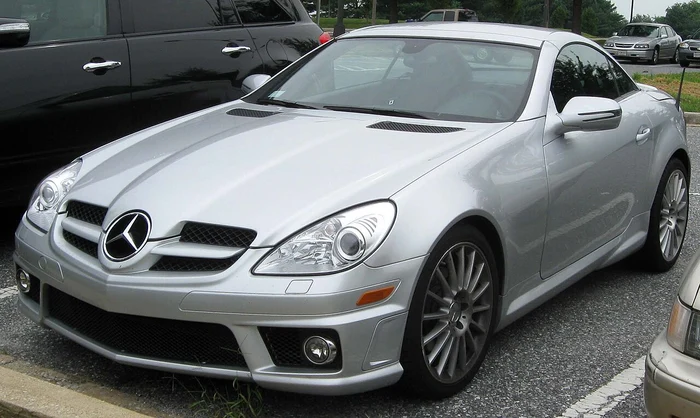
When the R172 generation launched in 2011 as a 2012 model, it didn’t just iterate on the formula; it sharpened every edge. It was the last of a dying breed: a compact, front-mid-engined, naturally aspirated V8 roadster with a retractable metal roof. No turbo lag, no all-wheel-drive sanitation, no particulate filters choking the soundtrack. Just 5.5 liters of hand-built AMG violence wrapped in a chassis that finally, finally, matched the engine’s ambition.
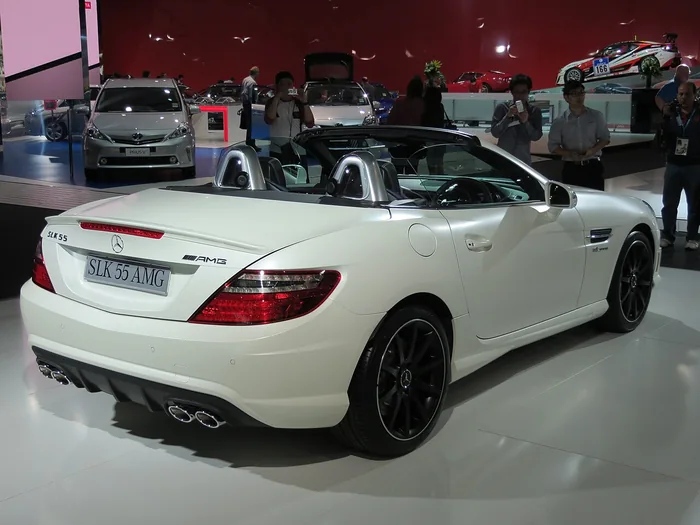
Image source: Wikimedia Commons (user OSX)
Development
To understand the R172 55, you have to remember the R171 it replaced. The previous SLK 55 AMG (2004–2011) was a legend in a straight line—its 5.4L M113 V8 was a torque monster—but dynamically, it was a handful. The chassis flexed, the steering was numb hydraulic assist, and the suspension tuning tried to paper over a fundamental lack of rigidity with stiff springs.
It was fast, but it wasn’t sharp. It earned the unfair “hairdresser’s car” label because it felt like a luxury cruiser playing dress-up in a track suit.
Mercedes-AMG knew the R172 had to change that narrative entirely. The development brief, led by then-AMG CEO Volker Mornhinweg, was unambiguous: The SLK 55 must be a genuine sports car first, a luxury roadster second.
The platform shift was radical. The R172 utilized a completely new aluminum-intensive monocoque. By moving the firewall back 37mm and the front axle forward 33mm, engineers achieved a true front-mid layout (engine centerline behind the front axle). Combined with a 70mm longer wheelbase and tracks widened by nearly 40mm, the structural rigidity jumped by 40% over the R171. For the first time, the SLK chassis could actually handle the 540 Nm of torque without turning into a pretzel.
Engines and performance
1. Engine and power delivery
Pop the aluminum hood (complete with those iconic twin power domes required to clear the valve covers) and you find the M152. This wasn’t a bored-out M273 passenger car engine. It was a bespoke AMG unit, hand-assembled in Affalterbach under the “One Man, One Engine” philosophy.
Displacing 5,461 cc, the M152 was a masterpiece of old-school high-revving engineering. It featured a forged crankshaft, forged connecting rods, and lightweight Mahle forged pistons. The compression ratio was a heady 11.3:1, enabled by direct injection (piezo injectors at 200 bar) and sophisticated knock control. But the real magic was the dry-sump lubrication.
2. Character and response
A multi-stage suction pump scavenged oil from the crankcase into a remote tank, ensuring zero oil starvation under 1.0+ g lateral loads while allowing the engine to sit 22mm lower in the chassis. This lowered the center of gravity and reduced the polar moment of inertia—engineering speak for “it turns in like a dart.”
The output: 422 PS (416 hp) at 6,800 rpm and 540 Nm (398 lb-ft) at 4,500 rpm. But the numbers barely tell the story. The throttle response was instantaneous—violently so. There was no turbo spool, no lag, just a direct mechanical connection between your right foot and eight throttle bodies snapping open.
The soundtrack was a deep, guttural baritone at idle that hardened into a savage, flat-plane-esque scream past 5,000 rpm, amplified by the electronically controlled exhaust flaps. It remains, to this day, one of the best-sounding production V8s ever made.
3. SPEEDSHIFT MCT
Bolting to the M152 was the AMG SPEEDSHIFT MCT 7-Speed (Multi-Clutch Technology). This was a pivotal moment. Traditional torque converters multiply torque but sap efficiency and blur shift feel. AMG’s solution was brilliant in its simplicity: they deleted the torque converter entirely and replaced it with a wet multi-plate launch clutch.
It functioned exactly like a manual clutch for standing starts (allowing true launch control with zero slip), but once rolling, the planetary gearsets and clutch packs handled shifts with ruthless speed—100 milliseconds in Sport+ mode. Crucially, it allowed double-declutch downshifts with automatic rev-matching that felt telepathic. It gave the SLK 55 the immediacy of a dual-clutch transmission (DCT) but with the smoothness and torque capacity of a traditional automatic. It was, arguably, the best transmission calibration AMG has ever produced for a street car.
Chassis and driving character
1. Suspension and traction
This is where the R172 rewrote the rulebook. The suspension geometry was pure sports car: double wishbones up front (aluminum lower arms), a five-link rear axle on an isolated aluminum subframe. But the tuning was the revelation.
Gone was the “comfort first” compliance of the R171. The SLK 55 sat 10mm lower on unique springs and significantly thicker anti-roll bars (28.5mm hollow front, 22mm solid rear). The steering—electromechanical (EPS) for the first time on an SLK—was a point of contention for purists initially. However, the variable-ratio rack (13.5:1) and the calibration were exceptional. It wasn’t hydraulic feel, but it was precise. You placed the nose exactly where you wanted it, with weighting that built naturally with lock and speed.
2. Steering and brakes
The star of the show was the Electronic Rear Limited-Slip Differential (E-LSD). Unlike a mechanical clutch-pack or Torsen unit, this multi-disc clutch could vary lock from 0 to 100% in milliseconds based on yaw rate, steering angle, and throttle position. On corner entry, it stayed open for rotation. At the apex, it locked progressively to put power down.
On exit, it allowed just enough slip to rotate the car gently on the throttle. It turned the SLK 55 from a “power oversteer” car into a chassis-adjustable car. You could drive it neatly at 8/10ths, or drift it at 10/10ths with total confidence.
The brakes matched the pace: 360mm front discs clamped by 6-piston fixed calipers. They were fade-resistant, modulation was excellent, and the pedal feel was firm and short—rare for a Mercedes of this era.
Design: retractable hardtop
The retractable hardtop (Varrio) was a carryover concept but heavily refined. Three pieces (aluminum front, steel center, composite rear) folded in a complex ballet into the trunk in 20 seconds (up to 40 km/h). The party trick was the MAGIC SKY CONTROL roof panel (optional): an electrochromic glass panel that switched from transparent to opaque at the touch of a button. It solved the convertible paradox: open-air feel with the roof up, without the greenhouse heat.
Structurally, the roof was the B-pillar. With it up, torsional rigidity was coupe-like. With it down, the wind buffeting was remarkably low thanks to the standard, automatically deploying wind deflector and the AIRSCARF neck-heating system (standard on AMG), which blew warm air from the headrests—extending the top-down season deep into winter.
Interior and equipment
Inside, the R172 finally felt worthy of the three-pointed star and the AMG badge. The “wing” dashboard design was driver-centric, dominated by the large central COMAND screen (floating on later models, integrated here) and the glorious AMG Performance steering wheel—flat-bottomed, thick-rimmed, perforated leather at 10 and 2, with substantial aluminum paddle shifters.
The AMG Performance seats were the highlight: deeply bolstered, integrated headrests (with AIRSCARF vents), and finished in a mix of ARTICO/Dinamica suede (standard) or stunning designo Nappa leather (optional). They held you in the car, not on it. Ergonomics were near-perfect; the driving position was low, the pedals perfectly aligned, the shifter (or paddles) falling naturally to hand.
Related models
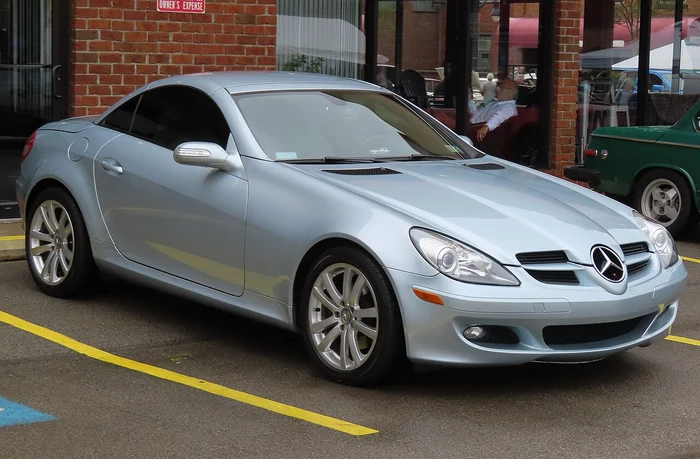
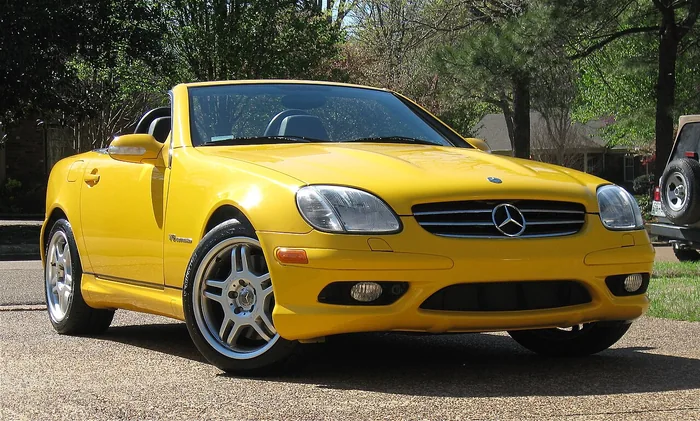
Other Motor Wiki entries in this SLK AMG cluster:
Legacy
The 2012 SLK 55 AMG R172 occupies a unique space in automotive history. It arrived just as the industry pivoted hard toward downsizing and turbocharging. The very next year, the C63 AMG switched to a 4.0L Twin-Turbo V8. The SLK’s successor, the SLC 43, would get a 3.0L Twin-Turbo V6.
The R172 55 AMG was the last naturally aspirated V8 in a compact Mercedes roadster. It represents the purest distillation of the AMG philosophy before hybridization and forced induction became mandatory. It is a car that does everything: it cossets you in traffic with a supple ride (in “C” mode), silences the world with the roof up, blasts “Thunderstruck” from a Harman Kardon system, and then, with a flick of the ESP switch and a press of the loud pedal, transforms into a track weapon capable of embarrassing dedicated sports cars.
It wasn’t perfect. The run-flat tires murdered the ride quality on broken pavement (fix: fit non-run-flats). The infotainment aged poorly. The roof mechanism complexity inspires fear in used buyers. The camshaft adjuster bolts are a known grenade (fix: ARP bolts immediately).
But dynamically? It remains a benchmark. It proved that a retractable hardtop roadster didn’t have to be a compromise. It could be rigid, balanced, adjustable, and ferociously fast. The 2012 SLK 55 AMG wasn’t just the best SLK ever made; it was one of the last great analog sports cars to wear a luxury badge. A scalpel in a tuxedo, indeed.
Leave a Reply
You must be logged in to post a comment.