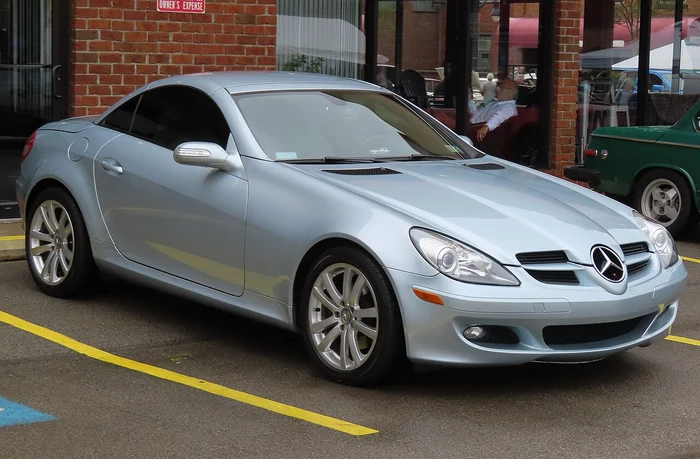
General information & model overview
| Category | Specification Details |
|---|---|
| Model name | 2004 Mercedes-Benz SLK (R171) |
| Internal code | R171 (launch generation) |
| Manufacturer | DaimlerChrysler / Mercedes-Benz; Bremen |
| Reveal / sales | Geneva Motor Show 2004; production 2004–2011 overall (this entry = pre-facelift 2004–early 2008 focus) |
| Body style | Two-door retractable hardtop roadster |
| Layout | Front-engine, rear-wheel drive |
| Designer | Gorden Wagener (design leadership period); Steve Mattin among exterior design credits for the F1-inspired nose |
| Predecessor | R170 facelift / R170 launch |
| Facelift entry | 2008 R171 facelift |
Body & dimensions
| Category | Specification Details |
|---|---|
| Wheelbase | 2,430 mm (+30 mm versus R170) |
| Length / width gains | About +72 mm length and +65 mm width versus R170 |
| Cd | About 0.32 (period factory claim; ~3% better than predecessor) |
| Roof operation | About 22 seconds (was ~25 s on R170); more compact stack; +63 litres boot with roof down |
| Structure claims | Higher high-strength steel content; large gains in bending and torsional stiffness roof-down versus R170 |
Engine specifications (launch years)
| Theme | Details |
|---|---|
| SLK 200 Kompressor | 1.8 supercharged I4 M271 — about 163 PS / 240 Nm (2004–2008) |
| SLK 280 | 3.0 V6 M272 — about 231 PS / 300 Nm |
| SLK 350 (early) | 3.5 V6 M272 — about 272 PS / 350 Nm |
| SLK 55 AMG | 5.4 V8 M113 — about 360 PS / 510 Nm from launch of AMG model |
| Black Series | Limited SLK 55 AMG Black Series ~400 PS (2006–2008) |
Drivetrain & transmission
| Category | Specification Details |
|---|---|
| Manual | 6-speed manual widely available including on V6 cars |
| Automatic | 5G-Tronic or 7G-Tronic depending on engine |
| Drive | Rear-wheel drive |
Chassis, equipment & new features
| Component | Specification |
|---|---|
| New signature feature | Airscarf — forced warm air at neck level from headrests |
| Safety | Adaptive two-stage front airbags; head/thorax sidebags |
| Aero open-top aids | Fabric windblocker over roll bars; reduced cabin draught design work |
Performance (approximate)
| Metric | Approximate data |
|---|---|
| SLK 350 early | About 5.4 s to 100 km/h with manual; limited ~250 km/h |
| SLK 55 AMG | About 4.3–4.9 s class; limited 250 km/h (higher with packages) |
| Position | Larger, stiffer, more powerful than R170; still a comfort-biased compact GT roadster |
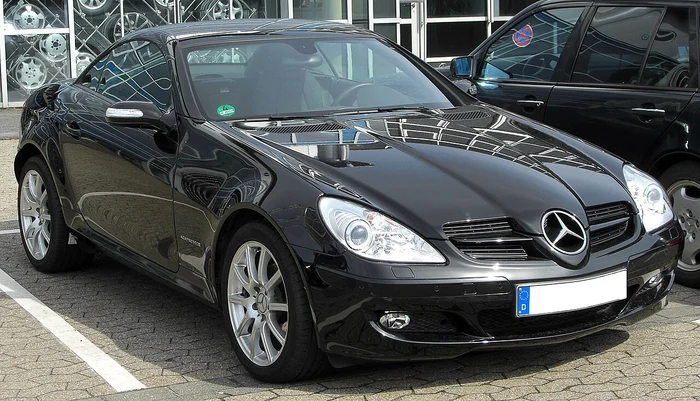
Image source: Wikimedia Commons
What the 2004 SLK (R171) is
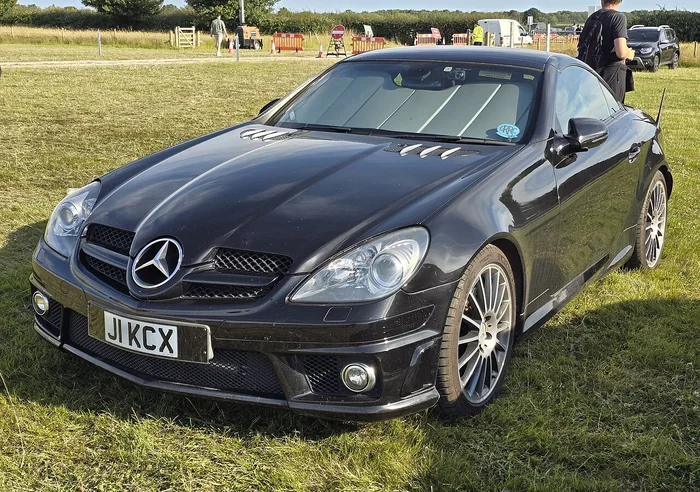
The 2004 Mercedes-Benz SLK is the second generation of the compact hardtop roadster. Unveiled at Geneva in 2004, it replaces the R170 with a longer wheelbase, wider body, faster-folding Vario roof, higher structural stiffness, and the new Airscarf comfort system. The “Formula One–inspired” pointed nose defined the car’s public image for the rest of the decade.
Why R171 was a step change
1. Structure and size
Mercedes increased high-strength steel content and claimed large stiffness gains with the roof down. The car is longer and wider than R170, improving cabin space and crash structure while remaining a two-seater.
2. Roof packaging
A rotary-pivoting rear window and redesigned stack cut operation time to about 22 seconds and freed boot space when the roof is stowed — a direct answer to R170 luggage complaints.
3. Airscarf
Neck-level heating made open-top driving viable in cooler weather and became a hallmark SLK feature carried into the R172.
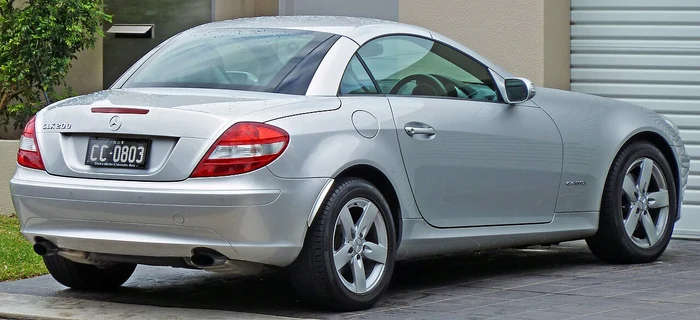
Image source: Wikimedia Commons
Powertrains of the launch years
Early cars centred on the supercharged 1.8 four, the 3.0 and 3.5 V6s, and the 360 PS SLK 55 AMG V8. The SLK 350 with a six-speed manual was widely reviewed as the driver’s choice in the non-AMG range. The 55 AMG brought a true V8 soundtrack and sub-5-second acceleration to the compact roadster class.
The limited Black Series (from 2006) raised output near 400 PS, fitted a fixed carbon roof theme, wider arches, and track-oriented suspension — a rare extreme branch, not the volume car.
Ownership notes for early R171
1. Pre-facelift identification
Front bumper, mirrors without later LED arrows, and lower-output 272 PS SLK 350 engines mark early cars. See the 2008 facelift entry for the later specification set.
2. Mechanical watch points
M272 V6 balance-shaft and timing issues are documented industry-wide on related engines — verify history. Supercharged fours need correct oil and supercharger condition. Roof drains and Airscarf blowers are inspection items unique to this product type.
3. Market role
By 2008 cumulative SLK family sales passed half a million units. Early R171 cars are now accessible used roadsters; condition of roof and electronics dominates value more than colour.
Formula One nose and second-generation packaging
The pointed front end, with its pronounced grille and air intakes, was marketed as Formula One–inspired and gave the R171 an aggressive face distinct from the elliptical R170. Underneath, the car grew in track and wheelbase to improve stability and cabin space. High-strength steel content rose, and Mercedes published large percentage gains in roof-down torsional stiffness — important because hardtop roadsters are structurally challenged when open.
Airscarf as a product invention
Warm air ducted from the headrests to the neck sounds like a comfort gimmick until used on a cool evening. It extends the open-top season and reduces the need to run the cabin heater hard with the roof down. The system includes blower and duct hardware that can fail or clog; function checks are part of any serious R171 inspection. Later generations kept the idea because customers expected it.
SLK 55 AMG and Black Series extremes
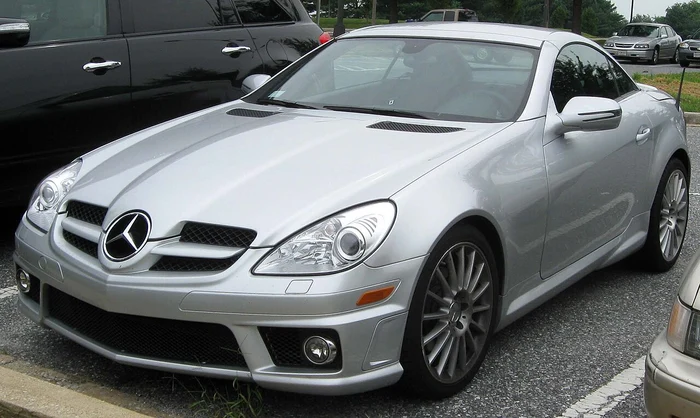
The standard 55 AMG put a 5.4-litre V8 into a compact roadster with AMG brakes, exhaust, and bodywork. Independent tests recorded mid-4-second 0–60 mph runs. The Black Series removed the folding-roof practicality in favour of a fixed carbon roof theme, wider bodywork, and about 400 PS — a rare track-leaning special, not a volume SKU. Most owners and most encyclopedia interest still centre on the regular folding-roof cars.
Legacy
The 2004 R171 established the modern SLK template: stiffer structure, Airscarf, F1-nose design, and a V8 AMG peak. It is the generation that made the compact Mercedes hardtop roadster a mature global product rather than a first-generation novelty. Durable facts: R171 from 2004, Bremen, Vario roof ~22 s, Airscarf debut, engines from ~163 PS four to 360 PS V8 AMG before the 2008 power bumps.
Leave a Reply
You must be logged in to post a comment.