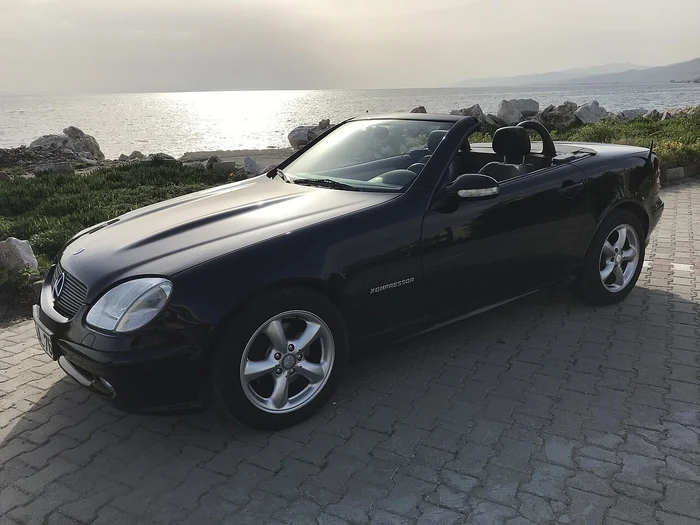
General information & model overview
| Category | Specification Details |
|---|---|
| Model name | 1996 Mercedes-Benz SLK (R170) |
| Internal code | R170 (launch generation) |
| Manufacturer | Daimler-Benz / later DaimlerChrysler; main assembly Bremen |
| Production | Mass production from July 1996; series through April 2004 (this entry = pre-facelift 1996–early 2000 focus) |
| Public launch | Turin Motor Show, 22 April 1996 |
| Body style | Two-door retractable hardtop roadster |
| Layout | Front-engine, rear-wheel drive; shortened W202 C-Class related platform |
| Design | Bruno Sacco era programme; Michael Mauer / Murat Günak among 1993 design credits |
| Name | SLK = sportlich, leicht, kurz |
| Spiritual wheelbase link | 2,400 mm — same figure as historic 190 SL / 300 SL |
Body & dimensions
| Category | Specification Details |
|---|---|
| Wheelbase | 2,400 mm (94.5 in) |
| Length | About 3,995–4,010 mm |
| Width | About 1,715 mm |
| Height | About 1,269–1,284 mm |
| Roof | Electro-hydraulic metal Vario roof (~25 seconds) — the product’s defining feature |
| Curb weight range | Roughly 1,270–1,495 kg depending on model |
| Platform note | Related R170 architecture later shared substantially with Chrysler Crossfire |
Engine specifications (launch years)
| Theme | Details |
|---|---|
| SLK 200 | 2.0 M111 I4 NA — about 136 PS / 190 Nm (1996–2000; selected markets) |
| SLK 200 Kompressor (early, limited markets) | 2.0 supercharged — about 192 PS early / later calibrations |
| SLK 230 Kompressor | 2.3 supercharged M111 — about 193 PS / 280 Nm (core global model) |
| Gearboxes | 5-speed manual (Getrag); 5-speed automatic; 6-speed manual later in life |
Chassis, equipment & safety
| Component | Specification |
|---|---|
| Brakes / safety | ABS; ESP era equipment; dual front and side airbags as standard package evolved |
| Comfort | Power seats/windows, dual-zone climate on many cars, alloy wheels |
| Options | AMG styling package, xenon lights, Bose audio, heated seats, Touch Shift automatic |
Performance & recognition (approximate)
| Metric | Approximate data |
|---|---|
| SLK 200 NA | About 9.3–9.7 s to 100 km/h |
| SLK 230 Kompressor | About 7.3–7.4 s to 100 km/h |
| Awards | Car and Driver 10Best 1997; North American Car of the Year 1997 |
| Production total R170 | About 311,222 including all years and variants |
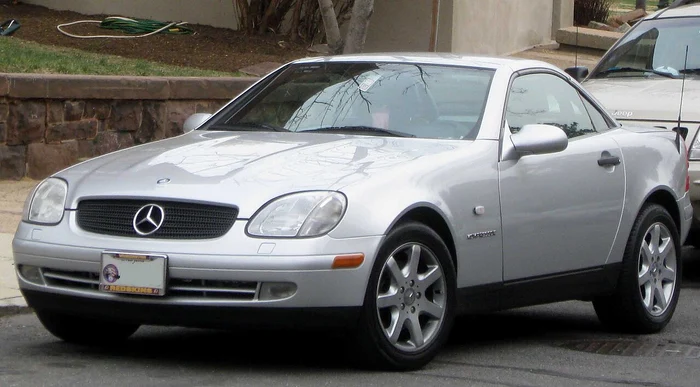
Image source: Wikimedia Commons
What the 1996 SLK is
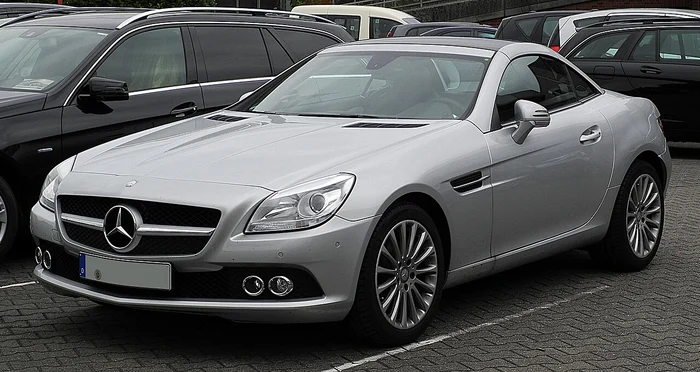
The 1996 Mercedes-Benz SLK is the car that reinvented the compact premium hardtop roadster. After concept showings in 1994 (SLK I / SLK II), the production R170 appeared at Turin in April 1996 and entered mass production that July. Its electro-hydraulic folding metal roof — the Vario roof — closed to a proper coupe profile and opened in about 25 seconds, solving the security and winter practicality problems of traditional soft-tops for a generation of buyers.
The name and short 2,400 mm wheelbase deliberately echo Mercedes sports-car heritage, including the 190 SL, while the engineering base is a shortened late-1990s C-Class platform.
Why the first SLK mattered
1. Vario roof as product definition
Retractable hardtops existed in limited forms before, but Mercedes industrialised the idea for a volume two-seater. Closed, the car is a secure, quiet coupe-like object. Open, it is a roadster. That dual use drove sales past 300,000 for the generation.
2. Supercharged four as brand hero
The SLK 230 Kompressor became the signature global engine: a supercharged 2.3-litre four with immediate mid-range punch and a distinctive blower sound. Naturally aspirated and early Kompressor 2.0 cars filled tax or market niches.
3. Design and awards
The long bonnet, short deck, and elliptical headlamps created an immediately recognisable late-1990s Mercedes sports face. Awards in 1997 confirmed both critical and market acceptance.
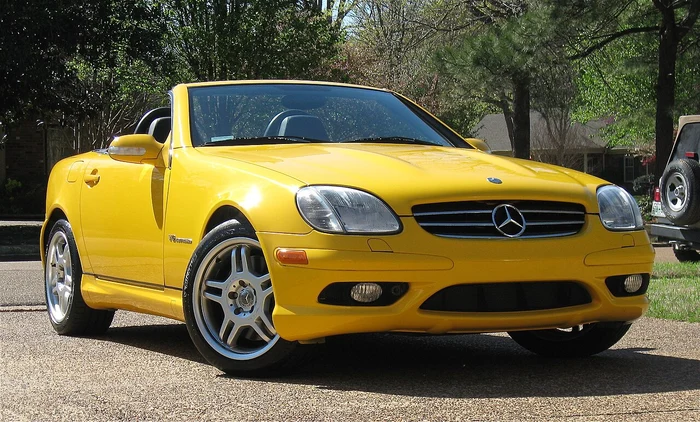
Image source: Wikimedia Commons
Driving character of the launch car
Pre-facelift SLKs are compact and relatively simple by modern standards. Steering and chassis are comfort-oriented sports-touring rather than hardcore. The hardtop mechanism adds mass high and aft when stowed, so the car never pretends to be a mid-engine pure sports car. Its job is stylish open-air travel with Mercedes systems and image.
Ownership notes for early R170
1. Pre-facelift identity
Earlier bumpers, grille, and lights, plus absence of the SLK 320/32 AMG, mark 1996–1999 cars. See the 2000 facelift for later engines and styling.
2. Roof and electronics
Roof hydraulics, microswitches, and seals are the ownership centre of gravity. Budget for specialist diagnosis. Early electronics and wiring age like any late-1990s Mercedes.
3. Supercharger service
M111 Kompressor engines need correct oil, cooling, and attention to charge-system condition. Neglected cars show boost issues and overheating under load.
From concept to Bremen production
SLK I and SLK II concepts in 1994 proved public appetite for a metal folding roof on a short Mercedes two-seater. Final design patents and board approval in the early 1990s led to pre-production cars in 1995 and full production in mid-1996. Bremen became the spiritual home of the SLK line through all three generations. The shortened C-Class platform kept development cost and parts commonality manageable while the roof mechanism absorbed the programme’s technical risk.
Market impact and rivals
BMW’s Z3 and later Porsche Boxster defined different points of the late-1990s roadster boom — fabric tops, different chassis philosophies. The SLK answered with security, winter practicality, and three-pointed-star image. North American Car of the Year recognition in 1997 accelerated US demand. Used values later softened as volumes aged, then stabilised as clean early cars became modern classics.
What “kurz” meant in practice
At roughly four metres long, the first SLK was easy to place in cities and still had a boot usable with the roof up. With the roof down, luggage space shrank — a complaint R171 later addressed. Two seats only was non-negotiable; the car never pretended to be a compact SL with occasional rear space.
Legacy
The 1996 R170 SLK founded an entire class of premium folding-hardtop roadsters and kept Mercedes in the two-seat open-car business below the full-size SL. Durable facts: R170 from 1996, Vario roof, 2,400 mm wheelbase, supercharged four as hero engine, ~311,000 built through 2004, facelift in 2000, replaced by R171.
Leave a Reply
You must be logged in to post a comment.