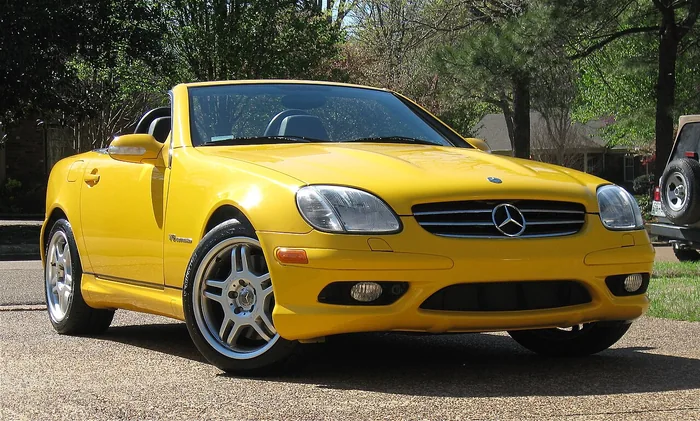
Vehicle Identity
| Category | Specification Details |
|---|---|
| Model Code | R170.466 — Internal factory designation |
| Sales Designation | SLK 32 AMG — Marketed as “SLK 32 AMG” (no “Kompressor” badge on trunk initially) |
| Model Years | 2001–2004 — Production: March 2001 – April 2004 |
| Vehicle Type | 2-Door Roadster / Cabriolet — Monocoque steel body with aluminum hood/trunk |
| Assembly Plant | Bremen, Germany — Body-in-white & paint; Final assembly at AMG (Affalterbach) for engine/transaxle marriage |
| Class | Premium Compact Sports Roadster — Competed with BMW Z3 M Roadster, Porsche Boxster S |
Dimensions & Weight
| Category | Specification Details |
|---|---|
| Wheelbase | 2,430 mm (95.7 in) — Identical to standard SLK |
| Length | 4,035 mm (158.9 in) — +35mm over standard SLK due to AMG bumpers |
| Width | 1,740 mm (68.5 in) — Excluding mirrors; +28mm over standard (widened rear track) |
| Height | 1,295 mm (51.0 in) — With roof closed |
| Front Track | 1,485 mm (58.5 in) — Widened vs. standard SLK (1,462 mm) |
| Rear Track | 1,505 mm (59.3 in) — Significantly widened vs. standard (1,447 mm) |
| Ground Clearance | ~110 mm (4.3 in) — Lowered 15mm vs. standard SLK Sport suspension |
| Curb Weight (DIN) | 1,495 kg (3,296 lb) — ~120 kg heavier than SLK 230; near 50/50 weight dist. |
| Weight Distribution | 51% Front / 49% Rear — Excellent for a front-engine roadster |
| Max. Permissible Weight | 1,830 kg (4,034 lb) |
| Trunk Capacity (Roof Up) | 208 L (7.3 cu ft) — Reduced by battery relocation & subwoofer |
| Trunk Capacity (Roof Down) | 123 L (4.3 cu ft) |
| Fuel Tank Capacity | 60 L (15.9 US gal) — Includes ~8 L reserve |
Powertrain — Engine (M112 E32 Ml)
| Category | Specification Details |
|---|---|
| Engine Code | M112.960 — Hand-built at AMG Affalterbach (“One Man, One Engine”) |
| Configuration | 90° V6, SOHC, 3 Valves/Cyl (2 Intake, 1 Exhaust) — Aluminum block & heads; Nikasil cylinder lining |
| Displacement | 3,199 cc (195.2 cu in) — Bore x Stroke: 89.9 mm x 84.0 mm |
| Compression Ratio | 9.0 : 1 — Lowered from 10.0:1 (NA M112) for boost reliability |
| Aspiration | Roots-Type Supercharger (Eaton M62) — Helix lobe rotors (60° twist), integrated intercooler |
| Supercharger Drive | Poly-V Belt (Crankshaft driven) — Electromagnetic clutch for decoupling at low load |
| Max Boost Pressure | ~0.73 bar (10.6 psi) — Relatively low boost for broad torque curve |
| Intercooling | Water-to-Air (Charge Air Cooler) — Separate low-temp coolant circuit w/ front heat exchanger |
| Fuel System | Bosch ME 2.8 Sequential MPI — Returnless fuel system; 2-stage fuel pump |
| Ignition | Coil-on-Plug (6 Individual Coils) — Ionization current knock detection |
| Valvetrain | Roller Rocker Arms, Hydraulic Lash Adjusters — Single cam per bank; short pushrods for exhaust |
| Engine Oil Capacity | 7.5 L (7.9 qt) — Dry sump-style deep pan; Spec: MB 229.5 (Synthetic 0W-40/5W-40) |
| Max Power (DIN) | 260 kW (354 PS / 349 hp) @ 6,100 rpm — SAE Net: ~349 hp |
| Max Torque (DIN) | 450 Nm (332 lb-ft) @ 3,000–4,500 rpm — Massive flat plateau; available just off idle |
| Specific Output | 110.6 PS/L — High for 2001 forced induction V6 |
| Redline / Rev Limiter | 6,500 rpm / 6,800 rpm — Soft limiter |
| Emissions Standard | EU3 / ULEV (US) — 3-way catalytic converters (2x close-coupled) |
Transmission & Driveline
| Category | Specification Details |
|---|---|
| Transmission Type | 5-Speed Automatic (5G-Tronic) — Model: 722.6 (W5A330) – AMG SPEEDSHIFT logic |
| Torque Converter | Lock-up in Gears 2–5 — Optimized stall speed for torque multiplication |
| Shift Modes | C (Comfort) / S (Sport) / M (Manual) — “S” holds gears longer, faster shifts; “M” = full manual control via shifter gate |
| Shift Time (Sport) | ~150–200 ms — Significantly faster than standard 722.6 |
| Gear Ratios | 1st: 3.59 — 2nd: 2.19 — 3rd: 1.41 — 4th: 1.00 — 5th: 0.83 — Rev: 3.16 |
| Final Drive Ratio | 3.27 : 1 (Standard) — Optional: 3.46 : 1 (Code 286) for acceleration |
| Drivetrain Layout | Front Longitudinal Engine / RWD |
| Differential | AMG Limited-Slip Differential (LSD) — Mechanical multi-plate clutch pack (25% lock-up) – Critical standard feature |
| Driveshaft | Two-piece aluminum tube — Center support bearing; CV joints |
Chassis & Suspension
| Category | Specification Details |
|---|---|
| Front Suspension | Double Wishbone (Aluminum Control Arms) — AMG-specific geometry; harder bushings; 15mm lower |
| Rear Suspension | 5-Link Multilink (Steel/Aluminum) — AMG-specific subframe bushings; widened trailing arms |
| Springs | Progressive Rate Coil Springs — ~30% stiffer than SLK Sport suspension |
| Dampers | AMG Tuned Gas-Pressure Monotube (Boge/Sachs) — Fixed rate; specific valving for R170 AMG |
| Anti-Roll Bars | Front: 30.5 mm (Hollow) — Rear: 22.0 mm (Solid) — Thicker than standard |
| Steering Type | Hydraulic Rack & Pinion (Servotronic) — Speed-sensitive assist; AMG ratio (14.5:1) – quicker than standard |
| Steering Turns (Lock-to-Lock) | 2.7 |
| Turning Circle | 10.6 m (34.8 ft) — Curb-to-curb |
Brakes
| Category | Specification Details |
|---|---|
| Front Brakes | 345 mm x 30 mm Vented & Cross-Drilled — 4-Piston Fixed Aluminum Calipers (Brembo-sourced, AMG branded) |
| Rear Brakes | 300 mm x 22 mm Vented & Cross-Drilled — 1-Piston Floating Calipers (AMG specific) |
| Parking Brake | Mechanical Drum-in-Hat (180 mm) — Integrated into rear rotor hub |
| Brake Booster | Tandem Diaphragm, Vacuum Assisted |
| ABS / ESP | Bosch ESP 5.7 (Electronic Stability Program) — Standard; “ESP Off” button on center console (partial defeat) |
| Brake Pad Compound | AMG Performance (High Friction, High Dust) — Part #: 000 420 79 20 (Front) / 000 420 80 20 (Rear) |
Wheels & Tires (Standard)
| Category | Specification Details |
|---|---|
| Wheel Design | AMG 5-Spoke Monoblock II (Code 781) — Forged Aluminum (rare for this price point then) |
| Front Wheels | 8.0 J x 17 ET 37 — Staggered fitment |
| Rear Wheels | 9.0 J x 17 ET 30 — Staggered fitment |
| Front Tires | 225/45 ZR 17 — Bridgestone Potenza S-02 / Michelin Pilot Sport PS2 (OE) |
| Rear Tires | 245/40 ZR 17 — Staggered widths prevent rotation |
| Spare Tire | TIREFIT Mobility Kit (Sealant + Compressor) — No spare well due to fuel tank / battery location |
| Optional Wheels | 17″ AMG Aero II (Code 785) / 18″ AMG Aero (Dealer/AMG Accessory) — 18″ requires fender rolling on early cars |
Performance (Manufacturer / Press Test Data)
| Category | Specification Details |
|---|---|
| 0–100 km/h (0–62 mph) | 5.2 sec (3.46 FD) / 5.4 sec (3.27 FD) |
| 0–160 km/h (0–100 mph) | ~12.5 sec |
| 0–200 km/h (0–124 mph) | ~21.0 sec |
| Standing 1/4 Mile | ~13.6 sec @ 104 mph |
| Top Speed (Electronically Limited) | 250 km/h (155 mph) |
| Top Speed (Derestricted) | ~265–270 km/h (165–168 mph) — Drag limited (Cd x A) |
| Lateral Acceleration (Skidpad) | ~0.92 – 0.95 g — On OE tires |
| Braking 100–0 km/h | ~35–36 m (115 ft) — Excellent fade resistance |
| Fuel Consumption (NEDC Combined) | 11.5 L/100km (20.5 mpg US) — Real world: 14–18 L/100km typical |
| CO2 Emissions | 274 g/km |
Exterior Features (Standard Over Slk 230/320)
| Category | Specification Details |
|---|---|
| Body Kit | AMG Front Apron (w/ larger intakes), Side Sills, Rear Apron (w/ diffuser) — Integrates fog lights; distinct “jet wing” front grille (3 vertical slats) |
| Hood | Aluminum w/ Power Domes (Twin “Power Bulges”) — Clears supercharger/intercooler; functional heat extraction |
| Roof Mechanism | Electro-Hydraulic Varivert (ZF) — 22 sec operation; 1-piece tonneau cover standard |
| Rear Wing | Fixed “Bootlid Spoiler” (High Gloss Black) — Reduces lift at rear axle by ~30% |
| Exhaust | Dual Twin-Pipe Chrome Tips (4 pipes total) — Flapper valves in mufflers (vacuum controlled) – quieter at cruise |
| Mirrors | Aerodynamic “Teardrop” Design — Body-colored housings; auto-dimming driver side (optional) |
| Lights | Bi-Xenon Headlights (Standard) — Dynamic auto-leveling; washers standard |
| Glass | Green-tinted Heat-Reflective — Windshield: IR-reflective (Climatised) |
Interior & Equipment (Standard)
| Category | Specification Details |
|---|---|
| Seats | AMG Performance Seats (Integral) — 4-way power (height, recline); manual fore/aft; pneumatic lumbar/side bolsters |
| Upholstery | Designo Silverstone Leather (Standard) — Perforated centers; Silver contrast stitching; “AMG” embossed headrests |
| Optional Upholstery | Designo Charcoal / Designo Classic Red / Designo Stone — Full leather dash/doors/console (Designo programs) |
| Steering Wheel | AMG 3-Spoke Sport (380mm) — Flat bottom (subtle); perforated leather grip; aluminum shift paddles (optional) |
| Shift Knob | Aluminum/Leather (Automatic) — Tiptronic gate illumination |
| Instrument Cluster | White-faced Gauges (VDO) — 280 km/h speedo; Boost gauge in center console (optional/Dealer) |
| Center Console Gauges | Analog Clock / Oil Temp / Voltimeter — Standard trio (replaces standard blank/ashtray) |
| Infotainment | Audio 10 Cassette / Radio / CDR (Optional) — Bose Sound System (Standard) w/ Subwoofer in passenger footwell |
| Climate Control | THERMOTRONIC Automatic Dual-Zone — Charcoal filter; residual heat; tunnel mode |
| Trim | Birdseye Maple Wood (Standard) — Carbon Fiber (Code 731) / Piano Black (Late) / Aluminum (AMG Perf. Studio) options |
| Safety | Dual Front Airbags, Side Thorax Airbags (Door), Belt Tensioners — Roll-over bars (spring-loaded behind seats) – Standard |
| Convenience | Rain Sensor, Auto-Dimming Rearview, Cruise Control, Parktronic (Opt) |
Key Option Codes (Datacard Reference)
| Category | Specification Details |
|---|---|
| 286 | Rear Axle Ratio 3.46 — Highly desirable for acceleration |
| 487 | Bi-Xenon Headlights — Standard on US spec; Optional ROW |
| 536 | Hardtop (Removable, Body Color) — Includes rear defroster & wiper; ~45 kg |
| 731 | Carbon Fiber Interior Trim — Replaces Birdseye Maple |
| 781 | 17″ AMG Monoblock II Forged Wheels — Standard |
| 785 | 17″ AMG Aero II Wheels — Cast, heavier |
| 873 | Heated Seats — Highly recommended |
| 889 | KEYLESS-GO — Proximity entry/start |
| 918 | Designo Leather (Full) — Extended leather to dash top, door pulls, console |
| 920 | Designo Metallic Paint — Special colors (e.g., Designo Silver, Graphite) |
| 957 | Fire Extinguisher — EU requirement often |
Production Numbers (Estimated Global)
| Category | Specification Details |
|---|---|
| Total Production | ~4,300 – 4,500 Units — R170 Total: ~55k; SLK 32 AMG ~7.5% of run |
| US Market Allocation | ~1,800 – 2,000 Units — 2001–2004 MY |
| Right-Hand Drive (UK/JP/AUS) | ~600 Units |
Model identity
When the original R170 SLK launched in 1996, it was a triumph of packaging—a compact roadster with a retractable hardtop that rewrote the rules for open-top versatility. But for the engineers at AMG, then still a wholly owned subsidiary operating with a start-up’s ferocity in Affalterbach, the standard SLK 230 Kompressor was merely a canvas. The brief was deceptively simple: shoehorn the most power possible into that short wheelbase without turning the car into a widow-maker.
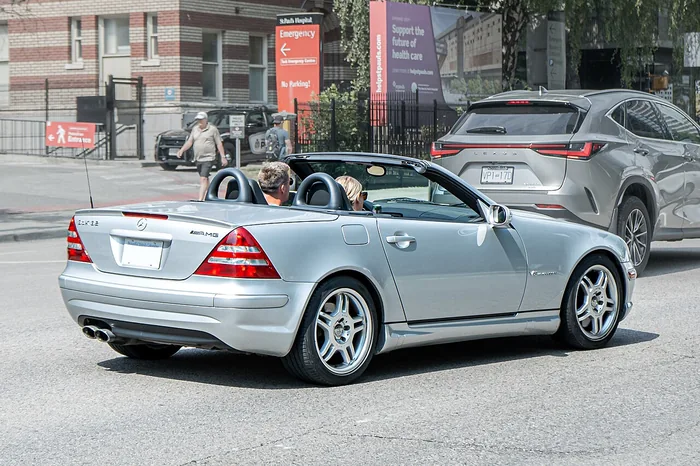
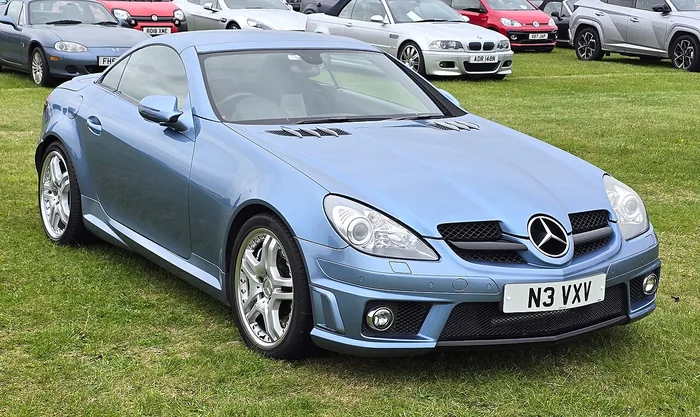
Image source: Wikimedia Commons (user OWS Photography)
Development
The result, unveiled at the 2001 Geneva Motor Show, was the SLK 32 AMG. It wasn’t just an “SLK with a bigger engine.” It was the first compact Mercedes to wear the AMG badge without a “55” or “63” suffix, and it introduced the world to the M112 E32 ML—a hand-built, supercharged 3.2-liter V6 that rewrote the rulebook on forced induction response.
Development wasn’t without internal friction. The R170 platform was never designed for 350+ hp. The firewall was tight, the cooling capacity marginal, and the rear subframe designed for forces half of what the AMG V6 could deliver. The solution wasn’t brute force; it was surgical precision. AMG didn’t just drop in an engine; they re-engineered the stress paths of the entire front structure, fabricated a bespoke aluminum crossmember, and developed a unique rear subframe mounting strategy to handle the 450 Nm torque tsunami.
Engines and performance
1. Engine and power delivery
In an era where the automotive world was pivoting aggressively toward turbocharging (think BMW’s incoming N54 or the VW 1.8T), AMG’s insistence on a Roots-type Eaton M62 supercharger felt anachronistic to some. It was, in fact, a masterstroke of character engineering.
Mounted in the valley of the 90-degree V6, fed by a massive airbox inhaling through the hood’s iconic twin power domes, the M62 spins at up to 14,000 rpm via a helical gear drive off the crank. Crucially, it features an electromagnetic clutch. Below 2,000 rpm, the rotors freewheel, eliminating parasitic drag and heat soak. Stomp the throttle, the clutch engages instantly, and 332 lb-ft of torque arrives at 3,000 rpm—flat until 4,500 rpm.
2. Character and response
There is no lag. No “rubber band” sensation. The throttle pedal is connected directly to the crankshaft via a blower that acts like a mechanical multiplier. The sound is the signature: a deep, guttural V6 growl overlaid with a distinct, mechanical whir—the sound of compressed air being shoved into cylinders.
It feels like a naturally aspirated 5.0-liter V8 that happens to rev to 6,500 rpm. The water-to-air intercooler, fed by its own low-temperature radiator behind the front grille, keeps intake temps remarkably consistent, preventing the power fade that plagued early turbo rivals on track days.
Chassis and driving character
1. Suspension and traction
The R170’s 95.7-inch wheelbase is short—shorter than a Mazda MX-5 of the era. Physics dictates a nervous pendulum effect. AMG’s answer was a masterclass in suspension tuning.
They widened the tracks significantly (front +23mm, rear +58mm via new control arms and subframe), allowing a staggered tire setup (225/45 front, 245/40 rear on forged 17-inch Monoblock II wheels). The springs were stiffened by roughly 30%, but the genius lay in the monotube dampers and progressive springs. The SLK 32 rides with a compliance that shocks passengers expecting a “race car.” It absorbs expansion joints with a sophisticated thud rather than a crash.
2. Steering and brakes
But push it, and the mechanical Limited-Slip Differential (LSD)—a 25% lock-up multi-plate unit—reveals the car’s true intent. This was standard equipment, a rarity even among M-cars of the time (the Z3 M Roadster used a viscous unit). The LSD allows you to put power down at the apex, rotating the nose in with the throttle.
The Servotronic steering, quickened to 2.7 turns lock-to-lock, weights up beautifully under load. It communicates the front tire contact patch with a clarity lost in modern electric racks. You know exactly when the 225-section fronts are saturated.
The braking system remains a high-water mark: 345mm cross-drilled fronts clamped by 4-piston fixed calipers. They are fade-resistant, modulable, and feel like they could stop a train. The Bosch 5.7 ESP system is intrusive if you drive like a novice, but the “ESP Off” button (a novel concept in 2001) unlocks a genuinely adjustable chassis balance—oversteer is progressive, catchable, and entirely driver-controlled.
Interior and equipment
Slide into the AMG Performance seats—standard, not optional—and you sit in the car, not on it. The pneumatic bolsters inflate to hug your ribs; the Designo Silverstone leather (standard) smells of tannins and cattle ranch, not plasticizers. The dashboard is a symphony of Birdseye Maple (standard) or optional Carbon Fiber, capped by the “three-pod” console gauges: Oil Temp, Voltmeter, Analog Clock. No screens. No menus. Just needles sweeping arcs.
The AMG 3-spoke wheel (flat-bottomed before it was cool) frames white-faced VDO gauges reading to 280 km/h. The shifter for the 5G-Tronic (722.6) falls perfectly to hand. This wasn’t a dual-clutch; it was a torque-converter auto with AMG SPEEDSHIFT logic. In “S” or “M” mode, it bangs gears with a mechanical authority that modern DCTs struggle to replicate emotionally. It holds gears to redline, blips downshifts (rudimentarily), and locks the converter early. It suits the supercharged torque curve perfectly—smooth in traffic, violent on demand.
Design: retractable hardtop
The party piece remains the electro-hydraulic hardtop. Press the button on the center console (or the key fob), and the tonneau cover rises, the rear window drops, the roof unlatches, folds in a complex origami sequence, and stows behind the seats—all in 22 seconds, at speeds up to 30 km/h.
With the roof up, the SLK 32 is a quiet, rigid coupe (torsional rigidity was class-leading at ~11,000 Nm/deg). With it down, you get the full supercharger aria. The standard wind deflector (stored in the trunk) makes 80 mph conversation possible without shouting.
Related models
Other Motor Wiki entries in this SLK AMG cluster:
Legacy
Production ended in April 2004 after roughly 4,300 units. It was replaced by the R171 SLK 55 AMG—a naturally aspirated V8 masterpiece, but one that lost the forced-induction torque character and the mechanical LSD (replaced by brake-actuated ETS).
The SLK 32 AMG occupies a unique sweet spot in Mercedes history. It was the last AMG roadster with a hand-built supercharged engine, a hydraulic steering rack, a torque-converter automatic with a mechanical LSD, and zero drive-mode screens. It predates the “AMG Lite” 43/45/53 proliferation. It is a car built by a small team in Affalterbach who signed their names on the engine plaques, not a product planned by a product committee in Stuttgart.
Today, it remains a “driver’s car” in the purest sense. It demands respect for its short wheelbase and massive low-end torque, but rewards it with a linearity and mechanical honesty that modern performance cars simulate with software. It is not merely a fast SLK; it is the moment AMG proved they could turn a lifestyle roadster into a legitimate scalpel—without losing the tuxedo.
Leave a Reply
You must be logged in to post a comment.