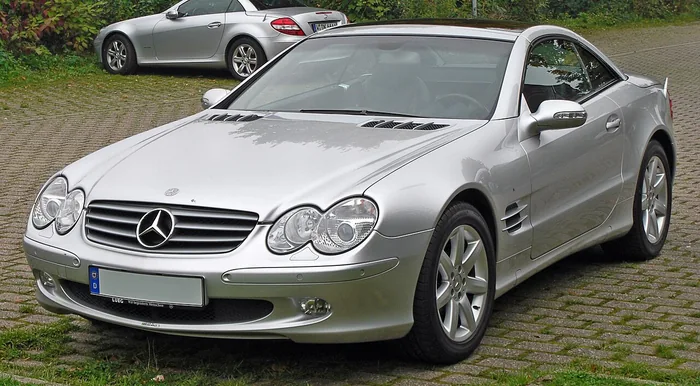
Identity and Model Codes
| Category | Specification Details |
|---|---|
| Manufacturer | DaimlerChrysler AG / Mercedes-Benz |
| Model Name | SL-Class Roadster |
| Internal Chassis Code | R230 |
| Sales Designation (Launch Models) | SL 500, SL 55 AMG |
| Model Years (Launch Generation) | 2001–2006 (Pre-facelift) |
| World Premiere | March 2001 (Geneva Motor Show) |
| Production Start | June 2001 |
| Assembly Plant | Bremen, Germany |
| Body Style | 2-door, 2-seat retractable hardtop roadster |
| Platform Architecture | Mercedes-Benz R230 dedicated sports car platform (shared floorpan elements with W220 S-Class) |
| Successor To | R129 SL-Class (1989–2001) |
| Predecessor To | R230 Facelift (2006–2011) / R231 (2012) |
Dimensions and Weights
| Category | Specification Details |
|---|---|
| Length | 4,522 mm (178.0 in) |
| Width (excluding mirrors) | 1,827 mm (71.9 in) |
| Height (roof closed) | 1,315 mm (51.8 in) |
| Wheelbase | 2,580 mm (101.6 in) |
| Track Width, Front | 1,562 mm (61.5 in) |
| Track Width, Rear | 1,566 mm (61.7 in) |
| Ground Clearance (unladen) | Approx. 120 mm (4.7 in) |
| Curb Weight (DIN) – SL 500 | 1,825 kg (4,023 lb) |
| Curb Weight (DIN) – SL 55 AMG | 1,905 kg (4,200 lb) |
| Gross Vehicle Weight (GVW) – SL 500 | 2,175 kg (4,795 lb) |
| Weight Distribution (F/R) – SL 500 | 51 / 49 % |
| Trunk Volume (Roof Up) | 220 L (7.8 cu ft) |
| Trunk Volume (Roof Down) | 135 L (4.8 cu ft) |
| Fuel Tank Capacity | 90 L (23.8 US gal) |
Engine Specifications: M113 E50 (SL 500)
| Category | Specification Details |
|---|---|
| Engine Code | M113.963 |
| Configuration | 90° V8, Aluminum Block & Heads |
| Displacement | 4,966 cc (303.0 cu in) |
| Bore x Stroke | 97.0 mm x 84.0 mm |
| Compression Ratio | 10.5 : 1 |
| Valvetrain | SOHC, 3 valves per cylinder (2 intake, 1 exhaust), Roller rockers |
| Variable Valve Timing | VVT on intake camshafts |
| Fuel System | Bosch ME 2.8 Sequential Multi-Port Fuel Injection |
| Ignition | Coil-on-plug, 8 individual ignition coils |
| Max Power (DIN) | 225 kW (306 PS / 302 hp) at 5,600 rpm |
| Max Torque (DIN) | 460 Nm (339 lb-ft) at 2,700–4,250 rpm |
| Specific Output | 61.6 PS/L |
| Engine Management | ME 2.8 (Motor Electronics) with drive-by-wire throttle |
| Emissions Standard | EU3 / LEV (US) |
| Recommended Fuel | Super Plus 98 RON (Min 95 RON) |
| Oil Capacity (with filter) | 8.5 L |
Engine Specifications: M113 E55 ML (SL 55 AMG)
| Category | Specification Details |
|---|---|
| Engine Code | M113.992 (Hand-built “One Man, One Engine”) |
| Configuration | 90° V8, Aluminum Block & Heads, Forged Crankshaft |
| Displacement | 5,439 cc (331.9 cu in) |
| Bore x Stroke | 97.0 mm x 92.0 mm |
| Compression Ratio | 10.0 : 1 |
| Valvetrain | SOHC, 3 valves per cylinder, AMG-specific cam profiles |
| Intake System | Two-stage variable length intake manifold |
| Fuel System | Bosch ME 2.8 Sequential Multi-Port Fuel Injection, High-flow injectors |
| Max Power (DIN) | 350 kW (476 PS / 469 hp) at 6,100 rpm |
| Max Torque (DIN) | 700 Nm (516 lb-ft) at 2,650–4,500 rpm |
| Specific Output | 87.5 PS/L |
| Engine Management | ME 2.8 AMG calibration |
| Emissions Standard | EU3 / ULEV (US) |
| Recommended Fuel | Super Plus 98 RON |
| Oil Capacity (with filter) | 9.5 L (Dry sump style lubrication system) |
Transmission and Driveline
| Category | Specification Details |
|---|---|
| Transmission Type (Both Models) | 5G-Tronic 5-Speed Automatic (722.6) |
| Torque Converter | Hydrodynamic with lock-up clutch (all forward gears) |
| Shift Control | Electro-hydraulic, adaptive fuzzy logic, Touch Shift manual gate |
| Gear Ratios (5G-Tronic) | 1st: 3.59, 2nd: 2.19, 3rd: 1.41, 4th: 1.00, 5th: 0.83, Rev: 3.16 |
| Final Drive Ratio (SL 500) | 2.82 : 1 |
| Final Drive Ratio (SL 55 AMG) | 2.65 : 1 (AMG Speedshift specific) |
| AMG Speedshift Features (SL 55) | Shorter shift times, double-declutch downshifts, manual mode holds gear to redline |
| Drive Layout | Front-engine, Rear-wheel drive |
| Differential (SL 500) | Conventional open differential with ASR/ETS traction control |
| Differential (SL 55 AMG) | AMG Limited-Slip Differential (mechanical, 30% lock) |
Chassis, Suspension, and Active Body Control
| Category | Specification Details |
|---|---|
| Front Suspension | Double wishbone (4-link), Aluminum lower arms, Steel upper arms, Coil springs |
| Rear Suspension | Multi-link (5-link), Aluminum/Steel construction, Coil springs |
| Active Body Control (ABC) | Standard on all R230 models |
| ABC System Pressure | 200 bar (2,900 psi) hydraulic pressure |
| ABC Function | Active roll stabilization, pitch control, ride height leveling, adjustable damping |
| ABC Modes | Sport / Comfort (Driver selectable) |
| Steering Type | Speed-sensitive Servotronic rack-and-pinion |
| Steering Ratio | Variable, approx. 16.5:1 (center) |
| Turning Circle | 11.0 m (36.1 ft) curb-to-curb |
| Front Brake Discs (SL 500) | Ventilated, 330 mm x 32 mm, 4-piston fixed calipers |
| Rear Brake Discs (SL 500) | Ventilated, 300 mm x 22 mm, Single-piston floating calipers |
| Front Brake Discs (SL 55 AMG) | Ventilated/Perforated, 360 mm x 32 mm, 6-piston AMG fixed calipers |
| Rear Brake Discs (SL 55 AMG) | Ventilated/Perforated, 330 mm x 22 mm, 4-piston AMG fixed calipers |
| Brake Assist | BAS (Brake Assist System) Standard |
| Parking Brake | Electric (EPB), Drum-in-disc on rear rotors |
Wheels and Tires (Standard Launch Fitment)
| Category | Specification Details |
|---|---|
| SL 500 Standard Wheel | 8.5J x 18 ET 43, 5-twin-spoke Light Alloy (Code 636) |
| SL 500 Standard Tires | 255/45 R18 99Y XL (Run-flat optional via TIREFIT kit standard) |
| SL 55 AMG Standard Wheel | 8.5J x 18 ET 43 (Front) / 9.5J x 18 ET 50 (Rear), AMG 5-spoke Forged (Code 781) |
| SL 55 AMG Standard Tires | 255/45 ZR18 (Front) / 285/40 ZR18 (Rear) |
| Optional Wheel (SL 500) | 19-inch AMG Multi-spoke (Staggered fitment available) |
| Tire Pressure Monitoring | RDK (ReifenDruckKontrolle) – Indirect via ABS wheel speed sensors |
| Spare Wheel | None (TIREFIT sealant kit + 12V compressor standard) |
Performance Figures (Manufacturer Claims)
| Category | Specification Details |
|---|---|
| 0–100 km/h (0–62 mph) – SL 500 | 6.2 seconds |
| 0–100 km/h (0–62 mph) – SL 55 AMG | 4.7 seconds |
| 0–160 km/h (0–100 mph) – SL 500 | 15.0 seconds |
| 0–160 km/h (0–100 mph) – SL 55 AMG | 11.2 seconds |
| Top Speed – SL 500 | 250 km/h (155 mph) Electronically Limited |
| Top Speed – SL 55 AMG | 250 km/h (155 mph) Electronically Limited (320 km/h / 199 mph with AMG Driver’s Package) |
| Standing Kilometer – SL 500 | Approx. 24.5 seconds |
| Standing Kilometer – SL 55 AMG | Approx. 22.0 seconds |
| Fuel Consumption (NEDC Combined) – SL 500 | 12.8 L/100 km (18.4 mpg US) |
| Fuel Consumption (NEDC Combined) – SL 55 AMG | 14.5 L/100 km (16.2 mpg US) |
| CO2 Emissions – SL 500 | 306 g/km |
| CO2 Emissions – SL 55 AMG | 347 g/km |
Vario Roof System
| Category | Specification Details |
|---|---|
| System Name | Vario-Roof (Retractable Hardtop) |
| Construction | Three-piece articulated steel/aluminum structure (Front panel, Center panel, Rear window assembly) |
| Operation Method | Electro-hydraulic (Integrated into ABC hydraulic circuit) |
| Opening Time | Approx. 16 seconds (Roof stowed) |
| Closing Time | Approx. 16 seconds |
| Operating Speed Limit | Up to 40 km/h (25 mph) |
| Rear Window | Heated Glass, Electric Defroster |
| Wind Deflector | Integrated, electrically deployable mesh screen (stows behind seats) |
| Trunk Partition | Automatic load separator (prevents luggage interference with roof stack) |
| Headroom (Roof Closed) | 948 mm (Front) |
| Headroom (Roof Open) | Unlimited |
Standard Equipment Highlights (Launch Specification)
| Category | Specification Details |
|---|---|
| Exterior Mirrors | Electrically adjustable, heated, auto-dimming (Driver), Aspherical (Passenger), Memory |
| Lighting | Bi-Xenon Headlamps with Dynamic Range Control, Headlamp Washers, LED Tail Lamps |
| Wipers | Rain Sensor, Heated Washer Jets |
| Seats | 12-way Power Front Seats with Memory (3 positions), Heated, Active Ventilation (SL 55), Lumbar Support |
| Upholstery | Designo Nappa Leather (Standard on SL 55), High-grade Leather (SL 500) |
| Climate Control | THERMOTRONIC Dual-Zone Automatic, Dust/Pollen Filter, Residual Engine Heat Utilization |
| Infotainment | COMAND APS (Navigation, Radio, CD, Cassette), Bose Sound System, In-dash 6-CD Changer |
| Connectivity | Telephone Pre-wiring (D2B Fiber Optic), Voice Control |
| Instrument Cluster | Electronic Speedometer/Tach, Multifunction Display (Oil Level, Trip, Service), Outside Temp |
| Steering Wheel | 4-spoke Multifunction (Leather/Wood SL 500, Leather/Alcantara SL 55), Tilt/Telescopic Electric |
| Keyless Entry | Keyless Go (Start/Stop button, Door handle sensors) |
| Security | Anti-Theft Alarm, Immobilizer, Tow-away Protection, Interior Motion Sensor |
Safety Systems
| Category | Specification Details |
|---|---|
| Airbags | Dual-stage Driver/Passenger Front, Side Thorax (Seat-mounted), Head/Thorax (Door-mounted – Windowbags) |
| Rollover Protection | Automatic Deployable Roll Bars (Behind Rear Seats, Spring-loaded, <0.3s deployment) |
| Electronic Stability | ESP (Electronic Stability Program) with ASR (Traction Control) & ABS |
| Braking Aids | BAS (Brake Assist), EBD (Electronic Brakeforce Distribution) |
| Structure | High-strength Steel/Aluminum Spaceframe, Reinforced A-Pillars, Door Impact Beams |
| Seat Belts | 3-point, Pyrotechnic Belt Tensioners, Belt Force Limiters, Automatic Height Adjustment |
| ISOFIX | Not applicable (2-Seater) |
| Pedestrian Protection | Deformable Hood Structure, Recessed Wiper Arms |
Key Options and Packages (Pre-Facelift)
| Category | Specification Details |
|---|---|
| Designo Packages | Exclusive Paint (Metallic/Matte), Two-tone Leather, Piano Lacquer/High-Gloss Wood Trim, Alcantara Headliner |
| AMG Performance Package (SL 55) | Top Speed Raised to 320 km/h, AMG Track-Calibrated ABC, Composite Front Brake Discs (Optional later), Specific Aero |
| Sport Package (SL 500) | AMG Body Styling (Front/Rear/Side), 19″ AMG Wheels, Staggered Tires, Sport Steering Wheel, Aluminum Pedals |
| Hard Drive Navigation | COMAND APS with 20GB HDD (Replaced CD-ROM Navi, introduced ~2003) |
| Keyless Go | Standard on SL 55, Optional on early SL 500 |
| Parktronic | Front & Rear Ultrasonic Parking Sensors with Visual/Audible Display |
| Xenon Headlamps | Standard Bi-Xenon; Adaptive Light System (Cornering Lights) Optional |
| Heated Steering Wheel | Optional (Wood/Leather rim) |
| Neck Heating (AIRSCARF) | Not available on R230 Pre-facelift (Introduced 2008 Facelift) |
Market Position and Model Year Notes
| Category | Specification Details |
|---|---|
| Primary Competitors (2001) | BMW Z8, Jaguar XKR Convertible, Porsche 911 Cabriolet (996), Ferrari 360 Spider, Aston Martin DB7 Volante |
| US Market Launch | Late 2001 as 2002 Model Year |
| US Launch Models | SL 500, SL 55 AMG |
| European Launch Models | SL 500, SL 55 AMG (SL 350 3.7 V6 added late 2002 for some markets) |
| Significant Running Change (2003) | COMAND HDD Navigation introduced; Minor interior trim revisions |
| Significant Running Change (2005) | Engine update for SL 500 to M273 5.5L V6 (388 hp) in some markets; 7G-Tronic intro delayed to Facelift |
| Facelift Transition | March 2006 Geneva Show (Model Year 2007) – New Front/Rear, 7G-Tronic, New Engines (M273/M275/M156) |
| Production Volume (Pre-Facelift Est.) | Approx. 100,000 units globally (2001–2006) |
Model identity
The Mercedes-Benz R230 SL-Class arrived in 2001 as the fifth generation of the storied SL lineage, carrying the internal designation R230. It replaced the long-serving R129, a car that had defined the grand-touring roadster segment for twelve years.
The R230’s brief was ambitious: retain the SL’s traditional blend of luxury, performance, and open-air versatility while introducing a level of structural rigidity and technological sophistication previously unseen in the segment.
The headline feature was the Vario-Roof, a three-piece retractable hardtop that transformed the car from a closed coupe to an open roadster in sixteen seconds.
This mechanism eliminated the traditional compromise of a soft-top’s noise and security or a fixed coupe’s lack of openness.
At launch, the range consisted of two distinct models. The SL 500 served as the volume flagship, powered by the 5.0-liter M113 V8 producing 306 PS.
Above it sat the SL 55 AMG, the first SL to wear the AMG badge from the factory since the limited R129 SL 73 AMG, packing a hand-built 5.4-liter V8 with 476 PS. Both utilized the 5G-Tronic five-speed automatic transmission and rear-wheel drive.
The R230 was positioned as a true grand tourer rather than a pure sports car, a distinction reinforced by its kerb weight exceeding 1.8 tonnes and its standard Active Body Control (ABC) hydraulic suspension.
It competed directly with the BMW Z8, Jaguar XKR, and Porsche 911 Cabriolet, though its pricing and mission aligned it closer to the Bentley Continental GT concept that would arrive shortly after.
Development
Development of the R230 began in the mid-1990s under the leadership of Bruno Sacco’s design direction.
And engineering chief Ulrich Walker. The project faced a fundamental architectural decision: adapt the existing W220 S-Class platform or create a dedicated sports car architecture. Mercedes chose a hybrid approach.
The R230 utilizes the W220’s front structure, firewall, and basic floorpan geometry, but the rear subframe, suspension mounting points, and the entire roof mechanism architecture were unique.
This saved immense development cost while allowing a wheelbase of 2,580 mm — short for an S-Class derivative but long for a two-seater, optimizing interior space.
The Vario-Roof presented the greatest engineering challenge. The requirement was a metal roof that stowed entirely behind the seats without a separate tonneau cover, preserving trunk space when deployed.
Engineers developed a complex kinematic system where the front panel lifts, the center section rotates 180 degrees.
And the rear window assembly tucks beneath the center section. The entire stack is powered by the ABC hydraulic system operating at 200 bar, avoiding the weight and packaging of dedicated electric motors.
The roof structure uses high-strength steel and aluminum to contribute to the body’s torsional rigidity, which Mercedes claimed at 14,000 Nm/degree — a 40 percent improvement over the R129 with the hardtop fitted.
Active Body Control was made standard across the range, a bold move for a volume model. The system uses high-pressure hydraulics to control each wheel’s spring and damper forces independently, counteracting body roll, pitch, and dive in real time.
The control unit processes sensor data at 1,000 Hz. This allowed the R230 to offer a compliant ride in Comfort mode while suppressing roll to near-zero in Sport mode, a bandwidth impossible with conventional steel springs.
The SL 55 AMG received specific ABC calibration with stiffer accumulator spheres and revised valve timing for sharper transient response.
Design
1. Exterior Philosophy
The R230’s design, penned under Sacco but detailed by Gorden Wagener’s team, marked a shift from the R129’s upright, almost formal proportions to a lower, wider.
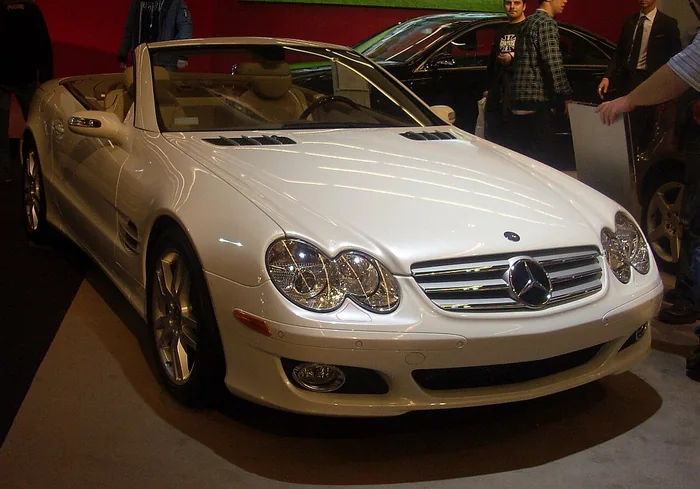
And more muscular stance. The front end features a prominent “face” dominated by a large three-slat grille and bi-xenon headlamps with integrated turn indicators.
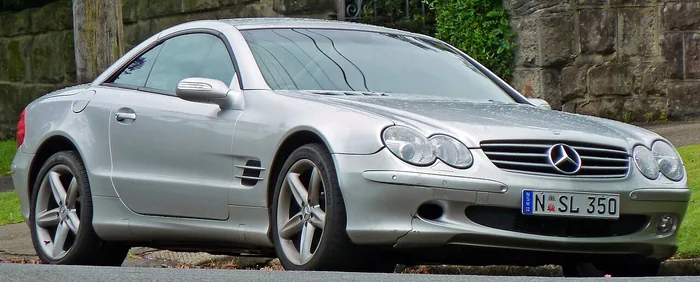
The hood features pronounced power domes, necessary for the V8’s height but styled to suggest performance. The side profile is defined by a strong shoulder line running from the front fender vent — a functional outlet for engine bay heat — to the rear haunches. The short overhangs.
And long hood emphasize the front-mid engine layout.
2. The Vario-Roof Aesthetic
With the roof up, the R230 presents a clean, coupe-like silhouette. The three-panel roof architecture creates distinct seams at the B-pillar and above the rear window, which the design team turned into a graphic element rather than hiding it.
The rear decklid is high and broad, necessitated by the roof stack volume, giving the rear a substantial, planted appearance. With the roof down, the mechanism folds into a shallow well behind the seats, covered by a rigid tonneau that sits flush with the beltline.
The integrated wind deflector deploys from the tonneau’s leading edge, maintaining clean lines. The roll-over bars remain hidden unless deployed, preserving the unbroken shoulder line.
3. Interior Architecture
The cabin follows the “cockpit” theme established by the W220 but with a driver-focused asymmetry. The center console sweeps toward the driver, housing the COMAND controller and climate controls within easy reach.
Materials are high-grade: the SL 500 features standard walnut or maple wood trim on the console and door inserts, while the SL 55 AMG substitutes carbon fiber or piano black lacquer.
The seats are a highlight — 12-way power adjustment with pneumatic lumbar and side bolsters, heating, and active ventilation (perforated leather with forced air on the AMG).
The analog instrument cluster features four round dials with a central multifunction display, a layout that aged gracefully. The thick-rimmed steering wheel (four-spoke on the 500, three-spoke flat-bottom on the 55) frames the view perfectly.
Engines and performance
1. M113 E50 in the SL 500
The SL 500 is powered by the M113 E50, a 5.0-liter SOHC V8 with three valves per cylinder.
And twin spark plugs per cylinder. This engine produces 306 PS (225 kW) at 5,600 rpm and 460 Nm (339 lb-ft) of torque between 2,700 and 4,250 rpm.
The block is aluminum-silicon (Alusil) with cast-in iron liners, and the heads are aluminum. The twin-spark ignition uses two coils per cylinder bank, firing the main and side plugs alternately to ensure complete combustion and meet emissions targets.
The intake manifold is a two-stage variable-length design (Resonance Intake Manifold) that switches at 3,600 rpm to broaden the torque curve. A drive-by-wire electronic throttle is standard.
The engine is mated exclusively to the 5G-Tronic 722.6 five-speed automatic with electronic shift control and a lock-up torque converter. The SL 500 accelerates from 0–100 km/h in 6.2 seconds and reaches an electronically limited top speed of 250 km/h.
2. M113 E55 in the SL 55 AMG
The SL 55 AMG receives the hand-built M113 E55, a 5.4-liter V8 also with three valves per cylinder and twin-spark ignition. Output is 367 PS (270 kW) at 5,750 rpm and 530 Nm (391 lb-ft) of torque between 2,750 and 4,000 rpm.
Each engine is assembled by a single technician at AMG’s Affalterbach facility and carries a signed plaque. Compared to the M113 E50, the E55 features a forged steel crankshaft.
Forged connecting rods, lightweight pistons, revised camshaft profiles, larger intake valves, and a high-flow intake manifold with shorter runners.
The exhaust system uses larger-diameter primary pipes and a freer-flowing muffler design with vacuum-controlled bypass valves that open above 3,500 rpm. The 5G-Tronic transmission receives AMG-specific software with shorter shift times, firmer pressure modulation, and a “C/S” (Comfort/Sport) mode selector on the console.
The SL 55 AMG covers 0–100 km/h in 5.4 seconds, also limited to 250 km/h.
3. Later Engine Developments
In 2006, the facelift (R230 facelift) replaced the M113 engines with the M273 5.5-liter DOHC four-valve V8 (388 PS) in the SL 500 and the M155 5.4-liter supercharged V8 (517 PS) in the SL 55 AMG.
The SL 600 continued with the M275 5.5-liter twin-turbo V12 (517 PS), while the range-topping SL 65 AMG debuted with the M275 AMG 6.0-liter twin-turbo V12 producing 612 PS and 1,000 Nm.
These later powertrains are not part of the 2001 launch specification but define the R230’s evolution.
Driving Character
The R230 delivers a driving experience that prioritizes grand touring composure over outright sports car agility, a deliberate choice consistent with the SL’s lineage. The ABC suspension is the defining dynamic element.
In Comfort mode, the system absorbs large bumps and expansion joints with a supple, damped motion that feels isolated but not floaty. High-frequency harshness is filtered effectively, and the hydraulic springs maintain a consistent ride height regardless of load.
Switching to Sport mode transforms the character: body roll is virtually eliminated, pitch under braking and acceleration is suppressed, and the steering — a hydraulic recirculating-ball system with speed-sensitive Servotronic assist — weights up noticeably.
The steering ratio is 16.5:1 on center, quickening off-center, providing precise placement but limited tactile feedback compared to a rack-and-pinion setup.
The SL 500’s M113 E50 delivers its torque low and linearly, making rapid progress effortless without requiring high revs. The 5G-Tronic shifts smoothly in Comfort, with a perceptible but not harsh firmness in Sport.
The SL 55 AMG feels distinctly more urgent: the additional 61 PS and 70 Nm arrive with a sharper throttle response and a deeper intake growl, while the AMG-calibrated ABC reduces vertical compliance slightly for better body control during rapid transitions.
Both models exhibit mild understeer at the limit, a safe and predictable balance for a front-mid-engine, rear-drive car of this mass (1,845 kg for the SL 500, 1,895 kg for the SL 55).
The ESP system (standard) intervenes progressively, allowing a modest slip angle before curbing power.
Braking is strong: the SL 500 uses 330 mm front / 300 mm rear ventilated discs with four-piston front calipers; the SL 55 upgrades to 360 mm front / 330 mm rear with six-piston front monobloc calipers, both with brake assist and electronic brakeforce distribution.
Ownership notes
Strengths
- Exceptional build quality and materials that have aged well; the R230 remains a credible luxury car two decades later.
- Vario-roof mechanism is robust when maintained; operation is quick (16 seconds) and the hardtop provides true coupe refinement.
- ABC suspension delivers a ride/handling spread unmatched by conventional steel springs; Comfort mode is genuinely limousine-like.
- M113 V8 engines are durable with long service intervals; timing chains, not belts, and no major inherent design flaws.
- Strong parts availability and global specialist network; Mercedes still supplies many trim and mechanical components.
- Classic eligibility in many jurisdictions; values for low-mileage SL 55 AMG and SL 600 examples have begun to appreciate.
Things to Watch
- ABC hydraulic system: fluid (Pentosin CHF 11S) must be changed every 2 years; accumulators (spheres) fail around 80,000–120,000 km, causing harsh ride or “ABC visit workshop” warnings. Pump and valve block leaks are common.
- Vario-roof hydraulic lines and cylinders can leak; roof mechanism alignment is critical — forcing a stuck roof causes expensive damage.
- 5G-Tronic transmission: conductor plate (electro-hydraulic control unit) fails due to heat and age, causing limp mode; updated part is reliable. Torque converter lock-up clutch wear causes shudder at low speeds.
- Electronic brake system (Sensotronic Brake Control) on early models (pre-2005) uses a hydraulic pump and electronic control; pump motor and pressure reservoir failures are expensive. Later models reverted to conventional vacuum-assisted hydraulics.
- Engine wiring harness insulation biodegradation (eco-friendly insulation) causes shorts and misfires on 2001–2005 V8s; updated harness is the only permanent fix.
- Rust on rear wheel arches, door bottoms, and underbody despite galvanization; inspect carefully in salt-climate cars.
- COMAND 2.0 navigation (CD-based) is obsolete; screen pixel failure is common. Aftermarket Android Auto/Apple CarPlay retrofits exist but require fiber-optic integration.
- Active ventilation seat fans (SL 55) clog with debris and fail; replacement requires seat disassembly.
Legacy
The R230 redefined the SL formula by making the retractable hardtop standard and integrating Active Body Control across the range, two technologies that filtered down to lesser Mercedes models and influenced competitors.
It proved that a folding metal roof could match a fixed roof for rigidity and refinement, a benchmark the BMW 6 Series (E63/E64) and later Aston Martin DB9 Volante had to answer.
The SL 55 AMG established the modern template for the high-performance SL: massive torque, automatic-only transmission, and a focus on straight-line speed over circuit capability — a philosophy that continues in the current R232 SL 55 and SL 63.
The R230 also marked the end of the naturally aspirated V8 SL; its successors adopted forced induction to meet emissions and performance targets.
Today, the R230 occupies a sweet spot: modern enough for daily usability with contemporary safety and infotainment basics, yet analog enough in its hydraulic steering, naturally aspirated V8 soundtrack, and tactile switchgear to appeal to enthusiasts.
Well-maintained examples, particularly the SL 55 AMG and the rare SL 65 AMG, are increasingly recognized as modern classics that represent the peak of Mercedes’ “over-engineered” era.
Leave a Reply
You must be logged in to post a comment.