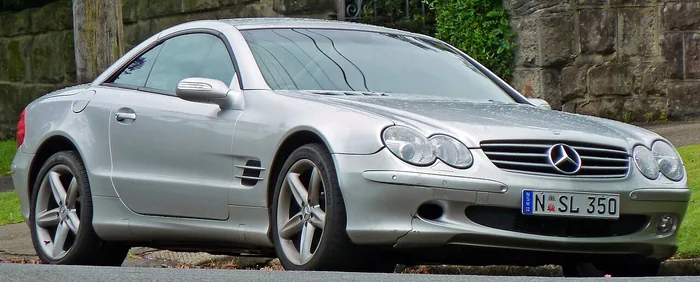
Model identity
| Category | Specification Details |
|---|---|
| Manufacturer | Mercedes-Benz (DaimlerChrysler AG) |
| Model Designation | SL-Class Roadster |
| Internal Chassis Code | R230 |
| Model Year | 2006 (mid-cycle production, pre-facelift) |
| Production Period | October 2001 – June 2008 (2006 MY built ~07/2005–06/2006) |
| Assembly Plant | Bremen, Germany |
| Body Style | 2-door, 2-seat retractable hardtop roadster (Vario-Roof) |
| Platform Architecture | Front-mid engine, rear-wheel drive; steel unibody with aluminum hood, trunk lid, and front fenders |
| Model Variants (2006 MY) | SL 350, SL 500, SL 55 AMG, SL 600, SL 65 AMG |
| VIN Prefix (WMI/VDS) | WDBFA (varies by engine/restraint system) |
Dimensions and Weights
| Category | Specification Details |
|---|---|
| Wheelbase | 2,585 mm (101.8 in) |
| Overall Length | 4,522 mm (178.0 in) |
| Overall Width (excl. mirrors) | 1,824 mm (71.8 in) |
| Overall Height | 1,316 mm (51.8 in) (top up) |
| Track Width, Front | 1,564 mm (61.6 in) |
| Track Width, Rear | 1,557 mm (61.3 in) |
| Ground Clearance (unladen) | Approx. 110 mm (4.3 in) |
| Curb Weight (DIN) — SL 350 | 1,765 kg (3,891 lb) |
| Curb Weight (DIN) — SL 500 | 1,825 kg (4,023 lb) |
| Curb Weight (DIN) — SL 55 AMG | 1,895 kg (4,178 lb) |
| Curb Weight (DIN) — SL 600 | 1,990 kg (4,387 lb) |
| Curb Weight (DIN) — SL 65 AMG | 2,055 kg (4,530 lb) |
| Gross Vehicle Weight Rating (GVWR) | 2,250–2,500 kg (varies by model) |
| Weight Distribution (F/R, approx.) | 52/48 % (V8 models); 51/49 % (V12 models) |
| Trunk Capacity (top up) | 364 L (12.9 cu ft) |
| Trunk Capacity (top down) | 210 L (7.4 cu ft) |
| Fuel Tank Capacity | 90 L (23.8 US gal) |
Engines and Powertrains
| Category | Specification Details |
|---|---|
| SL 350 — Engine Code | M272 E35 (3.5 L V6) |
| Displacement | 3,498 cc |
| Configuration | 90° V6, aluminum block & heads, 4 valves/cyl, DOHC |
| Bore × Stroke | 92.9 mm × 86.0 mm |
| Compression Ratio | 10.7:1 |
| Max Power | 200 kW (272 PS / 268 hp) at 6,000 rpm |
| Max Torque | 350 N·m (258 lb-ft) at 2,400–5,000 rpm |
| Fuel System | Sequential port injection, returnless fuel system |
| Valvetrain | VVT on intake & exhaust; roller rocker arms |
| SL 500 — Engine Code | M113 E50 (5.0 L V8) |
| Displacement | 4,966 cc |
| Configuration | 90° V8, aluminum block & heads, 3 valves/cyl, SOHC |
| Bore × Stroke | 97.0 mm × 84.0 mm |
| Compression Ratio | 10.0:1 |
| Max Power | 225 kW (306 PS / 302 hp) at 5,600 rpm |
| Max Torque | 460 N·m (339 lb-ft) at 2,700–4,250 rpm |
| Fuel System | Sequential port injection |
| Valvetrain | VVT on intake (cam-phasing); hydraulic tappets |
| SL 55 AMG — Engine Code | M113 ML55 (5.4 L supercharged V8) |
| Displacement | 5,439 cc |
| Configuration | 90° V8, aluminum block & heads, 3 valves/cyl, SOHC, Lysholm-type twin-screw supercharger |
| Bore × Stroke | 97.0 mm × 92.0 mm |
| Compression Ratio | 9.0:1 |
| Max Power | 368 kW (500 PS / 493 hp) at 6,100 rpm |
| Max Torque | 700 N·m (516 lb-ft) at 2,650–4,500 rpm |
| Supercharger Boost | Approx. 0.8 bar (11.6 psi) relative |
| Intercooling | Air-to-water, integrated into intake manifold |
| SL 600 — Engine Code | M275 E55 (5.5 L twin-turbo V12) |
| Displacement | 5,513 cc |
| Configuration | 60° V12, aluminum block & heads, 3 valves/cyl, SOHC, twin turbochargers |
| Bore × Stroke | 82.0 mm × 87.0 mm |
| Compression Ratio | 9.0:1 |
| Max Power | 368 kW (500 PS / 493 hp) at 5,000 rpm |
| Max Torque | 800 N·m (590 lb-ft) at 1,800–3,500 rpm (electronically limited) |
| Turbochargers | Two water-cooled KKK units, wastegate-controlled |
| SL 65 AMG — Engine Code | M275 E60 (6.0 L twin-turbo V12) |
| Displacement | 5,980 cc |
| Configuration | 60° V12, forged crankshaft, 3 valves/cyl, SOHC, twin turbochargers |
| Bore × Stroke | 82.6 mm × 93.0 mm |
| Compression Ratio | 9.0:1 |
| Max Power | 450 kW (612 PS / 604 hp) at 4,800–5,100 rpm |
| Max Torque | 1,000 N·m (738 lb-ft) at 2,000–4,000 rpm (electronically limited) |
| Emissions Standard (2006 MY) | EU4 / LEV-II / ULEV (market dependent) |
| Engine Management | Bosch ME 9.7 (V6/V8 NA); ME 2.8 (supercharged V8); ME 2.7.2 (twin-turbo V12) |
Transmissions
| Category | Specification Details |
|---|---|
| SL 350 / SL 500 — Transmission | 7G-Tronic (722.9) 7-speed automatic |
| Gear Ratios (7G-Tronic) | 4.38 / 2.86 / 1.92 / 1.37 / 1.00 / 0.82 / 0.73; Rev 3.42 |
| Torque Converter | Hydrodynamic with lock-up clutch (active in all gears) |
| Shift Control | Electronic (TCU), adaptive learning, DIRECT SELECT lever on column |
| SL 55 AMG — Transmission | 5G-Tronic (722.6) 5-speed automatic (AMG SPEEDSHIFT) |
| Gear Ratios (5G-Tronic AMG) | 3.59 / 2.19 / 1.41 / 1.00 / 0.83; Rev 3.16 |
| Shift Modes | C (Comfort), S (Sport), M (Manual) via steering-wheel paddles |
| SL 600 / SL 65 AMG — Transmission | 5G-Tronic (722.6) 5-speed automatic (reinforced for V12 torque) |
| Gear Ratios (V12 5G-Tronic) | 3.59 / 2.19 / 1.41 / 1.00 / 0.83; Rev 3.16 |
| Torque Converter Lock-up | Controlled slip strategy for smoothness under high torque |
| Drive Type | Rear-wheel drive (all variants) |
| Differential | Open differential with electronic traction control (ETS/ASR); optional AMG limited-slip (SL 55/65) |
Chassis, Suspension, Brakes, and Wheels
| Category | Specification Details |
|---|---|
| Front Suspension | Double wishbone (4-link), aluminum control arms, coil springs, ABC active struts |
| Rear Suspension | Multi-link (5-link), aluminum arms, coil springs, ABC active struts |
| Active Body Control (ABC) | Hydraulic active suspension (high-pressure servo-valves at each corner); 3 modes: Sport 1, Sport 2, Comfort; counteracts roll, pitch, dive, squat |
| ABC Hydraulic System | Tandem radial-piston pump (engine-driven), 200 bar operating pressure, Pentosin CHF 11S fluid |
| Steering | Speed-sensitive hydraulic rack-and-pinion (Servotronic); 2.7 turns lock-to-lock |
| Turning Circle | 11.0 m (36.1 ft) curb-to-curb |
| Front Brakes (SL 350/500) | 330 × 32 mm ventilated discs, 4-piston fixed aluminum calipers |
| Rear Brakes (SL 350/500) | 300 × 22 mm ventilated discs, single-piston floating calipers |
| Front Brakes (SL 55/600/65) | 360 × 32 mm ventilated & cross-drilled discs, 6-piston (SL 55) / 8-piston (SL 65) fixed calipers |
| Rear Brakes (SL 55/600/65) | 330 × 26 mm ventilated & cross-drilled discs, 4-piston fixed calipers |
| Brake Actuation | Hydraulic vacuum-assisted (SL 350/500); electro-hydraulic Sensotronic Brake Control (SBC) on SL 55/600/65 (2006 MY) |
| Parking Brake | Electric (EPB) on rear calipers (all models) |
| Standard Wheels (SL 350) | 18 × 8.0J ET41, 5-twin-spoke, 245/45 R18 |
| Standard Wheels (SL 500) | 18 × 8.5J ET41 front / 18 × 9.5J ET32 rear, staggered, 255/45 R18 front, 285/40 R18 rear |
| Standard Wheels (SL 55 AMG) | 19 × 8.5J ET41 front / 19 × 9.5J ET32 rear, AMG 5-spoke forged, 255/40 R19 front, 285/35 R19 rear |
| Standard Wheels (SL 600/65) | 19 × 8.5J ET41 front / 19 × 9.5J ET32 rear, 10-spoke (600) / AMG twin-spoke forged (65), same tire sizes as SL 55 |
| Tire Pressure Monitoring | Direct (valve-mounted sensors) standard on all 2006 MY |
| Run-flat Tires | Optional (MOExtended) on V8/V12 models; no spare tire, TIREFIT sealant kit standard |
Performance Figures (Manufacturer Data)
| Category | Specification Details |
|---|---|
| SL 350 — 0–100 km/h (0–62 mph) | 6.7 s |
| SL 350 — Top Speed | 250 km/h (155 mph) electronically limited |
| SL 500 — 0–100 km/h | 5.7 s |
| SL 500 — Top Speed | 250 km/h (155 mph) electronically limited |
| SL 55 AMG — 0–100 km/h | 4.7 s |
| SL 55 AMG — Top Speed | 250 km/h (155 mph) limited; 300 km/h (186 mph) with AMG Driver’s Package |
| SL 600 — 0–100 km/h | 4.8 s |
| SL 600 — Top Speed | 250 km/h (155 mph) electronically limited |
| SL 65 AMG — 0–100 km/h | 4.4 s |
| SL 65 AMG — Top Speed | 250 km/h (155 mph) limited; 300 km/h (186 mph) with AMG Driver’s Package |
| Fuel Consumption (NEDC, combined) — SL 350 | 11.2 L/100 km (21.0 mpg US) |
| Fuel Consumption (NEDC, combined) — SL 500 | 12.5 L/100 km (18.8 mpg US) |
| Fuel Consumption (NEDC, combined) — SL 55 AMG | 14.8 L/100 km (15.9 mpg US) |
| Fuel Consumption (NEDC, combined) — SL 600 | 15.2 L/100 km (15.5 mpg US) |
| Fuel Consumption (NEDC, combined) — SL 65 AMG | 16.0 L/100 km (14.7 mpg US) |
| CO₂ Emissions (combined) — SL 350 | 268 g/km |
| CO₂ Emissions (combined) — SL 500 | 298 g/km |
| CO₂ Emissions (combined) — SL 55 AMG | 354 g/km |
| CO₂ Emissions (combined) — SL 600 | 363 g/km |
| CO₂ Emissions (combined) — SL 65 AMG | 382 g/km |
Standard Equipment Highlights (2006 Model Year)
| Category | Specification Details |
|---|---|
| Retractable Hardtop | Vario-Roof: 3-piece aluminum/steel, electro-hydraulic operation, 16 s open/close, operable up to 40 km/h (25 mph) |
| Roof Lining | Standard fabric headliner; optional Alcantara (Designo) |
| Seats | 12-way power front seats with memory (driver + passenger), 4-way lumbar, heating standard |
| Seat Upholstery | Leather (standard); Nappa leather optional; Designo Exclusive Nappa optional |
| AIRSCARF | Neck-level heating integrated into head restraints (standard on SL 500/55/600/65; optional SL 350) |
| Climate Control | THERMATIC dual-zone automatic with sun sensor, residual heat, charcoal filter |
| Infotainment | COMAND APS (NTG1) with 7-inch color display, navigation (DVD-based), CD changer (6-disc), AM/FM, Bose AMG sound system (standard V8/V12; optional SL 350) |
| Audio | Bose 11-speaker (V8/V12) or 9-speaker (V6); subwoofer in parcel shelf |
| Instrument Cluster | Electromechanical gauges with central TFT matrix display (trip, menus, warnings) |
| Steering Wheel | Leather, 4-spoke, multifunction buttons; shift paddles on AMG models |
| Keyless Entry/Go | KEYLESS-GO (start/stop button, passive entry) standard on V8/V12; optional SL 350 |
| Exterior Mirrors | Power-folding, heated, auto-dimming (driver), memory-linked |
| Lighting | Bi-xenon headlamps with active curve illumination, LED tail lamps, adaptive brake lights, headlamp washing |
| Wind Deflector | Removable mesh screen (stored in trunk lid recess) |
| Roll-over Protection | Two spring-loaded bars behind rear seats, deploy in <0.3 s |
Safety Systems
| Category | Specification Details |
|---|---|
| Airbags | Dual-stage front, side thorax (seat-mounted), window bags (integrated in door trim), knee bag (driver) |
| Occupant Classification | Front passenger seat weight sensor with automatic airbag deactivation |
| Seat Belts | 3-point, pyrotechnic pretensioners, force limiters, belt force limiters adaptive |
| Electronic Stability Program (ESP) | Standard with ASR (traction control), ABS, BAS (Brake Assist), EBD |
| Active Body Control (ABC) | Integrates with ESP for roll stabilization during emergency maneuvers |
| Sensotronic Brake Control (SBC) | Electro-hydraulic brake-by-wire (SL 55/600/65); dry-braking function, hill-start assist |
| Tire Pressure Monitoring | Direct system with individual pressure/temperature readout in cluster |
| Anti-theft | Electronic immobilizer, tow-away protection, interior motion sensor, VIN etching (market specific) |
| Crash Structure | Front/rear crumple zones, reinforced A-pillars, door intrusion beams, integral rollover hoops |
Major Options and Packages
| Category | Specification Details |
|---|---|
| AMG Performance Package (SL 55/65) | Raised top speed to 300 km/h, AMG track-calibrated ABC, composite front brake discs (SL 65), AMG performance steering wheel |
| Designo Exclusive Interior | Two-tone Nappa leather, contrast stitching, Alcantara roof lining, wood/leather steering wheel, designated trim elements |
| Designo Wood/Leather Trim | Piano lacquer, bird’s-eye maple, olive ash, or carbon fiber (AMG) inserts |
| Keyless-GO | Passive entry and push-button start (standard V8/V12; option SL 350) |
| Distronic Plus | Adaptive cruise control with stop-and-go (radar-based); optional on all models |
| Parktronic | Ultrasonic front/rear parking sensors with visual/audible guidance |
| Rear-view Camera | Integrated in COMAND display (late 2006 availability) |
| Head-up Display | Not available on R230 (introduced later on W221 S-Class) |
| Night View Assist | Not available on R230 |
| Ceramic Composite Brakes | Optional on SL 55/600/65 (carbon-ceramic discs, painted calipers) |
| 19/20-inch Forged Wheels | Various AMG and Designo designs, staggered fitments |
| Bang & Olufsen BeoSound | High-end audio (14 speakers, 1,000 W); rare dealer-installed option |
| Tele Aid / mbrace | Emergency calling, stolen vehicle tracking, remote diagnostics (subscription) |
Market Notes and Model-Year Context
| Category | Specification Details |
|---|---|
| 2006 Position in Lifecycle | Mid-cycle (launched 2001); major facelift (updated front fascia, LED tail lamps, 7G-Tronic on V8) arrives as 2009 MY in mid-2008 |
| Key 2006 Changes vs 2005 | Minor: revised option packages, standard direct TPMS, updated COMAND DVD maps, new paint/trim colors |
| Key Differences vs 2001 Launch | SL 350 added (2003), 7G-Tronic on V6/V8 (2003), SBC on V12/AMG (2003), AIRSCARF standard on V8+ (2003), Bi-xenon standard (2003) |
| Key Differences vs 2008 Facelift | Facelift brings new bumpers, LED daytime running lights, revised engines (M273 V8, M276 V6), 7G-Tronic for all, updated COMAND (NTG2.5), SBC deleted |
| US Market Pricing (MSRP, approx.) | SL 350: $76,000; SL 500: $94,000; SL 55 AMG: $123,000; SL 600: $135,000; SL 65 AMG: $183,000 |
| European Pricing (DE, approx.) | SL 350: €89,000; SL 500: €112,000; SL 55 AMG: €152,000; SL 600: €168,000; SL 65 AMG: €245,000 |
| Primary Competitors (2006) | BMW 6 Series (E63/E64), Jaguar XK (X150), Porsche 911 Cabriolet (997), Aston Martin V8 Vantage Roadster |
| Known Service Campaigns (2006 MY) | SBC hydraulic unit recall (2004–2006 build), ABC hydraulic line chafing, roof hydraulic pump relay, crankshaft position sensor (V6/V8), balance shaft sprocket (M272 V6 early production) |
| Production Volume (2006 CY, approx.) | ~18,000 units globally across all R230 variants |
Model identity
The 2006 Mercedes-Benz SL-Class (R230) occupies a distinctive space in the marque’s history: a grand tourer that refuses to choose between cosseting luxury and genuine sports-car capability.
By this point in its production run, the R230 had matured past its early teething issues — most notably the Sensotronic Brake Control (SBC) system — while retaining the all-aluminum architecture and vario-roof that defined its technical ambition.
It sits at the intersection of the traditional SL ethos — effortless cross-continent speed, top-down ceremony, and peerless build quality — and the modern demands of dynamic driving, active safety, and infotainment integration.
The 2006 model year represents the peak of the pre-facelift generation, offering the broadest engine palette from the 3.5-liter V6 to the twin-turbo V12 AMG flagship, each paired with either the 5-speed or 7-speed automatic depending on output.
It is a car that delivers a specific kind of automotive theater: the hydraulic ballet of the folding hardtop, the turbine smoothness of a V12 at idle, the reassuring thunk of doors closing on a structure with no B-pillars to flex.
Development
Origins and Platform Strategy
The R230 program began in the mid-1990s under the shadow of its predecessor, the R129 — a model that had overstayed its welcome by nearly a decade.
Mercedes-Benz tasked its engineers with creating a roadster that could credibly challenge the emerging breed of high-performance convertibles from BMW, Jaguar, and Porsche, while upholding the SL’s role as a technological flagship.
The decision to adopt an all-aluminum body structure (designated ASF, or Aluminum Space Frame) was driven by the need to offset the mass penalty of a retractable hardtop, complex active suspension, and increasing safety equipment.
The result was a chassis that weighed roughly 120 kg less than a comparable steel monocoque, yet delivered 50 percent greater torsional rigidity than the R129 — a critical figure for a car without a fixed roof.
Engineering the Vario-Roof
The centerpiece of the R230’s development was the electro-hydraulic vario-roof, a five-section hardtop that could stow entirely within the rear deck in 16 seconds.
Unlike the fabric tops of rivals, the steel-panel roof provided coupe-like NVH performance, security, and a clean silhouette with the top up. The mechanism relied on 11 hydraulic cylinders, 7 electric motors, and a network of sensors orchestrated by a dedicated control unit.
Engineers calibrated the sequence to operate at speeds up to 40 km/h (25 mph), a practical advantage in changeable weather.
The roof’s kinematics were validated through thousands of cycles in climatic chambers ranging from -40 °C to +80 °C, ensuring reliability across the SL’s global market footprint.
Suspension Philosophy: ABC vs. Conventional
Active Body Control (ABC) debuted on the R230 as standard on V8 and V12 models, optional on the V6. The system uses high-pressure hydraulics (200 bar) to adjust spring rates.
And damping forces at each corner within milliseconds, effectively eliminating body roll in corners and dive under braking.
Unlike air suspension, ABC maintains constant ride height regardless of load, and its cross-linking of diagonal circuits allows the car to “lean” into corners by up to 2.5 degrees — a subtle but perceptible dynamic aid.
The V6 models received a conventional steel-spring setup with adaptive damping (ADS II), a cost-driven compromise that nonetheless delivered competent handling, albeit with more body motion and less precision at the limit.
Design
Exterior Language
The R230’s styling, penned under Bruno Sacco’s direction and refined by his successor Peter Pfeiffer, marked a departure from the R129’s upright, almost formal proportions. The new car adopted a lower.
Wider stance with a pronounced “power dome” hood, flared wheel arches, and a fast-receding greenhouse that emphasized its grand-tourer credentials.
The front fascia featured a large, jewel-like grille flanked by bi-xenon headlamps with integrated washers — a visual signature that announced the SL’s technological tier.
The 2006 model year retained the clear-lens tail lamps introduced at launch; the LED units would arrive with the 2009 facelift. Panel gaps were held to exacting tolerances (3.5–4.5 mm).
A testament to the aluminum structure’s dimensional stability and the precision of Mercedes’ Sindelfingen assembly line.
Interior Architecture
Inside, the R230 codified the modern Mercedes control language: a central COMAND controller on the transmission tunnel, a high-mounted display screen, and a minimalist array of physical switches.
The dashboard flows into the door panels in a continuous sweep, trimmed in hand-fitted leather (standard on V8/V12, optional on V6) with contrast stitching that follows the car’s beltline.
The seats — 14-way power-adjustable with memory, ventilation, and active bolsters on Designo trims — were engineered for 1,000 km days without fatigue. AIRSCARF.
The neck-level heating system integrated into the head restraints, became standard on V8 and V12 models for 2006, extending the top-down season deep into autumn.
The analog instrument cluster, backlit in white with red needles, remains a high-water mark for legibility and tactile quality in an era increasingly dominated by reconfigurable TFT displays.
Engines and performance
M272 3.5-Liter V6 (SL 350)
The entry-point SL 350 received the new M272 V6 in 2003, replacing the older M112. The 3.5-liter unit produces 272 PS (268 hp) at 6,000 rpm.
And 350 N·m (258 lb·ft) at 2,400–5,000 rpm, with variable valve timing on both camshafts and a two-stage intake manifold.
Paired with the 7G-Tronic seven-speed automatic, the SL 350 reaches 100 km/h (62 mph) in 6.6 seconds and an electronically limited 250 km/h (155 mph).
While the smoothest and most efficient engine in the range (9.5 L/100 km combined NEDC), it lacks the low-end authority and acoustic gravitas of the V8s, and its 50/50 weight distribution is slightly compromised by the lighter nose.
M113 5.0-Liter V8 (SL 500)
The SL 500’s naturally aspirated 5.0-liter V8 delivers 306 PS (302 hp) at 5,600 rpm and 460 N·m (339 lb·ft) at 2,700–4,250 rpm. Mated to the 7G-Tronic, it accelerates to 100 km/h in 5.4 seconds.
The M113 is renowned for its durability — many examples exceed 300,000 km without major work — and its linear torque delivery suits the SL’s grand-touring mission perfectly. The exhaust note is cultured rather than aggressive.
A deliberate tuning choice that aligns with the car’s clientele. Fuel consumption averages 12.5 L/100 km combined.
M113K 5.4-Liter Supercharged V8 (SL 55 AMG)
The SL 55 AMG employs a Lysholm-type twin-screw supercharger atop the M113 block, yielding 500 PS (493 hp) at 6,100 rpm.
And 700 N·m (516 lb·ft) at 2,650–4,500 rpm. The 5G-Tronic five-speed automatic (the 7G-Tronic could not handle the torque) manages the output with firm, quick shifts.
0–100 km/h arrives in 4.4 seconds; the limiter engages at 250 km/h, though the speedometer reads to 330 km/h. The supercharger’s instantaneous response eliminates turbo lag, delivering a torque curve that feels flat from just off idle.
This engine defines the SL 55’s character: brutal straight-line speed wrapped in a package that still cossets on the autobahn.
M275 5.5-Liter Twin-Turbo V12 (SL 600)
The SL 600’s biturbo V12 produces 500 PS (493 hp) at 4,800–5,100 rpm and a staggering 800 N·m (590 lb·ft) at 1,800–3,500 rpm. The 5G-Tronic is the only transmission rated for this torque.
Despite a 0–100 km/h time of 4.5 seconds — nearly identical to the SL 55 — the SL 600 feels fundamentally different: effortless, silent, and inexorable. The twin turbos spool with minimal lag thanks to small, low-inertia compressors and a sophisticated wastegate strategy.
This is the engine for the owner who values discretion over theater, and who expects the car to shrink continents without raising its voice.
M275 AMG 6.0-Liter Twin-Turbo V12 (SL 65 AMG)
At the apex sits the SL 65 AMG: 612 PS (604 hp) at 4,800–5,100 rpm and 1,000 N·m (738 lb·ft) at 2,000–4,000 rpm, electronically limited to protect the 5G-Tronic. The 6.0-liter displacement increase comes from a longer stroke (96 mm vs.
92.4 mm) and revised pistons; the turbos are larger, the intercoolers more efficient, and the ECU calibration uniquely aggressive. 0–100 km/h takes 4.2 seconds, but the real story is the in-gear acceleration: 80–120 km/h in third gear passes in under 3 seconds.
The SL 65 is a hypercar in evening wear, its V12 whispering at idle and roaring only when provoked. Production was limited to roughly 2,500 units globally across the R230’s life.
Driving Character
Behind the wheel, the 2006 SL reveals its dual nature within the first kilometer. The steering — hydraulic, speed-sensitive, with a 15.5:1 ratio — offers genuine feedback, a rarity in this segment by 2006.
The front end turns in with precision, the ABC system suppressing roll so effectively that the car feels lighter than its 1,800–2,000 kg mass suggests.
On a sweeping B-road, the SL 500 or SL 55 encourages a rhythm: brake late, turn in, feel the rear axle push gently wide on exit, then deploy the V8’s torque to straighten the line.
The ride, even in Sport mode, retains a underlying suppleness that absorbs broken pavement without crash harshness — a calibrated compromise that no pure sports car can match.
With the roof stowed, the cockpit remains remarkably calm at 160 km/h. The wind deflector (standard) and AIRSCARF create a microclimate that allows conversation at normal volume.
The vario-roof’s structural contribution is palpable: cowl shake is virtually absent, and the scuttle flex that plagues fabric-roof convertibles is a non-issue. At the limit.
The ESP system intervenes progressively, allowing a measurable slip angle before curbing power — a calibration that respects the driver without abdicating safety.
The ceramic composite brakes (optional on V12/AMG) offer fade-free performance and a 4 kg unsprung mass reduction per corner, sharpening turn-in response noticeably.
Ownership notes
Strengths
- All-aluminum body: Immune to structural rust; panel corrosion virtually nonexistent with proper care.
- Engine durability: M113 V8 and M275 V12 are over-engineered for their outputs; 300,000+ km is routine with maintenance.
- Vario-roof reliability: Hydraulic system proven over 20+ years; seals and cylinders serviceable, not disposable.
- Parts availability: Mercedes Classic Center supports R230; most mechanical and trim parts remain in production or NOS.
- Timeless design: Pre-facelift styling ages gracefully; no trend-driven details that date the car.
- Grand-tourer versatility: Genuine 2+2 seating (small rear bench), 360 L trunk with roof up, 200 L with roof down.
Things to Watch
- SBC hydraulic unit: 2004–2006 build cars subject to recall; unit replacement intervals ~100,000 km. Brake fluid changes every 2 years mandatory.
- ABC hydraulic system: High-pressure lines chafe against chassis; accumulator spheres lose pressure ~80,000 km. Fluid (Pentosin CHF 11S) and filter changes every 60,000 km critical.
- Roof hydraulic pump relay: Located in trunk; fails intermittently, preventing roof operation. Inexpensive fix, difficult diagnosis.
- Crankshaft position sensor (V6/V8): Heat-related failure causes hot-start issues or stalling. Replace preemptively at 100,000 km.
- Balance shaft sprocket (early M272 V6): 2003–2005 engines may develop wear; updated part available. Verify service history on SL 350.
- 5G-Tronic conductor plate (V12/AMG): Internal speed sensors fail, triggering limp mode. Updated plate resolves; labor-intensive.
- Battery management: Dual-battery system (main + auxiliary) sensitive to parasitic draw. Trickle charger essential for stored cars.
- Pixel loss in instrument cluster: LCD segments fade with age; repair requires cluster removal and specialized service.
Legacy
The R230 SL-Class, and the 2006 model year in particular, represents the last of the analog-digital hybrids in Mercedes’ flagship roadster lineage. It arrived when hydraulics still ruled active suspension.
And braking, when V12s breathed without particulate filters, when a folding hardtop was an engineering marvel rather than an expectation.
The 2009 facelift would bring LED lighting, direct-injection engines, and the deletion of SBC — advances that improved efficiency and compliance but diluted the mechanical purity that defined the R230’s character.
Today, the pre-facelift cars occupy a sweet spot for collectors and enthusiasts: complex enough to be fascinating, robust enough to be usable, and distinct enough to stand apart from the homogenized luxury convertibles that followed.
The SL 55 and SL 65 AMG variants, with their hand-built engines and limited production, have already transitioned from depreciating assets to appreciating classics.
The SL 500, meanwhile, remains the pragmatic choice — a car that delivers 90 percent of the experience for 40 percent of the peak-market price.
In the broader arc of the SL nameplate, the R230 marks the moment the model ceased being a “roadster” in the traditional sense and became something closer to a “coupé that opens”.
A distinction that, in 2006, felt like the future, and today feels like a high-water mark.
Leave a Reply
You must be logged in to post a comment.