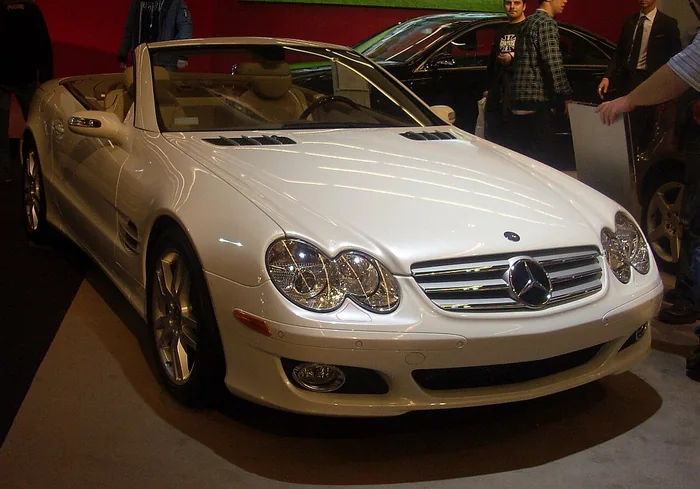
Model identity
| Category | Specification Details |
|---|---|
| Manufacturer | Mercedes-Benz |
| Model Series | SL-Class |
| Chassis Code | R230 |
| Model Year | 2008 |
| Production Period | March 2001 – January 2012 (2008 MY built ~mid-2007 to mid-2008) |
| Body Style | 2-door roadster with retractable hardtop (Vario-Roof) |
| Platform | Mercedes-Benz R230 dedicated roadster platform (front-mid engine, rear-wheel drive) |
| Assembly Plant | Bremen, Germany |
| Model Positioning | Grand touring luxury roadster; flagship of Mercedes-Benz roadster lineup |
| Key 2008 Updates | Revised front bumper, updated LED tail lamps, new wheel designs, COMAND APS with larger screen, revised engine management for SL 550, standard Bluetooth audio streaming |
Dimensions and Weights
| Category | Specification Details |
|---|---|
| Wheelbase | 2,585 mm (101.8 in) |
| Length | 4,520 mm (178.0 in) |
| Width (excl. mirrors) | 1,825 mm (71.9 in) |
| Height | 1,335 mm (52.6 in) |
| Front Track | 1,552 mm (61.1 in) |
| Rear Track | 1,555 mm (61.2 in) |
| Curb Weight (SL 350) | 1,785 kg (3,935 lb) approx. |
| Curb Weight (SL 550) | 1,845 kg (4,068 lb) approx. |
| Curb Weight (SL 600) | 2,010 kg (4,431 lb) approx. |
| Curb Weight (SL 65 AMG) | 2,070 kg (4,564 lb) approx. |
| Weight Distribution (front/rear) | 51 / 49 approx. (varies by engine) |
| Trunk Capacity (roof up) | 265 L (9.4 cu ft) |
| Trunk Capacity (roof down) | 100 L (3.5 cu ft) |
| Fuel Tank Capacity | 90 L (23.8 US gal) |
| Drag Coefficient (Cd) | 0.32 (roof closed); 0.36 (roof open) |
Engines
| Category | Specification Details |
|---|---|
| SL 350 — Engine Code | M272 E35 (3.5 L V6) |
| Displacement | 3,498 cc |
| Configuration | 90° V6, DOHC 24-valve, aluminum block & heads |
| Bore × Stroke | 92.9 mm × 86.0 mm |
| Compression Ratio | 10.7:1 |
| Max Power | 200 kW (272 PS / 268 hp) at 6,000 rpm |
| Max Torque | 350 N·m (258 lb·ft) at 2,400–5,000 rpm |
| Fuel System | Sequential multi-point injection, returnless fuel system |
| Valvetrain | VVT on intake & exhaust, roller rocker arms |
| SL 550 — Engine Code | M273 E55 (5.5 L V8) — revised for 2008 |
| Displacement | 5,461 cc |
| Configuration | 90° V8, DOHC 32-valve, aluminum block & heads |
| Bore × Stroke | 98.0 mm × 90.5 mm |
| Compression Ratio | 10.7:1 |
| Max Power | 285 kW (388 PS / 382 hp) at 6,000 rpm |
| Max Torque | 530 N·m (391 lb·ft) at 2,800–4,800 rpm |
| Fuel System | Sequential multi-point injection, two-stage intake manifold |
| Valvetrain | VVT on intake & exhaust, roller rocker arms |
| SL 600 — Engine Code | M275 E55 AL (5.5 L twin-turbo V12) |
| Displacement | 5,513 cc |
| Configuration | 60° V12, SOHC 36-valve (3 valves/cyl), aluminum block & heads |
| Bore × Stroke | 82.0 mm × 87.0 mm |
| Compression Ratio | 9.0:1 |
| Max Power | 380 kW (517 PS / 510 hp) at 5,000 rpm |
| Max Torque | 830 N·m (612 lb·ft) at 1,900–3,500 rpm (electronically limited) |
| Forced Induction | Two IHI turbochargers, air-to-water intercoolers |
| SL 65 AMG — Engine Code | M275 E60 LA (6.0 L twin-turbo V12, AMG hand-built) |
| Displacement | 5,980 cc |
| Configuration | 60° V12, SOHC 36-valve, forged internals, AMG-specific tuning |
| Bore × Stroke | 82.6 mm × 93.0 mm |
| Compression Ratio | 9.0:1 |
| Max Power | 450 kW (612 PS / 604 hp) at 4,800–5,100 rpm |
| Max Torque | 1,000 N·m (738 lb·ft) at 2,000–4,000 rpm (electronically limited) |
| Forced Induction | Two larger IHI turbochargers, larger intercoolers, revised boost mapping |
Transmissions
| Category | Specification Details |
|---|---|
| SL 350 / SL 550 | 7G-TRONIC 7-speed automatic (722.9) with DIRECT SELECT lever on column |
| SL 600 / SL 65 AMG | 5G-TRONIC 5-speed automatic (722.6) reinforced for high torque |
| Shift Modes | C (Comfort), S (Sport), M (Manual) via steering-wheel paddles |
| Torque Converter | Lock-up in all forward gears above ~30 km/h |
| Gear Ratios (7G-TRONIC) | 4.38 / 2.86 / 1.92 / 1.37 / 1.00 / 0.82 / 0.73; Reverse 3.42 |
| Gear Ratios (5G-TRONIC) | 3.59 / 2.19 / 1.41 / 1.00 / 0.83; Reverse 3.16 |
| Final Drive Ratio (SL 350) | 3.27 |
| Final Drive Ratio (SL 550) | 2.82 |
| Final Drive Ratio (SL 600 / 65 AMG) | 2.65 |
Chassis, Suspension, Brakes, Wheels
| Category | Specification Details |
|---|---|
| Front Suspension | Double wishbone (4-link) with ABC active body control, aluminum arms |
| Rear Suspension | 5-link independent with ABC, aluminum subframe |
| Active Body Control (ABC) | Hydraulic active suspension with cross-linked struts, 13 ms response, three modes (Sport 1, Sport 2, Comfort) |
| Steering | Speed-sensitive hydraulic power-assisted rack & pinion (Servotronic); 2.7 turns lock-to-lock |
| Front Brakes (SL 350 / 550) | 360 × 32 mm ventilated discs, 6-piston fixed aluminum calipers (AMG-enhanced on SL 550) |
| Rear Brakes (SL 350 / 550) | 330 × 26 mm ventilated discs, single-piston floating calipers |
| Front Brakes (SL 600 / 65 AMG) | 390 × 36 mm ventilated & cross-drilled discs, 6-piston AMG calipers |
| Rear Brakes (SL 600 / 65 AMG) | 360 × 26 mm ventilated & cross-drilled discs, 4-piston AMG calipers |
| Brake Assist | BAS Plus with predictive priming, SBC (Sensotronic Brake Control) on early 2008 builds; conventional hydraulic on later builds |
| Standard Wheels (SL 350) | 18 × 8.5J ET44, 5-twin-spoke, 255/45 R18 run-flat |
| Standard Wheels (SL 550) | 19 × 8.5J ET44 front / 19 × 9.5J ET48 rear, multi-spoke, 255/40 R19 F / 285/35 R19 R run-flat |
| Standard Wheels (SL 600 / 65 AMG) | 19 × 8.5J ET44 F / 19 × 9.5J ET48 R, AMG 5-spoke forged, same tire sizes as SL 550 |
| Optional Wheels | 19- and 20-inch AMG forged designs in various finishes |
| Tire Pressure Monitoring | Direct system with individual wheel readout |
Performance Figures
| Category | Specification Details |
|---|---|
| SL 350 — 0–100 km/h (0–62 mph) | 6.6 s (manufacturer) |
| SL 350 — Top Speed | 250 km/h (155 mph) electronically limited |
| SL 550 — 0–100 km/h | 5.4 s (manufacturer) |
| SL 550 — Top Speed | 250 km/h (155 mph) electronically limited |
| SL 600 — 0–100 km/h | 4.8 s (manufacturer) |
| SL 600 — Top Speed | 250 km/h (155 mph) electronically limited |
| SL 65 AMG — 0–100 km/h | 4.2 s (manufacturer) |
| SL 65 AMG — Top Speed | 250 km/h (155 mph) limited; 320 km/h (199 mph) with AMG Driver’s Package |
| SL 350 — Fuel Consumption (NEDC combined) | 11.2 L/100 km (21 mpg US) approx. |
| SL 550 — Fuel Consumption (NEDC combined) | 12.5 L/100 km (19 mpg US) approx. |
| SL 600 — Fuel Consumption (NEDC combined) | 14.8 L/100 km (16 mpg US) approx. |
| SL 65 AMG — Fuel Consumption (NEDC combined) | 16.5 L/100 km (14 mpg US) approx. |
| CO₂ Emissions (SL 350 / 550 / 600 / 65 AMG) | 265 / 295 / 350 / 390 g/km approx. |
Standard Equipment Highlights
| Category | Specification Details |
|---|---|
| Retractable Hardtop | Vario-Roof: 3-piece aluminum/steel, 16 s open/close at up to 40 km/h |
| Infotainment | COMAND APS with 7-inch color display, DVD navigation, CD/DVD changer, SD card slot, Bluetooth hands-free & audio streaming |
| Audio | Harman Kardon Logic 7 surround, 14 speakers, 590 W, DSP |
| Seats | AMG sport seats (SL 550/600/65), multicontour with ventilation, heating, memory; Nappa leather standard |
| Climate | THERMOTRONIC dual-zone automatic with AIRSCARF neck-level heating |
| Lighting | Bi-xenon headlamps with active curve illumination, LED tail lamps, adaptive high beam assist |
| Keyless Access | KEYLESS-GO start/stop, keyless entry with handle sensors |
| Driver Aids | Cruise control, Parktronic front/rear, rain sensor, auto-dimming mirrors |
| Interior Trim | High-gloss burr walnut or optional AMG carbon fiber / piano black |
Safety Systems
| Category | Specification Details |
|---|---|
| Airbags | Dual-stage front, side thorax-pelvis, window bags integrated in door panels, knee bag driver |
| Roll-Over Protection | Automatic deployable roll bars behind rear seats (activate in 0.3 s) |
| Electronic Stability | ESP with ASR, ABS, BAS, EBD; three-stage ESP (On / Sport Handling / Off) |
| Traction Control | ASR with torque reduction and brake intervention per wheel |
| Brake Assist | BAS Plus with radar-supported pre-fill (Distronic Plus equipped cars) |
| Tire Pressure | Direct TPMS with pressure/temperature per wheel |
| Structural | High-strength steel/aluminum space frame, reinforced A-pillars, integrated roll-over sensor |
| NCAP / IIHS | Euro NCAP 4 stars (2002 protocol); IIHS not tested (low volume) |
Major Options and Packages
| Category | Specification Details |
|---|---|
| AMG Sports Package (SL 350/550) | AMG body styling, 19-inch AMG wheels, sport steering wheel, stainless pedals, firmer ABC tuning |
| Designo Interior | Exclusive Nappa leather colors, contrast stitching, Designo wood/trim, Designo headliner |
| Distronic Plus | Adaptive cruise with stop & go, PRE-SAFE Brake, blind spot assist |
| Night View Assist | Infrared camera with pedestrian detection on COMAND display |
| Bang & Olufsen BeoSound | 14 speakers, 1,000 W, aluminum speaker grilles, DSP tuning |
| Ceramic Composite Brakes | Carbon-ceramic discs (420 mm front / 360 mm rear), gold calipers, weight saving ~20 kg |
| AMG Performance Studio (SL 65) | Raised limiter to 320 km/h, AMG track-calibrated ABC, exclusive trim badges |
| Panoramic Vario-Roof | Electrochromic glass panel with variable tint (Magic Sky Control) — late 2008 availability |
Market Notes
| Category | Specification Details |
|---|---|
| US Model Range (2008 MY) | SL 550, SL 600, SL 65 AMG (SL 350 not sold in US) |
| European Model Range | SL 350, SL 500 (badged 550), SL 600, SL 65 AMG |
| Base Price (US, 2008) | SL 550 ~$97,000; SL 600 ~$135,000; SL 65 AMG ~$185,000 |
| Base Price (Germany, 2008) | SL 350 ~€92,000; SL 500 ~€115,000; SL 600 ~€165,000; SL 65 AMG ~€230,000 |
| Key Competitors | BMW 6 Series Convertible (E64), Jaguar XK Convertible, Aston Martin V8 Vantage Roadster, Porsche 911 Cabriolet (997) |
| Production Volume (2008 MY est.) | ~12,000 units globally across all variants |
| Notable 2008 Running Changes | SBC brake system phased out mid-year for conventional hydraulic; updated ECU calibrations for Euro 5 readiness |
Model identity
The 2008 Mercedes-Benz SL-Class arrives at a subtle inflection point for the R230 generation. Launched in 2001 as a clean-sheet replacement for the venerable R129, the R230 introduced a retractable aluminum hardtop, Active Body Control, and a fully aluminum-intensive structure to the SL lineage.
By the 2008 model year the range has settled into its post-facelift stride: the 2006 mid-cycle refresh brought revised front-end styling, updated engines, and the 7G-TRONIC seven-speed automatic for V6 and V8 models.
The 2008 changes are evolutionary — new wheel designs, LED tail lamps, a larger COMAND screen.
And standard Bluetooth audio streaming — but they sharpen the car’s appeal against a newer crop of rivals such as the BMW 6 Series Convertible and the aluminum-bodied Jaguar XK.
Development
1. Platform Philosophy
Mercedes developed the R230 on a dedicated roadster platform rather than adapting a sedan floorpan. This decision allowed engineers to optimize the front-mid engine position, achieving a near 50:50 weight distribution while preserving a long hood and short overhangs.
The body structure uses a mix of high-strength steel in the passenger cell and aluminum for the hood, trunk lid, doors, and the complex Vario-Roof mechanism.
Torsional rigidity with the roof closed exceeds 12,000 N·m/degree — a figure that matched many contemporary coupés and eliminated the scuttle shake that plagued earlier soft-top SLs.
2. The Vario-Roof Engineering
The three-piece retractable hardtop remains the R230’s signature feature. Each section — front panel, center panel, rear panel — is constructed from aluminum outer skins with steel reinforcement frames.
The electro-hydraulic mechanism, supplied by Magna CarTech, completes a full open or close cycle in approximately 16 seconds at speeds up to 40 km/h. When stowed, the roof stack occupies the rear cargo area, reducing trunk volume from 265 liters to roughly 100 liters.
A powered tonneau cover separates the luggage compartment from the folded roof, and an optional wind deflector (stored in a dedicated bag) reduces cabin turbulence by roughly 60 percent at 100 km/h.
3. Active Body Control Maturity
By 2008, ABC has evolved through several software generations. The system uses high-pressure hydraulic struts at each corner, cross-linked diagonally, to counteract body roll, pitch, and dive.
Sensors monitor lateral acceleration, steering angle, and wheel displacement at 1,000 Hz, adjusting strut force within 13 milliseconds.
Three driver-selectable modes — Comfort, Sport 1, Sport 2 — alter the control map: Comfort prioritizes isolation over secondary ride.
Sport 1 adds roll stiffness for spirited driving, and Sport 2 firms the damping further while lowering the body by 10 mm at speeds above 120 km/h.
The system also includes a “Level Control” function that maintains ride height regardless of load.
Design
1. Exterior Evolution
The 2006 facelift gave the R230 a more upright grille with three horizontal louvres, reshaped front apron with larger air intakes, and bi-xenon headlamps with integrated LED daytime running elements.
For 2008 the changes are detail-oriented: the front bumper gains a chrome accent strip across the lower intake, the fog-lamp surrounds are restyled, and the rear LED clusters adopt a distinctive “arrow” signature that improves recognition at night.
New 18- and 19-inch wheel designs — including a forged AMG 5-spoke — reduce unsprung mass by up to 2 kg per corner. The drag coefficient remains 0.32 with the roof closed, aided by an automatically deploying underbody panel at 80 km/h.
2. Interior Architecture
The cabin architecture dates to the 2001 launch but ages gracefully. The central console sweeps toward the driver, housing the COMAND controller, climate controls, and the ABC mode switch within easy reach.
Materials are uniformly high-grade: Nappa leather on all seating surfaces, hand-finished wood veneers (burr walnut, bird’s-eye maple, or optional carbon fiber), and metal accents on switchgear. The analog instrument cluster features white-lit dials with a central TFT trip computer.
AIRSCARF outlets integrated into the head restraints deliver warm air at three intensity levels, extending top-down driving comfort into single-digit temperatures.
Engines and performance
1. M272 3.5 L V6 — SL 350
The entry-level SL 350 uses the M272 E35 V6 with variable valve timing on both camshafts and a two-stage intake manifold. Output of 272 PS.
And 350 N·m provides adequate thrust for grand touring, though the 0–100 km/h time of 6.6 seconds reflects the car’s 1,785 kg mass.
The 7G-TRONIC transmission keeps the engine in its sweet spot, and the tall seventh gear drops highway revs below 2,000 rpm at 130 km/h. Fuel consumption averages 11.2 L/100 km on the NEDC cycle — respectable for a two-ton roadster.
2. M273 5.5 L V8 — SL 550
The 2008 SL 550 receives the revised M273 V8 with updated engine management, revised piston cooling jets, and a slightly higher compression ratio. Power rises to 388 PS and torque to 530 N·m, available across a broad 2,800–4,800 rpm plateau.
The 7G-TRONIC’s wide ratio spread allows short first gear for launch and long overdrive gears for economy. The V8’s character is linear and refined; peak power arrives at 6,000 rpm with a cultured exhaust note that remains muted at cruise.
This powertrain combination strikes the sweet spot in the range for most drivers.
3. M275 Twin-Turbo V12 — SL 600 and SL 65 AMG
The V12 models share the M275 block architecture but differ substantially in execution. The SL 600’s 5.5 L unit produces 517 PS and 830 N·m (limited), mated to the 5G-TRONIC five-speed automatic chosen for its torque capacity.
The SL 65 AMG’s hand-built 6.0 L variant features forged pistons, larger turbochargers, revised intercoolers, and AMG-specific calibration yielding 612 PS.
And 1,000 N·m (limited). Both engines deliver overwhelming mid-range torque — 80 percent of peak is available from 1,900 rpm — making overtaking effortless at any legal speed.
The 5G-TRONIC’s torque converter locks up early to manage heat, and the transmission holds gears longer in Sport mode.
Driving Character
1. Ride and Handling Balance
With ABC active, the SL defies its mass. Turn-in is sharp for a grand tourer, and the front-mid engine placement yields neutral balance up to the limit.
The hydraulic struts suppress body roll to near-coupé levels, yet the Comfort mode absorbs expansion joints and potholes.
With a suppleness that belies the 19-inch run-flat tires. Sport 2 mode transforms the car: the body settles, steering weight increases, and the rear end becomes more responsive to throttle adjustments.
The trade-off is a firmer low-speed ride that some occupants may find busy on deteriorated urban surfaces.
2. Steering and Braking
The Servotronic hydraulic rack provides consistent weight build-up and decent feedback for a system of this era. On-center feel is precise, and the 2.7 turns lock-to-lock ratio suits the car’s long wheelbase.
Braking performance is strong across the range; the SL 550’s six-piston front calipers with 360 mm discs haul the car from 100 km/h in roughly 35 meters.
The optional carbon-ceramic brakes on V12 models offer fade resistance for track use but require higher pedal effort when cold — a consideration for daily driving.
3. Top-Down Experience
With the roof lowered, the SL remains remarkably composed. Cowl shake is virtually absent, and the AIRSCARF system extends the open-air season significantly.
Wind buffeting at 120 km/h is moderate; the optional mesh deflector reduces it further but occupies the rear parcel shelf. The V8 and V12 soundtracks become more present with the roof stowed, adding a sensory dimension that the fixed-roof coupé variants cannot replicate.
Ownership notes
Ownership notes Strengths: The R230’s build quality remains impressive; panel gaps, switchgear feel, and leather aging gracefully when maintained. The ABC suspension, often feared, proves durable with regular fluid changes every 60,000 km using MB-spec fluid.
The M273 V8 in the SL 550 is among Mercedes’ most reliable modern engines — timing chain stretch is rare before 200,000 km. The 7G-TRONIC transmission handles the V8’s torque smoothly and rarely requires more than fluid and filter service.
Residual values for well-documented SL 550 examples have stabilized, making them sensible purchases for enthusiasts seeking usable classics. Things to watch: ABC hydraulic leaks at the front struts.
And valve block are the most common major expense; budget €1,500–3,000 for a full reseal if not already addressed.
The vario-roof mechanism’s hydraulic lines and cylinders can weep after 15+ years — operate the roof monthly to keep seals pliable. Run-flat tires transmit harsh impacts to the suspension.
And are costly to replace; many owners switch to conventional Michelin Pilot Sport 4S or Continental PremiumContact 6 with a mobility kit.
The SL 600 and SL 65 AMG’s twin-turbo V12s demand meticulous oil changes (10 L capacity, 10,000 km intervals) and turbo cooling discipline; neglected examples develop oil consumption.
And actuator faults. Carbon-ceramic brake rotors on V12 models cost €8,000+ per axle — verify thickness before purchase.
The COMAND APS NTG2.5 navigation system lacks modern smartphone integration; aftermarket Android Auto/Apple CarPlay retrofit kits exist but require fiber-optic harness adaptation. Legacy The 2008 SL-Class represents the R230 at its most resolved.
By this point in the model cycle, Mercedes had refined the ABC suspension, sorted the early 7G-TRONIC software glitches, and introduced the M273 V8 that balanced performance, efficiency, and durability better than any engine in the range.
The SL 550, in particular, emerged as the definitive expression of the grand-touring roadster formula: capable of crossing continents in silence and comfort, yet rewarding on a mountain pass when the roof is folded and the V8 sings.
The facelift’s sharper lighting and revised bumpers aged well, avoiding the stylistic excess that afflicted some contemporaries.
Historically, the R230 bridged two eras. It was the last SL developed before Mercedes-AMG became a full performance sub-brand with dedicated platforms, and the last to offer a naturally aspirated V12 in the SL 600.
Its aluminum-intensive construction foreshadowed the industry-wide shift toward lightweight structures, while its retractable hardtop set the template for every subsequent open-top grand tourer.
Today, the 2008 SL 550 occupies a sweet spot in the collector market — modern enough for daily usability, analog enough to deliver a tactile driving experience, and distinct enough from the later R231‘s turbocharged, all-aluminum architecture to retain a loyal following.
For many, it remains the last SL that felt like a true Mercedes: over-engineered, understated, and built without compromise.
Leave a Reply
You must be logged in to post a comment.