Vehicle Identity
| Category | Specification Details |
|---|---|
| Model Designation | SL-Class (R231) |
| Model Year Range | 2012–2015 (pre-facelift) |
| Body Style | 2-door roadster, retractable hardtop |
| Platform Code | R231 |
| Internal Chassis Code | W231 |
| Manufacturer | Mercedes-Benz (Daimler AG) |
| Assembly Plant | Bremen, Germany |
| Predecessor | Mercedes-Benz SL (R230) |
| Successor | Mercedes-Benz SL (R231 Facelift, 2016) |
| Segment | Grand tourer / Luxury roadster |
Dimensions and Weights
| Category | Specification Details |
|---|---|
| Wheelbase | 2,585 mm (101.8 in) |
| Length | 4,638 mm (182.6 in) |
| Width (excl. mirrors) | 1,877 mm (73.9 in) |
| Width (incl. mirrors) | 2,092 mm (82.4 in) |
| Height | 1,315 mm (51.8 in) |
| Front Track | 1,615 mm (63.6 in) |
| Rear Track | 1,600 mm (63.0 in) |
| Curb Weight (SL 350) | 1,735 kg (3,825 lb) DIN |
| Curb Weight (SL 500) | 1,845 kg (4,068 lb) DIN |
| Curb Weight (SL 63 AMG) | 1,965 kg (4,332 lb) DIN |
| Curb Weight (SL 65 AMG) | 2,035 kg (4,486 lb) DIN |
| Gross Vehicle Weight Rating | 2,230–2,550 kg (varies by model) |
| Weight Distribution (SL 500) | 51% front / 49% rear (approx.) |
| Trunk Capacity (roof up) | 364 L (12.9 cu ft) |
| Trunk Capacity (roof down) | 224 L (7.9 cu ft) |
| Fuel Tank Capacity | 85 L (22.5 US gal) |
| Drag Coefficient (Cd) | 0.29 (top closed), 0.32 (top open) |
Body Structure and Aerodynamics
| Category | Specification Details |
|---|---|
| Body Construction | All-aluminium spaceframe (ASF) |
| Material Mix | Aluminium sheet, extrusions, castings; magnesium cross-car beam; steel crash boxes |
| Weight Saving vs. R230 | Up to 140 kg (309 lb) depending on model |
| Torsional Rigidity Increase | ~20% over predecessor |
| Retractable Hardtop Type | Vario-roof, 3-piece aluminium panel |
| Roof Operation Time | ~20 seconds (up to 40 km/h / 25 mph) |
| Magic Sky Control | Electrochromic glass panel (variable tint), optional |
| Wind Deflector | Integrated, electrically deployable (AIRSCARF compatible) |
| Frontal Area | 2.27 m² |
Engines – SL 350 (M276 DE35)
| Category | Specification Details |
|---|---|
| Engine Code | M276 DE35 |
| Configuration | 60° V6, aluminium block and heads |
| Displacement | 3,498 cm³ (213.5 cu in) |
| Bore × Stroke | 92.9 mm × 86.0 mm |
| Compression Ratio | 10.7:1 |
| Valvetrain | DOHC, 24 valves, variable valve timing (VVT) intake/exhaust |
| Fuel Injection | Direct injection (piezo, 200 bar) |
| Max Power | 225 kW (306 PS / 302 hp) at 6,500 rpm |
| Max Torque | 370 N·m (273 lb·ft) at 3,500–5,250 rpm |
| Redline | 7,000 rpm |
| Specific Output | 87.5 PS/L |
| Emissions Standard | Euro 5 / ULEV II |
| Start-Stop System | Standard (ECO start/stop) |
Engines – SL 500 (M278 DE46)
| Category | Specification Details |
|---|---|
| Engine Code | M278 DE46 |
| Configuration | 90° V8, aluminium block and heads |
| Displacement | 4,663 cm³ (284.5 cu in) |
| Bore × Stroke | 92.9 mm × 86.0 mm |
| Compression Ratio | 10.5:1 |
| Valvetrain | DOHC, 32 valves, variable valve timing, variable valve lift (intake) |
| Forced Induction | Twin-turbocharged (two single-scroll turbos inside V) |
| Max Boost Pressure | 0.8 bar (rel.) |
| Fuel Injection | Direct injection (piezo, 200 bar) |
| Max Power | 310 kW (422 PS / 416 hp) at 5,250–5,500 rpm |
| Max Torque | 600 N·m (443 lb·ft) at 1,600–4,750 rpm |
| Redline | 6,500 rpm |
| Specific Output | 90.5 PS/L |
| Emissions Standard | Euro 5 / ULEV II |
| Start-Stop System | Standard |
Engines – SL 63 AMG (M157 DE55)
| Category | Specification Details |
|---|---|
| Engine Code | M157 DE55 |
| Configuration | 90° V8, aluminium block, forged steel crank |
| Displacement | 5,461 cm³ (333.3 cu in) |
| Bore × Stroke | 98.0 mm × 90.5 mm |
| Compression Ratio | 10.0:1 |
| Valvetrain | DOHC, 32 valves, variable valve timing |
| Forced Induction | Twin-turbocharged (two twin-scroll turbos inside V) |
| Max Boost Pressure | 1.2 bar (rel.) |
| Fuel Injection | Direct injection (piezo, 200 bar) |
| Max Power (standard) | 395 kW (537 PS / 530 hp) at 5,500 rpm |
| Max Torque (standard) | 800 N·m (590 lb·ft) at 2,000–4,500 rpm |
| Performance Package Power | 410 kW (557 PS / 550 hp) |
| Performance Package Torque | 900 N·m (664 lb·ft) |
| Redline | 6,500 rpm |
| Cylinder Deactivation | Not equipped |
| Emissions Standard | Euro 5 |
Engines – SL 65 AMG (M279 E60)
| Category | Specification Details |
|---|---|
| Engine Code | M279 E60 |
| Configuration | 60° V12, aluminium block and heads |
| Displacement | 5,980 cm³ (364.9 cu in) |
| Bore × Stroke | 98.0 mm × 87.0 mm |
| Compression Ratio | 9.0:1 |
| Valvetrain | SOHC, 36 valves (3 valves/cyl), variable valve timing |
| Forced Induction | Twin-turbocharged (two single-scroll turbos) |
| Max Boost Pressure | 0.8 bar (rel.) |
| Fuel Injection | Direct injection (piezo, 200 bar) |
| Max Power | 463 kW (630 PS / 621 hp) at 4,800–5,400 rpm |
| Max Torque | 1,000 N·m (738 lb·ft) at 2,300–4,300 rpm |
| Redline | 5,800 rpm |
| Cylinder Deactivation | Not equipped |
| Emissions Standard | Euro 5 |
Transmissions
| Category | Specification Details |
|---|---|
| SL 350 / SL 500 | 7G-TRONIC PLUS (722.9), 7-speed torque-converter automatic |
| SL 63 AMG | AMG SPEEDSHIFT MCT 7-speed (722.9), wet multi-plate clutch start element |
| SL 65 AMG | AMG SPEEDSHIFT PLUS 7G-TRONIC (722.9), reinforced torque converter |
| Shift Modes (all) | C (Controlled Efficiency), S (Sport), S+ (Sport Plus), M (Manual) |
| Paddle Shifters | Standard (magnesium on AMG models) |
| Final Drive Ratio (SL 500) | 2.82:1 |
| Final Drive Ratio (SL 63 AMG) | 2.65:1 (std), 2.82:1 (Perf. Pkg) |
| Final Drive Ratio (SL 65 AMG) | 2.65:1 |
Chassis, Suspension, and Steering
| Category | Specification Details |
|---|---|
| Front Suspension | 4-link aluminium, coil springs, anti-dive geometry |
| Rear Suspension | 5-link aluminium, coil springs, anti-squat geometry |
| Standard Damping | ABC (Active Body Control) with crosswind stabilization |
| ABC Operating Pressure | 200 bar |
| ABC Modes | Comfort, Sport, Sport Plus |
| AMG Ride Control (SL 63/65) | ABC with stiffer tuning, lower ride height (-10 mm) |
| Steering Type | Electromechanical power steering (EPAS), speed-sensitive |
| Steering Ratio | Variable, approx. 14.5:1 (center) |
| Turning Circle | 11.3 m (37.1 ft) |
| Front Anti-roll Bar | Hollow, hydraulically actuated (ABC) |
| Rear Anti-roll Bar | Hollow, hydraulically actuated (ABC) |
Brakes
| Category | Specification Details |
|---|---|
| Front Brakes (SL 350/500) | 360 × 36 mm ventilated discs, 6-piston fixed calipers |
| Rear Brakes (SL 350/500) | 360 × 26 mm ventilated discs, 1-piston floating calipers |
| Front Brakes (SL 63 AMG) | 390 × 36 mm ventilated/compound discs, 6-piston fixed calipers |
| Rear Brakes (SL 63 AMG) | 360 × 26 mm ventilated discs, 1-piston floating calipers |
| Front Brakes (SL 65 AMG) | 400 × 36 mm carbon-ceramic (optional std. on some markets), 6-piston |
| Rear Brakes (SL 65 AMG) | 360 × 26 mm carbon-ceramic (optional), 1-piston |
| Brake Assist | BAS PLUS with cross-traffic detection |
| Parking Brake | Electric (EPB), auto-hold function |
Wheels and Tires
| Category | Specification Details |
|---|---|
| Standard Wheel Size (SL 350) | 19-inch 5-twin-spoke (8.5J×19 front, 9.5J×19 rear) |
| Standard Wheel Size (SL 500) | 19-inch 10-spoke (8.5J×19 front, 9.5J×19 rear) |
| Standard Wheel Size (SL 63 AMG) | 19-inch AMG 5-twin-spoke forged (8.5J×19 / 9.5J×19) |
| Standard Wheel Size (SL 65 AMG) | 20-inch AMG multi-spoke forged (8.5J×20 / 9.5J×20) |
| Standard Tires (SL 350/500) | 255/40 R19 front, 285/35 R19 rear (run-flat) |
| Standard Tires (SL 63 AMG) | 255/40 R19 front, 285/35 R19 rear (run-flat) |
| Standard Tires (SL 65 AMG) | 255/35 R20 front, 285/30 R20 rear (run-flat) |
| Optional Wheels | Various 19/20-inch AMG forged designs, matte black finishes |
| Tire Pressure Monitoring | Direct (TPM), individual pressure display |
Performance Figures (Manufacturer Claims)
| Category | Specification Details |
|---|---|
| 0–100 km/h (SL 350) | 5.9 s |
| 0–100 km/h (SL 500) | 4.6 s |
| 0–100 km/h (SL 63 AMG) | 4.2 s (std), 4.1 s (Perf. Pkg) |
| 0–100 km/h (SL 65 AMG) | 4.0 s |
| 0–200 km/h (SL 500) | 16.0 s |
| 0–200 km/h (SL 63 AMG) | 13.0 s (std), 12.2 s (Perf. Pkg) |
| 0–200 km/h (SL 65 AMG) | 11.8 s |
| Top Speed (SL 350) | 250 km/h (155 mph) limited |
| Top Speed (SL 500) | 250 km/h (155 mph) limited |
| Top Speed (SL 63 AMG) | 250 km/h limited; 300 km/h (186 mph) with AMG Driver’s Package |
| Top Speed (SL 65 AMG) | 250 km/h limited; 300 km/h with AMG Driver’s Package |
| Fuel Consumption Combined (SL 350) | 8.2–8.5 L/100 km (28–27 mpg US) NEDC |
| Fuel Consumption Combined (SL 500) | 9.3–9.7 L/100 km (25–24 mpg US) NEDC |
| Fuel Consumption Combined (SL 63 AMG) | 11.5–12.0 L/100 km (20–19 mpg US) NEDC |
| Fuel Consumption Combined (SL 65 AMG) | 13.5–14.0 L/100 km (17–16 mpg US) NEDC |
| CO₂ Emissions (SL 350) | 191–198 g/km |
| CO₂ Emissions (SL 500) | 217–226 g/km |
| CO₂ Emissions (SL 63 AMG) | 268–279 g/km |
| CO₂ Emissions (SL 65 AMG) | 317–325 g/km |
Standard Equipment Highlights
| Category | Specification Details |
|---|---|
| Lighting | Bi-xenon headlamps with Intelligent Light System, LED daytime running lights, LED tail lamps |
| Infotainment | COMAND Online with 7-inch display, HDD navigation, 10 GB music register, Bluetooth, USB, SD |
| Audio | Harman Kardon Logic 7 (14 speakers, 600 W) standard; Bang & Olufsen BeoSound (11 speakers, 1000 W) optional |
| Climate Control | THERMOTRONIC dual-zone automatic, AIRSCARF neck-level heating |
| Seats | AMG sports seats (SL 63/65), luxury seats (SL 350/500), multi-contour with massage, ventilation, heating |
| Upholstery | Designo Nappa leather standard on AMG; optional on SL 350/500 |
| Steering Wheel | AMG Performance steering wheel (nappa/Alcantara) on AMG; nappa leather with shift paddles on others |
| Keyless Access | KEYLESS-GO (start/stop button, door handle sensors) |
| Parking | PARKTRONIC (front/rear sensors), reversing camera |
| Wind Deflector | Electric, integrated into roll-over bars |
Safety and Driver Assistance Systems
| Category | Specification Details |
|---|---|
| Airbags | Dual-stage front, pelvis/thorax sidebags (integrated in seats), windowbags (door-mounted), knee bag (driver) |
| Roll-over Protection | Two fixed roll-over bars behind seats, pyrotechnic deployment (0.11 s) |
| PRE-SAFE | Standard: seat belt pre-tensioning, window/sunroof closure, seat positioning |
| PRE-SAFE Brake | Optional: autonomous emergency braking with pedestrian detection |
| DISTRONIC PLUS | Adaptive cruise control with Stop&Go, steering assist (optional) |
| Active Lane Keeping Assist | Optional: vibration warning, corrective braking |
| Active Blind Spot Assist | Optional: visual/audible warning, corrective braking |
| Night View Assist PLUS | Optional: infrared camera, pedestrian highlighting |
| Traffic Sign Assist | Optional: speed limit recognition, display in instrument cluster |
| Adaptive Brake | Hill-start assist, brake drying, hold function, HBA (Hydraulic Brake Assist) |
| ESP | 3-stage (On, Sport Handling, Off) with Curve Dynamic Assist |
| Tire Pressure Monitoring | Direct system with individual pressure/temperature display |
Major Options and Packages
| Category | Specification Details |
|---|---|
| Magic Sky Control | Electrochromic glass roof panel (5-stage tint), replaces standard aluminium panel |
| AMG Performance Package (SL 63) | +20 PS, +100 N·m, 300 km/h top speed, forged wheels, carbon-fibre engine cover, AMG track pace |
| AMG Driver’s Package (SL 63/65) | Top speed increase to 300 km/h, driver training voucher |
| Carbon-Ceramic Brakes | Standard on SL 65 AMG (some markets), optional on SL 63 AMG |
| Bang & Olufsen BeoSound | 11 speakers, 1000 W, aluminium speaker grilles, digital signal processing |
| Designo Interior | Extended nappa leather, contrast stitching, piano lacquer or carbon-fibre trim, designo headliner |
| Exterior AMG Sport Package (SL 350/500) | AMG body styling, 19/20-inch AMG wheels, sports suspension tuning, AMG steering wheel |
| Head-Up Display | Full-colour, speed, navigation, assistance systems |
| LED Intelligent Light System | Full-LED headlamps with adaptive highbeam assist (replaces bi-xenon) |
| MAGIC VISION CONTROL | Heated washer nozzles integrated in wiper blades |
Market Positioning and Production Notes
| Category | Specification Details | ||||||
|---|---|---|---|---|---|---|---|
| Launch Date | March 2012 (Geneva Motor Show debut; European deliveries summer 2012) | ||||||
| US Market Launch | September 2012 (2013 model year) | ||||||
| Primary Competitors | Porsche 911 Cabriolet (991), Jaguar XK Convertible, Aston Martin Virage Volante, BMW 6 Series Convertible (F12) | ||||||
| Price Positioning (Germany, 2012) | SL 350: ~€99,000; SL 500: ~€120,000; SL 63 AMG: ~€165,000; SL 65 AMG: ~€245,000 | ||||||
| Price Positioning (USA, 2013 MY) | SL 550: $105,000; SL 63 AMG: $149,000; SL 65 AMG: $215,000 (approx.) | ||||||
| Annual Production Volume (est.) | 10,000–12,000 units globally per year (all variants) | ||||||
| Facelift Introduction | Facelift Introduction | June 2016 (2017 model year): revised front/rear bumpers, updated LED headlamps, 9G-TRONIC for V8/V12, revised AMG models | End of Production | 2020 (R231 succeeded by R232 SL in 2022) | Total R231 Production | Approximately 55,000 units across all variants (2012–2020) |
Model identity
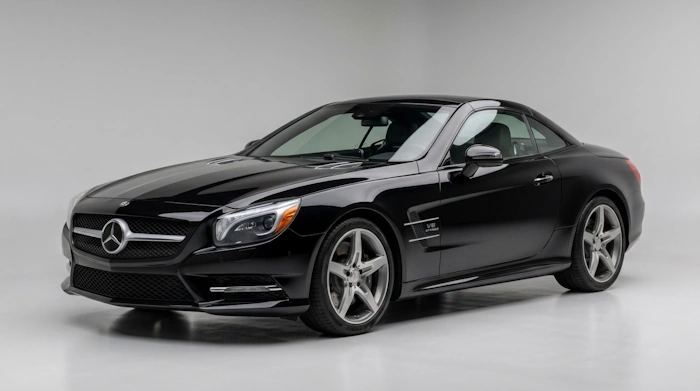
The R231 represents the sixth generation of the Mercedes-Benz SL lineage, a nameplate that traces its origins to the 1954 300 SL Gullwing.
Introduced in 2012, this iteration marked a fundamental shift in construction philosophy: for the first time since the original R129, the SL adopted an all-aluminium body structure, shedding up to 140 kilograms versus its R230 predecessor depending on specification.
The R231 was positioned not merely as a grand tourer but as a credible sports car alternative to the Porsche 911 Cabriolet, a brief reflected in its sharper handling dynamics, reduced mass, and the availability of AMG variants with genuine track capability.
It remained a 2+2 configuration, though the rear seats are best suited for occasional use or luggage.
Development
Lightweight architecture
Development of the R231 began in the mid-2000s under the internal code “R231” with a mandate to reduce weight, improve rigidity, and lower the centre of gravity.
The body-in-white employs a mix of aluminium alloys, high-strength steel, and magnesium components — the latter used for the dashboard cross-car beam and roof frame.
The aluminium-intensive structure comprises 51 per cent aluminium by weight, with the remainder high-strength and ultra-high-strength steel in key load paths. Torsional rigidity increased by 18 per cent over the R230, a notable achievement for an open-top vehicle.
The retractable hardtop mechanism, now fabricated largely from aluminium and magnesium, operates in 20 seconds at speeds up to 40 km/h.
Platform sharing and engineering scope
While the R231 shares its basic front-midship architecture with the contemporaneous W204 C-Class and W212 E-Class, the SL receives unique subframes, suspension geometry, and a dedicated electrical architecture.
The front axle uses a four-link design with aluminium forged control arms; the rear employs a five-link arrangement with an aluminium subframe isolated via hydraulic mounts.
Development prototypes accumulated over 3 million test kilometres, including extensive Nürburgring Nordschleife validation for the AMG variants. The programme also introduced Mercedes’ first application of MAGIC VISION CONTROL — heated washer nozzles integrated into the wiper blades — developed specifically for the SL’s aerodynamic profile.
Design
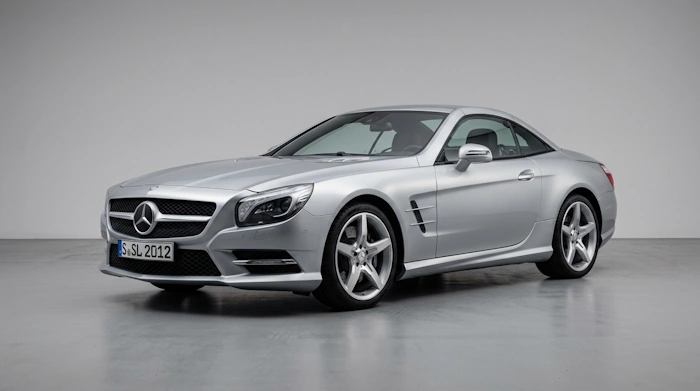
Under the direction of Gordon Wagener, the R231 adopts a more athletic, lower-slung silhouette than its predecessor. The long bonnet, short overhangs, and rearward-set greenhouse reinforce the front-midship proportions.
The signature “power domes” on the bonnet accommodate the tall V8 and V12 engines while providing a visual link to the 300 SL.
The front fascia features a deep, upright grille flanked by LED daytime running light signatures (standard on all models from 2012), while the rear incorporates a full-width LED light band and integrated exhaust finishers that vary by model.
The variable boot partition — linked to the roof state — maximises luggage capacity: 364 litres with the roof up, 240 litres with it stowed.
Aerodynamics
The R231 achieves a drag coefficient of Cd 0.32 with the roof closed and 0.35 with it open, aided by an automatically extending wind deflector behind the rear seats and underbody panelling.
The AIRSCARF neck-level heating system, integrated into the front head restraints, draws air through slots in the seat structure rather than external ducts, preserving clean side surfaces.
Active grille shutters behind the front aperture close at higher speeds to reduce drag and accelerate engine warm-up.
Engines and performance
The launch range comprised three engines: the SL 350’s 3.5-litre V6 (M276 DE35), the SL 500’s 4.7-litre twin-turbo V8 (M278 DE46), and the SL 63 AMG’s 5.5-litre twin-turbo V8 (M157 DE55). The SL 65 AMG followed shortly after with the 6.0-litre twin-turbo V12 (M279 E60).
All engines drive the rear wheels through the 7G-TRONIC PLUS seven-speed automatic torque-converter transmission, save for the SL 65 AMG which uses the 5G-TRONIC SPEEDSHIFT five-speed unit calibrated for the V12’s torque output.
The SL 350 and SL 500 feature ECO start/stop as standard; AMG models received it from the 2013 model year.
SL 350
The entry-level SL 350 produces 225 kW (306 PS) at 6,500 rpm and 370 N·m at 3,500 rpm.
Despite its modest output relative to the V8 siblings, the 3.5-litre V6 benefits most from the aluminium weight savings, returning a claimed 0–100 km/h time of 5.9 seconds and a combined fuel consumption of 7.9 L/100 km (NEDC).
The engine features direct injection, variable valve timing, and a start/stop system that restarts in 0.35 seconds.
SL 500
The SL 500’s 4.7-litre V8 delivers 310 kW (421 PS) at 5,250–5,500 rpm and 700 N·m from 1,800–3,500 rpm. This engine, shared with the W222 S-Class, employs twin-scroll turbochargers integrated into the exhaust manifolds for rapid response.
Performance figures: 0–100 km/h in 4.6 seconds, top speed electronically limited to 250 km/h. The M278’s cylinder deactivation (active between 30–130 km/h at light load) contributes to a combined figure of 8.7 L/100 km.
SL 63 AMG
The SL 63 AMG’s hand-built M157 5.5-litre V8 produces 395 kW (537 PS) at 5,500 rpm and 800 N·m at 2,000–4,500 rpm (900 N·m with the AMG Performance Package). Forged pistons, a strengthened crankshaft, and a dedicated oil cooling circuit distinguish it from the M278.
The AMG SPEEDSHIFT MCT 7-speed transmission replaces the torque converter with a wet multi-plate clutch pack for faster shifts and reduced parasitic loss. 0–100 km/h: 4.2 seconds (4.1 s with Performance Package).
Top speed: 250 km/h standard, 300 km/h with the AMG Driver’s Package.
SL 65 AMG
The flagship SL 65 AMG employs the M279 6.0-litre V12, rated at 463 kW (630 PS) at 4,800–5,400 rpm and a colossal 1,000 N·m from 2,300–4,300 rpm. Torque is limited to 1,000 N·m to protect the 5G-TRONIC transmission; the V12’s theoretical peak exceeds 1,200 N·m.
The SL 65 AMG accelerates to 100 km/h in 4.0 seconds and reaches 250 km/h (300 km/h with Driver’s Package). Standard carbon-ceramic brakes (420 mm front, 360 mm rear) and 20-inch forged wheels are unique to this model. Combined consumption: 11.9 L/100 km.
Driving character
The R231’s aluminium structure pays dividends in agility. Turn-in is sharper than any previous SL, with minimal scuttle shake on broken surfaces.
The electromechanical power steering (a first for SL) offers three weight settings via the drive mode selector (Comfort, Sport, Sport+), though ultimate feedback remains filtered compared to a hydraulic rack.
The AIRMATIC air suspension with Adaptive Damping System (ADS) provides a supple ride in Comfort mode, absorbing expansion joints with the isolation expected of an S-Class, while Sport+ firms the damping and lowers the body by 10 mm for reduced roll.
AMG Ride Control
AMG models receive AMG Ride Control with three distinct damper maps and a stiffer spring rate. The SL 63 AMG’s rear axle features an electronic limited-slip differential (standard on Performance Package.
Optional otherwise) that can lock up to 100 per cent, enabling controlled oversteer on exit.
The SL 65 AMG uses a mechanical limited-slip differential with a 30 per cent lock-up. Both AMG variants benefit from wider front tracks (+47 mm front, +38 mm rear versus non-AMG) and model-specific suspension geometry.
Braking and stability
The standard composite brakes (360 mm front, 360 mm rear on SL 350/500; 390 mm front, 360 mm rear on SL 63) offer strong initial bite and good fade resistance.
The optional carbon-ceramic discs (420 mm front, 360 mm rear) reduce unsprung mass by 12 kg and provide consistent pedal feel under repeated high-speed stops.
ESP operates in three stages: On, Sport Handling (permits higher slip angles before intervention), and Off. Curve Dynamic Assist applies individual wheel braking to mitigate understeer in tight corners.
Ownership notes
Strengths
- All-aluminium body eliminates structural corrosion concerns common on earlier SL generations
- Retractable hardtop operates quickly (20 s) and provides coupe-like refinement when closed
- V8 and V12 engines are over-engineered; with timely oil changes (10,000 km/12 months) they routinely exceed 200,000 km
- 7G-TRONIC PLUS transmission is robust; fluid and filter service every 60,000 km ensures longevity
- Comprehensive parts availability through Mercedes-Benz Classic and dealer network
- Strong enthusiast community and specialist independent support in most major markets
Things to watch
- AIRMATIC air springs and compressor may require replacement after 80,000–100,000 km; listen for compressor noise or overnight sag
- Retractable hardtop mechanism: lubricate seals and hinges annually; check for water ingress at A-pillar drains
- M278/M157 V8 turbocharger oil feed lines can carbonise; updated parts fitted from 2014 production
- M279 V12 ignition coils and spark plugs are expensive (12 each) and should be replaced per schedule (60,000 km)
- Carbon-ceramic brakes: excellent performance but replacement discs exceed €10,000 per axle; inspect for surface cracking
- Electromechanical steering rack: isolated reports of internal position sensor failure requiring rack replacement
- COMAND NTG5 infotainment: map updates require dealer or SD card; Bluetooth compatibility varies with newer smartphones
- Magic Sky Control roof: electrochromic panel can delaminate; replacement cost is significant (€4,000+)
Legacy
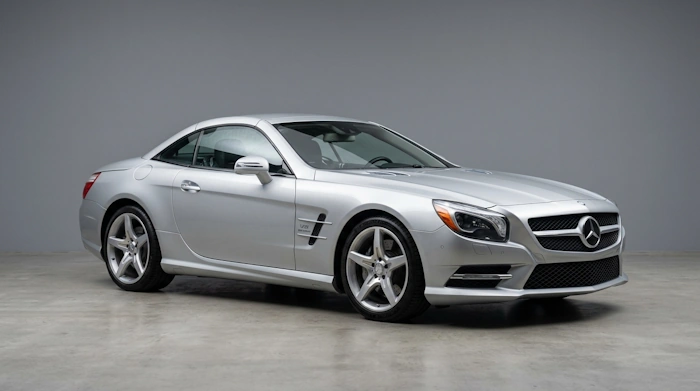
The R231 SL is widely regarded as the most dynamically competent SL of the modern era. Its aluminium construction set a template for subsequent Mercedes models, including the W222 S-Class and the AMG GT (C190), which shares the R231’s front-midship architecture and transaxle layout.
The R231 also marked the end of the naturally aspirated V8 and V12 era for the SL — every engine was turbocharged, a trend that continued with the R232’s four- and eight-cylinder lineup.
Production concluded in 2020 after approximately 55,000 units, a modest figure reflecting the segment’s contraction.
Values for well-maintained SL 63 and SL 65 AMG examples have stabilised, with the SL 65 AMG increasingly viewed as the last of the V12 grand tourers — a distinction that secures its place in Mercedes-Benz history.
Leave a Reply
You must be logged in to post a comment.