General information & model overview
| Category | Specification Details |
|---|---|
| Model name | 2012 Mercedes-Benz SLS AMG GT Roadster |
| Internal code | R197 (GT specification) |
| Manufacturer | Mercedes-AMG / Mercedes-Benz |
| Availability | From approximately 2012 alongside the GT Coupé; market timing varies slightly by region |
| Body style | Two-door, two-seat soft-top roadster with conventional doors |
| Layout | Front mid-engine, rear-wheel drive, rear dual-clutch transaxle |
| Power class | 435 kW / 591 PS; 650 Nm — GT output, not base 571 PS |
| Family position | Open GT between the 2011 base Roadster and closed GT Coupé; not a Black Series product |
| Hub | SLS AMG family overview |
Body & dimensions
| Specification | Details |
|---|---|
| Wheelbase | 2,680 mm |
| Overall length | 4,638 mm |
| Overall width | 1,939 mm excluding mirrors |
| Overall height | Approximately 1,262 mm roadster class |
| Roof | Three-layer fabric soft top; cycle time about 11 seconds; operation on the move at low-to-moderate speeds as on base roadster |
| Doors | Conventional hinged doors |
| Structure | Roadster reinforcement package retained (multi-chamber sills, scuttle/tunnel bracing, rear structural elements, fixed roll-over protection support) |
| Mass theme | Heavier than GT Coupé by open-car reinforcement and top mechanisms; still in the mid-1,600 kg class rather than Black Series light weight |
Engine specifications
| Theme | Details |
|---|---|
| Engine | M159 6,208 cc naturally aspirated V8, dry-sump |
| Peak power | 435 kW / 591 PS at approximately 6,800 rpm |
| Peak torque | 650 Nm at approximately 4,750 rpm |
| Versus base Roadster | +20 PS class; same torque headline; distinct ECU/calibration identity |
| Versus GT Coupé | Matched output pair; open body changes cooling airflow patterns and acoustic experience |
Drivetrain & transmission
| Category | Details |
|---|---|
| Transmission | AMG SPEEDSHIFT DCT 7-speed dual-clutch with GT-oriented shift response |
| Manual mode | Faster reaction emphasis versus early base calibrations |
| Shaft / layout | Carbon-fibre driveshaft in torque tube; rear-wheel drive |
| Modes | Full AMG mode set including Sport Plus and paddle manual |
Chassis, suspension & brakes
| Component | Specification |
|---|---|
| Suspension | AMG RIDE CONTROL performance suspension themes shared with GT Coupé intent |
| Geometry | Aluminium double wishbones front and rear |
| Brakes | Performance iron path; ceramic composite optional and common on GT-spec cars |
| Wheels / tyres | Staggered 19/20-inch; GT-era design choices and forged options |
| Open-car dynamics note | Reinforced structure approaches coupé stiffness but does not fully erase open-body compliance differences |
Performance (approximate)
| Metric | Approximate data |
|---|---|
| 0–100 km/h | GT-class acceleration; marginally quicker than base roadster claims when mass and conditions align |
| Top speed | Electronically limited mid-310 km/h family class |
| Open versus closed GT | Coupé remains the slightly purer structural sports tool; roadster trades a fraction of that for open-air use |
| Real-world limiters | Tyres, wind, and surface quality dominate more than the 20 PS paper delta once speeds are high |
Open GT: a distinct brief
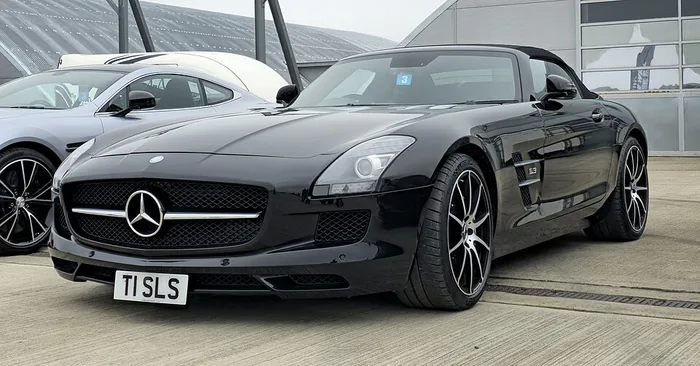
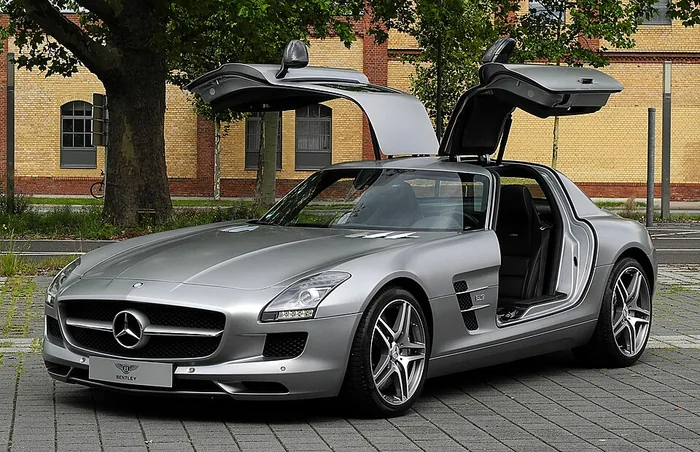
The 2012 Mercedes-Benz SLS AMG GT Roadster combines the R197 open body with the GT powertrain and chassis focus. It is not merely a base 2011 Roadster with different wheels, and it is not a gullwing. Peak power is 591 PS with 650 Nm of torque. Transmission response and RIDE CONTROL performance suspension themes align with the GT Coupé. Buyers and historians who collapse all open SLS cars into one category lose the output and calibration step that defines GT.
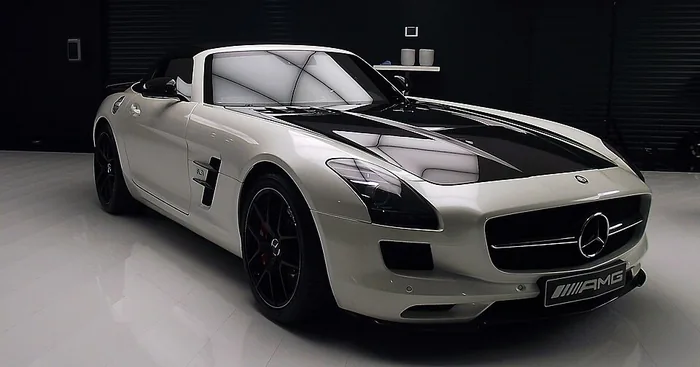
Image source: Wikimedia Commons
Within the family map, this car occupies the open high-output road slot. There is no factory Black Series roadster; the extreme limited car remains the closed Black Series only.
Body engineering carried forward
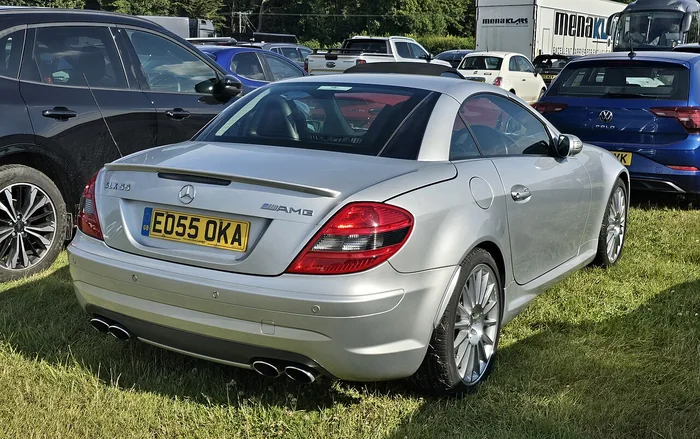
GT status does not delete the roadster reinforcement package. Multi-chamber sills, scuttle and tunnel bracing, rear curved reinforcement near the top and tank region, and the seat-back cross-member with roll-over protection remain the structural answer to roof deletion. The soft top still cycles in about eleven seconds with a three-layer fabric stack. Conventional doors keep everyday access simple compared with gullwings.
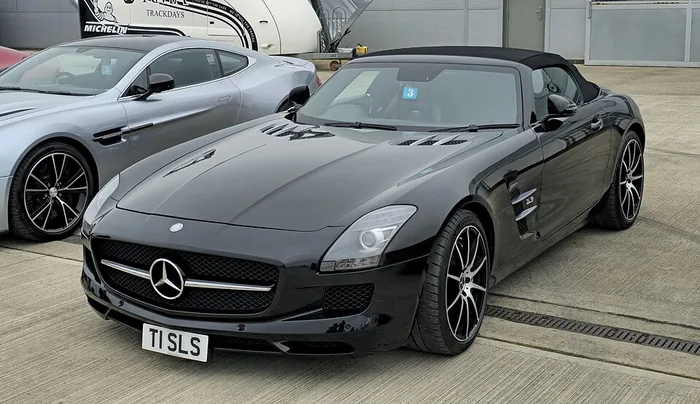
Image source: Wikimedia Commons
Mass sits above the GT Coupé because open cars carry top mechanisms and reinforcement steel/aluminium that closed shells handle differently. The result is still a mid-1,600 kg class sports roadster, not a featherweight barchetta. Expectations should match that physics.
1. Why the GT open car matters
It proves AMG was willing to sell the sharper calibration without forcing customers into a closed cockpit. Open-air M159 sound at 591 PS is a different ownership proposition from the quieter, stiffer gullwing.
2. Separation from base 2011 cars
Base roadsters are 571 PS cars. GT roadsters are 591 PS cars with GT shift and suspension intent. Badges, build data, and powertrain documentation separate them when paint and interiors look similar.
3. Separation from Final Edition cosmetics
Late Final Edition roadsters may add carbon aero and numbered plaques while remaining GT-class mechanically. Those packages are not Black Series conversions.
Powertrain and sensory differences versus the GT Coupé
On paper the GT Roadster and GT Coupé share 435 kW / 591 PS and 650 Nm. In use, roof-down driving changes throttle and exhaust audibility, wind load at speed, and the driver’s sense of velocity. Roof-up, the fabric top filters high-frequency content differently than a metal gullwing shell. Cooling airflow through the long front mid-engine bay remains a design priority; hard summer use still asks for healthy radiators and clean heat exchangers.
The dual-clutch’s sharper GT mapping is more obvious when exhaust and intake noise are unshielded. Low-speed urban crawl can still expose dual-clutch manners; software state and fluid service quality influence that behaviour as much as the GT label.
1. Dry-sump continuity
Open cars see the same cornering oil-control needs as closed cars. Dry-sump hardware is not optional equipment; it is core M159 architecture.
2. Torque tube packaging
The carbon shaft path is unchanged. Power delivery character is GT, not a different mechanical layout.
3. Fuel and range behaviour
High-load open touring consumes fuel quickly. Tank size supports sports-car range, not diesel-MPV range. Plan fuel stops on long alpine or coastal routes accordingly.
Chassis feel on the open GT
RIDE CONTROL performance suspension gives the driver damping choices that base early roadsters may only offer as options. In firmer modes the car feels more decisive; in softer modes it remains a wide, low sports car that notices poor pavement. Ceramic brakes, when fitted, maintain consistency on long descents. Stability control stages are still relevant in the wet because open cars invite more casual year-round use for some owners than Black Series coupés do.
Compared with the base Roadster, turn-in and shift aggression read higher when tyres are fresh. Compared with the GT Coupé, a trace more scuttle shake or rear compliance can appear on broken surfaces despite reinforcements. That is open-car normality, not a defect unique to SLS.
Sibling choices
Select the GT Roadster for 591 PS open-air GT calibration. Select the 2011 base Roadster for open air at 571 PS and earlier equipment framing. Select the GT Coupé for gullwing structure and matched output. Select the base Coupé for launch reference. Select the Black Series only if the brief is limited closed track-leaning extreme.
- R197 + GT — body and calibration identity.
- 591 PS / 650 Nm — shared with GT Coupé.
- Conventional doors + soft top — open usability.
- From ~2012 — GT open availability window.
- No Black Series roadster — hard family fact.
Ownership survey focus
Combine open-car checks (top fabric, drains, pumps, seals, roll-bar trim UV ageing) with GT mechanical checks (documented output, dual-clutch service, suspension mode operation, brake compound type). Verify that marketing photos labelled “SLS Roadster” match GT data if a premium is asked for GT status. Aluminium repair history remains critical after side or rear impacts that load reinforcement paths.
Parts commonality with other SLS cars helps availability; unique interior GT colourways and late carbon pieces can still be scarce. Tyre age on staggered fitments is a frequent failure point in low-mileage garage queens.
Legacy
The SLS AMG GT Roadster is the open-air expression of the programme’s mature road specification. It keeps the aluminium sports-car system, raises power to 591 PS, and refuses to force enthusiasts into a coupé if they want the sharper dual-clutch and suspension package. In that sense it completes the body-and-output matrix of the petrol road range: base and GT, closed and open, with Black Series as the separate limited closed extreme.
After production ended, the later AMG GT Roadster nameplate belongs to a different generation. The R197 GT Roadster remains the only way to combine SLS proportions, fabric roof, and GT-era M159 output. That uniqueness, more than brochure adjectives, secures its place in Mercedes-AMG history.
Record it accurately as a 591 PS open SLS with roadster reinforcements and GT calibration from about 2012 — distinct from the 2011 base Roadster and from every gullwing, including Black Series.
Leave a Reply
You must be logged in to post a comment.