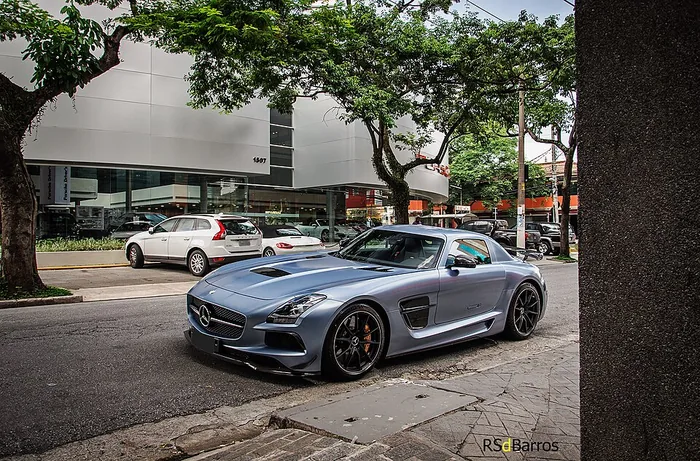
General information & model overview
| Category | Specification Details |
|---|---|
| Model name | 2010 Mercedes-Benz SLS AMG Coupé |
| Internal code | C197 |
| Manufacturer | Mercedes-AMG / Mercedes-Benz |
| Launch context | First series body of the SLS programme; introduced after 2009 Frankfurt reveal; customer deliveries from 2010 in core markets |
| Production window for this entry’s focus | Launch and early base coupé years from 2010; base coupé continued in parallel markets until later GT supersession patterns and Final Edition closure of the line |
| Body style | Two-door, two-seat gullwing coupé |
| Layout | Front mid-engine, rear-wheel drive, rear dual-clutch transaxle |
| Family position | Base closed car within the SLS AMG family; distinct from later GT and Black Series coupés and from all roadsters |
| Designer | Mark Fetherston (exterior design leadership for the production form) |
Body & dimensions
| Specification | Details |
|---|---|
| Wheelbase | 2,680 mm (105.5 in) |
| Overall length | 4,638 mm (182.6 in) |
| Overall width | 1,939 mm (76.3 in) excluding mirrors |
| Overall height | Approximately 1,252 mm (49.3 in) |
| Doors | Gullwing doors on gas struts; manual close (power auto-close systems rejected for mass reasons in development accounts) |
| Construction | Aluminium spaceframe and aluminium outer panels; long front mid-engine bay packaging |
| Curb weight (approximate) | About 1,619 kg (3,569 lb) DIN class with standard wheels |
| Luggage volume | Approximately 176 litres class behind the seats (confirm handbook for equipment-dependent figures) |
| Fuel tank | Sports-car capacity in the mid-80-litre class depending on market documentation |
Engine specifications
| Theme | Details |
|---|---|
| Engine code / type | M159 naturally aspirated 90° V8 petrol |
| Displacement | 6,208 cc (often marketed in “6.3” AMG language despite metric displacement) |
| Peak power | 420 kW / 571 PS (563 hp) at approximately 6,800 rpm |
| Peak torque | 650 Nm (479 lb-ft) at approximately 4,750 rpm |
| Lubrication | Dry-sump system for sustained high cornering loads |
| Induction | Naturally aspirated; performance intake and exhaust path unique to SLS development versus related M156 heritage |
| Character | High-revving large-capacity eight; linear delivery without turbo lag; substantial mid-range with a strong upper register |
Drivetrain & transmission
| Category | Details |
|---|---|
| Gearbox | AMG SPEEDSHIFT DCT 7-speed dual-clutch (Getrag 7DCL750 class), rear-mounted transaxle |
| Propulsion link | Carbon-fibre driveshaft enclosed in a torque tube between engine and gearbox |
| Drive | Rear-wheel drive |
| Driver modes | C / S / S+ / M style mode map with column paddles for manual shifts |
| Differential | Limited-slip / locking strategies integrated with AMG stability and traction logic (exact hardware varies by year and option path — verify on car) |
Chassis, suspension & brakes
| Component | Specification |
|---|---|
| Front suspension | Double wishbone, forged aluminium arms, coilover springs |
| Rear suspension | Double wishbone with toe links; aluminium construction themes matching the front |
| Spaceframe mass theme | Aluminium frame often cited near 241 kg for the structure alone |
| Standard brakes | Ventilated iron discs approximately 390 mm front (6-piston) and 360 mm rear (4-piston) |
| Optional brakes | Carbon-ceramic package with larger front rotors (about 402 mm class) and reduced rotating mass |
| Wheels / tyres (typical launch) | 19-inch front / 20-inch rear staggered fitment; common tyre sizes 265/35 R19 front and 295/30 R20 rear |
| Aerodynamics | Electronically deployed rear wing for stability; airbrake behaviour under heavy braking |
Performance (approximate)
| Metric | Approximate data |
|---|---|
| 0–100 km/h | About 3.8 seconds (manufacturer claim class) |
| Top speed | About 317 km/h class (some documentation cites about 315 km/h electronically limited) |
| Quarter-mile class | Independent tests of early cars have recorded roughly 11.7-second class runs depending on conditions |
| Lateral grip theme | Period instrumented tests reported high lateral acceleration for a production grand-touring sports car of the era |
| Fuel use (era cycle) | Around 13 L/100 km combined in early NEDC-oriented figures |
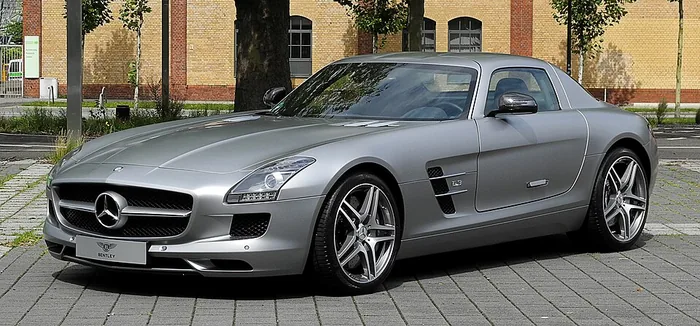
Launch gullwing: the 2010 SLS AMG Coupé defined
The 2010 Mercedes-Benz SLS AMG Coupé is the car that established the entire C197 programme. It is the base closed body with gullwing doors, the 571 PS M159 V8, and the seven-speed dual-clutch rear transaxle. Later GT and Black Series coupés modify power, chassis, and mass; the 2010 launch car is the reference against which those changes are measured. It is not a roadster, and it is not a Black Series. Understanding the launch coupé is therefore the correct first step in reading the family.
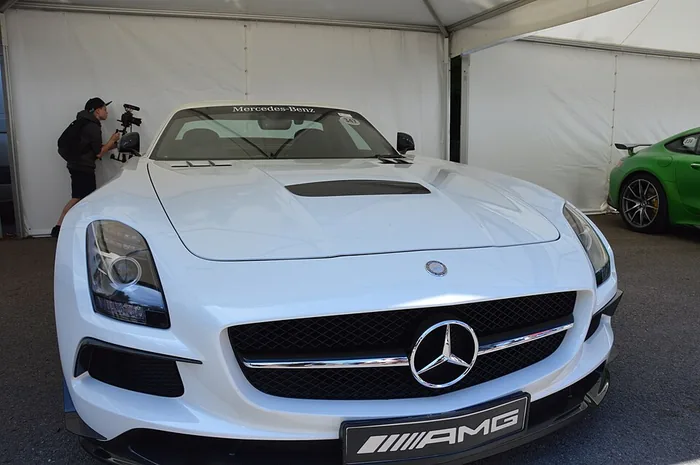
Image source: Wikimedia Commons
For the wider map, see the SLS AMG hub. Open-air counterparts begin with the 2011 Roadster. Higher-output closed cars are covered under the GT Coupé and Black Series entries.
Design and the modern gullwing problem
Reintroducing gullwing doors in a modern crash-regulated sports car required more than styling nostalgia. The doors swing upward on gas struts and must leave enough side structure for strength, sealing, and side-impact performance. AMG development accounts note that powered closing systems were rejected because of the mass they would add. Occupants close the doors manually. In severe rollover logic, the design includes measures to free the exits so the dramatic doors do not become traps.
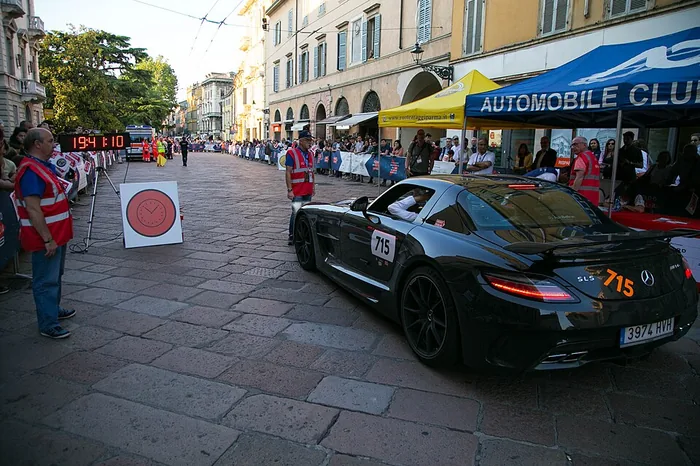
Image source: Wikimedia Commons
Exterior form follows a long front mid-engine proportion: short overhangs relative to the bonnet length, a low roof, and a wide rear stance. Mark Fetherston’s design period in 2006–2007 set that language before production. The car won multiple design awards after launch, but encyclopedia interest focuses on hard points: aluminium body supply, spaceframe stiffness, and packaging of a large dry-sump V8 ahead of the cabin with a rear gearbox.
1. Cabin packaging
Two seats, a driver-oriented centre stack, and COMAND-era infotainment define the launch interior. Materials include extensive Nappa leather options and optional carbon or metal trim. Luggage space is modest and secondary to structure and fuel systems behind the cabin.
2. Visibility and daily use
The long bonnet and thick pillars demand deliberate urban driving. Gullwing doors need vertical clearance in garages. These are practical constraints of the architecture, not flaws relative to the design brief.
3. Distinction from the SL
Contemporary SL models remained the comfort-oriented Mercedes open/closed grand tourers. The SLS Coupé is the sports-car statement: lighter than the SLR McLaren predecessor context, more circuit-capable in AMG’s own framing, and less amenity-heavy than an SL with multi-function seats and hardtop complexity.
M159 at 571 PS: the launch powertrain
The M159 is a purpose-developed SLS engine. Displacement is 6,208 cc. Peak figures for the launch coupé are 420 kW (571 PS) and 650 Nm. Dry-sump lubrication and extensive internal and breathing changes versus related AMG eights justify the separate code. At introduction AMG presented the unit as the most powerful naturally aspirated series production engine of its moment — a factual marketing claim of that period rather than a permanent absolute.
Power reaches the rear axle through a carbon-fibre shaft inside a torque tube and a Getrag dual-clutch seven-speed unit. The architecture is pure sports car: mass centralised, rotating masses controlled, and shift programmes selectable from comfort-oriented efficiency through aggressive paddle control. Early dual-clutch calibration could feel abrupt in some low-speed situations; software and later GT refinements improved the product, but the 2010 car must be judged as the first calibration customers received.
1. Why dry sump matters here
A low, wide car that can generate high lateral g needs oil control. Dry sump is not a race-only affectation on the SLS; it is part of making the long-bonnet layout usable at the adhesion limit on a closed circuit.
2. Carbon shaft and torque tube
The tube and carbon shaft form a rigid connection between power unit and transaxle. That supports shift quality and reduces the whip and mass of a conventional multi-piece propshaft layout for this packaging.
3. Service reality for owners
High-output NA V8s and dual-clutches need documented fluid services, cooling system integrity, and correct oil. Carbon-ceramic brakes, if fitted, change pad and disc economics. None of these points are unique to Mercedes, but they define the ownership envelope of a 2010-launch SLS Coupé today.
Chassis behaviour of the base coupé
Double wishbones at both ends, aluminium arms, and a stiff spaceframe give the launch car a precise, dense feel. It is not a soft boulevard GT. Standard iron brakes are large enough for road use; ceramics are the track-day and mountain-road upgrade. The rear wing deploys with speed and can assist under hard braking. Stability control stages allow progressive freedom for skilled drivers without requiring a full off switch for ordinary wet-road safety.
Instrumental comparisons of the era placed the SLS ahead of the heavier SLR McLaren in lateral grip metrics. That aligns with AMG’s claim that the SLS is the quicker track tool. Still, the car’s width, tyre sizes, and mass mean it rewards smooth inputs. It is not a lightweight mid-engine Italian in character; it is a front mid-engine German sports car with a very strong naturally aspirated eight.
How the launch coupé differs from later family members
Versus the Roadster, the coupé keeps gullwing doors, lower height, and roughly 40 kg less mass. Versus the GT Coupé, it makes 571 PS rather than 591 PS and uses the earlier dual-clutch and suspension calibration set. Versus the Black Series, it is heavier, less extreme in aero and track width, and tuned for a broader road role. Final Edition cars near the end of production often sit on GT mechanicals with cosmetic carbon packages; they should not be confused with a pure 2010 base car when documenting specifications.
- 571 PS / 650 Nm — launch M159 output pair.
- Gullwing C197 — defining body of the family.
- ~3.8 s to 100 km/h — manufacturer acceleration class.
- ~1,619 kg — approximate DIN curb weight reference.
- Dual-clutch only — no factory manual.
Ownership and documentation notes
When identifying a launch-era base coupé, confirm output via documentation and ECU identity rather than exterior colour. Options such as ceramic brakes, forged wheels, and premium audio do not change the fundamental 571 PS classification. Accident history on aluminium structures requires specialist assessment. Gullwing seals, struts, and door alignment are inspection points unique to the closed body.
The car remains recognisable to independent specialists and dealer networks. Parts for wear items exist; unique aero and interior pieces can be costly. Tyre compounds in staggered sizes age out and should be treated as safety-critical consumables rather than cosmetic details.
Legacy
The 2010 SLS AMG Coupé is the foundational production expression of AMG’s first clean-sheet sports car. Every later road variant in the family either opens the roof, raises power, or lightens and sharpens the closed car. Without the launch coupé’s architecture — aluminium spaceframe, dry-sump M159, carbon torque-tube shaft, rear dual-clutch — those variants would have no shared system to modify.
Historically the car reattached the gullwing idea to series Mercedes production under modern regulation and manufacturing. It also fixed a public image of Affalterbach as more than a tuner of saloons and SLKs: capable of authoring a full supercar-class two-seater. Later AMG GT generations change engines and layouts; they do not replace the 2010 coupé’s role as the SLS origin point.
For researchers, the durable facts are stable: C197, 420 kW / 571 PS, 650 Nm, approximately 3.8 seconds to 100 km/h, top speed in the mid-310 km/h limited class, and a curb weight near 1.6 tonnes. Everything else in the family is a controlled deviation from that launch specification.
Leave a Reply
You must be logged in to post a comment.