General information & model overview
| Category | Specification Details |
|---|---|
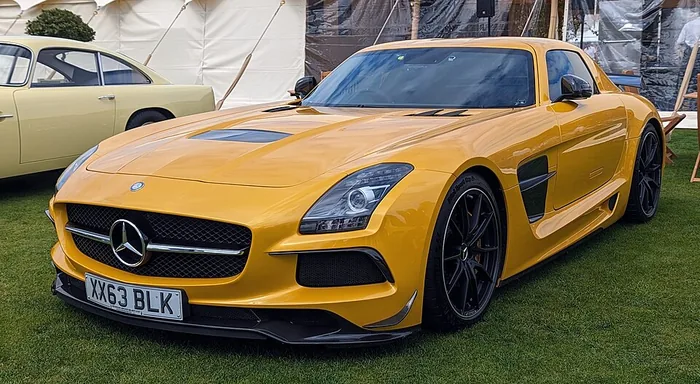
| Model name | 2013 Mercedes-Benz SLS AMG Black Series |
| Internal code | C197 (Black Series specification) |
| Manufacturer | Mercedes-AMG / Mercedes-Benz |
| Introduction | Unveiled 2012 Los Angeles cycle; market launch from about mid-2013 (2014 model year framing in some markets including the United States) |
| Body style | Two-door, two-seat gullwing coupé only — no factory Black Series roadster |
| Layout | Front mid-engine, rear-wheel drive, rear dual-clutch transaxle mounted slightly lower than standard SLS packaging |
| Production character | Limited series; published totals differ by source (commonly described in the low hundreds rather than multi-thousand volume). Treat exact unit counts as approximate where tables disagree. |
| Family position | Track-leaning extreme above SLS AMG GT Coupé; closed only; see family hub |
Body & dimensions
| Specification | Details |
|---|---|
| Wheelbase | 2,680 mm (shared family wheelbase) |
| Overall length | 4,638 mm class overall package with Black Series-specific aero appendages |
| Track / width themes | Flared wings; track increased on the order of about 20 mm front and about 24 mm rear versus standard; additional width at each side from flared arches |
| Height | Low coupé package; aero options can add fixed rear wing height |
| Doors | Gullwing — retained from C197 coupé identity |
| Lightweight body themes | Extensive CFRP use (bonnet with central outlet, aero elements, selected panels and interior deletions/substitutions) |
| Curb weight (approximate) | About 1,549–1,550 kg DIN class — roughly 70 kg lighter than a standard SLS coupé in factory language |
Engine specifications
| Theme | Details |
|---|---|
| Engine | M159 6,208 cc naturally aspirated V8, dry-sump, high-rev package |
| Peak power | 464 kW / 631 PS (622 hp) at approximately 7,400 rpm |
| Peak torque | 635 Nm at approximately 5,500 rpm — slightly below base/GT 650 Nm, delivered higher in the rev range |
| Rev limit | Approximately 8,000 rpm redline class |
| Internal / breathing changes | Revised camshafts and cam geometry; optimised coated bucket tappets; freer intake path; application and peak-pressure adaptations for higher engine speed |
| Exhaust | Titanium system contributing substantial mass reduction (order of about 13 kg cited for the exhaust change alone in factory material) |
Drivetrain & transmission
| Category | Details |
|---|---|
| Transmission | AMG SPEEDSHIFT DCT 7-speed dual-clutch |
| Packaging change | Transaxle mounted about 10 mm lower; gas-filled strut bracing against the body to manage load cycles |
| Shift behaviour | Faster shifts in Sport Plus and Manual; more audible throttle blips on downshifts |
| Temporary M mode | Paddle input can engage manual behaviour without menu navigation away from the wheel |
| Rear axle | Electronically controlled differential lock themes; shorter rear-axle ratio versus standard SLS |
| Shaft | Carbon-fibre driveshaft / torque-tube family concept retained; weight focus elsewhere in CFRP and titanium |
Chassis, suspension & brakes
| Component | Specification |
|---|---|
| Suspension | AMG RIDE CONTROL performance suspension with firmer base tune and two-stage electronic damping; coilover adjustability themes for wheel-load setup |
| Elastokinematics | Substantially stiffer bushing strategy (factory order of roughly 50% front / 42% rear more rigid versus standard references) |
| Front hardware | New wheel carriers; retuned front anti-roll bar |
| Wheels / tyres | Forged light 10-spoke designs; 10×19 front and 12×20 rear class; Michelin Pilot Sport Cup 2 type fitment 275/35 R19 front and 325/30 R20 rear class |
| Steering | Speed-sensitive AMG steering with Black Series-specific assistance calibration |
| Brakes | AMG ceramic discs emphasised (about 402×39 mm front and 360×32 mm rear class) with increased hardness focus |
| Aerodynamics | Carbon front splitter, side and rear carbon elements, enlarged inlets with flics; optional fixed adjustable carbon rear wing package inspired by GT3 thinking |
Performance (approximate)
| Metric | Approximate data |
|---|---|
| 0–100 km/h | About 3.6 seconds in factory class language; some independent tests to 60 mph have recorded still lower times on ideal surfaces |
| Top speed | About 315 km/h class electronically limited in much documentation |
| Power-to-weight theme | Factory emphasis on best ratio among Black Series cars of its moment after the ~70 kg reduction and 631 PS output |
| Character trade-off | Less low-end torque than base/GT 650 Nm cars; more top-end power and revs; sharper mechanical response |
Black Series as the closed extreme
The 2013 Mercedes-Benz SLS AMG Black Series is the limited, track-leaning summit of the C197 road range. It keeps gullwing doors and the aluminium sports-car layout but changes almost every performance-relevant subsystem: engine breathing and valvetrain for 631 PS at 7,400 rpm, titanium exhaust mass reduction, CFRP body and aero pieces, a lower dual-clutch installation, wider tracks, Cup-oriented tyres, and roughly seventy kilograms less mass than a standard coupé in AMG’s own comparison language. It is not offered as a roadster. It is not a cosmetic package on a GT. It is a separate specification.
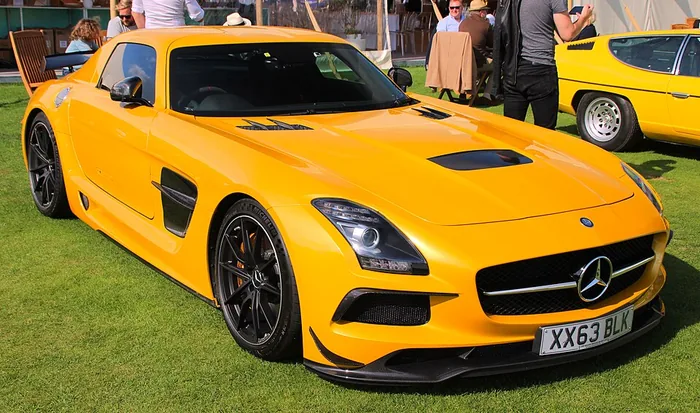
Image source: Wikimedia Commons
Context within the family: the base Coupé defines 571 PS launch identity; the GT Coupé defines 591 PS road sharpness; the Black Series defines the limited extreme. Open cars stop at GT calibration — see the GT Roadster and base Roadster. Overview architecture lives on the hub page.
Engine: 631 PS and the high-rev brief
Displacement remains 6,208 cc. Peak power rises to 464 kW / 631 PS at about 7,400 rpm. Peak torque is quoted at 635 Nm near 5,500 rpm — a few newton-metres below the 650 Nm of base and GT cars, but available in a package that lives higher in the rev range. Redline extends to about 8,000 rpm. Camshafts, tappets, intake derestriction, and engine application changes support that speed. At introduction the unit stood among the most powerful naturally aspirated production V8s of its period.
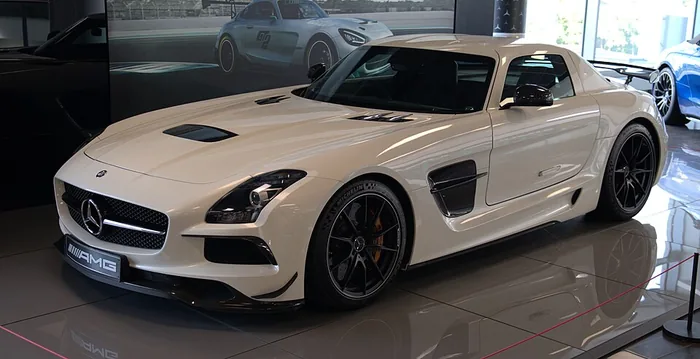
Image source: Wikimedia Commons
The titanium exhaust saves mass and alters acoustic character. Cabin and exterior sound are more intense than on GT cars. Heat management after repeated high-load runs remains an ownership responsibility; lightweight systems do not remove thermal physics.
1. Why torque falls slightly
Black Series tuning prioritises high-rpm power and response over the broadest possible low-rpm torque plateau. The car is meant to be driven with revs, not only with short-shifting torque.
2. Dry sump retained
Track lateral loads make dry-sump lubrication non-negotiable. The Black Series intensifies cornering demands relative to base cars; oil control remains foundational.
3. Service implications
High engine speeds, Cup tyres, and ceramic brakes concentrate wear. Oil specification, cooling system condition, and honest track-hour disclosure matter more than cosmetic presentation when evaluating a used example.
Mass reduction and chassis aggression
Factory material cites about 70 kg saved versus a standard SLS coupé. Contributors include CFRP components, titanium exhaust, and a lighter lithium-ion battery (order of about 8 kg savings cited for the battery change in period literature). The dual-clutch sits about 10 mm lower to drop the centre of gravity and is braced with gas-filled struts. Elastokinematics stiffen substantially. Track width grows. Forged wheels and wide Cup-type tyres raise mechanical grip and steering load.
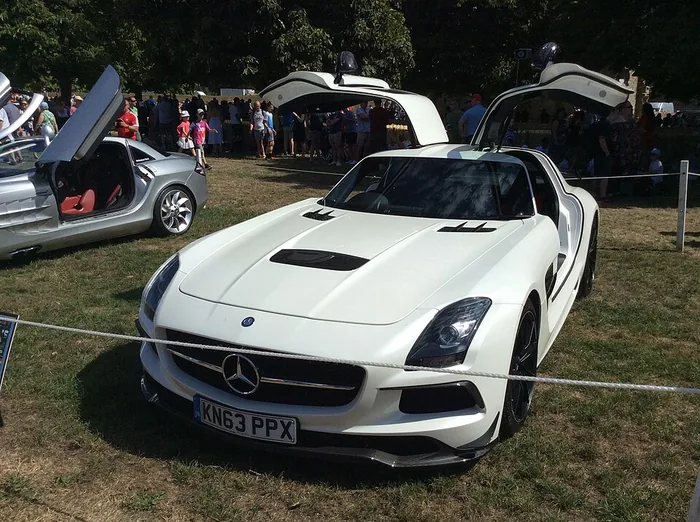
Image source: Wikimedia Commons
Aerodynamics move toward GT3 inspiration without converting the car into a full race homologation special for the road. Carbon splitter, flics, and optional fixed rear wing increase download and drag trade-offs. Interior simplification can delete or relocate comfort equipment (COMAND may be absent unless re-specified) in favour of Alcantara, carbon, and bucket-oriented seats.
1. Coupe-only decision
No Black Series roadster exists. Open-car reinforcements and soft-top mass would fight the lightening brief, and AMG kept the extreme specification visually and structurally tied to the gullwing shell.
2. Limited production language
Unit totals published in secondary tables vary. Some compilations list figures in the low hundreds. This encyclopedia does not treat a single contested number as sacred; it records the car as limited production far below mainstream SLS volume.
3. Relation to GT3 customer racers
Road Black Series cars borrow attitude and some aero thinking from the SLS AMG GT3 programme but remain road-legal products with dual-clutch road gearboxes and emissions constraints. They are not identical to race cars.
Driving the Black Series
On a warm track with correct tyre pressures the car is the most urgent road SLS: faster shifts, stronger top end, wider grip, more aero load when optioned, less mass to turn. On cold public roads Cup tyres and stiff bushings can feel uncompromising. The electronic differential and stability stages need understanding; the car can still overwhelm a driver who confuses badge intensity with invulnerability.
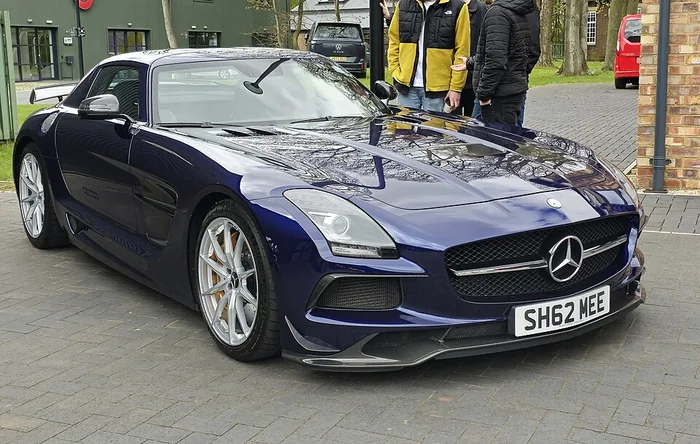
Image source: Wikimedia Commons
Acceleration claims around 3.6 seconds to 100 km/h (and occasionally lower independent 0–60 mph runs) depend on surface and tyres. Top speed remains limited near the mid-310 km/h class rather than being the primary point of the car. The point is response, grip, and mass discipline within the gullwing architecture.
Sibling comparison
Choose Black Series for limited closed extreme performance. Choose GT Coupé for 591 PS road usability without Cup-car compromises. Choose base Coupé for launch purity and broader comfort. Open-air needs stop at GT Roadster or base Roadster — never Black Series.
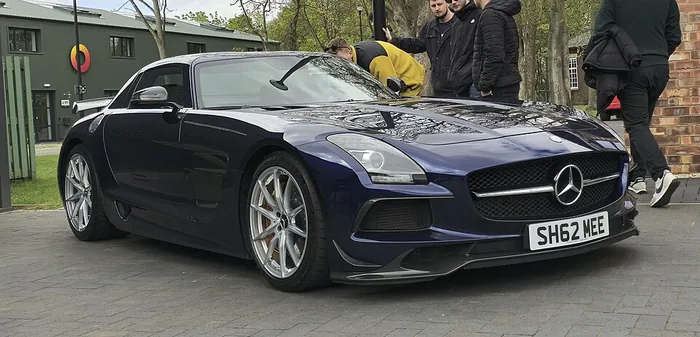
Image source: Wikimedia Commons
- 631 PS @ ~7,400 rpm — peak power identity.
- 635 Nm @ ~5,500 rpm — torque pair with high-rev bias.
- ~70 kg lighter — factory mass-reduction theme.
- CFRP + titanium exhaust — signature hardware.
- Coupé only / limited build — programme boundaries.
Authenticity and ownership discipline
Because values and myth concentrate on Black Series cars, documentation is essential. Confirm Black Series-specific engine and chassis equipment, wing and aero authenticity, and whether comfort equipment was deleted from the factory or altered later. Crash repairs on flared arches and carbon pieces are expensive and must be disclosed. Track use is part of many cars’ histories; brake and tyre budgets should assume that reality.
Storage on cold Cup tyres is poor practice. Alignment after kerb impacts matters more than on softer road SLS cars. Specialist knowledge of dual-clutch behaviour at the lower mount and of ceramic brake bedding separates serious ownership from garage display.
Legacy
The SLS AMG Black Series closes the C197 story at its most extreme road point. It demonstrates how far AMG could push the clean-sheet gullwing architecture while remaining a series (if limited) product: more revs, less mass, more aero, wider tracks, and a dual-clutch installed with circuit priorities. It also marks a high point for large naturally aspirated AMG V8 road cars before turbocharging dominated subsequent flagship narratives.
Historically the car sits in the Black Series lineage that includes earlier CLK and SLK extremes and later GT-family specials, but it is specifically the gullwing chapter of that idea. Production was intentionally scarce; secondary sources disagree on exact tallies, so careful writers use ranges and “limited” language rather than false precision.
Leave a Reply
You must be logged in to post a comment.