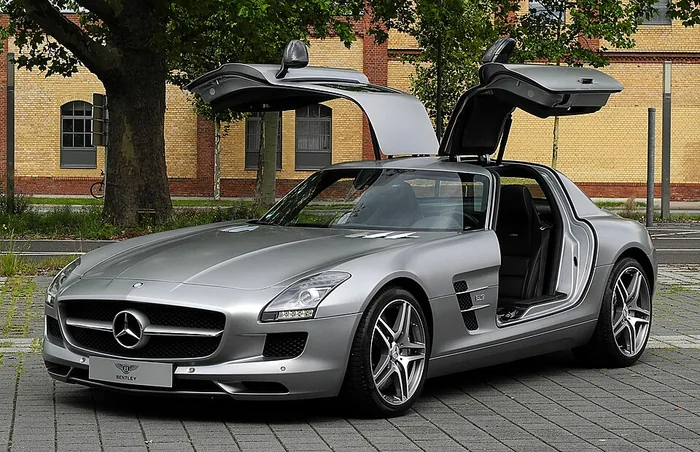
General information & model overview
| Category | Specification Details |
|---|---|
| Model name | Mercedes-Benz SLS AMG (family overview) |
| Internal codes | C197 (coupé); R197 (roadster) |
| Manufacturer | Mercedes-AMG (Daimler / Mercedes-Benz); first complete vehicle designed and built from scratch by AMG |
| Name meaning | SLS — Super Leicht Sport (Super Light Sport) |
| Production years | Series production approximately January 2010 through 2014; residual and Final Edition deliveries into model year 2015 in some markets |
| Body styles in family | Two-door gullwing coupé; two-door soft-top roadster with conventional doors; high-output GT variants of both; limited Black Series coupé only |
| Layout | Front mid-engine, rear-wheel drive; dual-clutch transaxle at the rear axle |
| Designer | Mark Fetherston (principal exterior design period c.2006–2007) |
| Assembly themes | Aluminium body structure largely associated with Magna Steyr (Graz); final assembly Sindelfingen; M159 engines hand-built at Affalterbach |
| Predecessor / successor context | Commercial and product successor context to the Mercedes-Benz SLR McLaren; spiritual link to the Mercedes-Benz 300 SL gullwing; later AMG GT (C190) occupies the next Affalterbach sports-car chapter rather than a direct one-for-one replacement of every SLS role |
| Related family pages | 2010 SLS AMG Coupé; 2011 SLS AMG Roadster; SLS AMG GT Coupé; 2012 SLS AMG GT Roadster; 2013 SLS AMG Black Series |
Body & dimensions
| Specification | Details |
|---|---|
| Wheelbase | 2,680 mm (105.5 in) |
| Overall length | 4,638 mm (182.6 in) |
| Overall width | 1,939 mm (76.3 in) excluding mirrors |
| Overall height | Coupé approximately 1,252 mm; roadster approximately 1,262 mm |
| Construction | Aluminium spaceframe with aluminium exterior body panels; carbon-fibre driveshaft inside a torque tube connecting engine to rear transaxle |
| Doors | Gullwing doors on coupés (including GT and Black Series); conventional hinged doors on roadsters |
| Seating | Two seats; luggage compartment behind the cabin (capacity varies slightly by body — roadster slightly different packaging around the soft top) |
| Curb weight class (approximate DIN figures) | Base coupé about 1,619 kg; base roadster about 1,659 kg; Black Series about 1,549–1,550 kg class |
Engine specifications
| Variant class | Engine | Power | Torque | Notes |
|---|---|---|---|---|
| SLS AMG (base coupé / roadster) | M159 6,208 cc naturally aspirated V8, dry-sump | 420 kW / 571 PS at about 6,800 rpm | 650 Nm at about 4,750 rpm | Core production tune; more than a hundred detailed changes versus related M156 block heritage |
| SLS AMG GT (coupé / roadster) | M159 6,208 cc NA V8 | 435 kW / 591 PS at about 6,800 rpm | 650 Nm at about 4,750 rpm | Higher peak power; sharper dual-clutch response themes; from about 2012 |
| SLS AMG Black Series (coupé only) | M159 6,208 cc NA V8, high-rev package | 464 kW / 631 PS at about 7,400 rpm | 635 Nm at about 5,500 rpm | Higher redline (about 8,000 rpm); titanium exhaust weight reduction; CFRP and chassis lightening |
Drivetrain & transmission
| Category | Details |
|---|---|
| Transmission | Getrag-based AMG SPEEDSHIFT DCT 7-speed dual-clutch transaxle (7DCL750 class), rear-mounted |
| Drive | Rear-wheel drive only on petrol SLS road cars (Electric Drive is a separate four-motor programme outside this body map) |
| Engine-to-transaxle link | Carbon-fibre driveshaft within a torque tube |
| Shift modes | Typical AMG mode set including Controlled Efficiency, Sport, Sport Plus, and Manual paddle control |
| Manual gearbox | Not offered; dual-clutch only across the road range described here |
Chassis, suspension & brakes
| Component | Specification |
|---|---|
| Spaceframe | Aluminium spaceframe (structure mass often cited near 241 kg class for the frame itself) |
| Suspension | Double wishbones front and rear with forged aluminium control arms and coilover springs; steel anti-roll bars |
| GT / Black Series chassis themes | AMG RIDE CONTROL performance suspension with selectable damping; Black Series adds wider tracks, firmer elastokinematics, and more aggressive spring/damper calibration |
| Steering | Front-mounted rack; speed-sensitive power assistance |
| Standard brakes | Large ventilated iron discs (front about 390 mm with six-piston calipers; rear about 360 mm with four-piston calipers — approximate factory sizes) |
| Optional / performance brakes | Carbon-ceramic discs available or emphasised on higher variants; larger front rotors in ceramic packages |
| Aerodynamics aids | Retractable rear wing on many road cars (deploy logic around higher speeds; airbrake function under hard braking); fixed wings on certain Final Edition and Black Series option packages |
Performance (approximate)
| Metric | Approximate data |
|---|---|
| 0–100 km/h (base SLS) | About 3.8 seconds (manufacturer class claim) |
| 0–100 km/h (GT class) | Slightly quicker than base in contemporary claims (order of a tenth in some market literature) |
| 0–100 km/h (Black Series) | About 3.6 seconds class in factory language; independent tests have reported still quicker figures depending on surface and tyres |
| Top speed | Electronically limited near 315–317 km/h depending on source and variant documentation |
| Fuel consumption (base class, NEDC-era) | Roughly 13 L/100 km combined in early provisional / NEDC-style figures — always confirm local cycle data |
What the SLS AMG family is
The Mercedes-Benz SLS AMG is the Affalterbach division’s first complete road car developed as an AMG programme rather than a modified Mercedes passenger model. Internal codes split the closed car (C197) from the open car (R197). The name Super Leicht Sport signals the engineering priority: a relatively light aluminium structure, a front mid-mounted naturally aspirated V8, and a rear dual-clutch transaxle linked by a carbon shaft in a torque tube.
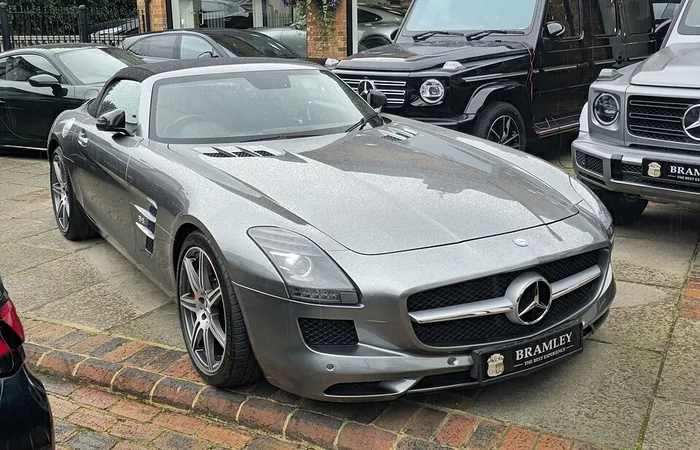
Image source: Wikimedia Commons
Commercially the SLS sits after the Mercedes-Benz SLR McLaren. Spiritually it looks further back to the 1950s 300 SL gullwing. The long bonnet, short deck, and upward-opening doors on the coupé are deliberate historical references, but the chassis, electronics, and dual-clutch architecture are twenty-first-century products. This hub page maps the road family: base coupé and roadster, GT coupé and roadster, and the Black Series coupé. Separate limited programmes such as the Electric Drive and customer GT3 racers exist outside the everyday road-variant map and are only noted where they clarify the petrol range.
Development context after the SLR McLaren
When AMG and Mercedes planned a successor to the SLR McLaren partnership car, the brief was not to recreate a carbon-heavy hyper-GT with a supercharged V8. The brief was an AMG-owned sports car with clearer track manners, lower mass than the SLR, and a pure naturally aspirated character. Tobias Moers and other AMG leadership later framed the SLS as the faster car on circuit relative to the SLR for both professional and ordinary drivers — a claim rooted in weight, balance, and chassis response rather than marketing poetry.
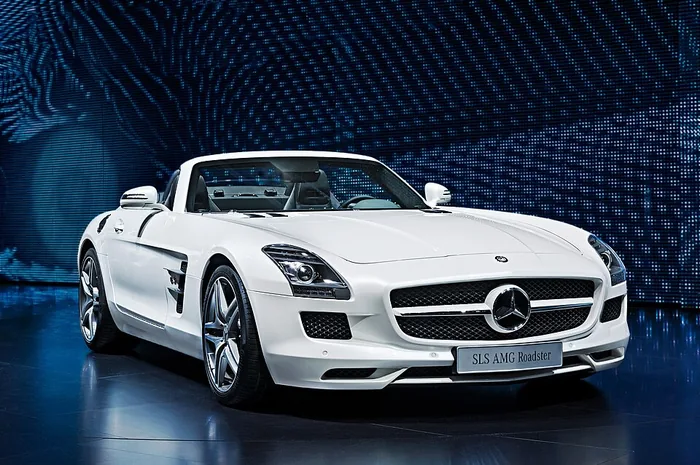
Image source: Wikimedia Commons
Design work under Mark Fetherston produced a car that is instantly readable as a modern gullwing without becoming a pastiche. Production began around January 2010 after the 2009 Frankfurt introduction. European sales started mid-2010; major markets such as the United States followed into 2011. Production of core petrol models wound down through 2014, with Final Edition cars and market-specific leftovers extending recognition into 2015.
1. First AMG clean-sheet vehicle
Earlier AMG road cars began as Mercedes models with Affalterbach engines and hardware. The SLS inverted that relationship: the platform and body programme were conceived as AMG sports cars from the start, even while using Mercedes brand distribution and manufacturing partners for structure and final assembly.
2. Super Leicht Sport as engineering language
Aluminium spaceframe construction, dry-sump lubrication, and the carbon propshaft are not ornamental. They support high lateral loads, a low centre of gravity for a long-bonnet layout, and packaging that places mass usefully between the axles.
3. Partner manufacturing without diluting identity
Body structures associated with Magna Steyr and final build at Sindelfingen do not change the fact that the M159 is an Affalterbach hand-built engine and that the car’s development centre of gravity sat with AMG. The split of labour is a production fact, not a brand dilution story.
Body variant map
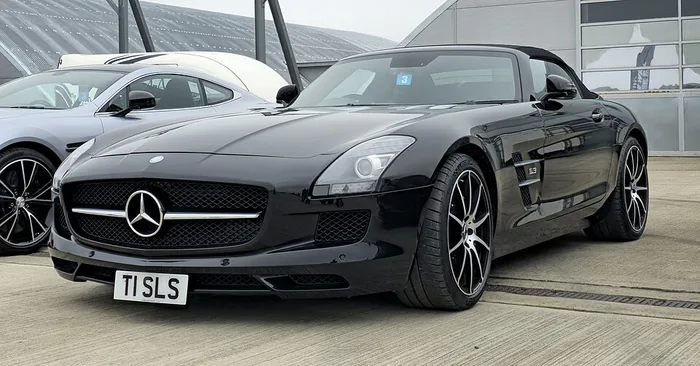
The road range is best understood as five core entries plus this hub. The 2010 SLS AMG Coupé is the launch gullwing with 571 PS. The 2011 SLS AMG Roadster opens the cabin with a fabric roof and conventional doors at a roughly 40 kg mass penalty and with structural reinforcements. From about 2012 the SLS AMG GT Coupé and SLS AMG GT Roadster raise output to 591 PS and sharpen transmission and suspension calibration. The 2013 SLS AMG Black Series is a limited, track-leaning coupé only — no roadster Black Series was offered.
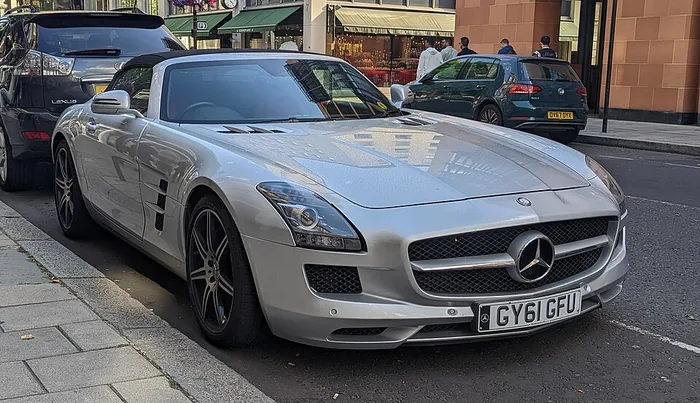
Image source: Wikimedia Commons
1. Coupé versus roadster hard points
Gullwing doors define the closed car’s public image and impose packaging and safety solutions (including emergency door separation concepts in rollover scenarios). Roadsters trade that silhouette for usability: easier parking-lot entry, a three-layer soft top that cycles in about eleven seconds, and a different noise and rigidity profile.
2. Base versus GT
GT cars keep the same 650 Nm peak torque as base models but add peak power and a more aggressive dual-clutch and chassis character. They are not a different engine family; they are a higher calibration of the same M159 architecture with corresponding chassis software and hardware themes.
3. Black Series as the extreme closed car
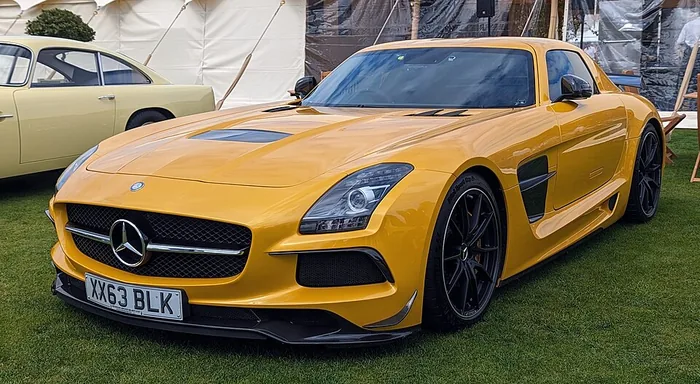
The Black Series removes mass (order of 70 kg versus a standard coupé in factory language), raises peak power to 631 PS, trims peak torque slightly, and widens the car’s track and aero vocabulary. Production was deliberately limited; published totals vary by source, so this encyclopedia treats it as a low-volume special measured in the low hundreds rather than mass series volume.
Powertrain architecture across the family
Every petrol road SLS described here uses the M159 6.2-litre naturally aspirated V8 with dry-sump lubrication. The engine is related to the M156 family in heritage but received extensive SLS-specific development, enough for AMG to assign a distinct code. Peak outputs climb from 571 PS on base cars to 591 PS on GT cars and 631 PS on the Black Series. Torque stays at 650 Nm for base and GT, with the Black Series quoted around 635 Nm at a higher engine speed.
The Getrag dual-clutch unit sits at the rear. That layout shortens the propeller path and helps polar moment behaviour. Mode selection changes shift aggression and throttle mapping. Early dual-clutch behaviour in the base car drew mixed commentary; later GT calibration and software work addressed response sharpness in manual and Sport Plus use. Owners evaluating used cars should still prioritise service history for dual-clutch fluid and software campaigns, because the transmission is central to how the car feels.
1. Dry sump and cornering
Dry-sump oiling supports sustained high lateral acceleration without oil starvation that a conventional wet sump would risk in a low-slung sports car.
2. Torque tube packaging
The carbon shaft inside the torque tube is a structural and dynamic element: it ties power unit and transaxle into a coherent assembly while keeping rotating mass low.
3. Exhaust and sound character
Base and GT cars already produce a strong naturally aspirated V8 voice. The Black Series titanium system and freer breathing package raise both mass reduction and acoustic intensity. Exhaust legality and heat shielding remain ownership concerns on modified or high-mileage examples.
Chassis character and driving envelope
Double-wishbone aluminium suspension and a rigid aluminium spaceframe give the SLS a clear sports-car message rather than a soft grand-tourer message, even though cabin materials and options can be luxurious. Compared with contemporary SL roadsters, the SLS is the more track-oriented Mercedes two-seater of its era. Compared with the earlier SLR, it is lighter and more communicative for circuit work when tyres and brakes are fresh.
Standard iron brakes are large; carbon-ceramics reduce unsprung mass and fade risk for hard use. The retractable rear wing on many cars adds high-speed stability and can act as an airbrake. Stability control is multi-stage, allowing progressive reduction of electronic intervention. None of that converts the SLS into a narrow formula car: it remains a wide, long-bonnet two-seater that needs space in urban parking and careful tyre pressure management.
How to read the family for research and ownership
Researchers should separate body code (C197/R197), output tier (base/GT/Black Series), and model year when comparing examples. Marketing labels and Final Edition packages can confuse casual listings. Mechanical identity rests on powertrain calibration, chassis equipment, and documentation rather than paint alone.
Ownership costs track any limited-production aluminium sports car: tyres in staggered 19/20-inch sizes, dual-clutch service, gullwing strut and seal care on coupés, soft-top mechanisms on roadsters, and carbon-ceramic pad/rotor economics if fitted. The M159 rewards correct oil specification and cooling system health. Parts supply remains better than for many older exotics because Mercedes-AMG dealer networks still recognise the car, but some body and aero pieces are expensive.
- Hub purpose — family map and shared architecture.
- Base coupé — original 571 PS gullwing reference.
- Base roadster — open 571 PS with conventional doors.
- GT coupé / GT roadster — 591 PS sharper calibration from about 2012.
- Black Series — limited 631 PS coupé extreme.
Legacy
The SLS AMG closed the SLR McLaren chapter and opened AMG’s era of self-authored sports cars. It reintroduced gullwing doors to series Mercedes production with modern safety engineering, and it preserved a large naturally aspirated V8 character at the moment the wider industry was accelerating toward forced induction. Later AMG GT models continue Affalterbach’s two-seater story with different architecture and engines; they do not erase the SLS as the clean-sheet statement of its decade.
Historically the car matters for three durable reasons. First, organisationally, it proved AMG could lead a full vehicle programme. Second, technically, the aluminium spaceframe, dry-sump M159, and rear dual-clutch layout formed a coherent sports-car system rather than a collection of aftermarket upgrades. Third, culturally, the modern gullwing gave Mercedes a silhouette that non-specialists still recognise a decade after production ended. Variant pages in this cluster document how that silhouette and system were adapted for open air, higher output, and track-leaning limited production without inventing a different car each time.
Leave a Reply
You must be logged in to post a comment.