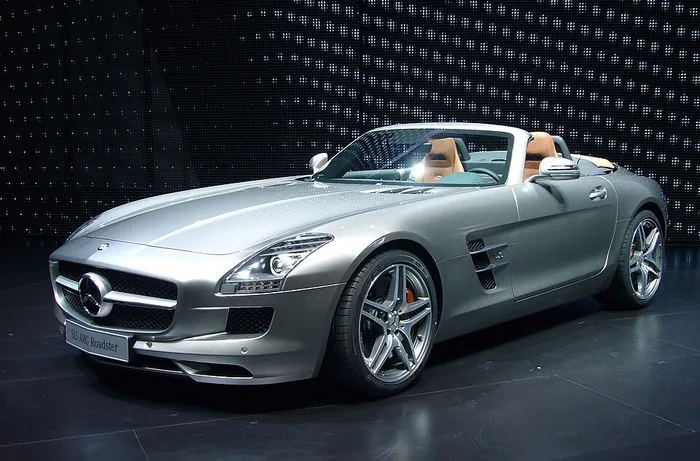
General information & model overview
| Category | Specification Details |
|---|---|
| Model name | 2011 Mercedes-Benz SLS AMG Roadster |
| Internal code | R197 |
| Manufacturer | Mercedes-AMG / Mercedes-Benz |
| Introduction | Unveiled 2011 Frankfurt cycle; market launch from autumn 2011 after mid-year order opening in key markets |
| Body style | Two-door, two-seat soft-top roadster with conventional hinged doors |
| Layout | Front mid-engine, rear-wheel drive, rear dual-clutch transaxle — shared architecture with the coupé family |
| Power class | Same M159 base tune as launch coupé: 420 kW / 571 PS and 650 Nm |
| Family position | Open counterpart to the 2010 SLS AMG Coupé; later superseded in spirit by the GT Roadster for higher-output buyers |
| Hub | Mercedes-Benz SLS AMG family overview |
Body & dimensions
| Specification | Details |
|---|---|
| Wheelbase | 2,680 mm (105.5 in) — shared with coupé |
| Overall length | 4,638 mm (182.6 in) |
| Overall width | 1,939 mm (76.3 in) excluding mirrors |
| Overall height | Approximately 1,262 mm (49.7 in) — slightly taller than the coupé |
| Roof | Three-layer fabric soft top; magnesium, steel, and aluminium framework elements; open/close cycle about 11 seconds; operable on the move up to about 50 km/h |
| Doors | Conventional side-hinged doors (not gullwing) |
| Curb weight (approximate) | About 1,659 kg DIN — roughly 40 kg more than the base coupé |
| Boot capacity theme | Approximately 175 litres class with top mechanisms packaged behind the cabin |
| Structural reinforcements | Thicker multi-chamber side sills; additional bracing of dashboard cross-member to windscreen frame and tunnel; curved rear strut near soft-top and tank area; cross-member behind seats supporting fixed roll-over protection |
Engine specifications
| Theme | Details |
|---|---|
| Engine | M159 6,208 cc naturally aspirated V8, dry-sump |
| Peak power | 420 kW / 571 PS at approximately 6,800 rpm |
| Peak torque | 650 Nm at approximately 4,750 rpm |
| Relation to coupé | Same base output class as the 2010–era SLS AMG Coupé; not the later 591 PS GT tune |
| Exhaust / acoustics | Open-top operation changes perceived sound level and cabin resonance versus the closed gullwing |
Drivetrain & transmission
| Category | Details |
|---|---|
| Transmission | AMG SPEEDSHIFT DCT 7-speed dual-clutch rear transaxle |
| Shaft architecture | Carbon-fibre driveshaft in torque tube — shared family solution |
| Drive | Rear-wheel drive |
| Modes | Efficiency through Sport Plus and full manual paddle control |
Chassis, suspension & brakes
| Component | Specification |
|---|---|
| Base suspension | Aluminium double wishbones front and rear with coilovers — family architecture retained |
| Optional suspension | AMG RIDE CONTROL sports suspension available on roadster order paths |
| Brakes | Large iron discs standard; optional AMG ceramic composite package |
| Wheels / tyres | Typical staggered 19/20-inch fitment; 265/35 front and 295/30 rear class sizes |
| Roll protection | Fixed roll-over protection system integrated with rear structural cross-member |
| Comfort options | AIRSCARF neck heating available; draught-stop glass insert; heated sports seats |
Performance (approximate)
| Metric | Approximate data |
|---|---|
| 0–100 km/h | Essentially the same 3.8-second class as the base coupé in manufacturer language despite the mass increase |
| Top speed | Mid-310 km/h electronically limited class, aligned with base family figures |
| Mass effect | +~40 kg versus coupé; real-world agility slightly tempered, still within the same performance band |
| Open-air character | Higher wind and exhaust presence; slightly different torsional feel despite reinforcements |
Opening the SLS: why the Roadster exists
The 2011 Mercedes-Benz SLS AMG Roadster (R197) translates the aluminium spaceframe sports car into an open two-seater without attempting to keep gullwing doors. Conventional hinged doors and a three-layer fabric roof make the car more usable in everyday garages and at valet stands, while structural additions recover stiffness lost when the fixed roof is removed. Power stays at the base M159 level: 571 PS and 650 Nm. Buyers who want the open cabin with the later higher output should look to the GT Roadster rather than assuming every open SLS is identical.
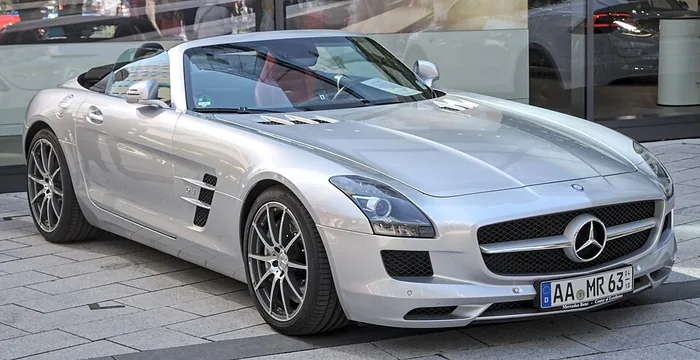
Image source: Wikimedia Commons
Within the family hub, the Roadster is the first major body expansion after the launch coupé. It is not a Black Series derivative, and no open Black Series was built. It is the base-output open car of the programme.
Soft top and structural engineering
The fabric roof uses a multi-material frame and a three-layer stack for insulation and shape. A full open or close cycle takes about eleven seconds and can run while rolling at modest speeds up to roughly 50 km/h. That operability matters more in real ownership than static brochure drama: short urban hops and sudden weather changes are part of open-car life.
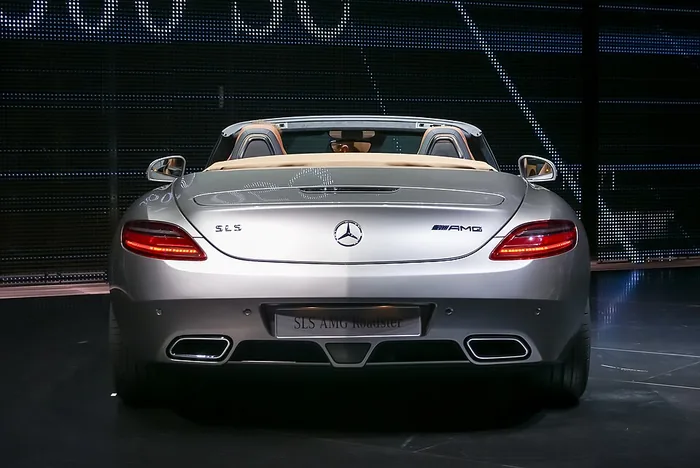
Image source: Wikimedia Commons
Removing the coupé’s roof shell costs stiffness. AMG answered with thicker, multi-chamber side sills; extra struts tying the dashboard cross-member to the windscreen frame and centre tunnel; a curved reinforcing strut in the rear between soft-top region and fuel tank area; and a cross-member behind the seats that supports fixed roll-over protection. The result is a roadster that still feels like an SLS rather than a floppy convertible, at a published DIN mass penalty of about forty kilograms versus the coupé.
1. Doors and access
Conventional doors eliminate the garage-height problem of gullwings. Entry and exit in tight parking structures become ordinary sports-car problems instead of special-case problems. The visual trade-off is clear: the Roadster does not reproduce the 300 SL silhouette cue that defines the closed car.
2. Draught management
A slot-in glass draught-stop and optional AIRSCARF systems address open-cabin comfort at speed. These are equipment themes, not structural substitutes for the reinforcements listed above.
3. Luggage and packaging
Boot volume sits near the mid-170-litre class. Soft-top mechanisms occupy space the coupé can simplify. Long-distance touring is possible but remains a two-soft-bag proposition, not a family GT brief.
Shared powertrain, open-air experience
Mechanically the base Roadster is intentionally close to the base Coupé. The same dry-sump M159 feeds the same dual-clutch rear transaxle through the same carbon shaft architecture. Acceleration claims stay in the 3.8-second band to 100 km/h. The difference is sensory: roof-down driving raises exhaust and intake presence, changes wind noise, and makes the dual-clutch’s behaviour more audible. Roof-up, the three-layer top reduces but does not erase the open-car acoustic signature.
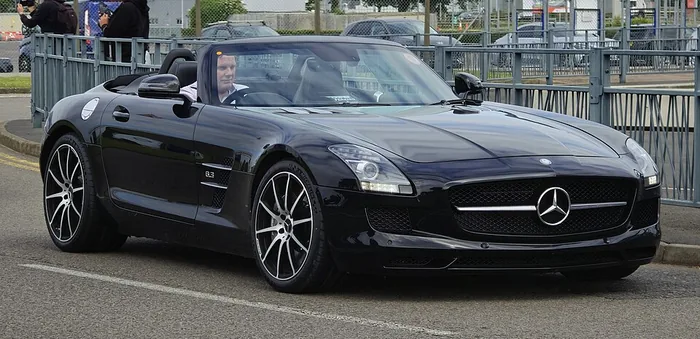
Image source: Wikimedia Commons
Optional RIDE CONTROL suspension and ceramic brakes allow a Roadster to be specified closer to a track-leaning coupé, yet the default character of the 2011 base open car is grand-touring sports rather than Black Series aggression. Compare carefully with the later GT open car if advertisements blur model years and badges.
1. Why output did not rise at launch
AMG kept 571 PS for the first Roadster year so the open car launched as a body variant, not a simultaneous power escalation. The GT step arrived later as a range-wide calibration move.
2. Dual-clutch in open cars
Heat management and fluid service remain critical. Open-car use that includes traffic crawls with the roof up still stresses cooling systems; roof-down high-load runs stress them differently. Service history matters either way.
3. Tyres and mass
The extra roughly forty kilograms sit on the same staggered tyre sizes as the coupé family. Fresh, correct-speed-rated rubber is as important here as on the closed car, especially when carrying two adults and weekend luggage.
Driving the R197 base Roadster
On a smooth motorway the Roadster is an authoritative, loud-when-asked two-seater with a long bonnet reference line and strong mid-range thrust. On a back road the width and steering mass require planning; the car rewards committed, clean lines more than constant direction changes. Compared with contemporary SL soft-top or retractable-hardtop grand tourers, the SLS Roadster is firmer, wider in stance, and more explicitly sports-car in damping and seat geometry.
Roll-over protection is fixed rather than pop-up theatre. That suits the structural story: the rear cross-member is part of the stiffness strategy, not only a safety add-on. Stability control stages remain available for wet roads and imperfect surfaces. The Roadster does not need to be driven as a drift toy to be understood; its point is open-air access to the same aluminium sports-car system as the gullwing, with practical doors.
Position against siblings
Choose the 2011 base Roadster when documentation and output match the 571 PS class and the buyer wants open air without GT calibration. Choose the Coupé for gullwing identity and lower mass. Choose the GT Roadster for 591 PS and the sharper dual-clutch and suspension themes. Choose the Black Series only as a closed limited extreme — it is not an open-car alternative.
- R197 base open car — 2011 introduction focus.
- ~11 s soft top — practical open/close cycle.
- +~40 kg — published mass delta to coupé.
- 571 PS / 650 Nm — shared with base coupé.
- Conventional doors — defining usability difference.
Inspection themes for open cars
Soft-top fabric condition, frame alignment, drain paths, and pump/hydraulic or electric actuation health (as equipped) dominate open-car surveys. Water ingress into rear bulkhead areas and electrical modules is a classic convertible risk if drains clog. Check roll-bar trim, seat bolsters for sun ageing, and whether optional draught equipment is complete. On the structure, look for accident repairs to sills and rear cross-member regions where reinforcements concentrate loads.
Matching numbers for a Roadster means confirming R197 identity and base versus GT output. Cosmetic carbon packages and special colours do not convert a base car into a GT. Build sheets and data cards remain the reliable tools.
Legacy
The 2011 SLS AMG Roadster proved that AMG’s clean-sheet sports car could be more than a single gullwing silhouette. By solving stiffness with targeted reinforcements rather than abandoning the aluminium spaceframe concept, the Roadster kept mechanical kinship with the coupé while changing daily usability. It also fixed the open-air sound of the M159 in public consciousness: many enthusiasts first heard the engine properly with the roof down.
In the broader Mercedes timeline the Roadster sits between the SLR McLaren era’s limited open interpretations and the later AMG GT Roadster generation. It is not a volume SL substitute; it is a low-volume sports roadster with supercar-class power and dual-clutch architecture. Production of base and later GT open cars shared the short SLS window of the early 2010s, so surviving examples are finite even if not as rare as Black Series coupés.
Encyclopedia value rests on clear separation: R197 body, conventional doors, ~11-second fabric roof, roughly 40 kg extra mass, and 571 PS base output until the GT programme raised power across the sharper open and closed variants. That separation keeps used-market and historical claims honest.
Leave a Reply
You must be logged in to post a comment.