General information & model overview
| Category | Specification Details |
|---|---|
| Model name | Mercedes-Benz X-Class |
| Internal code | W470 |
| Production years | November 2017 – May 2020 |
| Body style | Mid-size double-cab pickup truck (ute / bakkie) |
| Designer | Wini Camacho (exterior styling leadership) |
| Assembly | Barcelona, Spain (Nissan Motor Ibérica plant) |
| Platform | Nissan F-Alpha architecture, shared with the D23 Nissan Navara and Renault Alaskan |
| Layout | Front-engine, rear-wheel drive or selectable / permanent four-wheel drive (4MATIC depending on version) |
| Key characteristics | Mercedes-Benz’s first modern premium mid-size pickup; lifestyle-oriented double cab; three main trims (Pure, Progressive, Power); diesel-only powertrains including a late-arriving V6 |
| Primary markets | Europe, Australia, New Zealand, South Africa, selected Latin American markets (not sold in the United States or Canada) |
Body & dimensions
| Specification | Details |
|---|---|
| Wheelbase | 3,150 mm (124.0 in) |
| Overall length | Approximately 5,340 mm (210.2 in) |
| Overall width | Approximately 1,920 mm (75.6 in), excluding mirrors |
| Overall height | Approximately 1,819 mm (71.6 in) depending on suspension and tyre package |
| Load bed | Double-cab load bay sized for European / international mid-size ute standards; under-rail and over-rail load width suitable for pallet-style cargo with careful packing |
| Payload | Typically around 1,000–1,100 kg depending on market specification, engine, and equipment |
| Braked towing capacity | Up to about 3,500 kg on suitably equipped versions (market-dependent; always confirm the specific vehicle’s plate and handbook) |
| Fuel tank capacity | Approximately 73–80 litres depending on market and configuration |
| Ground clearance | Roughly 200–220+ mm depending on wheels, tyres, and suspension specification |
| Curb weight | Typically in the low-to-mid 2,000 kg range for four-cylinder models; higher for the V6 X350d and heavily optioned trucks |
Engine specifications (common variants)
| Model | Engine | Displacement | Power | Torque | Notes |
|---|---|---|---|---|---|
| X220d | OM699 inline-4 turbo diesel (single turbo) | 2,298 cc | 120 kW / 163 PS / 161 hp at approx. 3,750 rpm | 403 Nm (297 lb-ft) at approx. 1,500–2,500 rpm | Entry diesel; closely related to the Renault-Nissan 2.3 dCi family; 6-speed manual |
| X250d | OM699 inline-4 twin-turbo diesel | 2,298 cc | 140 kW / 190 PS / 188 hp at approx. 3,750 rpm | 450 Nm (332 lb-ft) at approx. 1,500–2,500 rpm | Volume mid-range engine; 6-speed manual or 7-speed automatic |
| X350d | OM642 V6 turbo diesel | 2,998 cc | 190 kW / 258 PS / 255 hp at approx. 3,600 rpm | 550 Nm (406 lb-ft) at approx. 1,600 rpm | Mercedes-sourced V6 diesel; 7-speed automatic; introduced later (from 2018); flagship performance and refinement |
Drivetrain & transmission
| Category | Details |
|---|---|
| Manual gearbox | 6-speed manual available on X220d and X250d in relevant markets |
| Automatic gearbox | 7-speed automatic available on X250d; standard on X350d |
| Drive systems | Rear-wheel drive on some base specifications; part-time or permanent four-wheel-drive systems marketed under Mercedes 4MATIC branding depending on configuration |
| Off-road modes | Selectable drive programs and low-range gearing on 4×4 versions for unsealed roads, light trails, and loaded work use |
| Differentials | Rear limited-slip or locking strategies vary by trim and market; higher specifications improve traction when towing or climbing with a load |
Chassis, suspension & brakes
| Component | Specification |
|---|---|
| Front suspension | Independent suspension with coil springs (body-on-frame mid-size pickup architecture shared with the Navara family) |
| Rear suspension | Multi-link / coil-spring rear layout derived from the partner platform — a comfort-focused choice compared with traditional leaf-spring work utes |
| Steering | Power-assisted rack-and-pinion; calibration aimed more at lifestyle driving than pure commercial harshness |
| Brakes | Four-wheel disc brakes with ABS, electronic brake-force distribution, and stability control; trailer stability assists available depending on equipment |
| Wheels & tyres | Steel wheels on work-oriented Pure; larger alloys on Progressive and Power (commonly 17–19 inch packages depending on market and options) |
Performance (approximate figures)
| Metric | Approximate data |
|---|---|
| 0–100 km/h (X250d) | Typically around 11–12 seconds depending on gearbox, drive layout, and load |
| 0–100 km/h (X350d) | Typically around 7.5–8.5 seconds unladen — clearly the quickest factory X-Class |
| Top speed | Generally electronically limited in the region of 170–205 km/h depending on model and market |
| Fuel economy | Four-cylinder models more efficient in mixed use; V6 stronger for high-speed towing and overtaking but thirstier when driven hard |
| Driving character | Quieter cabin and softer primary ride than many hard-core work pickups; still a ladder-frame truck when empty or heavily loaded |
Key timeline & model changes
| Year | Changes |
|---|---|
| 2015–2016 | Mercedes-Benz publicly confirms premium pickup plans with the Renault–Nissan alliance; X-Class Concept shown |
| July 2017 | World premiere events (notably Cape Town); production model detailed for global markets outside North America |
| Late 2017 | Customer deliveries begin; initial range focused on 2.3-litre four-cylinder diesels and Pure / Progressive / Power trims |
| 2018 | X350d V6 diesel arrives as the range flagship; first full sales year globally |
| 2019 | Sales remain modest versus volume Japanese and American rivals; perception of platform sharing continues to dominate public debate |
| January–May 2020 | Mercedes-Benz confirms production will end; final vehicles leave the Barcelona line in May 2020 |
Trim levels explained
| Trim | Description |
|---|---|
| Pure | Most work-oriented specification: simpler cabin materials, smaller wheels, practical equipment emphasis. Aimed at buyers who wanted the three-pointed star on a dual-cab without full luxury pricing. |
| Progressive | Mid-range balance of utility and comfort: upgraded interior trim, more convenience equipment, better audio/infotainment presentation, and more lifestyle styling cues. |
| Power | Flagship lifestyle trim: larger alloys, richer cabin finishes, more driver-assistance and comfort options, and the strongest visual connection to Mercedes passenger-car design language. |
Safety highlights
| Category | Details |
|---|---|
| Euro NCAP (2017) | 5-star overall result (adult occupant approx. 90%, child occupant approx. 87%, pedestrian approx. 80%, safety assist approx. 77%) |
| ANCAP | Aligned 5-star rating for markets using the same test programme period |
| Assistance systems | Depending on trim and options: autonomous emergency braking strategies, lane-keeping aids, blind-spot monitoring, multi-camera parking support, adaptive cruise on higher packages |
| Structure | Modern mid-size pickup structure with dual-cab crash protection priorities; still a body-on-frame truck, so empty-bed ride and load management matter in real use |
The Mercedes-Benz X-Class (W470): development, design, and short production life
The Mercedes-Benz X-Class is a mid-size double-cab pickup sold from late 2017 until production ended in May 2020. Internally coded W470, it was Mercedes-Benz’s first modern attempt at a premium one-tonne / mid-size lifestyle ute for markets outside North America. The model combined Mercedes exterior and interior design with a ladder-frame architecture shared with the D23 Nissan Navara and the related Renault Alaskan, and it was assembled at Nissan’s plant in Barcelona, Spain.
Commercially, the X-Class never reached the volume Mercedes needed to justify a multi-generation programme. For owners who used one carefully, it offered a quieter cabin, stronger equipment packages, and — on the later X350d — a Mercedes V6 diesel that clearly separated it from the four-cylinder partner engines. This entry summarises engineering, trims, engines, driving character, market role, and ownership considerations for a short-lived but historically clear product chapter.
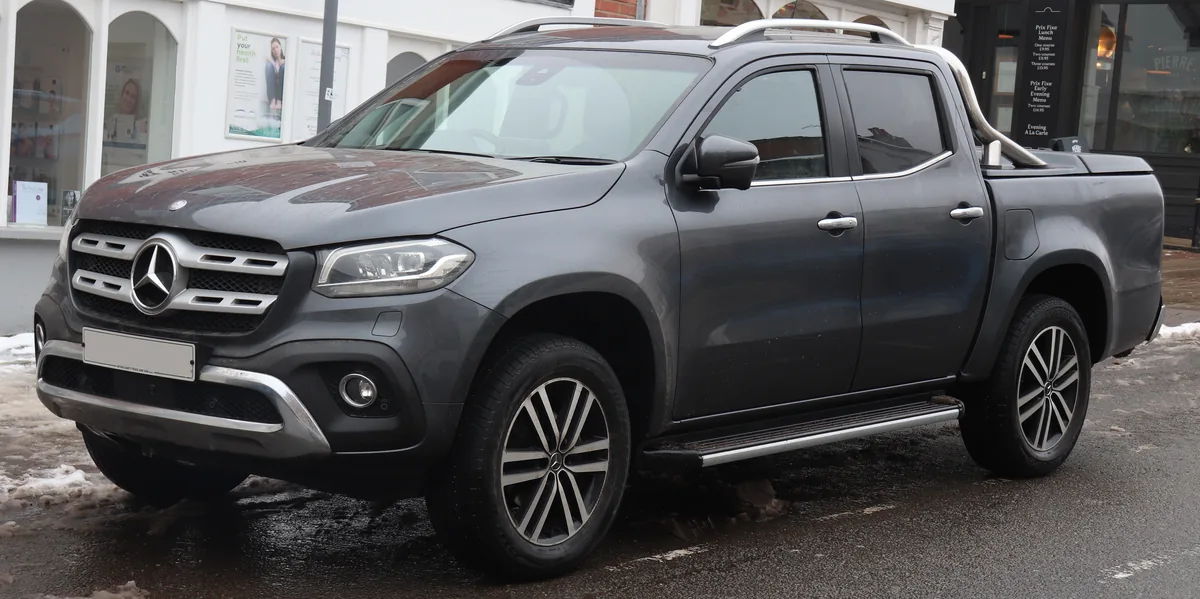
Image source: Wikimedia Commons (Vauxford)
Why Mercedes entered the mid-size pickup segment
By the mid-2010s, dual-cab pickups had moved well beyond pure trades use in several important markets. In Australia and South Africa they were already everyday family and rural transport. In Europe volumes were smaller than for SUVs, but lifestyle and mixed-use dual-cabs were growing: buyers wanted a vehicle that could carry pallet-style cargo and still present acceptably for client meetings or weekend travel. Mercedes-Benz identified room above the volume Japanese and American offerings for a more carefully finished cabin and a stronger brand presentation.
Rather than develop a complete new ladder-frame architecture for comparatively modest European and export volumes, Mercedes worked with the Renault–Nissan alliance. The industrial logic was sound: shared F-Alpha mid-size pickup underpinnings reduced investment and time to market. The brand risk was equally clear: once buyers and commentators framed the truck as an expensive Navara, every price comparison reinforced that framing. Mercedes argued that design, chassis calibration, equipment packaging, and later the OM642 V6 made the product more than a rebadge. Public debate often compressed those distinctions into a single slogan.
Strictly speaking, North America had already seen luxury-branded pickups such as the Lincoln Mark LT and Cadillac Escalade EXT. Those vehicles lived in a different size class and market structure. The X-Class targeted the global mid-size dual-cab world — Europe’s mixed motorways and farms, Australia’s ute culture, New Zealand’s rural routes, South African bakkie roads, and selected Latin American customers prepared to pay for a three-pointed star on a load bay. It was not sold in the United States or Canada.
Assembly and sales geography
Series production at Barcelona suited European distribution and export to both left- and right-hand-drive markets. Plans discussed for additional South American production did not fully reshape the model’s commercial life. The truck’s sales footprint therefore remained relatively compact, which later affected residual volumes, specialist familiarity, and the density of body parts in breakers yards compared with high-volume rivals such as the Toyota Hilux or Ford Ranger.
Design and packaging
Exterior design leadership for the production truck is associated with Wini Camacho. The brief was to make the vehicle read as Mercedes-Benz at a distance: a broad upright grille, structured headlamp graphics, and a bonnet line more passenger-car than pure work-ute. The double-cab greenhouse is tall, with a strong shoulder running into the rear quarters. The load bay follows classic dual-cab proportion — five-seat cabin, open bed behind — rather than the covered boot of an SUV.
Trim level changes the visual and tactile message. Pure keeps simpler materials, smaller wheels or steels, and a more work-oriented presentation. Progressive adds convenience equipment and lifestyle detailing. Power pushes larger alloys, richer cabin finishes, and more driver-assistance options, aligning the truck more closely with Mercedes SUV design language of the period. None of the trims turns a ladder-frame pickup into a saloon; they change how much of the cabin and exterior presentation is devoted to comfort and image versus basic utility.
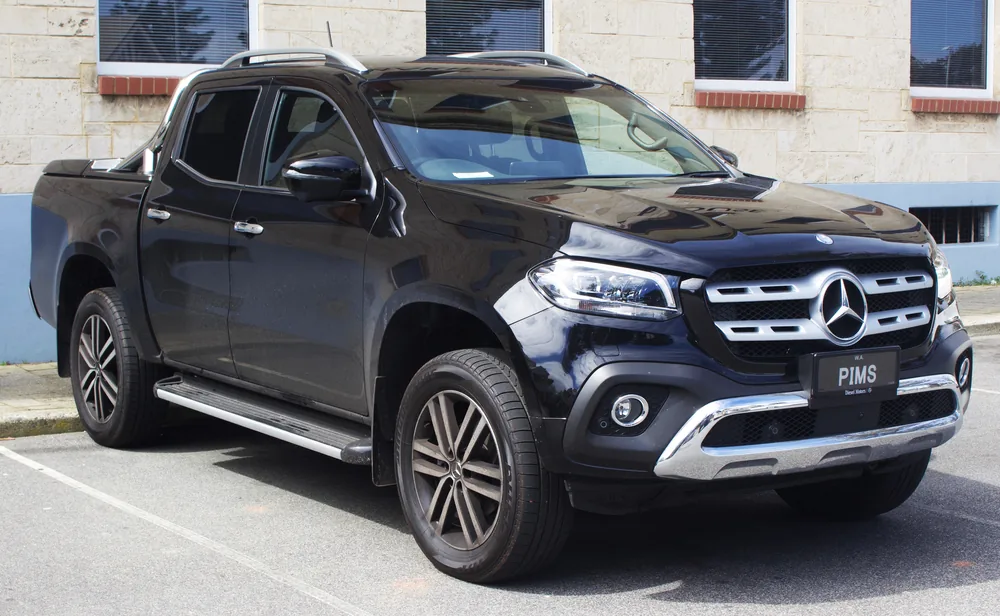
Image source: Wikimedia Commons
Cabin and daily use
Inside, the X-Class is where the premium intent is most obvious. Steering wheel design, switchgear quality, seat construction, and infotainment presentation sit closer to Mercedes passenger cars than to fleet commercial pickups of the same years, especially in Progressive and Power form. Surfaces do not always equal a contemporary E-Class, but first-time sitters usually notice a clear step up from volume dual-cabs.
Practical dual-cab constraints still apply. Rear legroom is usable for adults on medium journeys. The bed remains a true open load bay, so weather protection depends on a tonneau, canopy, or roller cover. Step-in height is higher than a saloon and lower than many heavily lifted off-road specials. Noise isolation is generally better than older leaf-sprung work trucks, yet tyre roar and body-on-frame movement remain part of the experience when the bed is empty. Payload is typically around 1,000–1,100 kg depending on specification; braked towing can reach about 3,500 kg on suitably equipped versions. Both figures must be confirmed against the individual vehicle’s plate and handbook.
Platform partnership: shared hardware and Mercedes contributions
It is accurate to describe the X-Class as related to the Nissan Navara. It is incomplete to describe it only as a Navara with a badge. Shared elements include the broad F-Alpha architecture, the double-cab layout, the comfort-oriented multi-link coil-spring rear arrangement on the partner platform, and — on four-cylinder models — diesel engines from the Renault–Nissan industrial family marketed by Mercedes under OM699 designations.
Mercedes contributions were strongest in exterior and interior design, chassis tuning targets, branding of drive systems, equipment packages, and the later X350d’s OM642 V6 diesel. That V6 was both a mechanical and a brand statement: a familiar Mercedes commercial and passenger diesel architecture that no careful observer could dismiss as a simple four-cylinder rebadge. Chassis and steering calibration aimed more at lifestyle road use than at the harshest fleet work-ute feel, while low-range and selectable programmes on four-wheel-drive versions retained light trail and unsealed-road capability.
Engines and transmissions
The production range covered here was diesel-only, matching the work and long-distance use cases Mercedes expected in its target markets.
X220d
The X220d used a 2.3-litre four-cylinder turbo diesel with about 120 kW and 403 Nm, paired with a six-speed manual. Output sits in the traditional mid-size work-ute band: enough torque for daily loads, lighter trailers, and motorway cruising if overtakes are planned. Buyers usually chose it for purchase price and running costs rather than prestige performance. Clean service history and a body free of heavy commercial abuse matter more than badge appeal when assessing residual value on these trucks.
X250d
The X250d raised output to about 140 kW and 450 Nm with a twin-turbo setup on the same 2.3-litre family. Manual and seven-speed automatic options made it the volume sweet spot for private and business buyers. With four-wheel drive and a sensible tow package, it covers the majority of dual-cab duties: site visits, boats and caravans within rating, and mixed sealed/unsealed commuting. Mid-range pull is the useful quality; absolute sprint times remain secondary to a tall, heavy pickup. The automatic suits urban stop-start and long motorway days; the manual suits operators who prefer direct control and slightly lower complexity.
X350d
From 2018, the X350d brought Mercedes’s 3.0-litre OM642 V6 turbo diesel with approximately 190 kW and 550 Nm, standard with a seven-speed automatic. Unladen acceleration into the roughly 7.5–8.5 second range to 100 km/h makes it the quickest factory X-Class. More importantly for real use, the extra cylinders smooth delivery and supply stronger authority for heavy towing and high-speed overtakes. The trade-offs are mass, fuel use, and the fact that the engine arrived after many buyers had already formed opinions about the model line. For collectors of short-run Mercedes products, the V6 is often the most distinctive factory powertrain story in the range.
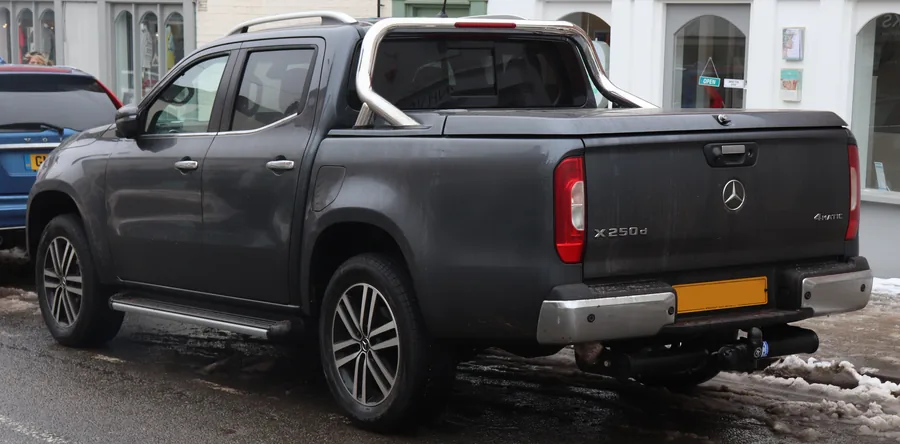
Image source: Wikimedia Commons (Vauxford)
On the road and light off-road use
As a road vehicle, the X-Class aims higher than a pure fleet pickup. Steering is more passenger-car in intent, cabin noise at a steady cruise is lower than many hard work utes of the previous decade, and the multi-link rear helps the unladen truck feel less skittish than older leaf-spring designs. Physics still applies. An empty dual-cab pitches and moves over broken surfaces; a loaded bed improves balance; trailer work changes braking distances and gear selection. Owners who treat it as a practical dual-cab with a refined cabin are usually better served than those who expect G-Class rock-crawling ability or saloon-like body control.
Off-road capability is best described as competent for fire trails, muddy farm tracks, snowed secondary roads, and construction approaches when tyres, ground clearance, and low range (where fitted) are appropriate. Deep ruts, serious articulation trails, and hardcore overlanding modifications are possible only with aftermarket support and realistic limits. Mercedes positioned the truck for lifestyle adventure and professional utility, not for trophy-truck competition.
Safety and equipment
In independent crash testing of the period, the X-Class achieved a five-star Euro NCAP result, with strong adult and child occupant scores and competitive pedestrian and safety-assist numbers for a mid-size pickup. ANCAP ratings for markets using the same programme period were aligned. That matters because dual-cabs are often family vehicles in Australia and elsewhere, not purely commercial tools.
Equipment varies heavily by trim and options. Higher cars can feel almost SUV-like with camera systems, blind-spot monitoring, and adaptive cruise. Lower Pure trucks can feel basic. When buying used, the specification sheet is therefore as important as the model name: two X-Classes from the same year can differ substantially in assistance systems, interior materials, and towing equipment.
Market performance and end of production
Commercially, the X-Class never became a volume success on Mercedes’s global scale. Public reporting around the first full sales year pointed to roughly 16,700 units in 2018 across its regions, with 2019 remaining in a modest band rather than climbing into a self-sustaining growth curve. Australia was an important dual-cab market, yet even there the truck remained a small slice next to Hilux, Ranger, and Navara sales.
In early 2020 Mercedes-Benz confirmed that production would stop, and the Barcelona line wound down by May 2020. The main commercial factors were:
- Price positioning — many customers compared equipment and towing figures with cheaper rivals and struggled to justify the premium.
- Platform perception — shared underpinnings dominated public discussion more than cabin quality did.
- Segment gravity — volume brands already owned dual-cab mindshare; a late premium entrant needed a larger product gap or stronger differentiation.
- Strategic focus — Mercedes continued to prioritise SUVs, electrification, and core passenger lines where brand equity converted more reliably into profit.
None of those points makes every X-Class a poor vehicle. They explain why the production run was short and why the model is a closed chapter rather than a multi-generation family.
Ownership: strengths and inspection points
Strengths
- Cabin quality and presence — especially Progressive and Power; still distinctive in mixed company.
- Ride comfort relative to hard work utes — coil-spring rear and Mercedes calibration help on long sealed roads.
- X350d powertrain — the most distinctive factory engine story in the range.
- Safety credentials — five-star-era structure and optional assistance support family dual-cab use.
- Utility package — genuine load bay, serious towing potential when correctly specified, and usable four-wheel-drive hardware on off-road versions.
Things to watch
- Service costs — Mercedes pricing is higher than mass-market ute networks; budget accordingly or use a specialist familiar with both Mercedes diesels and the partner platform.
- Commercial wear — inspect load bay, tailgate, tow hitch area, suspension bushes, and underbody for work damage.
- Four-cylinder diesel maintenance — modern diesels dislike neglected oil changes, poor filters, or endless short urban trips without occasional longer runs.
- Parts and body supply — a short-run model means less common body panels at breakers than a Hilux or Ranger, though many mechanical parts overlap with the wider industrial family.
- Tyres and geometry — large alloys look correct on Power trucks but are costly; verify alignment after kerb or off-road impacts.
- Electronics and options — confirm cameras, sensors, and assistance systems still function; repairs are not always inexpensive.
Who the X-Class suits as a used buy
As a used vehicle, the X-Class makes most sense for a buyer who wants dual-cab practicality with more cabin polish than a base fleet ute, and who accepts somewhat higher running costs for the Mercedes badge and equipment. It suits tradespeople who meet clients in person, rural owners who tow within ratings, and lifestyle buyers who prefer a pickup silhouette to another SUV.
It is less ideal for pure cost-per-kilometre fleet duty, for buyers who object in principle to platform sharing, or for anyone who needs the deepest aftersales density of the highest-volume Japanese or American dual-cabs. Engine, gearbox, drive system, service history, bed condition, and a price that still makes sense against a well-specified rival should decide the purchase — not slogans about badges alone.
Length of programme and residual perspective
A production window of roughly two and a half years is short by Mercedes passenger-car standards. That brevity has practical consequences. Software and option complexity never had many mid-cycle generations to settle. Dealer sales staff in some markets had limited time to build deep dual-cab expertise. Used values can move with fashion more than with a stable multi-decade residual curve. Against that, limited volume can preserve scarcity interest among enthusiasts of unusual Mercedes products, especially clean X350d Power examples with full history.
Compare the X-Class carefully with period rivals on the points that matter to your use: payload, tow rating, bed accessories, cabin noise at 100–110 km/h, seat comfort on long drives, and the real cost of scheduled maintenance. A well-kept Progressive automatic may serve better than a neglected Power V6 bought only for the badge. Conversely, a low-mileage X350d with documented care can remain a distinctive long-distance tow vehicle for years if the buyer accepts diesel complexity and tyre costs.
Insurance, accessories, and aftermarket support deserve early attention. Dual-cab canopies, liners, and tow electronics are widely available in dual-cab markets, but Mercedes-specific styling parts and some electronic modules may take longer to source than equivalent Navara or Hilux items. Owners who plan accessory fitment before purchase — and who verify that the chassis electrics still support trailer stability and camera systems — avoid expensive surprises later.
Legacy
The X-Class will not be remembered as a sales triumph. It remains a useful case study: a serious production attempt by a German premium brand to enter the global mid-size lifestyle pickup arena with a full product rather than a concept-only gesture. It showed that Mercedes design language can work on a dual-cab body. It also showed that brand premium has limits when customers can see a close industrial partnership underneath and can buy comparable capability for less.
In the wider Mercedes-Benz product story, the X-Class sits with other short experiments that taught the company where its strengths convert cleanly into demand and where they do not. For used buyers and historians, that leaves a small fleet of trucks that look different from the dual-cab majority, combine comfort and utility in a particular way, and carry a three-pointed star into working environments saloons never reach. Judge each example on condition, specification, and total cost of ownership. That is the appropriate measure for a real, short-lived Mercedes pickup with clear strengths and clear limits.
Leave a Reply
You must be logged in to post a comment.