General information & model overview
| Category | Specification Details |
|---|---|
| Model name | Mercedes-Benz Vaneo |
| Internal code | W414 |
| Production years | 2001 – 2005 (sales largely 2002–2005 depending on market) |
| Body style | Five-door compact MPV / mini people-mover; not a panel van |
| Assembly | Ludwigsfelde, Germany (Industriewerke Ludwigsfelde) |
| Platform | Derived from the first-generation Mercedes-Benz A-Class (W168), including sandwich-floor architecture |
| Layout | Front-engine, front-wheel drive only |
| Key characteristics | Tall compact footprint, dual sliding rear side doors, optional seven seats, high seating position, A-Class underpinnings adapted for family and accessibility use |
| Name origin | “Vaneo” draws from “van” language used in German for MPV-style vehicles |
| Successor | Conceptually replaced in the line-up by the first Mercedes-Benz B-Class (W245), launched as Vaneo production ended |
Body & dimensions
| Specification | Details |
|---|---|
| Wheelbase | 2,900 mm (114 in) |
| Overall length | Approx. 4,192 mm (165 in) |
| Overall width | Approx. 1,742 mm (69 in) |
| Overall height | Approx. 1,830 mm (72 in) |
| Doors | Two front hinged doors, two sliding rear side doors, rear tailgate |
| Seating | Five seats standard; optional third-row buckets for up to seven occupants |
| Maximum cargo volume | Up to roughly 3,000 litres with rear seats removed (configuration-dependent) |
| Optional load aid | Slide-out boot floor rated around 120 kg on some option packs |
| Roof rails | Standard on many Trend and Ambiente specifications |
Engine specifications (common variants)
| Model | Engine | Power | Torque | 0–100 km/h (approx.) | Top speed (approx.) |
|---|---|---|---|---|---|
| 1.6 (82) | 1.6 L inline-4 petrol | 82 PS (60 kW / 81 hp) | 140 Nm | ~15.3 s | ~156 km/h |
| 1.6 (102) | 1.6 L inline-4 petrol | 102 PS (75 kW / 101 hp) | 150 Nm | ~13.1 s manual / ~13.8 s auto | ~164–167 km/h |
| 1.9 (125) | 1.9 L inline-4 petrol | 125 PS (92 kW / 123 hp) | 180 Nm | ~10.7 s manual / ~11.5 s auto | ~177–182 km/h |
| 1.7 CDI (91) | 1.7 L inline-4 turbo diesel | 91 PS (67 kW / 90 hp) | 180 Nm | ~13.6 s manual / ~15.5 s auto | ~158–161 km/h |
All engines were four-cylinder units meeting Euro 3 emissions standards of the period. Exact economy and CO2 figures vary by gearbox and market; diesel versions were the thriftier choice for high annual mileage.
Drivetrain & transmission
| Category | Details |
|---|---|
| Drive | Front-wheel drive only — no factory 4MATIC Vaneo |
| Manual | 5-speed manual |
| ACS | 5-speed automated clutch system (semi-automatic character) available on selected engines |
| TouchShift | 5-speed conventional automatic with TouchShift control on selected engines |
| Character | Transmissions prioritise urban ease over sport; ACS can feel unusual to drivers used to modern dual-clutch units |
Chassis, suspension & brakes
| Component | Specification |
|---|---|
| Architecture | A-Class sandwich-floor concept adapted to a taller, longer MPV body |
| Suspension | Comfort-biased setup for family and accessibility use; can feel firm over sharp urban imperfections |
| Steering | Light, city-friendly power assistance; high seating position aids placement |
| Brakes | Disc/drum or disc combinations depending on specification era; ABS as part of the safety package of the period |
| Wheels & tyres | Relatively modest diameters typical of early-2000s compact MPVs; cheap tyres hurt refinement quickly |
Performance (approximate figures)
| Metric | Approximate data |
|---|---|
| Urban character | Excellent visibility and compact width for multi-seat packaging; easy to place in tight streets |
| Motorway character | Adequate with 1.9 petrol or CDI when not overloaded; base 82 PS petrol is best kept to lighter local use |
| Fuel economy (period figures) | Petrol models roughly mid-30s mpg (imperial) class in brochure figures; 1.7 CDI could approach high-40s mpg in careful mixed use |
| CO2 (period brochure band) | Roughly mid-150s to around 200 g/km depending on engine and gearbox |
Key timeline & model changes
| Year | Changes |
|---|---|
| 2001 | Production begins at Ludwigsfelde; model positioned as compact Mercedes MPV for families, taxis, and accessibility users |
| 2002 | Broader European sales push; Euro NCAP test year for many published ratings |
| 2002–2004 | Core sales window across Trend and Ambiente lines with petrol and CDI engines |
| 2005 | Production ends after a short run; B-Class arrives as the brand’s more car-like compact MPV direction |
Trim levels explained
| Trim | Description |
|---|---|
| Trend | More practical equipment emphasis: roof rails commonly included, durable cabin focus, sensible for high-use family or Motability-style duty |
| Ambiente | Higher comfort and presentation: richer interior touches and more lifestyle-oriented optioning for private buyers who wanted the Mercedes badge in MPV form |
Safety highlights
| Category | Details |
|---|---|
| Euro NCAP (2002 programme) | Adult occupant rated 4 stars in the period’s scoring; pedestrian rating 2 stars |
| ISOFIX | Included across the range for child-seat anchoring on appropriate rear positions |
| Sandwich floor | Inherited A-Class structural concept intended to help manage frontal impact energy and package a tall cabin on a short footprint |
| Security (Thatcham NVSR period ratings) | Stronger rating for theft of vehicle than for theft from vehicle in published period summaries |
The Mercedes-Benz Vaneo (W414): compact MPV packaging from the A-Class era
The Mercedes-Benz Vaneo is a short-lived compact multi-purpose vehicle built from 2001 to 2005 and sold mainly in the early 2000s. Internally coded W414, it adapted the sandwich-floor architecture of the first-generation A-Class (W168) into a taller people-mover with dual sliding rear side doors, optional seven-seat layouts, and a high seating position. Assembly took place at Ludwigsfelde, Germany.
In product terms the Vaneo did what it set out to do: deliver more usable cabin volume and easier access than a conventional compact hatch while remaining shorter than a full-size van. Commercially, sales were modest, quality reputation was uneven, and Mercedes soon directed customers toward the first B-Class (W245) as a more car-like compact MPV. The Vaneo remains of interest because it is focused rather than fashionable — not a rebadged panel van, not a soft-roader, but a purpose-built compact MPV with a Mercedes star on a body prioritising access and space.
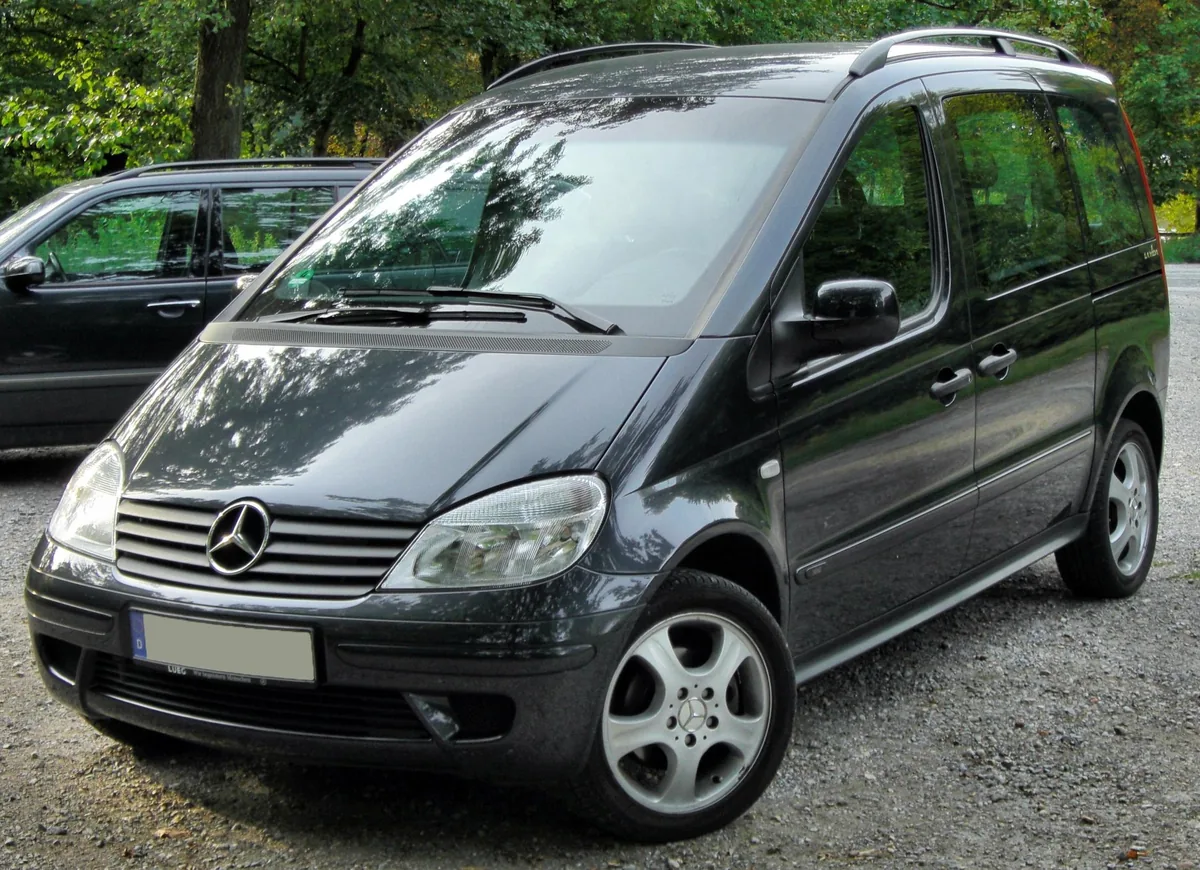
Image source: Wikimedia Commons
From A-Class architecture to mini people-mover
The first-generation A-Class introduced many Mercedes buyers to a sandwich-floor concept: a tall body on a relatively short footprint, with structural packaging that differed from conventional hatchbacks. The Vaneo extends that idea into MPV territory. Wheelbase grows to 2,900 mm, overall length sits a little over 4.19 metres, width is about 1.74 metres, and height rises to roughly 1.83 metres. The result is a van-like seating position without becoming a full commercial vehicle.
That combination was aimed at several audiences at once. Families wanted easy child access. Urban drivers wanted compact external dimensions. Accessibility and Motability-style users valued a high, upright cabin and wide door openings. Taxi and local hire operators in some markets saw a Mercedes badge on a practical five- or seven-seat package. Few cars try to serve all of those groups at once; the Vaneo did, and that breadth of ambition shows in both its strengths and its compromises.
Sliding doors and modular space
Dual sliding rear doors are central to the Vaneo’s usefulness. In narrow parking bays they avoid the door-swing conflicts of conventional MPVs. For child seats and elderly passengers, the wide aperture often matters more than peak power. Five seats were standard; optional third-row buckets raised capacity to seven, with the usual compact-MPV caveat that the rearmost row is best for children or short trips.
With rear seats removed, cargo volume can approach roughly three cubic metres. That is the Vaneo’s main packaging advantage: it can serve as a family runabout during the week and as a flat-pack or sports-kit hauler at the weekend without needing a separate estate. An optional slide-out load floor on some cars, rated around 120 kg, underlines the practical intent, even if few used examples retain every original accessory. Roof rails were common on Trend and Ambiente specifications and remain useful if the rails and bars are sound.
Design: upright proportions, period materials
Exterior design is tall, short-nosed, and unapologetically practical. Contemporary reviews often called it ungainly, which is fair as pure styling criticism and incomplete as product criticism. The shape is a packaging diagram made visible: maximum cabin for minimal length, sliding doors, and a high eye point. Nobody bought a Vaneo for fashion; buyers bought it for access and volume.
Inside, materials quality varied with trim and age. Ambiente cars feel more finished. Hard-used Trend examples can show rattles and worn plastics that amplified the model’s reputation for fragile cabin components. The seating position is command-like for the class, which many owners value in traffic and some dislike because it feels more “van” than “car.” Neither reaction is wrong; both follow from the same geometry.

Image source: Wikimedia Commons
Engines and transmissions
All Vaneos use four-cylinder engines. There is no V6 halo model and no factory four-wheel-drive version. The range is intentionally simple and meets Euro 3 emissions standards of the period.
The 1.6-litre petrol in 82 PS form is the least hurried. It suits light local duty and drivers who prioritise simplicity over overtaking reserve. The 102 PS 1.6 is the more balanced petrol for mixed roads. The 1.9-litre 125 PS petrol is the quickest factory petrol and the version that feels least out of breath on motorways when carrying a full family. Approximate 0–100 km/h times range from about 15.3 seconds for the base 1.6 to around 10.7–11.5 seconds for the 1.9, depending on gearbox.
The 1.7 CDI diesel, with about 91 PS and 180 Nm, was the high-mileage logic choice. It does not feel sporty, but torque arrives earlier than in the smaller petrols, and period economy figures made it attractive for taxi-like annual distances. In modern traffic it remains adequate if maintained; neglected CDIs from this era can become expensive lessons. Brochure-era petrol economy sat roughly in the mid-30s mpg (imperial) class; careful mixed use of the 1.7 CDI could approach the high-40s mpg in period figures. CO2 bands typically ran from the mid-150s to around 200 g/km depending on engine and gearbox.
Gearbox choice shapes personality. The five-speed manual is the most predictable. TouchShift automatic suits urban convenience. The ACS automated-clutch system sits between them and can feel hesitant or abrupt if a driver expects modern dual-clutch behaviour. On a test drive, spend time in the exact transmission you plan to live with — especially ACS — before committing.
On the road
In town the Vaneo is in its element. Compact width, high seating, light steering, and sliding doors make dense streets manageable. Visibility is generally strong, though thick pillars still need shoulder checks. The ride can feel firm over broken urban surfaces; that is a common period observation rather than proof that every example is worn out, though tired dampers certainly make it worse.
On faster roads the taller body notices crosswinds, and the lower-powered engines ask for planning on dual-carriageway merges. Loaded with passengers, the car can feel more settled than when empty, but it never pretends to be a sports tourer. The correct mental model is a compact Mercedes people-mover optimised for access and space efficiency, not for B-road heroics. Base 82 PS petrols are best kept to lighter local use; the 1.9 petrol or CDI suits mixed motorway work when not overloaded.
Safety in period context
Euro NCAP’s 2002-era programme gave the Vaneo four stars for adult occupant protection under that programme’s rules, with a two-star pedestrian rating. Those scores should be read as historical context, not as a claim of modern five-star equivalence. Crash standards and test protocols have moved on. Mercedes fitted ISOFIX across the range and built the car around a sandwich-floor structural concept intended for a tall short vehicle. Period Thatcham NVSR summaries noted a stronger rating for theft of the vehicle than for theft from the vehicle.
For families shopping used examples today, the practical checklist matters as much as stars: working seatbelts and pretensioners, healthy tyres, effective brakes, and airbags that have not been compromised by unreported damage. Sandwich-floor repairs after accidents must be done properly; unclear structural histories are a reason to walk away.
Why production ended after a few years
Mercedes discontinued the Vaneo after only a short run. Public commentary at the time pointed to weaker-than-hoped sales and quality concerns. Buyers who wanted a Mercedes compact MPV increasingly found the B-Class more car-like and easier to accept emotionally. Buyers who wanted maximum space often stepped up to larger vans with windows. The Vaneo sat between those instincts and never fully owned either audience.
That short life is now part of its identity. It is not a multi-generation icon. It is a focused experiment: A-Class engineering stretched into sliding-door MPV form, sold briefly, then replaced by a different product philosophy centred on the B-Class.
Ownership: strengths and things to watch
Strengths
- Space on a short footprint — genuine MPV usefulness without a five-metre body.
- Sliding rear doors — excellent for families and tight parking.
- High seating position — confidence in traffic and easier entry and exit for many passengers.
- Flexible cargo mode — strong load volume with seats out.
- Simple range logic — four-cylinder engines only; easier to understand than a sprawling powertrain maze.
Things to watch
- Service history — especially for CDI diesels and automatics or ACS units.
- Interior wear and rattles — inspect seat bases, door cards, and dashboard trims carefully.
- Sliding door tracks and rollers — grit and wear produce expensive annoyances.
- Rust and underside condition — check sills, jacking points, and rear structure.
- Early-2000s electronics — test windows, central locking, heater controls, and instruments thoroughly.
- Parts and specialist familiarity — less common than A-Class or B-Class; confirm local support before purchase.
- Accident history — sandwich-floor repairs must be done correctly.
Who the Vaneo suits now
Today the Vaneo makes sense for a used buyer who values access and packaging over style, who wants a Mercedes badge on a compact family tool, or who needs Motability-style practicality in a short body. It is less suitable for drivers chasing modern refinement, for those who dislike upright van-like aesthetics, or for anyone expecting strong residual value as a mainstream collectible — though low volumes can make carefully kept examples interesting to enthusiasts of unusual Mercedes models.
Engine choice should match mileage pattern: CDI for high annual distance, 1.9 petrol for mixed ease, and the lower-powered 1.6 petrols only where local use and light loads predominate. A well-documented Ambiente or carefully kept Trend with complete history will serve better than a cheap high-mileage car with unknown transmission behaviour.
Living with a short-run compact Mercedes MPV
Parts support is thinner than for the A-Class or B-Class that bookend the Vaneo in Mercedes history. Specialists familiar with W168-era components help, because much of the mechanical thinking is shared even when body panels and sliding-door hardware are unique. Budget time as well as money for mechanical refurbishment. Sliding-door mechanisms, seat rails, and heater systems are high-use items on family cars of this type and should be exercised thoroughly on any test drive.
Fuel and insurance costs are generally modest by large-MPV standards because the vehicle is compact and four-cylinder only. Tyre sizes are typically modest for the era; cheap rubber hurts refinement quickly on a tall body. Geometry and damper condition matter more than most buyers expect: a worn Vaneo on poor tyres feels much older than a sorted example on quality rubber.
Compared with later large Mercedes people-movers such as the Viano or the current-generation V-Class, the Vaneo is a different product scale entirely. It is closer in mission to early compact MPVs and accessibility-focused family cars than to airport shuttles. Compared with the short-lived premium pickup experiment of the X-Class, it sits at the opposite end of Mercedes’ experimental product map of the 2000s and 2010s: maximum people access on minimum length, rather than lifestyle dual-cab utility.
Documentation for used cars may be incomplete after two decades. Service books, cam belt or chain-related records where applicable to the specific engine, and invoices for sliding-door work all add confidence. A pre-purchase inspection by a mechanic who understands early-2000s Mercedes compact models is more valuable than a brochure-level comparison of horsepower figures that were never the point of this car.
Legacy
The Vaneo’s legacy is not sales dominance. It is a chapter in Mercedes’s search for compact people-moving formats between the first A-Class and the later B-Class. It shows how sliding doors, sandwich-floor packaging, and a high cabin can create real usefulness — and how difficult it is to sell usefulness when the styling conversation turns against the product.
On the road, a good Vaneo still explains itself quickly: easy entry, clever doors, more space than the exterior length suggests. Judge examples on condition and history rather than nostalgia. For the right owner, this short-lived Mercedes MPV remains a competent, highly specialised tool that still does the job written into its proportions.
Leave a Reply
You must be logged in to post a comment.