General information & model overview
| Category | Specification Details |
|---|---|
| Model name | Mercedes-Benz Typ 8/38 (also 8/38 PS / 8/38 hp) |
| Internal codes | Early design documentation W 6506 (DMG-style); company works designation W02 under Daimler-Benz numbering |
| Production years | Approximately 1926 – 1933 (passenger cars); commercial and special variants extend beyond pure passenger tallies |
| Manufacturer | Daimler-Benz AG (post-merger brand Mercedes-Benz) |
| Market role | Mid-size two-litre passenger car — volume backbone of the early Mercedes-Benz range after the 1926 merger |
| Layout | Front-engine, rear-wheel drive |
| Engine class | Inline six-cylinder side-valve petrol, approximately 1,988 cc, about 38 PS |
| Naming logic | “8” = German tax horsepower class based on cylinder dimensions; “38” = claimed metric horsepower (PS) |
| Later commercial name | From the November 1928 facelift era also marketed as Typ Stuttgart 200 / 8/38 hp 200 — see dedicated Stuttgart 200 entry |
| Related programmes | Typ Stuttgart (W02 overview); Stuttgart 260 (W11); sports contrast Typ S is a different product class |
| Approximate passenger production | About 16,956 two-litre W02 passenger cars across 8/38 and Stuttgart 200 phases (literature totals); manufacturer archive splits include roughly 9,105 early 8/38 hp and about 6,452 Stuttgart 200 units among related tallies |
Body & dimensions
| Specification | Details |
|---|---|
| Body programme | Open Tourenwagen (torpedo tourer); two- and four-door limousine/saloon; cabriolets; landaulets; bare chassis for coachbuilders; later expanded catalogue including sports two-seater and formal open styles |
| Wheelbase | Approximately 2,810 mm (period passenger cars) |
| Overall length | Roughly 4,060 – 4,375 mm depending on body |
| Width | About 1,680 mm early (1926–1929 class); about 1,710 mm later (1929–1933 class) |
| Height | About 1,800 mm (body-dependent) |
| Seating | Typically four to five; special bodies and commercial variants differ |
| Construction | Separate chassis with factory catalogue bodies or independent coachwork; wood-and-steel practices of the late 1920s |
| Commercial derivatives | Lieferwagen L 3/4 (¾-tonne class) and later L 1000 Express chassis themes on related mechanical roots |
Engine specifications
| Theme | Details |
|---|---|
| Engine family | M 02 inline six-cylinder side-valve petrol |
| Displacement | 1,988 cc (approximately two litres) |
| Output | About 38 PS (28 kW; ~37 hp) at roughly 3,400 rpm early; Stuttgart 200 phase later quotes similar power at slightly lower rpm with raised compression |
| Induction | Naturally aspirated; period carburettor (early Zenith theme; later Solex theme on facelifted cars — verify on the vehicle) |
| Compression | Early cars commonly cited around 5:1; facelifted Stuttgart 200 era raised toward about 6.2:1 |
| Character | Smooth multi-cylinder mid-size touring engine; not a Kompressor sports unit |
| Development lineage | Basis for later larger side-valve sixes including the M 11 (~2.6 L) of the Stuttgart 260 / W11 |
Drivetrain & transmission
| Category | Details |
|---|---|
| Drive | Front-engine, rear-wheel drive |
| Gearbox (early) | Three-speed manual as standard on launch-era cars |
| Gearbox (later option) | Four-speed manual available on facelifted Stuttgart 200-era cars; fourth ratio acts as overdrive-style ratio relative to direct third |
| Later overdrive option | From about 1930, optional Mercedes-Benz/Maybach overdrive discussed in period lists for Stuttgart-family cars |
| Axles | Rigid front and rear axles with semi-elliptic leaf springs |
| Brakes | Four-wheel mechanical drum brakes with rod linkages |
Performance (approximate figures)
| Measure | Details |
|---|---|
| Top speed (early) | About 75 km/h (47 mph) class for early 8/38 cars depending on body and condition |
| Top speed (later) | About 80 km/h (50 mph) class claimed for facelifted Stuttgart 200-era cars with gearbox/engine updates |
| Acceleration | Leisurely by modern standards; period touring pace is the correct expectation |
| Use envelope | Secondary roads, conservative modern itineraries; not sustained dual-carriageway speeds |
Key timeline & naming changes
| Period | What changed |
|---|---|
| October 1926 | Berlin Motor Show launch of the two-litre model as Mercedes-Benz 8/38 hp — among the first passenger cars of the merged brand — see 1926 launch entry |
| Late 1926 – 1927 | Series production ramps; tourer, two- and four-door saloons, then convertibles and special bodies |
| February 1928 | Sales codes add three-digit displacement cue: 8/38 hp 200; body catalogue expands; price pressure and boardroom tensions form commercial background |
| November 1928 | Facelift under Hans Nibel’s engineering leadership; marketing name Typ Stuttgart 200 — see Stuttgart 200 |
| 1929–1933 | Stuttgart 200 continues alongside more powerful Stuttgart 260 (W11); production of two-litre passenger cars winds down in 1933 as newer mid-size models appear |
Equipment & variants overview
| Theme | Details |
|---|---|
| Early catalogue | Open tourer; 2-/4-door saloon; special convertibles; landaulet and doctor/hospital specials later; chassis for coachbuilders |
| Stuttgart-era packages | Standard/normal and special/luxury equipment themes; radiator, brightwork, and instrument differences between packages |
| Commercial | L 3/4 delivery and small-bus chassis; later L 1000 Express; rural postal and combination bodies in period use |
| Military/special | Later Kübelwagen production on related Stuttgart 260 mechanical roots (not identical to pure passenger 8/38 tallies) |
Mercedes-Benz Typ 8/38: mid-size two-litre backbone after the merger
The Mercedes-Benz Typ 8/38 is the period sales name for the company’s mid-size two-litre six-cylinder passenger car introduced in 1926 and continued, under evolving names, into 1933. Internally it is the W02 programme (after early W 6506 documentation). On Motor Wiki this page is the designation hub: what “8/38” means, how the model sat in the post-merger range, how production and naming evolved, and how dedicated pages for the 1926 launch year and the Stuttgart 200 facelift phase should be read together with the broader Typ Stuttgart (W02) overview.
The numbers in the name follow German practice of the time. The first figure is tax horsepower, calculated from cylinder dimensions for annual vehicle tax. The second is the manufacturer’s claimed power in metric horsepower (PS). For this car, eight tax horsepower and about thirty-eight PS describe a two-litre six that was meant to be useful and saleable in a difficult economy—not a supercharged sports statement and not a multi-litre luxury eight.
That product honesty is the key to reading the Typ 8/38 correctly. Concurrently, Mercedes-Benz also sold far more glamorous machines. The supercharged Typ S / W06 line dominates popular memory. Large formal cars such as the Typ Nurburg occupied the multi-cylinder luxury shelf. The 8/38 occupied the middle: quality mid-size transport under the new three-pointed-star brand after Daimler-Motoren-Gesellschaft and Benz & Cie. completed their merger into Daimler-Benz AG.
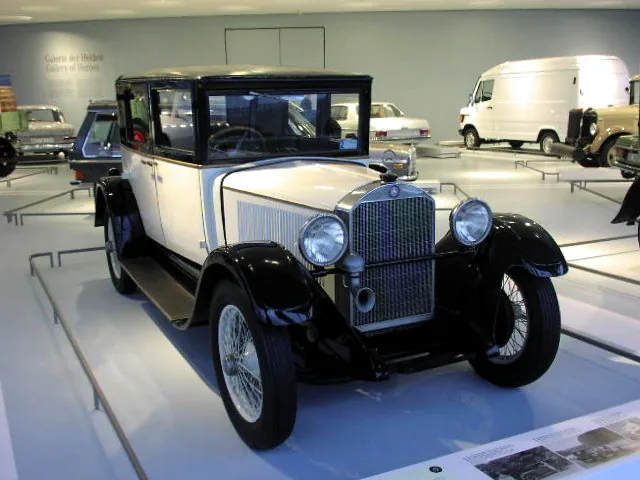
Image source: Wikimedia Commons
Development after the community of interest and the merger
Development of a competitive mid-size car was already urgent during the community of interest between DMG and Benz in the mid-1920s. Board debates swung between sophisticated, expensive concepts and lower-priced volume strategies. The final two-litre programme that reached production was intentionally conventional: rigid axles, leaf springs, and a side-valve six rather than experimental chassis or supercharged complexity for the entry mid-size slot.
Ferdinand Porsche, as technical director in the early Daimler-Benz years, is associated with the hurried passenger-car work that produced the W02 alongside other new codes (including the never-series W01 prototype theme and larger multi-litre models). Early production teething problems and pricing disputes formed part of a tense commercial climate. Porsche’s contract was not renewed beyond 1928; Hans Nibel then led technical modernisation that fed the Stuttgart 200 facelift narrative covered on its own page.
The cars were unveiled in October 1926 at the Berlin Motor Show—the first major motor-show appearance of the merged Mercedes-Benz brand. Series chassis began to leave Untertürkheim in late 1926, with deliveries ramping strongly into 1927. Manufacturer history notes that the two-litre car alone sold more than twice as many units in 1927 as the combined Mercedes, Benz, and Mercedes-Benz passenger output of 1926. That is the commercial meaning of the Typ 8/38: it made the new brand a volume mid-size presence, not only a maker of expensive specials.
Naming: 8/38, 8/38 hp 200, Stuttgart 200, W02
Readers meet several labels for one mechanical family. At launch the sales name is 8/38 hp (or 8/38 PS). Early internal design language still used DMG-style codes such as W 6506. Under the new Daimler-Benz works system the car became W02—the second passenger type code after the W01 prototype line.
In February 1928 Mercedes-Benz added a three-digit displacement cue to many sales designations. Multiplied by ten, the number approximates cubic centimetres. Thus 8/38 hp 200 points to a roughly two-litre engine. That three-digit habit later became a long-running Mercedes passenger-car convention.
From the November 1928 Berlin show facelift, marketing also used Typ Stuttgart 200, naming the production city and aligning with place-name prestige already used for the Nürburg eight and later for the Mannheim line. Internally and in modern literature, W02 remains the cleanest single identifier. On this site, Typ 8/38 is the designation-first entry; Stuttgart 200 is the facelift-and-equipment entry; the 1926 page is the launch-year entry.
Design and body programme
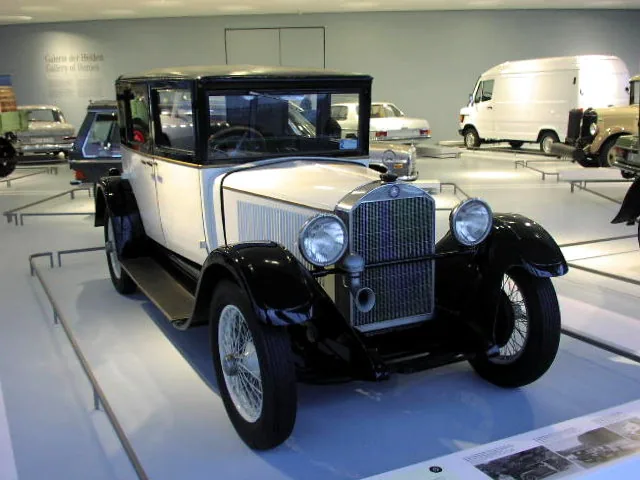
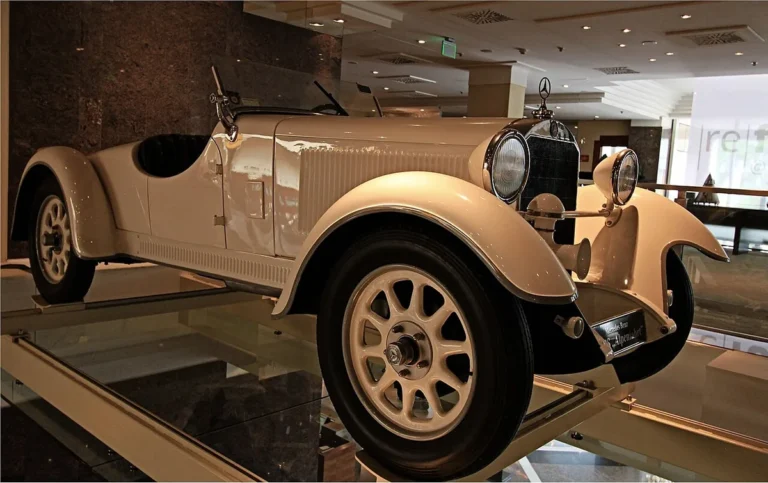
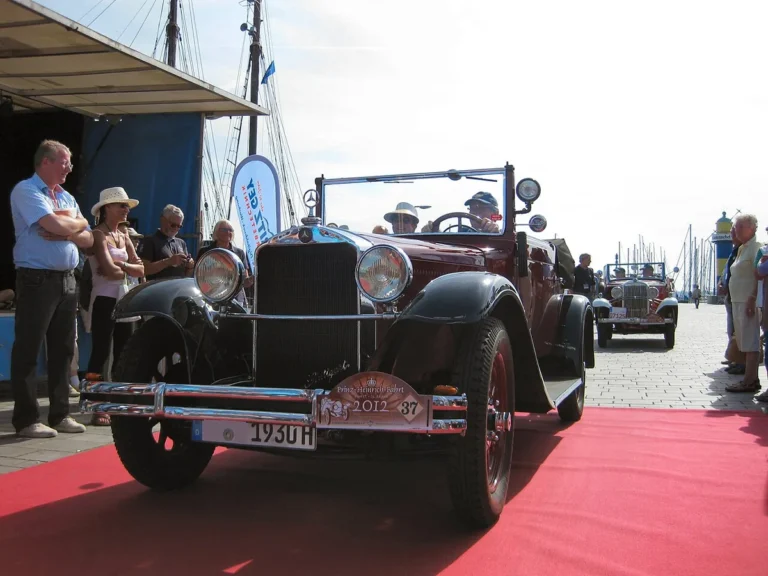
Visually the 8/38 is of its period: upright radiator shell with three-pointed star, separate wings, running boards on most catalogue bodies, and a cabin height that reads as late-1920s formality. What varies most is coachwork. An open tourer presents different mass and weather exposure from a four-door limousine. Cabriolets and landaulets sit between closed and open extremes. Bare chassis allowed independent coachbuilders to supply special bodies, so surviving cars must be identified from plates and documentation rather than from a single “correct” silhouette.
Interior equipment ranges from simple standard packages to richer special versions in the Stuttgart era. Instrument panels, radiator construction (honeycomb versus finned-tube on some standard packages), brightwork, and luggage arrangements differ by year and equipment line. Over-restoration into modern gloss can erase period quietness; neglect turns wood framing and floor structures into moisture traps.
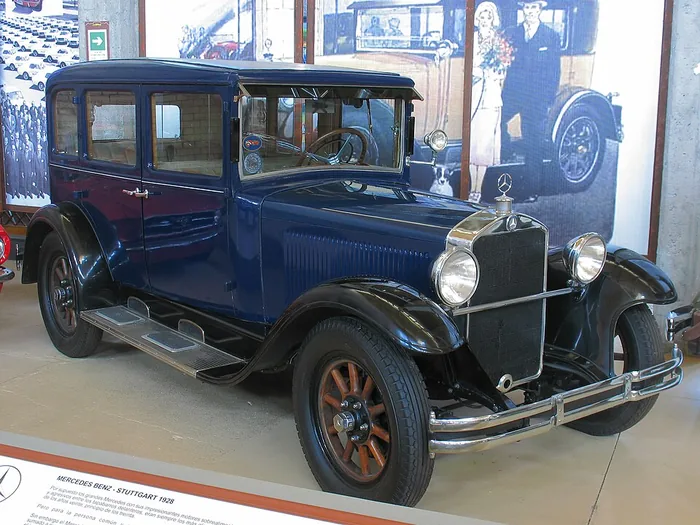
Image source: Wikimedia Commons
Engine, drivetrain, and driving character
The M 02 approximately 1,988 cc side-valve six delivering about 38 PS is the mechanical constant across the passenger programme. Early cars used a three-speed gearbox and modest compression. Facelifted cars raised compression, changed carburettor type in literature, and offered a four-speed gearbox with an overdrive-style fourth ratio. Listed top speeds move from roughly 75 km/h early toward about 80 km/h later—still period touring figures, not modern cruise targets.
On the road a sound 8/38 is upright, deliberate, and multi-cylinder smooth when ignition and fuelling are correct. Steering is slow by modern standards. Brakes are mechanical drums requiring early application. Leaf-spring axles transmit road texture. Period tyres and lighting set further limits. Fair-weather open use and dry storage between outings remain realistic ownership patterns for soft-top bodies.
Comparing the car unfavourably with a Typ S or SSK confuses product classes. Comparing it with the later Stuttgart 260 is more useful: same mid-size idea, larger ~2.6-litre M 11 six, and a parallel body catalogue. Comparing closed and open 8/38 bodies teaches how mass and weather gear rewrite the same ~38 PS.
Market role and production context
Through the late 1920s and early 1930s the 8/38 / Stuttgart 200 family and the related Stuttgart 260 were mainstays of Mercedes-Benz passenger output in a depressed German market. Yearly production shares cited in specialist literature show how dependent the firm was on these mid-size cars until smaller and newer models such as the W15 generation began to reshape the ladder in the early 1930s. Two-litre passenger production trailed off in 1933 as the more advanced mid-size 200 (W21) generation took over the volume conversation.
Commercial derivatives—delivery vans, small buses, postal combinations—extended the chassis idea beyond private cars. Those variants share family mechanical roots but are not identical in frame detail or gearing. Collectors and researchers should separate passenger 8/38 identity from commercial L 3/4 / L 1000 documentation when valuing a vehicle.
Ownership: strengths and things to watch
Strengths
- Historical centrality — first-generation Mercedes-Benz mid-size volume car after the 1926 merger.
- Clear designation logic — tax PS / actual PS naming that explains period German catalogues.
- Six-cylinder smoothness — multi-cylinder character at accessible mid-size scale when maintained.
- Body variety — tourers, saloons, cabriolets, and specials for different uses.
- Family documentation path — links to 1926 launch, Stuttgart 200, W02 overview, and Stuttgart 260.
Things to watch
- Wood and sills — damp storage destroys coachwork structure.
- Mechanical brakes — drums and linkages need excellent condition and defensive driving.
- Cooling and fuel systems — neglected radiators and carburettors undo a good engine.
- Identity mix-ups — 8/38, Stuttgart 200, W02, and commercial L-codes can be confused on paperwork.
- Expectation mismatch — not a supercharged sports car and not a large luxury eight.
- Parts and specialists — pre-war mid-size Mercedes need club and expert support.
Sibling comparisons
Use this Typ 8/38 page for designation, production context, and the full 1926–1933 two-litre map. Use the 1926 entry for launch-year detail and merger-era product strategy. Use the Stuttgart 200 entry for the Nibel-era facelift, four-speed option, and equipment packages. Use the Typ Stuttgart overview for the place-name programme framing. Use the Stuttgart 260 for the larger-engine sibling. Use Typ S / Nurburg pages only as sports and luxury contrasts.
Legacy
The Typ 8/38 established that the merged Mercedes-Benz brand could sell a rugged, reasonably priced mid-size six in volume while still building glamorous sports and luxury cars. Its M 02 engine became a development root for later larger side-valve sixes. Its naming path—from tax/power figures to three-digit displacement cues to place names—illustrates how Mercedes sales language modernised at the end of the 1920s.
For research, read this hub with the launch-year and Stuttgart 200 pages, then place the family against the Stuttgart 260 and against higher programmes. For ownership, treat any surviving car as a specialist historic vehicle: dry storage, correct tyres, excellent brakes, honest cooling, and complete identity documentation. Maintained on those terms, the Typ 8/38 continues to represent the practical middle of early Mercedes-Benz passenger history rather than the extremes of racing myth or flagship ceremony.
Keep the mechanical brief honest. About two litres, about thirty-eight horsepower, rear-wheel drive, leaf springs, and mechanical drums are enough when the car is used as designed. They are not enough when the car is forced into modern high-speed roles. Collectors who respect that boundary keep both the machine and its historical meaning intact.
Leave a Reply
You must be logged in to post a comment.