General information & model overview
| Category | Specification Details |
|---|---|
| Model name | Mercedes-Benz Typ Stuttgart 260 Sportwagen (W11) |
| Internal code | W11 (Sportwagen / light sporting open body expression on the Stuttgart 260 theme) |
| Focus year | 1930 (within the broader approximately 1929 – 1933/1934 Stuttgart 260 production window) |
| Parent model | Mercedes-Benz Typ Stuttgart 260 (W11) |
| Predecessor context | Six-cylinder accessible mid-size idea descended from the earlier Typ Stuttgart (W02) |
| Body style | Light sporting open body — the sportiest Stuttgart 260 expression without claiming supercharged W06 power |
| Manufacturer | Daimler-Benz AG (Mercedes-Benz) |
| Engineering context | Hans Nibel era Mercedes passenger-car engineering climate; sporting coachwork on a mid-size touring chassis |
| Market role | Fair-weather sporting open car for owners wanting the lightest, liveliest face of the accessible 260 six |
| Layout | Front-engine, rear-wheel drive |
| Key characteristics | c. 2581 cc inline-six, about 50 PS at ~3400 rpm (period class); 4-speed manual; reduced coachwork mass relative to limousines and formal cabriolets |
| Explicit non-identity | Not a Typ S / W06 supercharged sports car (SS/SSK class is a different world) |
Body & dimensions
| Specification | Details |
|---|---|
| Body concept | Sportwagen: light open sporting coachwork emphasising reduced mass and open-air driving pleasure |
| Seating | Typically two seats or compact sporting accommodation; less formal multi-passenger focus than Cabriolet D |
| Wheelbase context | Mid-size W11 chassis programme; sporting body does not transform it into a short racing chassis |
| Mass character | Lightest sporting open expression in the Stuttgart 260 family conversation — key to the livelier feel |
| Weather equipment | Often more minimal than formal cabriolets; fair-weather orientation is part of the character |
| Construction | Period open sporting coachwork with steel-and-wood practices; lightness must not be confused with flimsiness — structure still needs integrity |
| Contrast within family | Sportier and lighter than Cabriolet A and far less formal than Cabriolet D |
Engine specifications
| Theme | Details |
|---|---|
| Configuration | Inline six-cylinder petrol, naturally aspirated (shared W11 Stuttgart 260 theme) |
| Displacement | Approximately 2581 cc |
| Output (period class) | About 50 PS at roughly 3400 rpm — unchanged by the sporting body label |
| Induction | Naturally aspirated; no factory Kompressor narrative |
| Character in this body | Best power-to-weight expression of the family; still modest absolute power by later standards |
| Fuelling & cooling | Period carburettor and liquid cooling; enthusiastic use still demands healthy systems |
Drivetrain & transmission
| Category | Details |
|---|---|
| Drive layout | Front-engine, rear-wheel drive |
| Gearbox | 4-speed manual of period design |
| Clutch | Mechanical clutch; sharper subjective response when body mass is low |
| Final drive | Period touring gearing; not a close-ratio racing transmission package |
| Driver impression | Most engaging shift-and-throttle rhythm of the W11 open family when the car is well sorted |
Chassis, brakes & structure (period construction)
| Category | Details |
|---|---|
| Frame | Separate ladder chassis of the mid-size W11 programme — sporting body, not a purpose-built racing frame |
| Suspension | Solid front axle, live rear axle, leaf springs; damping quality strongly shapes the “sporting” feel |
| Steering | Mechanical steering box; lighter body can make the car feel more alert without modern precision |
| Brakes | Period drum brakes; reduced mass helps slightly, but distances remain long by modern norms |
| Light open structure | Minimal bodywork increases exposure of chassis and scuttle behaviour; rattles and flex are diagnostic |
| Wheels & tyres | Sporting use makes tyre quality and pressure discipline especially important |
Performance (period context)
| Category | Details |
|---|---|
| Power-to-weight | Best in the Stuttgart 260 family due to light open coachwork; absolute power still ~50 PS class |
| Top speed class | Can feel livelier than the ~90 km/h closed-car mental model; do not equate with W06 supercharged performance |
| Character | Lightest sporting open W11 experience: wind, modest thrust, engaging secondary-road pace |
| Comparison | Sportiest 260 expression vs Cabriolet A / Cabriolet D; still not an SSK-class machine |
Timeline & history
| Period | Development |
|---|---|
| Pre-1929 | W02 Typ Stuttgart establishes accessible mid-size Mercedes naming |
| ~1929 | Stuttgart 260 (W11) six-cylinder programme begins with multiple body styles |
| 1930 | Sportwagen theme highlights the lightest sporting open cut on the W11 idea |
| Early 1930s | Open sporting and cabriolet bodies continue alongside formal closed cars within the 260 window |
| Concurrent extreme | Supercharged Typ S / W06 sports cars occupy a different power and price universe |
| ~1933–1934 | W11 production winds down; surviving Sportwagen-bodied cars remain rare lively expressions of the accessible six |
Body & variants notes
| Theme | Details |
|---|---|
| Sportwagen identity | Lightest sporting open body on the Stuttgart 260 theme; fair-weather focus |
| Sibling: Cabriolet A | More finished two-seat grand-touring elegance — Cabriolet A |
| Sibling: Cabriolet D | Formal four-seat open social car — Cabriolet D |
| Sibling: limousine | Closed practical core — main W11 overview |
| Coachbuilt caution | Light sporting bodies vary; verify originality and avoid assuming every open light 260 is an authentic Sportwagen story |
Safety & construction notes (classic-era context)
| Category | Details |
|---|---|
| Minimal protection | Light open sporting body offers least weather and crash shelter of the family |
| Temptation risk | Livelier feel can encourage speeds the drums and tyres cannot safely support — discipline required |
| Brakes & tyres | First maintenance priorities for any owner who enjoys the sporting character |
| Lighting | Period lamps and open seating make night use particularly demanding |
| Structure | Lightness must not mean neglected wood and mounts; inspect scuttle, floors, and wing attachments |
| Seatbelts | Specialist retrofit may help if legally and historically considered; period cars lack modern restraint design |
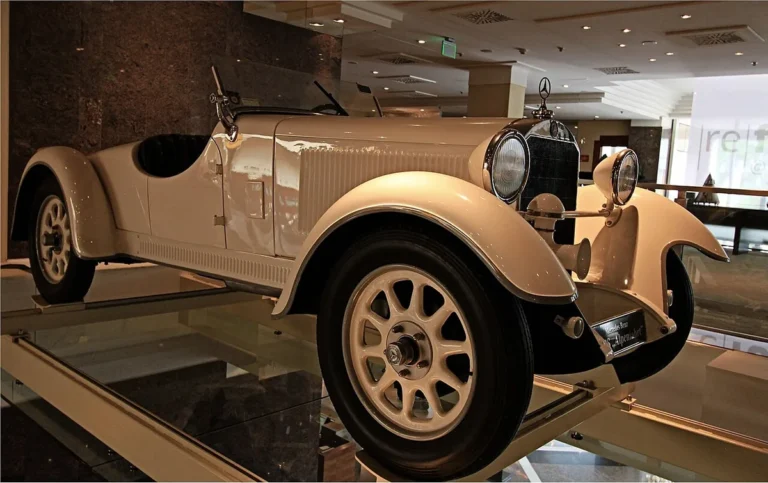
Stuttgart 260 Sportwagen (W11): open sporting body on the mid-size six chassis (1930)

Image source: Wikimedia Commons
The Mercedes-Benz Typ Stuttgart 260 Sportwagen is a 1930 open sporting body style on the W11 six-cylinder chassis. It represents the lightest open emphasis within the Stuttgart 260 family while retaining the same basic touring mechanicals: approximately 2.6-litre inline-six, about 50 PS class, rear-wheel drive, separate chassis, period manual gearbox.
Parent mechanical overview: Typ Stuttgart 260 (W11). Related open bodies: Cabriolet A, Cabriolet D. Earlier Stuttgart name: W02. Supercharged sports contrast: SSK / Typ S. Upper luxury contrast: Typ Nurburg.
The Sportwagen should be read as a body programme on the W11 touring chassis, not as a separate high-output powertrain line. Lightness is relative to closed and formal open Stuttgart 260 bodies, not absolute by modern sports-car standards.
Body definition and design
Period “Sportwagen” language for this class usually means an open sporting cut with reduced formal bulk: two main seats or a compact open layout, folding weather equipment, and visual emphasis on open-air use. Exact door and seat arrangements vary by catalogue and coachbuilder. Confirm on the vehicle with body tags and period documentation.
Compared with Cabriolet A, the Sportwagen is often discussed as the more stripped open expression of the same chassis idea. Compared with Cabriolet D, it carries less formal multi-seat orientation. Compared with closed limousines, it trades weather protection for lower mass and open-air use. Restoration and originality of wings, doors, scuttle, and top structure are central to correct identity. Mixed parts from other open styles are not uncommon after long lives and should be disclosed where known.
Exterior grammar remains early-1930s Mercedes: upright radiator shell, three-pointed star, separate wings, and period lighting. What changes is bulk and cabin formality. A correct Sportwagen reads as light open presentation on a mid-size chassis, not as a short-wheelbase competition special. Over-restoration into modern show gloss can erase that restrained sporting cut; neglect turns wood and light structures into alignment and safety problems.
Interior trim should match the reduced formal programme. Hardware quality, seat construction, and weather equipment completeness affect both use and value. A car that only looks open-sporty in photographs may still lack correct top structure or identity papers.
Mechanical basis and performance envelope

Image source: Wikimedia Commons
Specification tables list the shared W11 six-cylinder data. Power remains about 50 PS class. There is no factory supercharger programme of W06 type. Any freer feel versus a closed car comes mainly from reduced coachwork mass and open aerodynamics of the body, not from a different engine family.
Top-speed and acceleration claims should be treated as approximate and condition-dependent. Drum brakes, period tyres, and leaf-spring chassis define safe operating speeds on modern roads more tightly than brochure figures. Drive layout, gearbox, and chassis details match the parent W11 entry: separate ladder frame, solid axles with leaf springs, mechanical steering, drum brakes.
Maintenance of grease points, fuel system cleanliness, cooling, and ignition is the same as for other Stuttgart 260 cars, with extra attention to open-body structures. Seasonal storage is common for light open cars; returning to the road after inactivity requires careful inspection of fuel, brakes, seals, and cooling before public use.
Driving character
A sound Sportwagen feels more open and responsive than a heavy closed 260, while remaining a deliberate pre-war touring car in control weights and braking. Steering is slow by modern standards. Gears require patience. Wind noise is normal with the top down.
Fair-weather use is realistic. Soft-top seals and side equipment of 1930 are not modern convertible systems. Storage between outings should be dry. Tyres and brakes must be correct before any public-road use. Wet cobbles and polished surfaces reduce grip; period lighting is weak for night work.
The correct comparison is internal to the W11 family, not to supercharged sports cars. Against a closed limousine, the Sportwagen is freer and more vocal. Against a Cabriolet D, it is less formal and usually less multi-seat. Against a Typ S or SSK, it remains a mid-size six without Kompressor culture, gearing, or maintenance intensity.
Ownership and inspection
Strengths include open sporting presentation on a coherent mid-size six; clear family documentation path via the W11 hub; and a calmer operating envelope than supercharged sports cars. Watch points: body originality; top and weather gear; wood rot; sill and wing corrosion; steering and brake condition; chassis and engine identity; previous accident or rebody history.
Specialist coachwork and mechanical support are required for correct work. Running costs can be high relative to purchase price if the body needs major wood and top work. Factor that in before acquisition. Thin paperwork under a glamorous open body is a common market risk; price should reflect provenance as well as cosmetics.
Parts commonality with other W11 cars helps for mechanicals; body-specific open fittings may be harder. Club and marque literature improve identification of correct Sportwagen features versus later mixed open reconstructions.
Collecting context
Sporting open bodies often attract strong interest, which increases the importance of documentation. A car that only “looks right” is incomplete without coherent identity. Compare prices and condition against Cabriolet A and formal D examples on the same chassis family.
For engines, closed bodies, and overall W11 timeline, use the parent Stuttgart 260 page. For the four-cylinder ancestor, read the Typ Stuttgart (W02). For the era’s real supercharged sports pole, use the Typ S and SSK as contrasts, not as mechanical twins of the Sportwagen.
Fashion can inflate open sporting presentation beyond what the mechanical brief supports. A coherent Sportwagen is valuable as the lightest open expression of a mid-size six; it is not a substitute for short-chassis Kompressor specials in either performance or culture.
Ownership: strengths and things to watch
Strengths
- Lightest open W11 emphasis — sporting body programme on the Stuttgart 260 chassis.
- Shared six-cylinder base — clear mechanical continuity with closed and cabriolet siblings.
- Open-air presentation — freer feel than heavy formal bodies without leaving the touring brief.
- Calmer envelope — approachable relative to W06 supercharged sports cars.
- Family research value — completes the open map with Cabriolet A and Cabriolet D.
Things to watch
- Body originality — mixed open parts and rebody history are common after long lives.
- Top and weather gear — light open cars still depend on correct fabric and structure.
- Wood and alignment — scuttle, doors, and wings hide structural failure.
- Brakes and tyres — freer feel does not remove period safety limits.
- Storage after seasonal use — fuel, seals, and cooling suffer from inactivity.
- Expectation mismatch — not an SSK and not a modern sports car.
Sibling comparisons
Choose the Sportwagen if the priority is the lightest open sporting expression of the Stuttgart 260 idea. Choose the Cabriolet A for more formal intimate open elegance. Choose the Cabriolet D for multi-seat formal open touring. Choose a closed W11 if weather protection and practical multi-seat use matter more. Read the parent overview for engines, timeline, and market placement.
Legacy
The 1930 Sportwagen shows that the Stuttgart 260 programme included a light open sporting expression without leaving the mid-size six-cylinder touring brief. It is historically useful as a body variant, not as a proxy for W06 competition cars.
Maintain it as an open pre-war Mercedes: dry storage, correct tyres and brakes, careful coachwork, and complete records of identity and work done. For research, pair this page with the W11 hub and the other open subtypes. That set teaches the full open lesson on one chassis: intimate elegance, formal multi-seat open touring, and light sporting presentation—all without requiring supercharged sports machinery.
Collectors who confuse Sportwagen presentation with Kompressor performance will be disappointed. Collectors who read it as the lightest open chapter of the Stuttgart 260 story will find a coherent, usable historical object—provided structure, brakes, and documentation are sound. Kept on those terms, the Sportwagen continues to illustrate how Mercedes-Benz sold open mid-size prestige in 1930 on touring rather than racing terms.
Leave a Reply
You must be logged in to post a comment.