General information & model overview
| Category | Specification Details |
|---|---|
| Model name | Mercedes-Benz Typ Mannheim Cabriolet (W10), including Sport Cabriolet / 370 S open themes of the early 1930s |
| Internal code | W10 / WS10 family (sporting open cuts often associated with 370 S presentation) |
| Production years | Approximately 1931 – 1933 for the core Sport Cabriolet generation highlighted here (parent Typ Mannheim programme ~1929–1934) |
| Body style | Open cabriolet / sport cabriolet — typically two main seats with elegant folding-top coachwork; social open touring rather than pure two-seat race special |
| Parent family | Mercedes-Benz Typ Mannheim (W10) |
| Layout | Front-engine, rear-wheel drive |
| Key characteristics | ~3.7-litre inline-six in the ~75 PS class; open-air mid/upper Mercedes elegance; lighter visual bulk than closed limousines on the same mechanical idea |
| Not the same as | Supercharged short-chassis sports cars such as the SSK — different mission, different power story |
Body & dimensions
| Specification | Details |
|---|---|
| Coachwork type | Cabriolet / Sport Cabriolet with folding fabric top, brightwork, and open-side presentation typical of early-1930s Mercedes open luxury |
| Seating | Primarily two comfortable front seats; occasional rear or luggage emphasis depends on exact body cut and coachbuilder |
| Chassis emphasis | Sporting presentation of the Mannheim touring chassis — often shorter or visually lighter than formal limousines of the same W10 family |
| Doors | Typically two-door open layout for Sport Cabriolet themes |
| Top & weather gear | Period folding top with side screens / weather equipment of the era; “all weather” is optimistic by modern standards — fair-weather excellence is the honest brief |
| Construction | Steel panels over wooden framing common to the period; top irons, door bottoms, and scuttle structure are critical survival points |
| Mass character | Lighter and freer-feeling than closed Mannheim bodies, still a substantial pre-war Mercedes — not a featherweight cyclecar |
Engine specifications
| Category | Details |
|---|---|
| Configuration | Inline six-cylinder petrol, naturally aspirated |
| Displacement | Approximately 3,689 cc (~3.7 litres) for the common 370 / Sport Cabriolet theme of 1931–1933 |
| Power (period class) | About 75 PS / ~55 kW at roughly 3,200 rpm (period rating class; individual cars may differ) |
| Torque character | Mid-range touring pull suited to open-road progress rather than high-rpm sports revs |
| Induction | Naturally aspirated — not a factory Kompressor sports engine in the W06 sense |
| Earlier context | Parent line also included ~3.4-litre Mannheim 350 themes before the 3.7-litre heart of this cabriolet generation |
| Fuelling & cooling | Period carburettor and liquid cooling; open-car use still overheats tired systems in parade traffic |
Drivetrain & transmission
| Category | Details |
|---|---|
| Drive | Rear-wheel drive |
| Gearbox | Manual multi-speed (period four-speed class typical for this Mercedes touring tier) |
| Clutch | Mechanical; smoothness counts when showing the car with passengers |
| Gearing intent | Early-1930s open touring — not modern motorway lock-up cruise |
Chassis, brakes & structure
| Component | Specification |
|---|---|
| Frame | Separate ladder chassis from the W10 Mannheim programme (Porsche-origin structure refined under Nibel-era passenger engineering) |
| Suspension | Solid axles with leaf springs front and rear — conventional, honest, maintenance-visible |
| Steering | Mechanical box; heavy at parking speeds, deliberate on the open road |
| Brakes | Drum brakes; plan early on wet cobbles and alpine descents |
| Wheels | Often wire wheels on sporting open examples; check spoke tension and hub condition |
Performance (approximate figures)
| Metric | Approximate data |
|---|---|
| Power | ~75 PS class |
| Top speed class | Often associated with figures around ~115 km/h for sporting 370 open themes (body, gearing, and condition decide reality) |
| Acceleration | Leisurely by modern standards; the pleasure is open-air six-cylinder flow, not sprint bragging |
| Compared with closed Mannheim | Feels livelier because the cabriolet carries less formal mass and presents a freer silhouette |
| Compared with W06 sports cars | Quieter mission — touring elegance, not Kompressor drama |
Key timeline
| Year | Changes |
|---|---|
| 1929 | Parent Typ Mannheim W10 established as mid/upper six-cylinder touring line |
| 1931 | Sport Cabriolet / open sporting catalogue emphasis strengthens with 3.7-litre themes |
| 1931–1933 | Core production window for the Mannheim Cabriolet generation documented on this page |
| 1933 | Open programme winds down as model years and successor planning shift the mid/upper open offering |
| Afterlife | Surviving Sport Cabriolets become highly photogenic pre-war Mercedes collectibles |
Trim & presentation notes
| Theme | Description |
|---|---|
| Sport Cabriolet | Two-door open elegance — the face most people mean by “Mannheim cabriolet” in collector conversation |
| 370 S association | Sporting chassis/body language on the 3.7-litre idea; still a touring cabriolet, not a race homologation special |
| Coachbuilder variants | Factory-associated and specialist open bodies exist; documentation beats brochure assumption |
Safety & construction notes
| Category | Details |
|---|---|
| Open structure | No modern rollover protection; seatbelts if fitted are usually later specialist additions |
| Brakes & weather | Wet roads and drum brakes demand conservative gaps; open cars amplify wind and spray |
| Top mechanism | Irons, fabric, and seals are expensive when neglected |
| Wood rot | Scuttle, door bases, and rear body framing fail before chrome does |
Typ Mannheim Cabriolet (W10): open six-cylinder touring elegance, 1931–1933
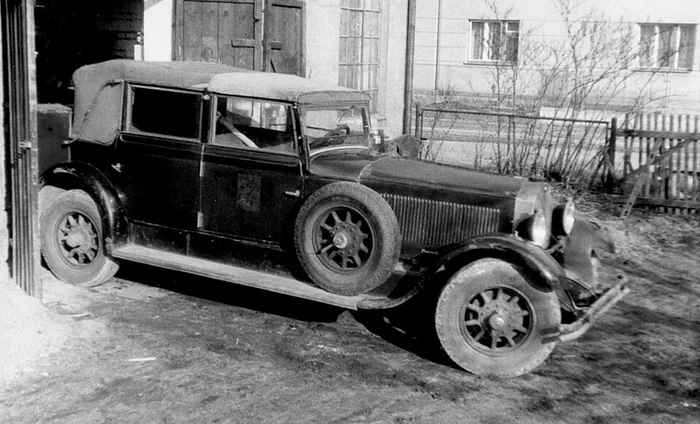
The Mercedes-Benz Typ Mannheim Cabriolet of the early 1930s is the open expression of the mid-to-upper W10 touring programme. The generation most collectors mean when they say “Mannheim cabriolet” is roughly 1931–1933, centred on Sport Cabriolet and related open cuts on the 3.7-litre theme. Underneath sits the parent Typ Mannheim W10 idea: a six-cylinder touring chassis with about 3.7 litres and something like seventy-five horsepower in period rating class. Above that idea sits coachwork designed for open-air presentation rather than for closed professional duty alone.
This is not a supercharged short-chassis sports car. Models such as the SSK occupy a different aisle of the catalogue and of later mythology. The Mannheim cabriolet’s point is subtler: it shows that a six-cylinder touring Mercedes can look as desirable as a sports special without pretending to be one.
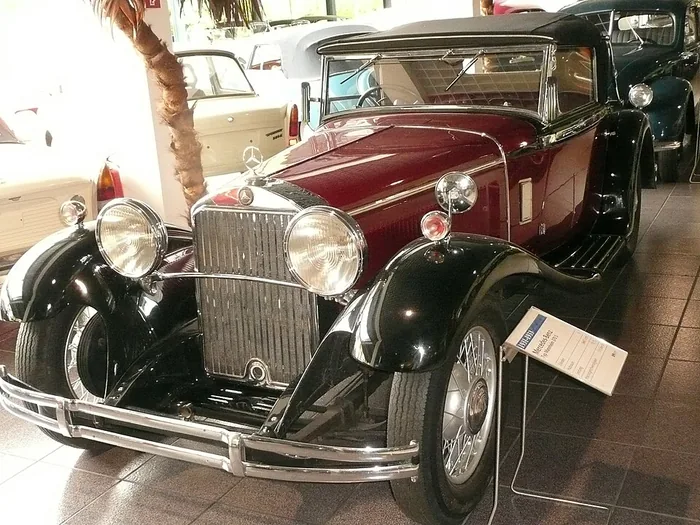
Image source: Wikimedia Commons
How this cabriolet fits the family
The parent Mannheim line runs longer than this open chapter — roughly 1929 to 1934 across 350 and 370 themes, closed cars included. The cabriolet generation this page focuses on is the open flowering of that programme: the years when sporting soft-top bodies made the model especially memorable.
Think of the closed limousine as the weekday professional tool. Think of this cabriolet as the open leisure counterpart that still obeys the same mechanical manners. Same company architecture. More air. More display value. Still not an SSK.
Below the Mannheim cabriolet in the accessibility ladder sit smaller open cars and mid-size programmes. Above it, open Nürburg bodies play a more ceremonial eight-cylinder game. Beside it, the W06 sports line plays a different sport entirely. That middle open niche is historically valuable: glamorous without being unapproachable in concept, sporting in silhouette without lying about power.
The 3.7-litre six: enough power for the brief
Most of these cars speak in 370 language — about 3,689 cubic centimetres, roughly 75 PS at around 3,200 rpm in period rating class. On paper that sounds modest. In an open body with two people and careful luggage, it is adequate for the roads the car was designed to use.
The engine’s gift is smoothness more than shock. The six is audible at work without thrashing. Carburettor manners, ignition health, and cooling-system honesty decide whether a demonstration drive becomes a successful outing or a cautionary tale.
Earlier Mannheim 350 themes with slightly smaller sixes sit in the parent story. Later multi-cylinder prestige cars sit above. For this cabriolet window, the 3.7-litre naturally aspirated six is the honest centre of gravity. Induction is not a factory Kompressor sports system in the W06 sense.
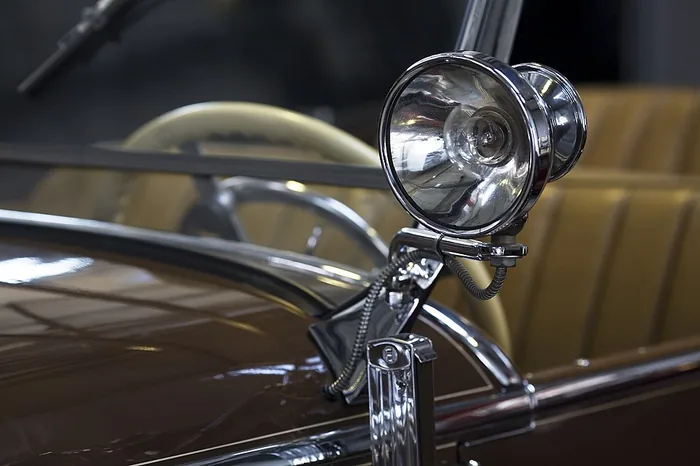
Image source: Wikimedia Commons
Design: open touring grammar of the early 1930s
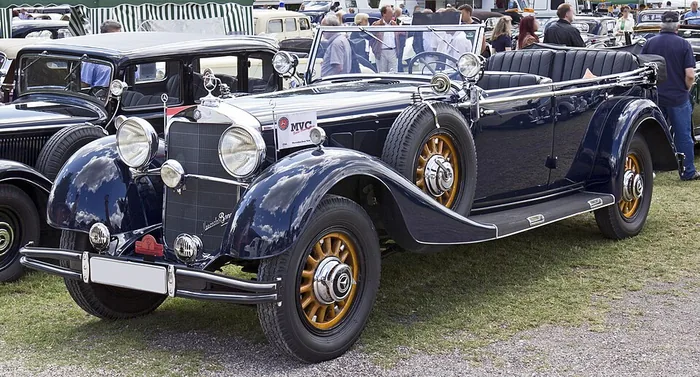
Separate wings, a long bonnet, a lower beltline when the top is down, and often wire wheels define the visual grammar. Up close, the car is full of practical period detail: how the top irons stack, the thickness of the doors, the relationship between screen and scuttle. Sport Cabriolet bodies lean toward two-door intimacy. They look faster than a Pullman even when the stopwatch disagrees, because proportion and open silhouette create a strong first impression.
With the top up, the silhouette becomes more formal and slightly heavier. With the top down, the cabin becomes an open touring platform. Either way, the car announces Mercedes without needing racing numbers on the door.
Seating is primarily two comfortable front seats; occasional rear or luggage emphasis depends on exact body cut and coachbuilder. Mass is lower than closed Mannheim bodies, yet the car remains a substantial pre-war Mercedes, not a featherweight cyclecar. “All weather” claims for period open cars are optimistic by modern standards; fair-weather excellence is the honest brief.
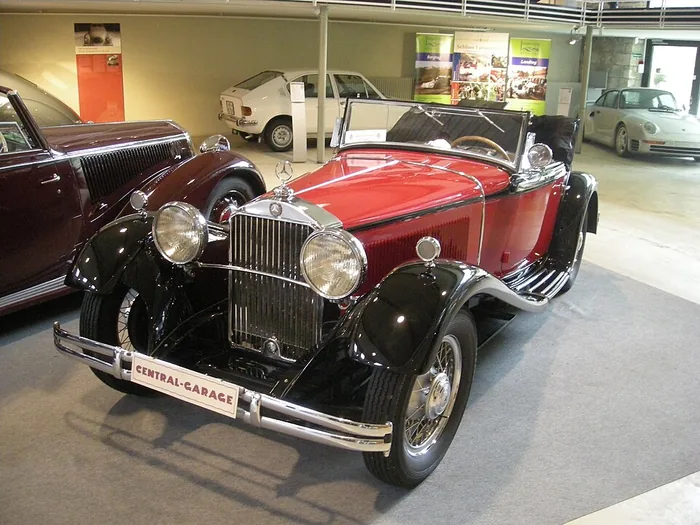
Image source: Wikimedia Commons
On the road: open-air touring, not lap times
Drive a carefully sorted example and the difference from a closed Mannheim is immediate. There is less mass to haul. There is more wind. There is more of the engine’s voice. Steering still asks for arms and anticipation. Brakes still want early respect. The gearbox still prefers a driver who listens.
What changes is mood. A closed car is a private room. A cabriolet is a conversation with the weather. On a dry secondary road at moderate pace, that conversation is the point of owning one.
Quoted top speeds in the neighbourhood of 115 km/h for sporting 370 open themes are useful as envelope, not as targets. Period tyres, drum brakes, and modern traffic write stricter rules than any brochure.
Wet cobblestones are not romantic. Neither is a top that will not seal. Owners who treat the car as fair-weather open touring live longer relationships with it than owners who demand modern all-weather practicality from 1930s fabric and wood. Period open Mercedes were marketed as pleasures to be managed, not as appliance convertibles. The reward is atmosphere that a modern sealed cabin does not fully replace.
Chassis and structure notes
The separate ladder chassis comes from the W10 Mannheim programme — Porsche-origin structure refined under Nibel-era passenger engineering. Solid axles with leaf springs front and rear are conventional, honest, and maintenance-visible. Mechanical steering is heavy at parking speeds and deliberate on the open road. Drum brakes require early planning on wet cobbles and alpine descents. Wire wheels on sporting open examples need spoke tension and hub condition checks.
Open structure means no modern rollover protection. Seatbelts, if fitted, are usually later specialist additions. Top irons, fabric, and seals are expensive when neglected. Wood rot in scuttle, door bases, and rear body framing fails before chrome does. Those structural truths decide whether a pretty open car is usable or a project.
Buying and owning: romance with a checklist
These cars are rare enough to matter and beautiful enough to tempt shortcuts. Do not skip unromantic inspection.
Start with identity. Chassis stamps, engine numbers, body tags, and period photographs should tell one story. “It looks like a Sport Cabriolet” is not provenance. Then structure: wood rot in doors and scuttle; rust where mudguards meet frame; top mechanism that has been forced; wiring that has been improvised. A shiny repaint can hide a tired skeleton.
Then the systems that keep people safe: brakes, steering play, kingpins, tyre age, spring condition. An open car that cannot stop cleanly is not charming. It is a liability with a star on the radiator.
Strengths
- Presence — among the most photogenic mid/upper Mercedes of its years.
- Open-air character — the Mannheim idea at its most personal and display-oriented.
- Honest power story — six-cylinder touring that can be understood and maintained with specialist help.
- Clear family link — sits neatly under the Typ Mannheim hub for research and comparison.
Things to watch
- Top and weather gear — expensive when wrong; essential to the car’s identity when right.
- Coachwork wood — structural, not cosmetic.
- Brakes and steering — non-negotiable before public-road use.
- Overheating and fuel issues — classic six-cylinder neglect patterns.
- Value temptation — beauty can outrun paperwork; do not let it.
Where it sits among other open Mercedes of the era
Below the Mannheim cabriolet in the accessibility ladder sit smaller open cars and mid-size programmes. Above it, open Nürburg bodies such as the multi-seat formal open cars of the W08 family play a more ceremonial eight-cylinder game. Beside it, the W06 sports line plays a different sport entirely.
That middle open niche is precious for historical understanding. It is glamorous without being unapproachable in concept. It is sporting in silhouette without lying about power. For many enthusiasts, that is the practical sweet spot of pre-war Mercedes desire: a car one can imagine using on a good fair-weather day, not only admiring behind a rope.
Use culture and realistic itineraries
The Mannheim Cabriolet thrives on owner-driver open touring: scenic secondary roads, overnight hotel runs, club events, and display occasions where a folding top matters. Passengers need briefing on open-air practicalities. Luggage must be planned carefully. Daily distances must respect period brakes, cooling, and average speeds.
Modern owners who chase that fair-weather touring feeling — and accept the mechanical manners that come with it — understand the model better than those who only chase auction headlines. The car rewards preparation and punishes improvisation that treats 1930s open coachwork as if it were a modern convertible executive saloon.
Timeline and production window
In 1929 the parent Typ Mannheim W10 was established as the mid/upper six-cylinder touring line. Around 1931 Sport Cabriolet and open sporting catalogue emphasis strengthens with 3.7-litre themes. The core production window for the Mannheim Cabriolet generation documented on this page is approximately 1931–1933. By 1933 the open programme winds down as model years and successor planning shift the mid/upper open offering. Surviving Sport Cabriolets become highly photogenic pre-war Mercedes collectibles, with values and risks that follow fashion as well as condition.
Legacy
The Typ Mannheim Cabriolet does not need to win arguments about which Mercedes was fastest in 1932. It wins a different argument: that elegance and usability can share a chassis with a city name on the catalogue and a six-cylinder heart under the bonnet.
If you are mapping the family, return to the parent Typ Mannheim overview for engines, closed bodies, and the full 1929–1934 span. If you are standing in front of a Sport Cabriolet with the top down, you are looking at the open subplot this page was written to explain: mid/upper touring manners, open-air presentation, and a clear refusal to confuse luxury soft-top elegance with Kompressor sports mythology.
Maintain the car with dry storage, correct weather equipment, sound wood structure, excellent brakes, honest cooling, and documented identity. Driven gently within period limits, the Mannheim Cabriolet still delivers the use it was designed for — open six-cylinder touring under a three-pointed star, without needing to shout about performance it never claimed.
For collectors building a pre-war Mercedes ladder, the Mannheim Cabriolet pairs naturally with a closed Mannheim, a mid-size open Stuttgart-class car if available, and an open or closed Nürburg for the eight-cylinder step above. That set teaches scale, cylinder count, and body mission more clearly than any single extreme sports model can. The cabriolet’s particular contribution is open-air mid/upper elegance: the point at which a six-cylinder touring Mercedes becomes most personal without leaving the touring-car world for the sports-special world.
Leave a Reply
You must be logged in to post a comment.