General information & model overview
| Category | Specification Details |
|---|---|
| Model name | Mercedes-Benz Typ Nürburg / Nurburg Cabriolet C (W08) |
| Internal code | W08 (Cabriolet C body style on the Typ Nürburg chassis programme) |
| Production years | Approximately 1928 – 1933 (intimate formal open expression within the wider ~1928–1939 W08 family) |
| Parent model | Mercedes-Benz Typ Nürburg / Nurburg (W08) family overview |
| Body style | Cabriolet C — typically a more intimate open luxury cut than formal multi-door D/F bodies (2/4-seat open social elegance rather than Pullman ceremony) |
| Manufacturer | Daimler-Benz AG (Mercedes-Benz) |
| Engineering context | Early W08 years of Mercedes-Benz’s first eight-cylinder passenger car; Porsche-period foundations with ongoing chassis evolution |
| Market role | Owner-driver open luxury with social flexibility — more intimate than Cabriolet D/F, more formal-multiuse than a pure Sport Roadster |
| Layout | Front-engine, rear-wheel drive |
| Key characteristics | Inline-eight luxury power (~4622 cc 460 / 18/80 PS class early theme; ~80 PS class); lighter formal open presence than multi-door Pullman cabriolets; dual-mode weather use |
Body & dimensions
| Specification | Details |
|---|---|
| Body concept | Intimate open luxury cabriolet: sporting-formal balance with less bulk than four-door social D or later Pullman F bodies |
| Seating | Typically two to four depending on exact coachwork — more flexible than a pure two-seat roadster, less ceremonial than multi-seat formal open cars |
| Length & mass | Still a large W08 luxury chassis, but reduced formal bulk relative to Cabriolet D and Cabriolet F |
| Top & weather gear | Proper folding-top equipment for dual-mode use; generally less monumental ironwork than Pullman-scale open cars |
| Doors | Often two-door or lighter multi-door open layouts depending on coachwork — verify on the individual car rather than assuming a single factory pattern |
| Construction | Period steel-and-wood composite practices; cowl, doors, and top structure are key inspection zones |
| Contrast within family | More intimate than D/F; more formal-social than pure Sport Roadster; open opposite of the closed sedan |
Engine specifications
| Theme | Details |
|---|---|
| Configuration | Inline eight-cylinder petrol (shared W08 / M08 luxury theme) |
| Displacement class | Approximately 4622 cc in the Typ Nürburg 460 / 18/80 PS early identity central to 1928–early 1930s cars |
| Output (period class) | Roughly 80 PS class for core luxury ratings |
| Character in this body | Same multi-cylinder smoothness as other Nürburgs; lower formal bulk than D/F yields a freer, more personal open feel without roadster extremes |
| Induction | Primarily naturally aspirated; contrast supercharged Typ S / W06 |
| Cooling | Liquid-cooled; summer open touring still stresses systems if neglected |
Drivetrain & transmission
| Category | Details |
|---|---|
| Drive layout | Front-engine, rear-wheel drive |
| Gearbox | Manual multi-speed of period design; owner-driver culture more common than pure chauffeur Pullman use |
| Clutch | Mechanical clutch; progressive technique still essential on a large luxury chassis |
| Final drive | Period luxury touring gearing |
| Driving implication | Invites personal open pleasure while remaining capable of occasional social passenger use depending on seating |
Chassis, brakes & structure
| Category | Details |
|---|---|
| Chassis base | W08 luxury ladder frame; early tall Hochbett character common in the 1928–1933 window |
| Suspension | Solid axles with leaf springs; lighter formal open mass than D/F can feel more responsive over the same hardware |
| Steering | Mechanical box; still low-geared by modern standards |
| Brakes | Period drums; better subjective urgency than heavy formal open cars still does not create modern stopping power |
| Structure priorities | Cowl rigidity, door fit, top irons, and floor integrity; open luxury bodies punish damp storage |
| Tyres | Correct period sizes and condition essential for open driving safety |
Performance (period context)
| Category | Details |
|---|---|
| Power-to-weight | More favourable than multi-seat formal D/F bodies; usually less extreme than a pure Sport Roadster cut |
| Character | Intimate open luxury: personal elegance with optional light social capacity |
| Comparison within family | Between Sport Roadster sporting drama and Cabriolet D multi-seat formality |
| Comparison outside family | Luxury open eight, not a W06 Kompressor sports car; above mid-size Typ Stuttgart programmes in size and prestige |
| Success metric | Does open eight-cylinder luxury feel personal without abandoning dual-mode weather manners? |
Timeline & history
| Period | Development |
|---|---|
| 1928 | Typ Nürburg / W08 launches as Mercedes-Benz’s first eight-cylinder passenger car; closed sedan establishes the formal core |
| 1928–1933 | Cabriolet C occupies the intimate open luxury niche while Cabriolet D and Sport Roadster cover social and sporting poles |
| Early chassis years | Tall Hochbett luxury stance common; eight-cylinder 460 / 18/80 PS class identity frames the product |
| After ~1933 | Broader family continues; later formal open ceremony increasingly associated with bodies such as Cabriolet F |
| Family total | Overall W08 programme roughly 3,800 units class across all bodies and years |
| Afterlife | Cabriolet C survivors valued as elegant intermediate open Nürburgs — neither pure roadster nor full multi-door formal open cars |
Body & variants notes
| Theme | Details |
|---|---|
| Cabriolet C identity | Intimate open luxury expression of the early Typ Nürburg |
| Sibling: Cabriolet D | Four-door formal social open — Cabriolet D |
| Sibling: Cabriolet F | Later Pullman-scale open ceremony — Cabriolet F |
| Sibling: Sport Roadster | Two-seat sporting open extreme — Sport Roadster |
| Sibling: Sedan | Closed all-weather core — Nurburg Sedan |
| Family hub | Typ Nürburg W08 overview |
| Coachbuilt variation | Door count, rear seat provision, and top details can vary; document the individual body |
Safety & construction notes (classic-era context)
| Category | Details |
|---|---|
| Open-body risk | Soft top is not a safety cell; period restraints absent as standard |
| Braking | Drums require early planning even on the lighter formal open cut |
| Lighting | Weak period lamps; night open driving is specialist activity |
| Structure | Cowl, doors, floors, and top irons hide rot and misalignment |
| Tyres | Age and correct size critical for open driving pleasure and safety |
| Identity documentation | Open luxury bodies can attract rebody stories; paperwork matters |
Cabriolet C: intimate open luxury on the Nürburg eight
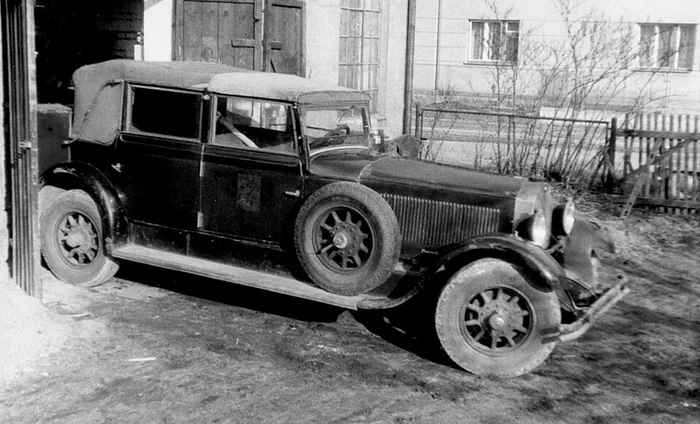
The Mercedes-Benz Typ Nürburg Cabriolet C is the intimate open luxury expression of the early W08 years. It occupies a carefully useful middle: more personal and less bulk-bound than the four-door formal Cabriolet D or the later Pullman-scale Cabriolet F, yet more dual-mode and socially flexible than a pure two-seat Sport Roadster. It remains a chapter of Mercedes-Benz’s first eight-cylinder passenger-car family — not a misplaced supercharged sports special.
This entry focuses on approximately 1928–1933, when Cabriolet C logic is especially central to the early open catalogue. Mechanical foundations live on the Typ Nürburg overview: roughly 1928–1939 overall production, about 3,800 units class for the whole programme, Nürburg/Nurburg naming linked to the Eifel and Nürburgring geography, 460 / 18/80 PS class early power near 4622 cc, later 500 evolution near 4918 cc, Porsche-period development roots, Nibel-era lower-chassis updates, and Horch-class luxury rivalry rather than SSK mythology.
Letter C, in this Motor Wiki reading, means intimacy with manners: open air without abandoning weather equipment, elegance without demanding a full guest list, and eight-cylinder prestige without the multi-door ceremony of larger formal open cars. Exact door counts and rear seating on any surviving car should still be verified against that car’s coachwork and documents.
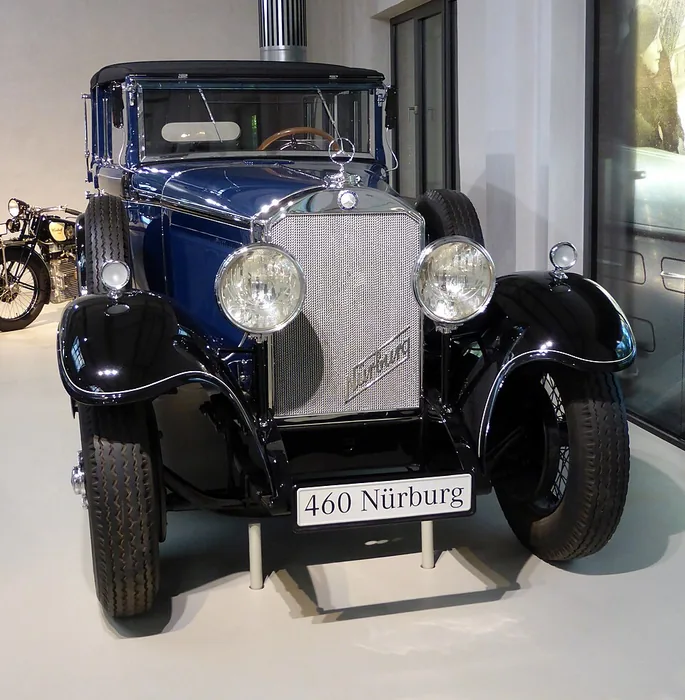
Image source: Wikimedia Commons
1928–1933: the case for an intimate open eight
When the Typ Nürburg launched around 1928, the closed sedan and Pullman carried the programme’s serious all-weather argument. Open bodies then sorted customers by how they wanted to be seen and how many people they needed to carry. Some wanted two-seat drama. Some wanted four-door social capacity. Others wanted something between: a cabriolet that felt personal to the owner-driver yet could still host a small social circle when required.
That is the Cabriolet C brief. It sold open-air Mercedes prestige to buyers who found pure roadsters too narrow in use and formal multi-door open cars too ceremonial for everyday owner-driver pleasure. In a market of spa towns, lake hotels, and variable weather, dual-mode capability mattered. The car had to look finished with the top raised and intentional with the top down.
Early mechanical identity centres on the 460 theme: roughly 4.6 litres, 18/80 PS class language, about eighty horsepower. Those numbers supported heavy luxury coachwork across the family; under a lighter formal open cut, they feel more responsive without inventing sports-car performance. The concurrent Typ S / W06 remained a different universe of supercharged ambition.
Place on the open spectrum
Early Nürburg open bodies form a spectrum. The Sport Roadster sits at the sporting personal pole. Cabriolet C occupies the intimate formal-open middle. Cabriolet D extends into four-door social formality. Later, Cabriolet F pushes open ceremony toward Pullman scale. The closed sedan remains the weather fortress at the other end of the entire family. Choosing among them is choosing a use pattern, not merely a silhouette.
Design: proportion, intimacy, and the raised-top test
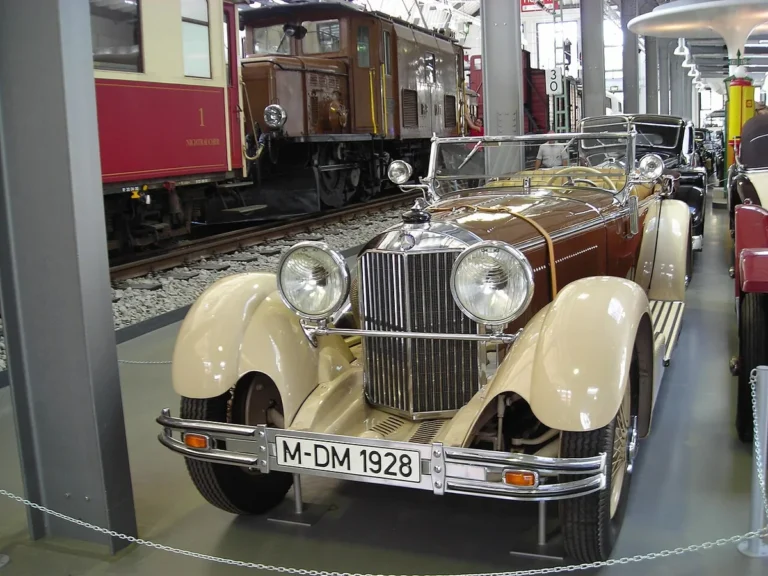
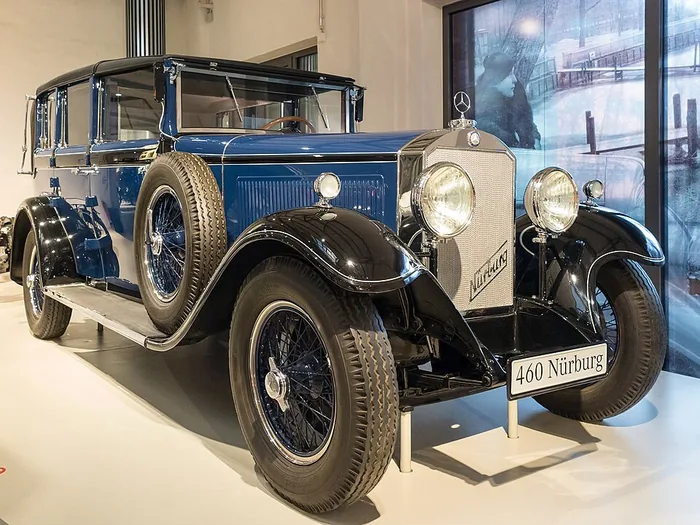
A convincing Cabriolet C balances a long eight-cylinder bonnet with a passenger cell that reads intimate rather than processional. Compared with a Cabriolet D, there is typically less multi-door formal bulk. Compared with a roadster, there is usually more weather-complete cabriolet character and a less purely sporting cut. The Mercedes radiator and star still announce large-car prestige; the open roofline and top hardware announce leisure use.
Top down, the car should look like designed open luxury, not a half-finished formal body. Top up, fabric tension and rear treatment should produce a finished silhouette suitable for town arrival. Dual-mode success is the design’s real exam. Restorations that only photograph well in sunshine with the top folded fail the historic mission.
Interior space is flexible rather than maximal. Two people tour in comfort; three or four may be possible depending on the specific coachwork, but nobody should confuse a Cabriolet C with a Pullman open multi-seat state car. Luggage remains a packing puzzle. The pleasure is proportion and personal elegance, not cargo volume.
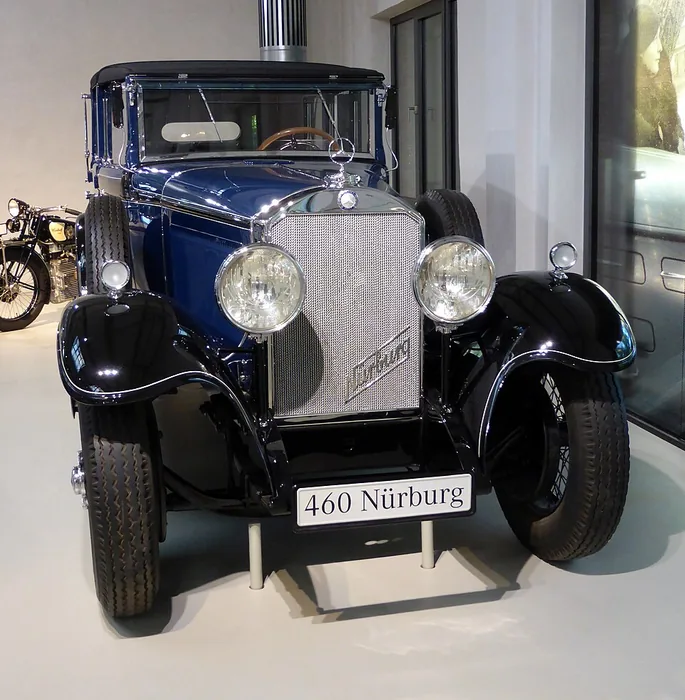
Image source: Wikimedia Commons
The eight-cylinder in an intimate open body
Shared W08 engine facts apply. What changes is subjective feel. Under sedan mass, the eight is a formal draft animal. Under Cabriolet C mass, it becomes a more conversational partner: still smooth, still leisurely by modern standards, but freer than multi-seat formal open cars. The entertainment is multi-cylinder sound, long-bonnet presence, and open-air touring composure.
Cooling and fuel systems still decide whether a summer route ends in pleasure. A lighter body does not excuse a blocked radiator or dirty carburettor. Oil discipline on a long crankshaft engine remains non-negotiable. Specialists who know pre-war Mercedes eights protect both drivability and value.
Any supercharging claim on a later-adjacent car needs documents. The Cabriolet C’s centre of gravity in this entry is naturally aspirated early-programme luxury power.
Drivetrain: owner-driver open manners
Cabriolet C culture leans owner-driver more than pure chauffeur Pullman culture. Gear changes are part of the pleasure. That does not excuse harsh technique. Period manuals reward skill; they punish haste. Smooth clutch work protects the driveline and keeps any passengers comfortable when the car is used socially.
Rear-wheel drive on period tyres asks for gentleness on wet stones. The car can feel lively relative to a heavy D or F; it still lacks modern traction aids. Correct tyres and modest throttle are safety equipment as much as style choices.
Chassis: lighter formal open on a large frame
The underlying W08 frame is still a large luxury chassis. Early tall Hochbett cars dominate the 1928–1933 mental picture: high step-in, formal verticality, aristocratic presence. Later lower trends in the wider family may touch some cars, but this entry’s emotional centre is early intimate open luxury on traditional tall-to-transitional frames.
Solid axles, leaf springs, mechanical steering, and drum brakes define the ride and stop. Relative to multi-seat formal open cars, reduced mass can improve subjective response. Relative to modern cars, everything remains slow, soft, and demanding of foresight. The danger is assuming “lighter Nürburg” means “sports car.” It does not.
Structure inspection should emphasise cowl integrity, door fit, top iron articulation, and floor soundness. Open luxury bodies stored damp develop expensive wood and alignment problems. A glossy exterior is not a structural survey.
Performance: the middle-path pleasure
Expect a pace between roadster liveliness and multi-seat formal leisure. The Cabriolet C will usually feel freer than a Cabriolet D or Cabriolet F, and less extreme than a Sport Roadster. That middle path is the point. Buyers who want maximum ceremony should look larger; buyers who want maximum sporting cut should look to the roadster; buyers who want year-round fortress security should look to the sedan.
Against a Typ S, the Cabriolet C is not a performance rival. Against a mid-size Typ Stuttgart, it is a larger, more multi-cylinder prestige object. Against Horch-class open luxury peers, it is Mercedes-Benz’s intimate open eight argument of the early years.
Driving culture: couple elegance with optional company
The Cabriolet C thrives on owner-driver itineraries that still allow a friend or two: scenic secondary roads, overnight hotel touring, club events, and formal gatherings where a raised top matters. It is less of a pure display two-seater than a roadster and less of a multi-seat party car than a D or F. That flexibility is its social product.
Passengers still need briefing on open-air practicalities. Weather equipment must work. Luggage must be planned. Daily distances must respect period brakes, cooling, and average speeds. The car rewards hosts who plan; it punishes hosts who improvise as if driving a modern convertible executive saloon.
Because the body is glamorous without being the most extreme open cut, it can be a useful first large open Nürburg for collectors who want open air without the full multi-seat top complexity of later Pullman cabriolets — still expensive, still large, still specialist, but emotionally more personal.
Collecting: the intermediate open position
Market fashion often elevates pure roadsters and grand formal open cars. Cabriolet C cars can sit between those fashion poles, which sometimes means thoughtful relative value and sometimes means under-recognition. Condition, originality, and documentation still dominate. A coherent early open luxury body with sound structure and correct W08 mechanicals can be deeply satisfying.
Inspection should cover identity papers, body originality, top assemblies, cowl and door structures, brakes, tyres, and cooling. Read the family overview so expectations stay aligned with roughly eighty-horsepower class luxury reality rather than Kompressor fantasy.
Running costs include open-body wood, weather equipment, and large pre-war Mercedes systems. Dry storage is mandatory. Specialist networks beat improvisation.
Ownership: strengths and things to watch
Strengths
- Intimate open luxury balance — personal elegance between roadster extremes and multi-door formal open bulk.
- Dual-mode manners — weather equipment and raised-top presence as part of the design, not an afterthought.
- Owner-driver pleasure — more personal use culture than pure Pullman ceremony.
- Eight-cylinder prestige — first Mercedes passenger eight character in open form.
- Family links — clear contrasts with overview, D, F, roadster, and sedan.
Things to watch
- Coachwork variation — door and seating details must be verified, not assumed from letter alone.
- Open-structure rot — cowl, doors, floors, and top irons hide cost.
- Brakes and expectations — freer feel can tempt overdriving relative to drum capability.
- Documentation — open luxury bodies attract identity stories; demand proof.
- Not a roadster substitute — if pure two-seat sporting cut is the goal, the Sport Roadster fits better.
- Not a multi-seat party car — if four-door hospitality is the goal, choose D or F.
- Not a W06 sports car — Kompressor mythology belongs elsewhere.
Sibling comparisons
Choose the Cabriolet C if the goal is open eight-cylinder Mercedes luxury that feels personal, dual-mode, and intermediate in bulk. Choose the Sport Roadster if two-seat sporting presentation is non-negotiable. Choose the Cabriolet D if four-door social open touring is the priority. Choose the Cabriolet F if later Pullman open formality is the goal. Choose the sedan if closed weather security outweighs open air.
All are W08 luxury eights. The Cabriolet C is the intimate open chapter of the early years.
Legacy
The Typ Nürburg Cabriolet C should be remembered as the intimate open luxury expression of Mercedes-Benz’s first eight-cylinder passenger-car family in the approximate 1928–1933 window. Roughly 4.6-litre class early eight-cylinder power, rear-wheel drive, dual-mode weather manners, and a mission of personal elegance rather than Pullman ceremony or pure roadster sport. The overview holds the mechanical map; siblings hold the poles of closed formality, multi-seat open hospitality, late Pullman open scale, and two-seat sporting desire.
Understood on those terms, the Cabriolet C is not a leftover letter code. It is a precise answer to a real interwar question: how does a large eight-cylinder Mercedes feel when open air is for the owner first, without abandoning the manners of a formal cabriolet?
For clubs, museums, and private collections that already hold a closed Nürburg or a more formal open sibling, the Cabriolet C is an especially useful companion piece. It shows the same eight-cylinder luxury idea in a more personal register: less processional than the Cabriolet D or Cabriolet F, less purely sporting than the Sport Roadster, and more weather-flexible than either extreme might suggest. That middle path is historically honest. Interwar buyers did not live only at catalogue poles; many wanted exactly this balance of open air, dual-mode manners, and eight-cylinder prestige.
Maintenance culture follows the same intermediate logic. The car is large enough to need specialist eight-cylinder knowledge, cooling attention, and serious brake care, yet it is not as fabric-and-iron intensive as the biggest Pullman open bodies. Owners who budget for wood, weather equipment, correct tyres, and dry storage will find a usable pre-war luxury open car. Owners who treat it as a static sculpture will eventually pay for neglected joints and damp fabric. The Cabriolet C rewards being driven gently and often within its period limits.
Finally, keep the wider map in view. The Typ Nürburg overview explains why the eight-cylinder programme existed, how the 460 and 500 themes relate, and how tall early chassis gave way to lower later presentations. The sedan shows the closed launch identity. The open siblings show the social and sporting branches. The Typ S and Typ Stuttgart remain the necessary contrasts at sports and mid-size poles. Within that constellation, the Cabriolet C is the intimate open expression — not the most extreme in raw glamour, but one of the most complete answers to everyday luxury open-air life on Mercedes-Benz’s first passenger eight.
Leave a Reply
You must be logged in to post a comment.