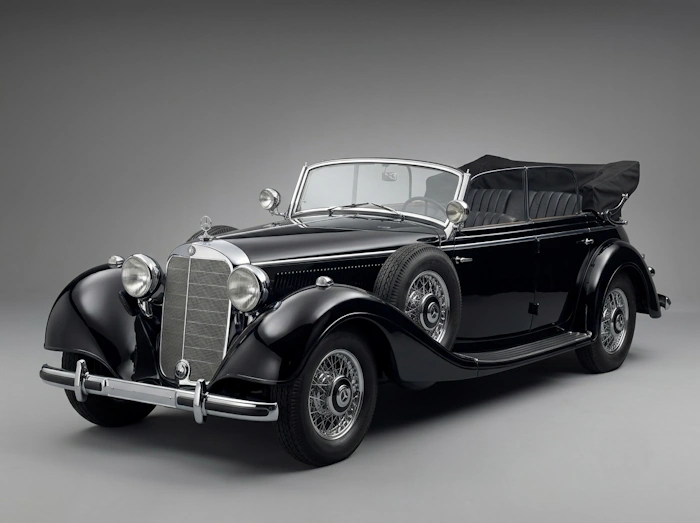
General information & model overview
| Category | Specification Details |
|---|---|
| Model name | Mercedes-Benz “Grosser Mercedes” Tourenwagen (W150) (1939–1943) |
| Family | Mercedes-Benz Typ 770 / “Grosser Mercedes” second generation |
| Internal code | W150 |
| Production years | Approximately 1939 – 1943 within the W150 programme (chassis programme into early 1940s; last bodies delivered into 1944 in family tallies) |
| Manufacturer | Daimler-Benz AG |
| Market role | Ultra-luxury / state and ceremonial flagship; most expensive German passenger car class of its moment, often priced “on request” |
| Body focus of this entry | Tourenwagen — open multi-seat touring / parade body on W150 |
| Layout | Front-engine, rear-wheel drive |
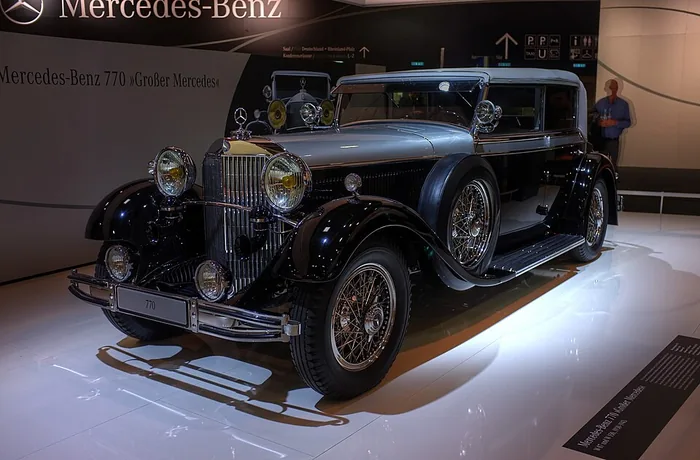
| Predecessor generation | W07 Typ 770 (1930–1938) — see Typ 770 hub |
| Related W150 bodies | Cab B, Cab D, Cab F, Tourenwagen |
| W150 programme scale | Approximately 88 W150-series cars (all bodies combined) |
Body & dimensions (W150 chassis class)
| Specification | Details |
|---|---|
| Wheelbase | Approximately 3,880 mm (about 153 in) |
| Overall length | Roughly 6,000 – 6,500 mm depending on body and equipment |
| Width | About 2,100 – 2,500 mm class depending on body and armour packages |
| Height | About 1,900 mm class |
| Chassis | Oval-section tube frame; independent front suspension; de Dion rear axle; coil springs |
| Brakes | Hydraulic brakes (advance over W07 mechanical servo system) |
| Special equipment | Selected cars ordered with armour glass, steel plating, and related security fittings — verify on the individual vehicle |
Engine specifications (W150 / M150 theme)
| Theme | Details |
|---|---|
| Configuration | Inline eight-cylinder petrol, related architecture to W07 M07 but revised |
| Displacement | 7,665 cc |
| Output (naturally aspirated) | About 155 PS / 155 bhp (116 kW) at roughly 3,000 rpm |
| Output (supercharged) | About 230 PS / 230 bhp (172 kW) at roughly 3,200 rpm with blower |
| Special high-output theme | Literature notes rare twin-supercharged high-power cars (very small numbers) — individual verification required |
| Top speed class | Around 170 km/h quoted for typical supercharged cars; higher figures claimed for rare high-output versions |
Drivetrain (W150)
| Category | Details |
|---|---|
| Gearbox | Five-speed manual; fourth direct, fifth overdrive-style in period descriptions |
| Drive | Rear-wheel drive |
| Suspension | Independent front; de Dion rear; coil springs |
| Brakes | Hydraulic drums suited to very high mass when well maintained |
Mercedes-Benz “Grosser Mercedes” Tourenwagen: body identity on the W150 Grosser chassis
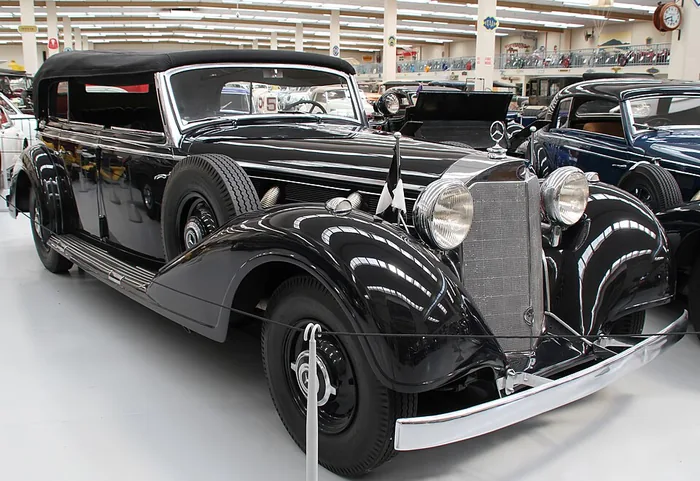
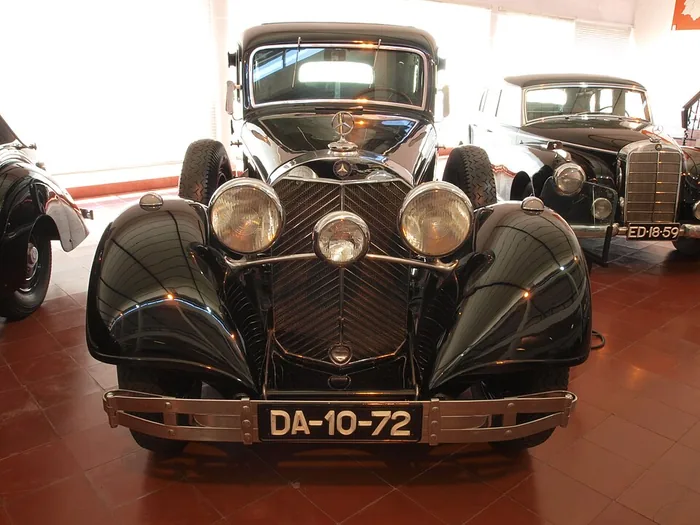
The Grosser Mercedes Tourenwagen on the W150 chassis is the second-generation open multi-seat touring and parade body. It continues the ceremonial visibility role of the earlier W07 Tourenwagen on the more advanced oval-tube chassis with hydraulic brakes and revised eight-cylinder output.
Programme years for this entry follow approximately 1939–1943 within the broader W150 window that sees final bodies into 1944 in family tallies. About 88 W150 cars were built in total across all bodies.
Related W150 styles: Cabriolet B, D, F. Hub: Typ 770.
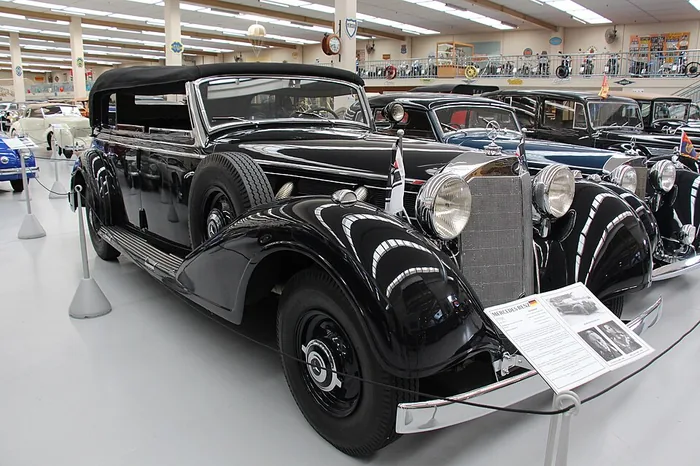
Image source: Wikimedia Commons
Design and coachwork
Open multi-seat design prioritises passenger visibility and capacity. Weather equipment may be simpler than full formal cabriolets depending on order. Side screens and seating rows must be confirmed on the vehicle.
Armoured or security-modified tourers exist in the wider W150 story; they change glass thickness, door mass, and recommended maximum speeds. Treat each car as a specification island.
Post-war paint and military-use repaints appear on some survivors. Conservation choices should be documented for future researchers.
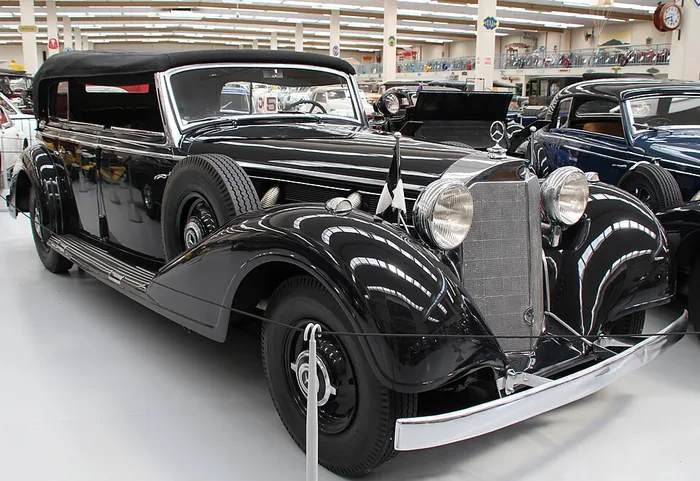
Image source: Wikimedia Commons
Mechanical basis and driving character
Driving character is formal open progress on a sophisticated heavy chassis. Hydraulic brakes help when correctly maintained; neglect cancels the advantage. Independent front suspension improves road holding relative to W07 beam axles without making the car agile in a modern sense.
Full passenger loads and parade idle periods stress cooling. Plan events with thermal management in mind.
Five-speed gearing rewards smooth formal driving rather than rushed shifts.
Collecting and documentation
Tourenwagen photographs are common in period archives; chassis identity remains the only reliable anchor. Compare asking prices against completeness of weather gear and originality of major components.
Read alongside the Cabriolet F page for the most ceremonial open alternative on the same generation.
Ownership: strengths and things to watch
Strengths
- Second-generation open multi-seat role — visibility on updated chassis.
- Improved control potential — IFS and hydraulics when maintained.
- Rich post-war history layers — useful for serious exhibitions if recorded.
Things to watch
- Deferred suspension/brake work — “later” is not automatically safer.
- Paint archaeology — institutional repaints hide schemes worth recording.
- Transport damage — soft straps and rear overhang on open multi-seat bodies.
- Event speed discipline — processions only, not mixed motorway stages.
Sibling comparisons
W150 Tourenwagen is second-generation open multi-seat visibility. Compare with W150 cabriolets B/D/F for convertible formality and with W07 Tourenwagen for the earlier chassis. Hub page for generation mechanics.
Legacy
The W150 Tourenwagen continues open multi-seat visibility on a more modern chassis. Post-war custody layers often matter as much as delivery colour; paint archaeology is part of the story.
Transport discipline and honest event speeds are how remaining tourers stay legible objects rather than damaged props.
Leave a Reply
You must be logged in to post a comment.