General information & model overview
| Category | Specification Details |
|---|---|
| Model name | Mercedes-Benz “Grosser Mercedes” Cabriolet B (W150) (1938–1943) |
| Family | Mercedes-Benz Typ 770 / “Grosser Mercedes” second generation |
| Internal code | W150 |
| Production years | Approximately 1938 – 1943 within the W150 programme (chassis programme into early 1940s; last bodies delivered into 1944 in family tallies) |
| Manufacturer | Daimler-Benz AG |
| Market role | Ultra-luxury / state and ceremonial flagship; most expensive German passenger car class of its moment, often priced “on request” |
| Body focus of this entry | Cabriolet B — formal open body on W150, typically less Pullman-extreme than D/F |
| Layout | Front-engine, rear-wheel drive |
| Predecessor generation | W07 Typ 770 (1930–1938) — see Typ 770 hub |
| Related W150 bodies | Cab B, Cab D, Cab F, Tourenwagen |
| W150 programme scale | Approximately 88 W150-series cars (all bodies combined) |
Body & dimensions (W150 chassis class)
| Specification | Details |
|---|---|
| Wheelbase | Approximately 3,880 mm (about 153 in) |
| Overall length | Roughly 6,000 – 6,500 mm depending on body and equipment |
| Width | About 2,100 – 2,500 mm class depending on body and armour packages |
| Height | About 1,900 mm class |
| Chassis | Oval-section tube frame; independent front suspension; de Dion rear axle; coil springs |
| Brakes | Hydraulic brakes (advance over W07 mechanical servo system) |
| Special equipment | Selected cars ordered with armour glass, steel plating, and related security fittings — verify on the individual vehicle |
Engine specifications (W150 / M150 theme)
| Theme | Details |
|---|---|
| Configuration | Inline eight-cylinder petrol, related architecture to W07 M07 but revised |
| Displacement | 7,665 cc |
| Output (naturally aspirated) | About 155 PS / 155 bhp (116 kW) at roughly 3,000 rpm |
| Output (supercharged) | About 230 PS / 230 bhp (172 kW) at roughly 3,200 rpm with blower |
| Special high-output theme | Literature notes rare twin-supercharged high-power cars (very small numbers) — individual verification required |
| Top speed class | Around 170 km/h quoted for typical supercharged cars; higher figures claimed for rare high-output versions |
Drivetrain (W150)
| Category | Details |
|---|---|
| Gearbox | Five-speed manual; fourth direct, fifth overdrive-style in period descriptions |
| Drive | Rear-wheel drive |
| Suspension | Independent front; de Dion rear; coil springs |
| Brakes | Hydraulic drums suited to very high mass when well maintained |
Mercedes-Benz “Grosser Mercedes” Cabriolet B: body identity on the W150 Grosser chassis
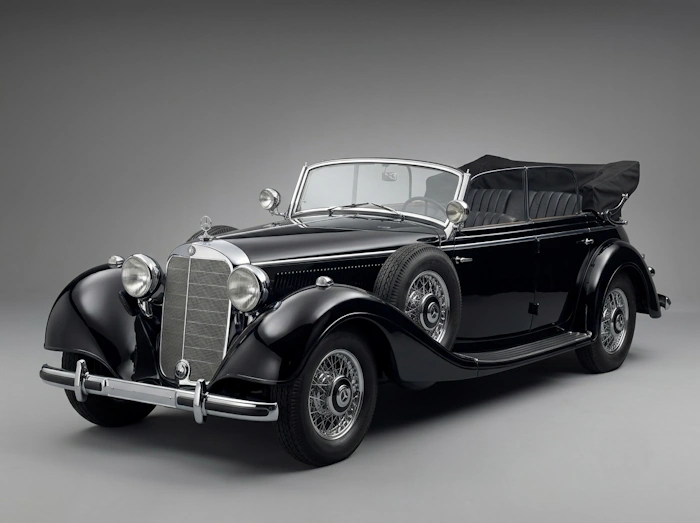
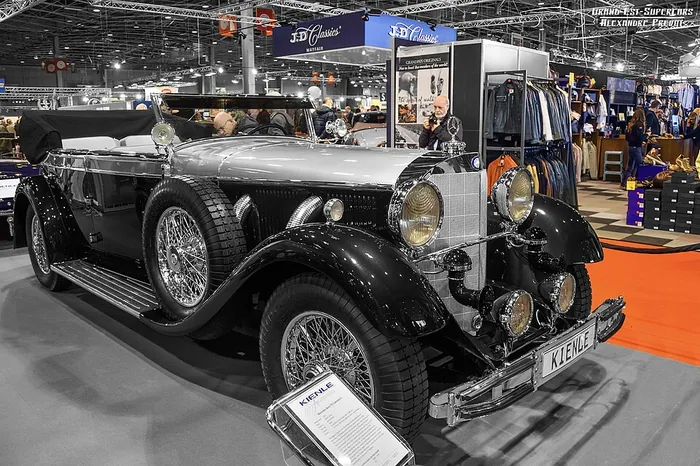
The Grosser Mercedes Cabriolet B on the W150 chassis is a formal open body style within the second-generation Typ 770 programme. Relative to Cabriolet D and F, the B letter generally indicates a less extreme Pullman open arrangement—still a vast flagship convertible, but oriented toward a somewhat more compact formal open social cut. Surviving two-door multi-seat interpretations appear in specialist histories and concours records; confirm layout on the individual car.
Mechanicals are pure W150: 7.7-litre eight, five-speed gearbox, oval-tube chassis, IFS, de Dion rear, hydraulic brakes — see the hub.
Compare with Cabriolet D, F, Tourenwagen, and the earlier W07 Cabriolet B.
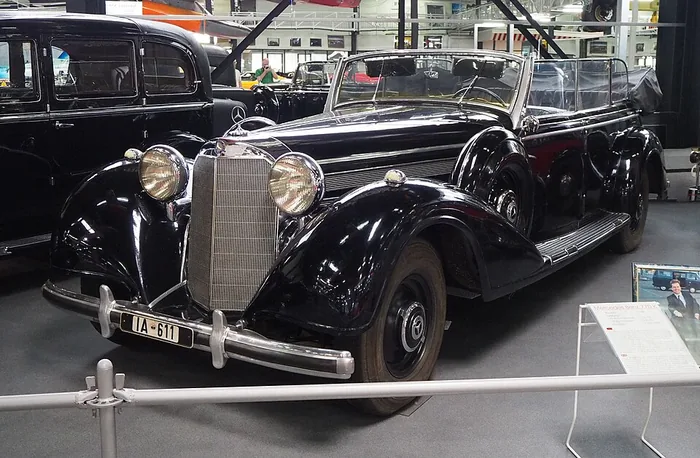
Image source: Wikimedia Commons
Design and coachwork
Design remains long-bonnet formal open Mercedes language of the late 1930s. Folding top, brightwork, and multi-seat cabin define the type. Exact door count and seat arrangement require case-by-case verification.
Because B-bodies can be less common in public memory than parade tourers or armoured formal cars, correct identification depends more on paperwork and measurements than on casual photos.
Restoration ethics should preserve generation-correct chassis details: hydraulic brake hardware and oval-tube frame features must not be confused with W07 practice.
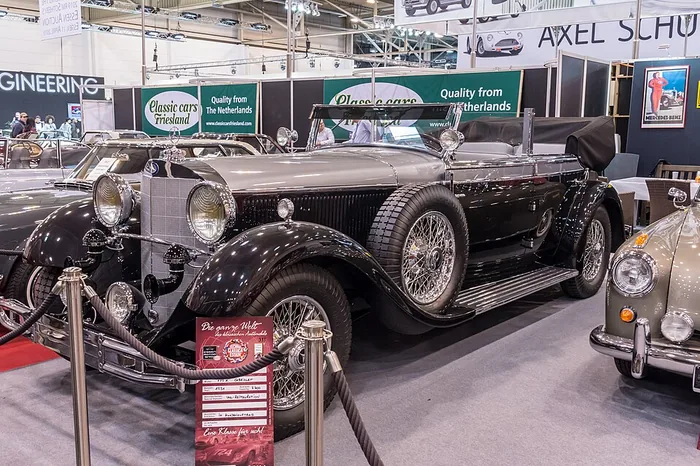
Image source: Wikimedia Commons
Mechanical basis and driving character
Driving character is formal and heavy, with second-generation chassis composure when suspension and brakes are healthy. Supercharged cars offer stronger high-load response. Wind and weather with the top down are normal operating conditions.
Tyre selection must respect mass. Under-rated modern rubber is a safety failure. Cooling systems need full attention after any storage period.
Owners should plan routes that avoid tight multi-storey parking structures and low clearances—simple physical facts of a six-metre-class flagship.
Collecting and documentation
Cabriolet B examples illustrate that not every W150 was a parade tourer or maximum Pullman open car. That diversity matters for a complete Grosser history.
Keep documentation of body letter, engine blower status, and chassis number together. Use the hub and sibling pages for comparative research.
Ownership: strengths and things to watch
Strengths
- Documented less-extreme open W150 cut — fills the family map beyond tourers and F cars.
- Full second-generation engineering — same care standards as larger open siblings.
- Caption-correction value — keeping B visible improves public accuracy.
Things to watch
- Identity erasure — vague “Grosser cabriolet” paperwork.
- Hydraulic and oval-tube neglect — letter does not simplify mechanics.
- Fifth-gear health — confirm overdrive-style ratio behaviour.
- Reassembly documentation — number mounts before body-off work.
Sibling comparisons
W150 Cabriolet B is formal open without always matching D/F bulk. Use D or F when paperwork and body scale show larger ceremony; Tourenwagen when multi-seat open utility dominates. W07 B is leaf-spring generation only.
Legacy
W150 Cabriolet B is the second-generation open cut most at risk of vanishing into vague captions. Keeping the B letter visible in papers and photo credits is itself a conservation act.
Full W150 mechanical standards still apply; body letter changes coachwork cost, not the need for oval-tube and hydraulic care.
Leave a Reply
You must be logged in to post a comment.