General information & model overview
| Category | Specification Details |
|---|---|
| Model name | Mercedes-Benz “Grosser Mercedes” Cabriolet D (W150) (1938–1943) |
| Family | Mercedes-Benz Typ 770 / “Grosser Mercedes” second generation |
| Internal code | W150 |
| Production years | Approximately 1938 – 1943 within the W150 programme (chassis programme into early 1940s; last bodies delivered into 1944 in family tallies) |
| Manufacturer | Daimler-Benz AG |
| Market role | Ultra-luxury / state and ceremonial flagship; most expensive German passenger car class of its moment, often priced “on request” |
| Body focus of this entry | Cabriolet D — large formal multi-seat open body on W150 |
| Layout | Front-engine, rear-wheel drive |
| Predecessor generation | W07 Typ 770 (1930–1938) — see Typ 770 hub |
| Related W150 bodies | Cab B, Cab D, Cab F, Tourenwagen |
| W150 programme scale | Approximately 88 W150-series cars (all bodies combined) |
Body & dimensions (W150 chassis class)
| Specification | Details |
|---|---|
| Wheelbase | Approximately 3,880 mm (about 153 in) |
| Overall length | Roughly 6,000 – 6,500 mm depending on body and equipment |
| Width | About 2,100 – 2,500 mm class depending on body and armour packages |
| Height | About 1,900 mm class |
| Chassis | Oval-section tube frame; independent front suspension; de Dion rear axle; coil springs |
| Brakes | Hydraulic brakes (advance over W07 mechanical servo system) |
| Special equipment | Selected cars ordered with armour glass, steel plating, and related security fittings — verify on the individual vehicle |
Engine specifications (W150 / M150 theme)
| Theme | Details |
|---|---|
| Configuration | Inline eight-cylinder petrol, related architecture to W07 M07 but revised |
| Displacement | 7,665 cc |
| Output (naturally aspirated) | About 155 PS / 155 bhp (116 kW) at roughly 3,000 rpm |
| Output (supercharged) | About 230 PS / 230 bhp (172 kW) at roughly 3,200 rpm with blower |
| Special high-output theme | Literature notes rare twin-supercharged high-power cars (very small numbers) — individual verification required |
| Top speed class | Around 170 km/h quoted for typical supercharged cars; higher figures claimed for rare high-output versions |
Drivetrain (W150)
| Category | Details |
|---|---|
| Gearbox | Five-speed manual; fourth direct, fifth overdrive-style in period descriptions |
| Drive | Rear-wheel drive |
| Suspension | Independent front; de Dion rear; coil springs |
| Brakes | Hydraulic drums suited to very high mass when well maintained |
Mercedes-Benz “Grosser Mercedes” Cabriolet D: body identity on the W150 Grosser chassis
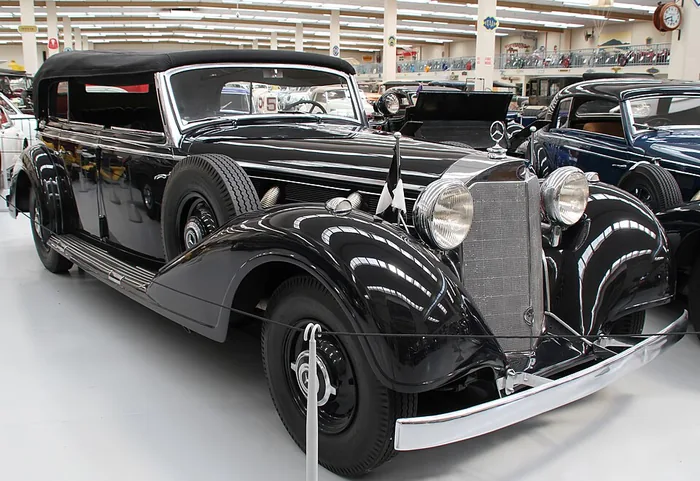
The Grosser Mercedes Cabriolet D on the W150 chassis is a large formal open body for multi-seat ceremonial and elite social use in the second-generation Typ 770 programme. It parallels the role of the W07 Cabriolet D on a longer, more modern chassis with hydraulic brakes and five-speed transmission.
Production sits inside the approximate 1938–1943 body window of W150 open formal cars. Shared mechanicals and generation context are on the Typ 770 hub.
Siblings: Cabriolet B, Cabriolet F, Tourenwagen.
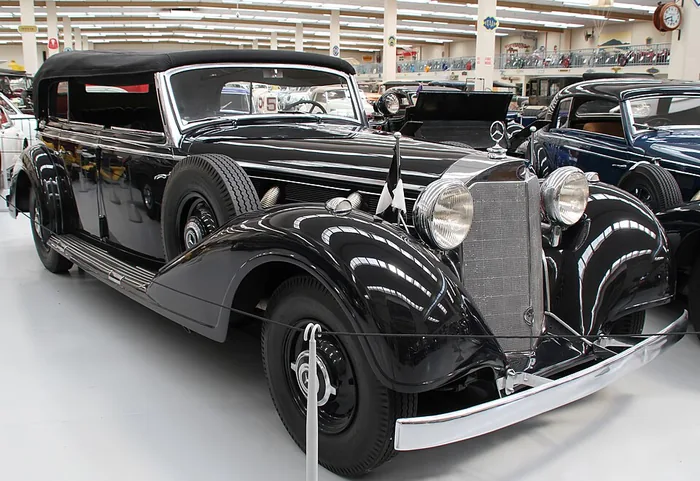
Image source: Wikimedia Commons
Design and coachwork
Coachwork emphasises multi-seat open formality with a substantial folding top. Door arrangements and rear compartment fittings vary by order and should be matched to period documentation.
Length and mass exceed ordinary luxury convertibles by a wide margin. Workshop lifts, storage buildings, and transport trailers must be sized accordingly before acquisition.
Interior richness and brightwork quality are part of flagship identity. Incomplete interiors reduce both historical value and practical usability.
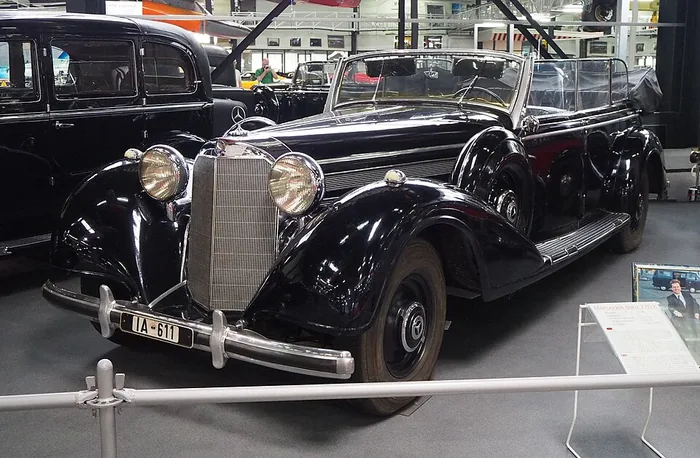
Image source: Wikimedia Commons
Mechanical basis and driving character
On the road the Cabriolet D is a formal open carriage with second-generation chassis benefits. Supercharged output around the 230 PS class provides strong period reserve under full throttle; unblown cars rely on the eight’s flexibility.
Hydraulic brakes require correct fluid, seals, and adjustment. A large open Grosser with tired brakes is unsafe regardless of engine health.
Fair-weather use remains realistic. Soft-top seals of the late 1930s are not modern convertible systems.
Collecting and documentation
Document supercharger status, armour if any, and coachwork originality. Letter-code confusion between D and F is common in informal descriptions—measure the car against known D/F hallmarks and papers.
Specialist insurance and conservation plans should exist before transport or public display.
Ownership: strengths and things to watch
Strengths
- Large formal multi-seat open W150 — ceremony with five-speed and hydraulics.
- Clear neighbour pages — B, F, Tourenwagen for comparison.
- Strong period presence — length and cabin make the generation obvious.
Things to watch
- Long brake pipe runs — corrosion and chafing points.
- Trim pattern accuracy — post-war convertible patterns will not fit.
- D vs F sales inflation — measure and paper-match.
- Top fastener inventory — bag every clip during work.
Sibling comparisons
W150 Cabriolet D is large formal multi-seat open on the later chassis. F is rarer and more Pullman-extreme; B is usually the less extreme open cut; Tourenwagen differs in equipment emphasis. W07 D is not the same car.
Legacy
W150 Cabriolet D keeps large formal open multi-seat use on the later drivetrain and brake package. It shows continuity of ceremony with updated chassis engineering.
Correct lettering and fastener-level documentation during restoration keep D-bodies from dissolving into generic open-Grosser mythology.
Leave a Reply
You must be logged in to post a comment.