Most concept cars are built to be admired and then quietly forgotten — a motor-show curiosity that never touches a production line. Mercedes-Benz treats them differently.
Inside the company, a concept car is closer to a public sketchbook: a way of testing a design language, a technology, or a piece of interior thinking in front of the world before committing it to a car people will actually buy. Trace the brand’s recent concept vehicles and a pattern shows up quickly — almost none of them are dead ends.
They’re previews, and the gap between "concept" and "customer" has been getting shorter.
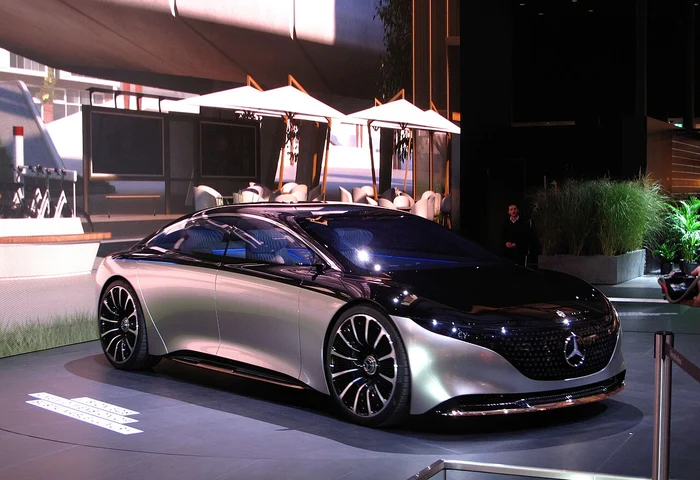
Image source: Wikimedia Commons
The prototype that never stopped paying off
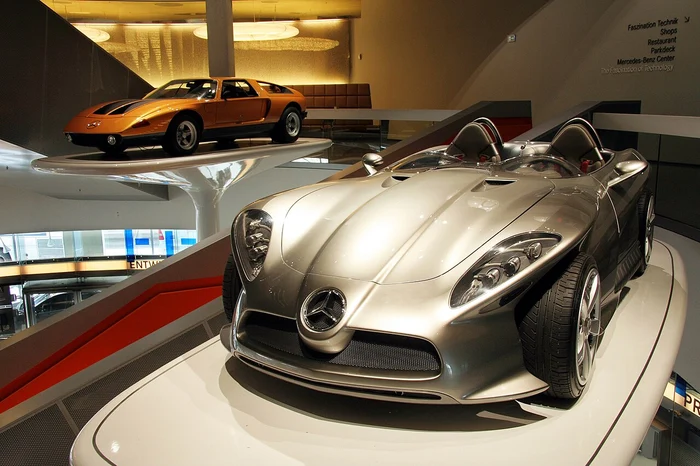
Long before "concept car" meant a polished stage piece with a single press release attached, Mercedes had already run the idea’s most extreme version. Between 1969 and 1970, and again through the mid-1970s, the company built a series of experimental prototypes under one shared codename: C111.
Penned by a young Bruno Sacco, the wedge-shaped, gullwing-doored C111 wasn’t built with any intention of reaching a showroom — Mercedes used it, across more than a dozen individual cars, purely as a rolling laboratory. Early versions tested a three- and later four-rotor Wankel engine; when that technology proved too thirsty and too short-lived for the durability standards Mercedes required, the same chassis was repurposed to test turbodiesel power instead, eventually setting more than a dozen speed records at Nardò.
Along the way, the C111 program also became an early test bed for fiberglass-reinforced body construction, multi-link rear suspension, and anti-lock braking — technologies that quietly migrated into ordinary production Mercedes models over the following two decades, long after the orange wedge itself had been retired to the company museum. It’s a useful reminder that the link between Mercedes concept cars and Mercedes production cars isn’t a recent marketing innovation; it’s closer to house style, dating back more than fifty years.
The face before the face
Perhaps the clearest example of a concept doing real design work is the Vision EQS, shown at the Frankfurt motor show in 2019.
- a smooth, aerodynamically driven ".
- one-bow".
- silhouette with a minimized traditional grille, previewing almost exactly the face that would appear on the production EQS two years later.
The Vision AVTR, unveiled at CES in January 2020, pushed the same design vocabulary somewhere far stranger. Built as a tie-in with the film Avatar: The Way of Water, its balloon-like wheels, fiber-optic "nerve pathway" lighting, and control interface built around a small joystick in place of a steering wheel were never destined for a showroom in that literal form.
But chief designer Gorden Wagener pointed out that the AVTR’s front-end treatment previewed the EQS sedan’s actual production face months before that car was revealed — a reminder that even the most theatrical concept cars tend to be doing quieter, more practical design work underneath the spectacle.
A face borrowed from a concept, three years early
The clearest evidence that Mercedes treats its concepts as genuine design drafts rather than throwaway theater is how often a specific detail shown on a stage resurfaces almost unchanged on a showroom floor. The one-bow roofline that defined the Vision EQS in 2019 is a good example: rather than being softened or abandoned before production, it was carried through with relatively little compromise onto the production EQS sedan that followed.
Mercedes has been explicit that this particular silhouette — a single, unbroken visual gesture running from the base of the windshield to the trunk — was deliberately developed as a signature shape for the brand’s electric cars specifically, distinct from the proportions used on its combustion-engine models, which meant the concept car’s job wasn’t just to look striking under studio lighting but to establish a repeatable formula the design studio could apply across an entire sub-lineup.
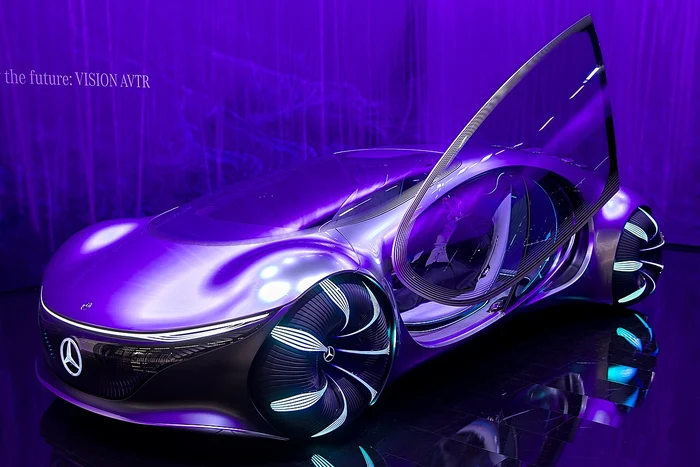
Image source: Wikimedia Commons
Concepts as technology test beds
Not every concept exists to preview a shape. Some exist to prove a number.
The VISION EQXX, revealed at CES in January 2022, was built almost entirely around a single engineering target: maximum efficiency from a single charge. Mercedes’ own account of the car describes an aerodynamic body with an unusually low drag coefficient, a battery and drivetrain combination engineered for roughly 95 percent efficiency, and an estimated range beyond 1,000 kilometers on one charge, aided by solar cells integrated into the roof and hood.
The EQXX wasn’t meant to be sold as-is; it was meant to prove that figures like that were achievable at all, with the expectation that its lightweight construction, thermal management, and motor efficiency gains would filter into future production EVs piece by piece rather than arrive as one finished car.
The F 015 Luxury in Motion, shown at CES in January 2015, ran the same test-bed logic against a different question: what happens to a car’s interior once it no longer strictly needs a driver. Built as a research vehicle around autonomous-driving technology, its lounge-like cabin — with seats able to rotate to face one another — was less a marketable feature than a provocation, an attempt to get the industry and the public thinking seriously about what a passenger compartment becomes when driving stops being the main activity happening inside it.
Concepts as a return address
Not all of Mercedes’ concept work points forward. A recurring thread runs the other direction — concept cars built explicitly to reconnect a design department with its own archive before deciding where to go next.
The Vision Mercedes Simplex, for instance, reimagined the brand’s early-1900s Simplex model as a two-seat electric roadster, using a piece of pre-war history as license to experiment with proportions a modern production car couldn’t get away with.
That instinct resurfaced most visibly with the Vision Iconic, unveiled in Shanghai in October 2025 under outgoing design chief Gorden Wagener’s final months in the role. Where the EQ-era concepts had spent nearly a decade minimizing the traditional Mercedes grille in favor of smoothed-over EV noses, the Vision Iconic did the opposite, reviving a tall, upright, heavily chromed grille that deliberately echoed the brand’s prewar Simplex-era cars.
It was a pointed statement at a moment of leadership transition — Wagener would step down at the end of January 2026, handing the studio to Bastian Baudy, previously head of design at Mercedes-AMG — and it left an open question about which of the brand’s two recent instincts, the smoothed EQ face or the revived vertical grille, will actually define the next generation of production Mercedes models.
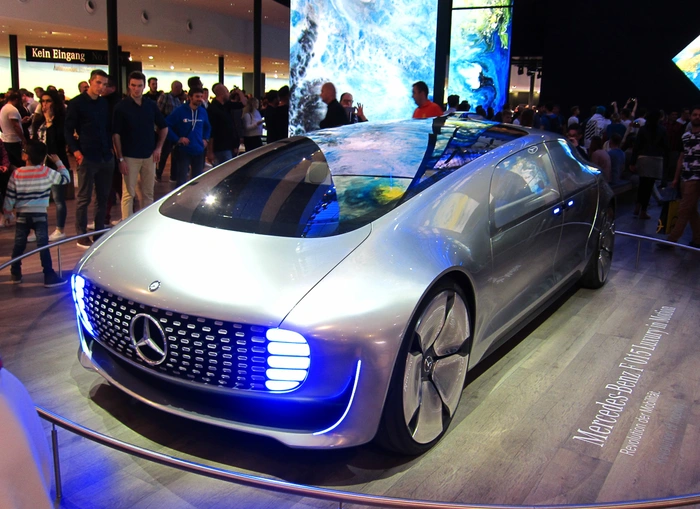
Image source: Wikimedia Commons
Concepts built to make a scene
Not every concept is chasing a production date at all, and it would be misleading to suggest Mercedes only builds show cars with a business case attached. The Vision Tokyo, shown in 2015, was conceived as what the company called a "spatial experience" — a monolithic, lounge-like design study built to reflect a specific city rather than preview a specific model, with no real expectation of a production descendant.
The Vision EQ Silver Arrow, unveiled at the Pebble Beach Concours d’Elegance in 2018, was a similarly self-contained exercise: a one-seat, open-wheeled electric homage to Mercedes’ 1930s Grand Prix Silver Arrow racers, built to connect the brand’s electric future to its motorsport past rather than to signal an upcoming model.
These cars matter for a different reason than the EQXX or the Vision EQS — they’re less about engineering targets or production silhouettes, and more about keeping a 140-year-old brand’s design department fluent in its own history, so that when a genuine production preview like the Vision Iconic does arrive, it has decades of visual vocabulary to draw from rather than a blank page.
A studio still deciding on its own next move
There is one more reason Mercedes’ concept output rewards close attention right now: the design department producing it is mid-transition. Bastian Baudy, who took over the top design role in early 2026 after Gorden Wagener’s departure, spent his prior years leading design at Mercedes-AMG, a division with its own, sharper-edged visual instincts than the mainstream Mercedes-Benz line.
How much of that AMG sensibility carries over into the wider brand’s concept output over the next few years — and how much the Vision Iconic’s revived vertical grille turns out to be a genuine signal rather than a one-off nostalgia piece — is something only the next handful of motor-show unveilings will actually answer.
For a company that has spent fifty years using concept cars to think out loud before committing to a shape, that makes the current run of show cars worth watching more closely than usual.
Why the pattern matters
What separates Mercedes’ concept-car output from a typical motor-show highlight reel is how consistently these ideas complete the journey into showrooms. A one-bow silhouette shown on a stage in Frankfurt in 2019 was steering the wheel of a customer’s car within two years.
A digital cockpit idea sketched for a concept interior became the working infotainment system in a compact-class Mercedes. A drag-reduction figure chased purely to win a press cycle became the quiet engineering target behind an entire generation of production EVs.
Read that way, a Mercedes concept car isn’t really a fantasy about the future — it’s closer to a public first draft, built to be argued over, refined, and eventually driven.
Leave a Reply
You must be logged in to post a comment.