Say "Hey Mercedes" inside a current Mercedes-Benz and something happens that would have seemed like science fiction inside an S-Class a decade ago: the car listens, understands context, and responds in natural language, without a menu button in sight.
That moment — the wake word, the pause, the reply — is the most visible piece of a system called MBUX, or Mercedes-Benz User Experience, and it has quietly become one of the most consequential engineering projects the company runs. Depending on how you count, MBUX is now on its third or fourth major generation, and its story says as much about how cars are built today as it does about touchscreens.
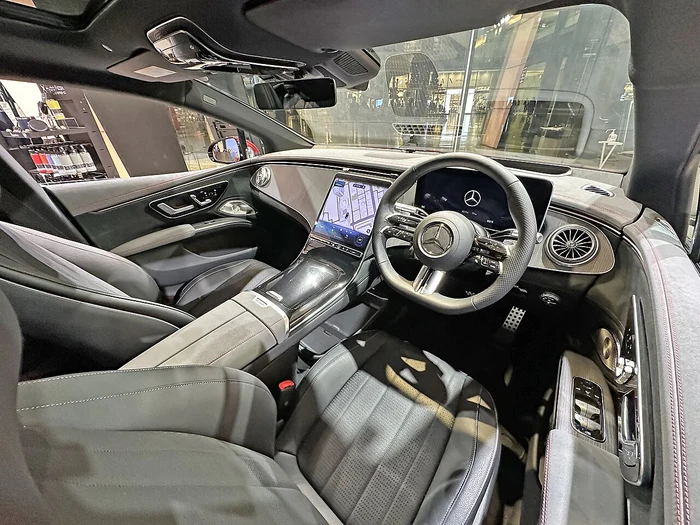
Image source: Wikimedia Commons
Why MBUX exists
Before 2018, Mercedes’ infotainment systems — like most of the industry’s — were built around a rotary controller (COMAND) and a fairly rigid menu tree. It worked, but it treated the car’s software the way the industry had always treated it: as a feature bolted onto a mechanical product, updated once every model cycle if at all.
MBUX was conceived as something different — an interface designed to learn, to be updated after the car left the factory, and to feel less like operating a machine and more like talking to an assistant. The name itself was a small piece of marketing theater: engineers reportedly considered "MBUE" before settling on the more memorable MBUX, leaning into "UX" — user experience — as the organizing idea rather than "infotainment" as a feature list.
Generation one: 2018, the A-Class starts it
MBUX had its world premiere at CES in Las Vegas in January 2018, and rather than debut in the flagship S-Class, Mercedes chose to launch it first in the compact A-Class — a deliberate signal that this was meant to be a lineup-wide platform, not a halo-model indulgence. The first generation introduced the pieces that still define MBUX today: a widescreen digital cockpit combining driver display and central touchscreen under a single black-panel surface, touch control on the steering wheel and center console, augmented-reality navigation that overlaid directional graphics onto a live camera feed of the road ahead, and natural-language voice control triggered by "Hey Mercedes." Crucially, the system used artificial intelligence to adapt to individual drivers over time and could receive updates over the air — a genuinely new idea for a mainstream automaker’s cabin electronics in 2018, borrowed more from smartphone culture than from traditional car development cycles.
Generation two: 2021, the Hyperscreen moment
The second major step arrived with the 2021 S-Class and, more dramatically, with the MBUX Hyperscreen — an optional, almost dashboard-wide expanse of glass housing the driver display, central touchscreen, and front passenger display as one continuous surface, at the time the largest human-machine interface Mercedes had ever built.
Under that glass, the second generation was meaningfully quicker and more capable than the first: faster processing, more fluid graphics, and a voice assistant that could handle more conversational, less rigidly phrased requests. It extended down through the lineup over the following years, reaching everyday models like the C-Class and GLC rather than staying confined to the S-Class and EQS.
Generation three: 2024 onward, software takes the wheel
The most recent step, introduced with the current E-Class generation and described internally as the third significant development phase of MBUX, includes an optional MBUX Superscreen and is described by Mercedes as more intelligent and more capable of learning than its predecessors. The more important change may be underneath the glass rather than on it: the underlying electronics architecture has shifted to be more software-defined and less hardware-fixed, which in practice means the interior systems can be updated and individually configured after purchase far more extensively than earlier generations allowed — closer to how a smartphone receives feature updates than how a traditional car’s cabin electronics used to work.
Learning to recognize a face, a voice, a preference
Personalization was part of MBUX’s pitch from the very first generation, but it has become more layered with each successive one. Early MBUX cars could remember a driver’s seat position, climate preferences, and favorite radio stations tied to a profile.
Later generations extended that recognition further into the cabin — biometric elements like fingerprint or face recognition on higher trims, multiple simultaneous driver profiles that could be switched automatically as different family members got behind the wheel, and a voice assistant capable of handling compound, conversationally phrased requests ("it’s a bit warm in here and I need directions to the nearest charging station") rather than requiring a single rigid command at a time.
None of this personalization work shows up on a traditional spec sheet next to horsepower and torque, but it’s arguably done more to change how owners actually interact with a modern Mercedes on a daily basis than any single mechanical upgrade of the same period.
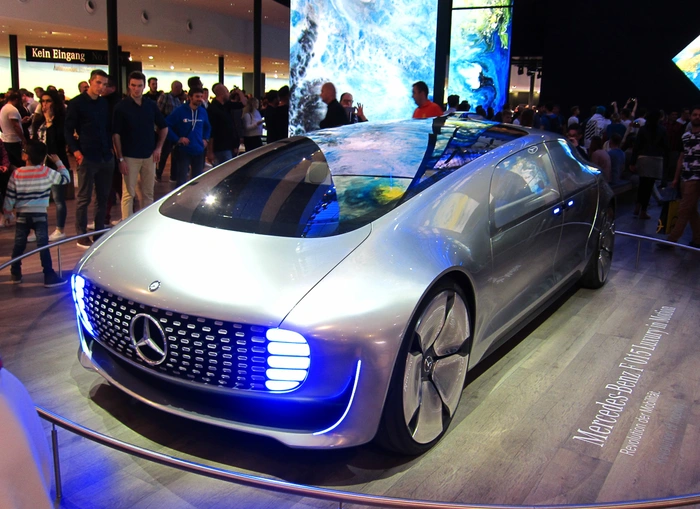
Image source: Wikimedia Commons
Where the ideas actually came from
MBUX didn’t appear out of nowhere. Mercedes has said the system draws direct inspiration from the interior concepts shown in its Vision EQS concept car, which imagined cabin displays as a kind of "virtual digital arena" rather than a cluster of separate screens — an idea that fed fairly directly into the panoramic, edge-to-edge display treatments that followed in production form.
It’s a pattern that recurs throughout Mercedes’ recent history: concept-car cabin ideas that look far-fetched at a motor show tend to resurface, tempered and productionized, two or three model cycles later.
The trade-offs nobody puts on a spec sheet
Every generation of MBUX has also had to answer a harder question than "what can it do": how much should a driver be asked to touch a screen while driving. Mercedes has pushed hard on voice and gesture control partly for convenience, but explicitly framed around reducing distraction — a touch-first system only works as a safety proposition if there’s a reliable way to avoid using touch for the input in the first place.
That’s part of why voice recognition natural enough to skip rigid command phrases, rather than requiring drivers to memorize exact trigger words, has been treated as a genuine engineering priority across every generation rather than a marketing footnote.
The part that never makes the launch keynote: over-the-air updates
One of the least glamorous but most consequential decisions made in MBUX’s first generation was building the system to accept software updates after the car had already been sold. It sounds minor next to a Hyperscreen or an AI voice assistant, but it changes the relationship between the automaker and the vehicle.
A traditional infotainment system was effectively frozen the day it left the factory; fixing an interface quirk or adding a feature meant waiting for the next model year, or it simply never happened at all. An over-the-air-capable system turns the car into something closer to a product with a lifecycle — the navigation engine, the voice assistant’s vocabulary, and even some comfort and convenience functions can be revised long after delivery.
That’s also, in practical terms, what enabled Mercedes to describe the newest MBUX generation as more software-driven and less hardware-driven than its predecessors: once an automaker commits to updating a car’s brain after the sale, it has an incentive to build more of that brain in software in the first place, rather than fixing capability in physical hardware that can’t be revised.
Screens as real estate, not just displays
Each MBUX generation has also had to answer a question that has nothing to do with processing power: how much of the dashboard should actually be screen. The first generation kept the driver display and central touchscreen as two distinct panels sharing a single black surface.
The Hyperscreen, in the second generation, argued for merging driver display, central screen, and a front-passenger display into one continuous band of glass spanning nearly the full width of the dashboard — a genuinely different design proposition, since it meant treating the passenger not just as a rider but as a second user of the car’s software, with their own separate content and permissions.
The current generation’s optional Superscreen extends that logic further while pairing it with the more software-driven backend described above, suggesting Mercedes now sees the size of the display less as a luxury flex and more as a settled architectural decision that different models simply scale up or down.
The bigger shift MBUX represents
Step back from the individual screens and MBUX tells a broader story about how Mercedes-Benz builds cars now. A rotary-controller infotainment system from the early 2010s was, functionally, finished the day the car shipped.
MBUX is closer to a platform than a product: a system built assuming it will change after the sale, developed by a company that increasingly thinks of its cabin electronics the way a technology company thinks about an operating system — versioned, updatable, and expected to keep getting better long after the car has left the dealership. Whether that comparison flatters the automotive industry or the technology industry more is a matter of taste.
What’s not in dispute is that the black-panel screen glowing on an A-Class dashboard in 2018 turned out to be the opening chapter of something Mercedes is still actively rewriting.
Leave a Reply
You must be logged in to post a comment.