General information & model overview
| Category | Specification Details |
|---|---|
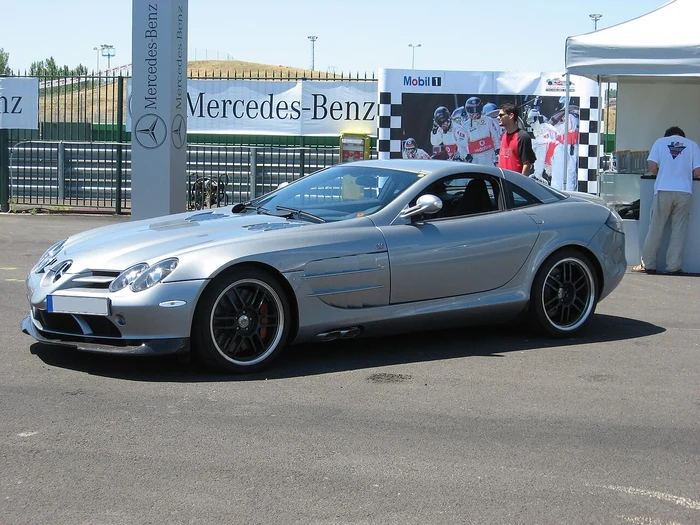
| Model name | 2006 Mercedes-Benz SLR McLaren 722 Edition |
| Internal code | C199 (limited 722 Edition coupé) |
| Manufacturers | Mercedes-Benz / AMG engine build; McLaren Technology Centre assembly at Woking |
| Introduction | Announced mid-2006 as a performance-focused limited edition of the SLR coupé |
| Production limit | Approximately 150 units (often cited as 150; some registries list figures near 151) |
| Name origin | “722” recalls the race number of Stirling Moss and Denis Jenkinson’s 1955 Mille Miglia-winning Mercedes-Benz 300 SLR (start time 7:22) |
| Body style | Two-door, two-seat coupé with butterfly doors (closed car only for this edition) |
| Layout | Front mid-engine, rear-wheel drive |
| Base car relationship | Uprated, lowered, and aerodynamically revised version of the 2003 SLR McLaren coupé |
| Related open cars | Roadster 722 S (later open counterpart, separate limited run); family also includes base Roadster and Stirling Moss |
Body & dimensions
| Specification | Details |
|---|---|
| Wheelbase | 2,700 mm (106.3 in) — shared SLR hard point |
| Overall length | 4,656 mm (183.3 in) class |
| Overall width | 1,909 mm (75.2 in) class |
| Ride height | Approximately 10 mm lower than the base coupé |
| Construction | CFRP structure and body themes as SLR family; detail mass reduction via wheels, damper hardware, and interior materials |
| Curb weight (approximate) | About 1,724 kg class in some documentation; other period sources cite roughly 20–45 kg less than a typical base coupé depending on equipment baseline |
| Visual identifiers | Red “722” badging, darker-tinted lamp treatments, revised front splitter / air dam, revised rear diffuser, 19-inch forged light-alloy wheels |
| Interior themes | Black leather with Alcantara elements, red stitching, extensive carbon-fibre trim; Alcantara-rimmed steering wheel in period descriptions |
Engine specifications
| Theme | Details |
|---|---|
| Engine | M155 SLR 5.4-litre supercharged V8, 722-specific calibration |
| Displacement | 5,439 cc |
| Peak power | 478 kW / 650 PS (641 hp) at 6,500 rpm |
| Peak torque | 820 Nm (605 lb-ft) at about 4,000 rpm |
| Delta versus base SLR | +24 PS and +40 Nm versus the standard 626 PS / 780 Nm tune |
| How the gain was achieved | Primarily engine-management remapping and related calibration of the supercharged M155 rather than a wholly different bottom end |
| Induction / architecture | Same twin-screw supercharger, intercoolers, dry-sump, SOHC three-valve architecture as the base car |
Drivetrain & transmission
| Category | Details |
|---|---|
| Gearbox | AMG SPEEDSHIFT R five-speed automatic with manual modes |
| Controls | Period 722 cars use aluminium shift paddles (versus earlier wheel-button arrangements on some base cars) |
| Drive | Rear-wheel drive |
Chassis, suspension & brakes
| Component | Specification |
|---|---|
| Suspension | Stiffer damper calibration than base SLR; 10 mm lower ride height |
| Wheels | 19-inch light-alloy (forged) wheels reducing unsprung mass versus typical base fitment |
| Front brakes | Larger carbon-ceramic front discs about 390 mm (15.4 in) with high-performance callipers (Brembo association in period press) |
| Aerodynamics | Revised front air dam / splitter (period claims of large front-axle downforce increase without a matching drag penalty); revised rear diffuser; air-brake angles set more aggressively (about 15° automatic / up to about 35° selected versus base 10° / 30°) |
| Brake system type | Carbon-ceramic with Sensotronic Brake Control lineage shared with the family |
Performance (approximate)
| Metric | Approximate data |
|---|---|
| 0–100 km/h | About 3.6 seconds (manufacturer) |
| 0–200 km/h | About 10.2 seconds (manufacturer class) |
| 0–300 km/h | About 27.6 seconds (manufacturer class) |
| Top speed | About 337 km/h (209 mph) |
| Position versus base | Faster in acceleration and top speed than the 626 PS base coupé; firmer chassis response on secondary roads and circuits |
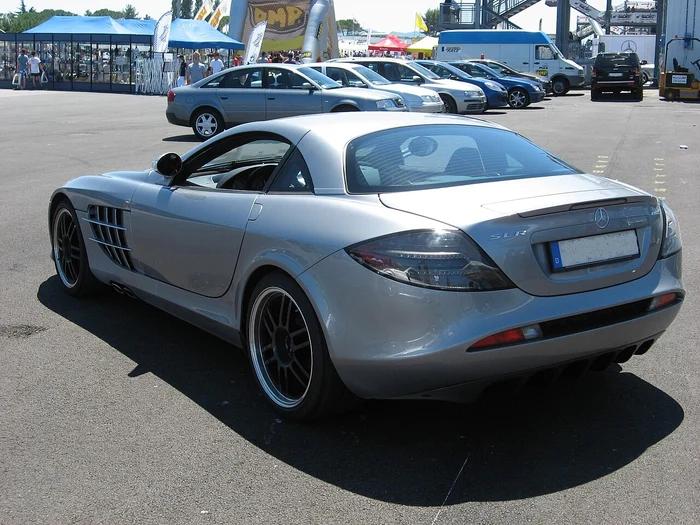
Image source: Wikimedia Commons
What the 722 Edition is
The 2006 Mercedes-Benz SLR McLaren 722 Edition is the first major factory performance step above the base C199 coupé. It keeps the closed butterfly-door body and the same fundamental architecture — carbon structure from Woking, supercharged M155 from Affalterbach, five-speed AMG SPEEDSHIFT R — but raises power to 650 PS and 820 Nm, lowers and firms the suspension, enlarges the front ceramics, revises aero hardware, and limits production to about 150 cars. The name does not refer to horsepower. It commemorates Stirling Moss’s 1955 Mille Miglia start number 722 on a 300 SLR.
For collectors and historians, the 722 is the reference “driver’s” closed SLR of the Mercedes–McLaren era before the more extreme open Stirling Moss speedster. A later Roadster 722 S applied similar mechanical themes to the open R199 body; that open car is related but separate from this closed Edition entry.
Why “722” matters in Mercedes history
On 1 May 1955, Stirling Moss and Denis Jenkinson won the Mille Miglia in a Mercedes-Benz 300 SLR carrying race number 722, corresponding to a 7:22 a.m. start. That victory is one of the most famous results in Mercedes sports-car history. When Mercedes and McLaren wanted a name that signalled a sharper SLR without inventing a new chassis code family, they reused 722 as an edition badge. The modern car is not a recreation of the 1955 racer. It is a limited road coupé that borrows the number and the association with Moss.
The later SLR Stirling Moss (Z199) takes the tribute further by naming the car after the driver and removing roof and windscreen in a speedster layout. The 722 Edition remains the closed-car tribute: more power, more aero, more chassis edge, still a usable two-seat grand tourer with glass and climate control.
Mechanical changes versus the base coupé
1. Power and torque
Bosch engine management remapping and related calibration work lift the M155 from 626 PS / 780 Nm to 650 PS / 820 Nm. Peak power still arrives at 6,500 rpm; peak torque is quoted near 4,000 rpm. The character remains supercharged mid-range force rather than a high-rev naturally aspirated peak. Gains are meaningful on paper and in top-end acceleration claims (especially 200 and 300 km/h times) without changing the fundamental engine architecture.
2. Chassis and wheels
A 10 mm ride-height reduction and stiffer dampers cut body roll and sharpen response. Nineteen-inch forged wheels reduce unsprung mass relative to typical base equipment. The car still weighs in the mid-1,700 kg class; the 722 does not transform the SLR into a lightweight special, but it does move the balance of the closed car toward more sporting priorities.
3. Brakes and aero
Front carbon-ceramic rotors grow to about 390 mm. The front splitter and rear diffuser are revised; Mercedes period claims emphasised a large increase in front downforce with careful drag management. The air-brake deployment map is more aggressive than on the base car. Together these changes address high-speed stability and stopping when the 650 PS car is used hard.
4. Cabin and controls
Carbon trim, Alcantara, black leather, and red stitching mark the cabin. Aluminium paddles for manual shifts replace earlier button-style controls on some base cars. The cabin still offers Mercedes luxury fittings; the 722 is not a stripped track car like the later independent 722 GT race programme built in very small numbers outside this road Edition.
Performance and road character
Manufacturer figures place 0–100 km/h at about 3.6 seconds and top speed at about 337 km/h — both improvements on the base coupé. The longer acceleration times to 200 and 300 km/h illustrate where the extra power and aero work show most clearly: sustained high-speed pulls rather than only a short sprint. Ride is firmer. Steering response benefits from the lower centre of gravity and tyre package. On a smooth circuit or a fast A-road the 722 feels more “set” than a base car; on broken urban surfaces the firmer dampers are less forgiving.
Independent first-drive coverage of the period generally accepted the car as the preferred closed SLR for enthusiasts who prioritised dynamics over absolute comfort. It remains, however, a long, wide, heavy grand tourer with a five-speed automatic. Expectations should stay inside that envelope.
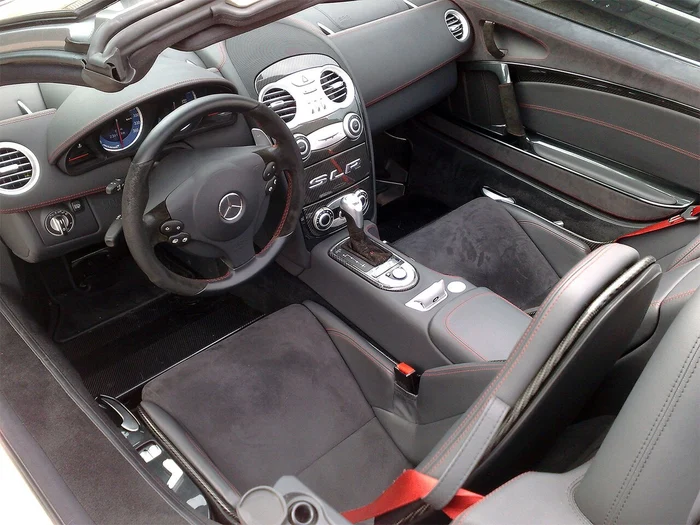
Image source: Wikimedia Commons
Production, pricing, and rarity
Production was limited to about 150 coupés, and contemporary reporting noted that the allocation sold quickly at a premium above the base SLR. Exact delivered counts in secondary registries sometimes differ by a unit or two; for practical purposes, treat the edition as a roughly 150-car closed run. That scarcity sits between the relatively numerous base coupés inside the ~2,157 family total and the even rarer 75-car Stirling Moss.
The 722 GT race car developed with Ray Mallock Ltd. for a one-make series is a different product: wider bodywork, major weight reduction, race brakes and seats, and roughly 680 PS class output. It should not be confused with the road 722 Edition when documenting a road car.
Ownership notes specific to the 722 Edition
1. Correct identity
Confirm 722 status through build documentation, VIN/options data, engine output coding, and visual edition markers (badging, aero, 19-inch wheels, cabin materials). Cosmetic replica badges on a base car do not create a 722.
2. Shared SLR systems
SBC, ceramics, supercharged M155, and CFRP body care follow the same specialist rules as the base coupé. The larger front discs and firmer suspension add 722-specific wear and alignment checks.
3. Market position
722 Editions typically command a premium over comparable base coupés when history is clean. Condition, mileage, colour, and service provenance still dominate over the badge alone.
Legacy
The SLR McLaren 722 Edition is the definitive factory performance closed car of the Mercedes–McLaren partnership: 650 PS, 820 Nm, limited to about 150 units, and named for one of Mercedes’ greatest racing results. It proved that the heavy CFRP grand tourer could be sharpened meaningfully without abandoning the five-speed automatic architecture or the luxury two-seat cabin.
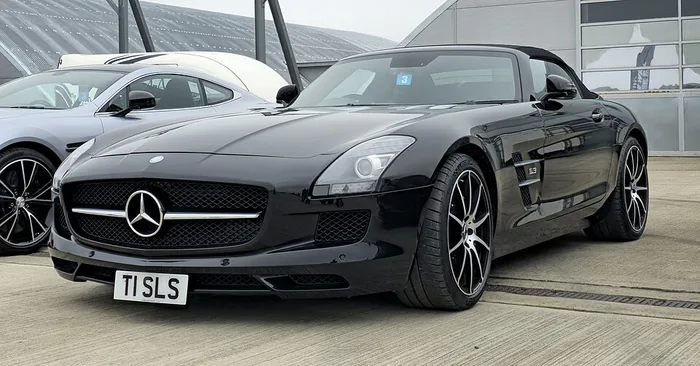
In the longer Mercedes sports-car timeline, the 722 sits between the base SLR’s grand-touring statement and AMG’s later clean-sheet SLS AMG, which pursued lower mass and a dual-clutch sports-car layout instead of further supercharged GT evolution. For the SLR family itself, the durable 722 facts are: C199 coupé, 650 PS / 820 Nm M155, ~3.6 s to 100 km/h, ~337 km/h top speed, 10 mm lower firmer chassis, 390 mm front ceramics, and a roughly 150-car production cap.
Leave a Reply
You must be logged in to post a comment.