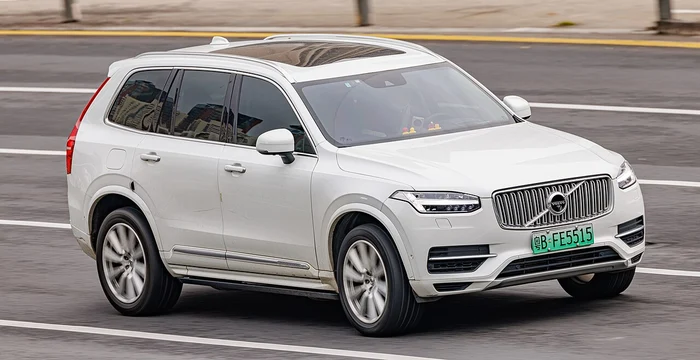
Every plug-in hybrid Volvo has built since 2012 shares a family resemblance: a turbocharged engine driving the front wheels, an electric motor driving the rear, and a battery pack sitting low in the chassis rather than intruding on cabin or boot space. What that basic layout has concealed, generation after generation, is just how much has changed underneath it.
The battery chemistry, the motor output, the software managing the handoff between combustion and electric power, and even the fundamental engine architecture powering the front axle have all been substantially reworked at least three separate times since Volvo’s first plug-in hybrid reached customers.
This is an account of that evolution, generation by generation, told through the hardware rather than the marketing around it.
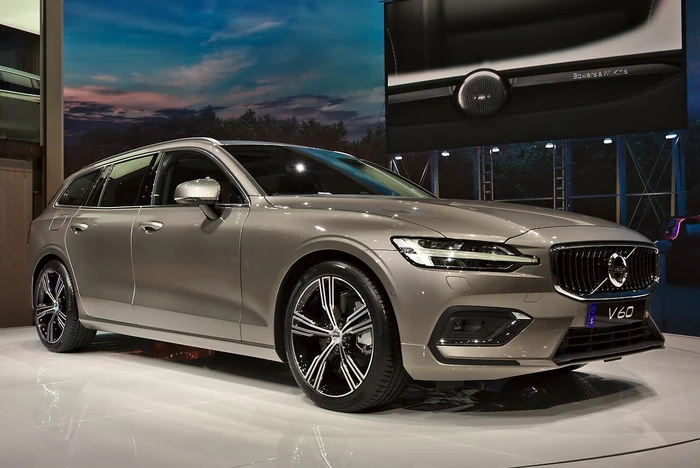
Image source: Wikimedia Commons
Generation Zero: The Diesel Experiment (2012–2014)
Volvo’s plug-in hybrid story does not begin with the T8 badge at all, and it does not begin with petrol. The V60 Plug-in Hybrid, launched for 2012, paired a 2.4-litre five-cylinder diesel engine — a direct descendant of Volvo’s long-running inline-five family — with an electric motor on the rear axle and a battery pack offering roughly 11.2 kWh of capacity, unusually generous for its era.
Volvo marketed the car as the world’s first diesel plug-in hybrid to reach series production, and the combination delivered official electric range in the region of 31 miles alongside genuinely low combined fuel consumption figures for a car of its size.
This generation never expanded much beyond the V60 and its closely related saloon sibling, and it was effectively discontinued as Volvo’s broader engine strategy pivoted away from five- and six-cylinder units. Its most important legacy was architectural rather than commercial: it established the front-engine, rear-motor layout that every subsequent Volvo plug-in hybrid would retain, along with the packaging principle of running the battery pack through the car’s central tunnel rather than displacing luggage space.
Generation One: The Birth of T8 Twin Engine (2014–2019)
The genuine starting point of the modern T8 story is the Drive-E engine family — a single, highly modular 2.0-litre four-cylinder unit designed to eventually replace nearly every other engine in Volvo’s lineup. For the plug-in hybrid application, that engine was fitted with both a supercharger and a turbocharger working in sequence, the supercharger providing immediate low-rpm response while the turbocharger took over as engine speed climbed, a solution to the classic turbo-lag problem that a smaller displacement four-cylinder would otherwise have struggled with in a heavy SUV application.
| Specification | First-generation T8 (2014–2019) |
|---|---|
| Combustion engine | 2.0-litre four-cylinder, turbocharged and supercharged |
| Electric motor output | Approximately 60 kW (82 hp) |
| Battery capacity | Approximately 9.2 kWh |
| Combined system output | Around 400 horsepower |
| Electric-only range | Roughly 17 miles (NEDC) |
| Launch platform | Second-generation XC90 |
Badged T8 Twin Engine, this powertrain first appeared on the second-generation XC90 and was extended within a few years to the S90 saloon, V90 estate, XC60, S60 and V60. The combined output figure — around 400 horsepower — was notable for placing the plug-in hybrid variant well ahead of any petrol-only engine Volvo offered at the time, establishing the pattern that would hold for the following decade: the plug-in hybrid as the performance flagship of the range, not merely its efficiency specialist.
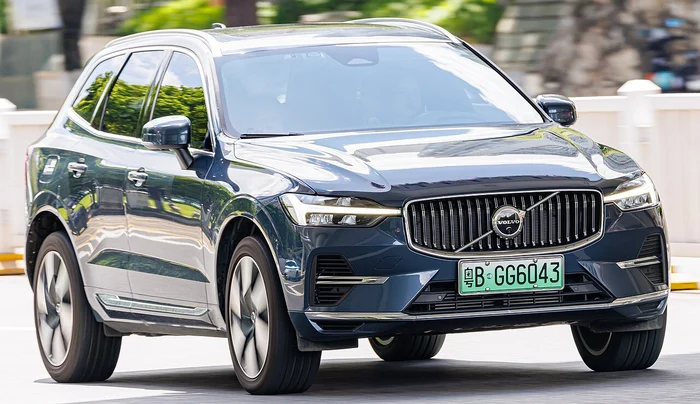
Image source: Wikimedia Commons
Generation Two: Bigger Battery, Broader Rollout (2019–2022)
The second generation of T8 hardware, arriving alongside a broader mid-cycle update across Volvo’s 90- and 60-series models, focused primarily on incremental gains rather than a wholesale redesign. Battery capacity grew to approximately 11.6 kWh usable, electric motor output increased modestly, and combined system power climbed in stages — first to around 390 horsepower on some applications following a software-driven change in how Volvo measured and reported combined output, then back up toward 415 horsepower on later variants as the company continued refining the calibration between the two power sources.
More significant than the raw numbers was the introduction of the newer WLTP testing standard partway through this generation’s production run, which changed how electric range was measured and reported. Under the new methodology, T8 models in this generation returned electric range figures in the region of 21 miles — a number that looks like a regression compared with earlier NEDC-tested figures until the different testing standards are accounted for.
This period also saw Volvo extend the mild-hybrid B-series badges (B4, B5, B6) across the rest of the lineup using the same 48-volt architecture principles found in rival systems, establishing the two-tier hybrid structure — mild hybrid as the volume standard, plug-in hybrid as the flagship — that still defines Volvo’s combustion-adjacent lineup today.
Generation Three: The Battery Finally Catches Up (2022–Present)
The most recent generation of T8 hardware represents the largest single jump in the programme’s history, and arguably the point at which the plug-in hybrid stopped being a compromise technology and started behaving, in daily use, like something closer to a part-time electric car.
| Specification | Third-generation T8 (2022–present) |
|---|---|
| Combustion engine | 2.0-litre four-cylinder, turbocharged, Miller-cycle variants on select models |
| Battery capacity | Approximately 18.8 kWh usable |
| Electric-only range | Roughly 35 miles (WLTP), some applications approaching 45 miles |
| Combined system output | Up to 455 horsepower on range-topping variants |
| Charging | AC charging supported at increased rates versus earlier generations |
| Naming | "T8" suffix, Recharge badge discontinued from 2025 model year |
A battery pack nearly double the size of the original 2014 unit changed the character of ownership considerably. Where earlier T8 generations offered enough electric range for a short errand before the combustion engine inevitably intervened, the current generation can plausibly cover an entire day’s typical driving — a school run, a commute, an evening trip to see friends — without the four-cylinder engine firing at all, provided the car is charged overnight.
Volvo also used this generation to introduce a Miller-cycle variant of its 2.0-litre engine on certain applications, a combustion-efficiency refinement — using a modified intake valve timing to improve thermal efficiency — layered on top of the electrification gains rather than in place of them, suggesting the company continued to see value in refining the combustion half of the powertrain even as the electric half grew more capable.
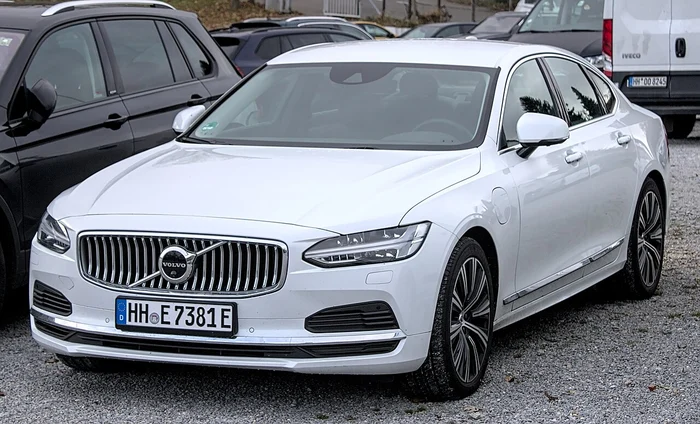
Image source: Wikimedia Commons
The Naming Layer, Stripped Away
Running parallel to the hardware evolution has been a naming evolution worth tracking separately, because it reveals how Volvo’s own understanding of the technology’s purpose shifted over time.
- 2012–2019, Twin Engine: a literal, mechanical description of the two power sources, used with minimal marketing embellishment.
- 2019–2024, Recharge: an umbrella brand deliberately shared with Volvo’s emerging battery-electric models, blurring the distinction between plug-in hybrid and full electric in customer-facing communication.
- 2024–present, T6/T8 suffix only: the Recharge name dropped entirely from plug-in hybrids, replaced by a simple power-output designation, while fully electric models adopted distinct EX and EC nameplates of their own.
That final change, implemented for the 2025 model year, was explained by Volvo as an effort to reduce confusion between electrified and fully electric ownership — an implicit acknowledgment that blending the two under a single Recharge identity had, by that point, outlived its usefulness now that the battery-electric side of the lineup was substantial enough to stand on its own.
Reading the Trajectory
Laid out generation by generation, the T8 programme’s technical evolution shows a consistent direction of travel rather than a series of unrelated updates: batteries have grown steadily larger at every generational step, electric range has expanded even after accounting for stricter testing standards, and combined power output has climbed even as Volvo simultaneously pursued combustion-side efficiency refinements like the Miller-cycle engine.
Nothing in that pattern resembles a technology being quietly run down ahead of an eventual replacement. It resembles, instead, a powertrain architecture that Volvo’s engineering teams kept investing in seriously, generation after generation, right through a period when the company’s own public messaging about its electrification timeline was shifting substantially around it.
The badge on the boot lid changed three times in a decade. The underlying commitment to making the hardware genuinely better, generation after generation, did not change at all.
Leave a Reply
You must be logged in to post a comment.