
Misfueling your vehicle is a surprisingly common mistake that can have consequences ranging from minor inconvenience to catastrophic engine damage. Every year, thousands of drivers accidentally pump the wrong type of fuel into their tanks, often with expensive results.
Different fuel types and engine designs
Before diving into what happens when you use the wrong fuel, it’s important to understand how different engines are designed to work with specific fuel types. Gasoline engines and diesel engines operate on fundamentally different principles, which is why using the wrong fuel can be so problematic.
In gasoline engines, a spark plug ignites the air–fuel mixture to start combustion. The fuel is relatively volatile and ignites easily when exposed to a spark. These engines typically operate at higher RPMs and rely on precise timing of the spark ignition to run smoothly.
Diesel engines, by contrast, rely on compression to ignite the fuel. They compress air to extremely high pressures and temperatures, then inject diesel fuel into this superheated air where it ignites spontaneously. Diesel fuel is less volatile than gasoline and serves a dual purpose as both fuel and lubricant for the injection system.
Natural gas vehicles, including those running on compressed natural gas (CNG) or liquefied petroleum gas (LPG/propane), use yet another system. These engines are modified gasoline engines that can handle gaseous fuels, with specialized fuel storage tanks, regulators, and injection systems designed for gases rather than liquids.
Putting diesel in a gasoline car
This is one of the most common misfueling scenarios, and fortunately, it’s often caught early because diesel pump nozzles are typically larger than gasoline filler necks in most countries, making it physically difficult to insert them. However, when it does happen, the consequences depend largely on how much diesel enters the system and whether you start the engine.
What happens to the fuel system
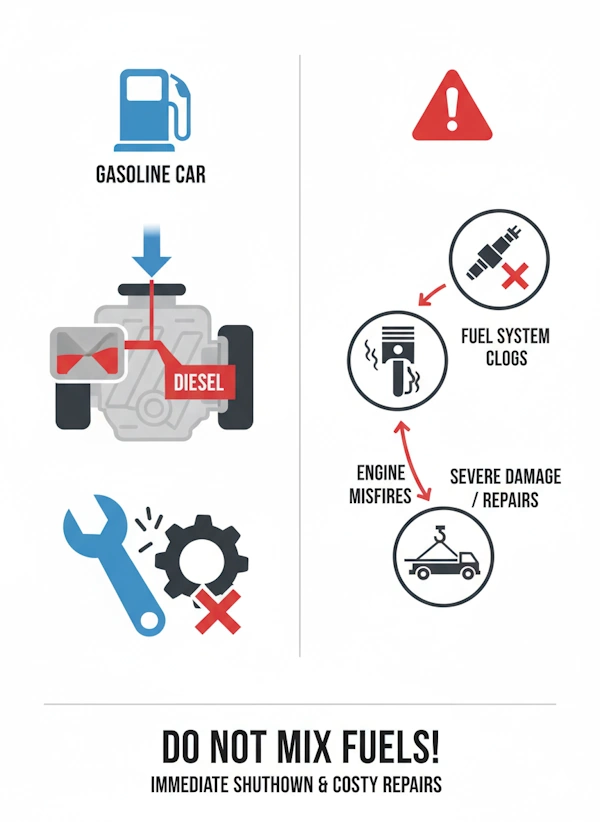
Diesel fuel in a gasoline tank creates immediate problems. Diesel is much thicker and oilier than gasoline, with different volatility characteristics. When diesel enters a gasoline fuel system, it doesn’t vaporize properly in the fuel injectors or carburetor. The fuel pump, which is designed to handle thin, light gasoline, struggles to move the heavier diesel through the system.
If you start the engine with diesel in the tank, the fuel pump will begin circulating the contaminated fuel throughout the entire system. The diesel will coat the fuel lines, fuel rail, injectors, and enter the combustion chambers. Because diesel doesn’t ignite with a spark the way gasoline does, the engine will run extremely poorly if it runs at all.
Engine performance and symptoms
If you manage to start a gasoline engine with diesel fuel in it, you’ll immediately notice severe performance problems. The engine will likely produce excessive smoke from the exhaust, particularly black or dark gray smoke. This occurs because the diesel fuel doesn’t burn completely in the combustion process designed for gasoline.
The engine will probably misfire constantly, run very rough, and have almost no power. You might hear knocking or pinging sounds as the diesel fuel fails to ignite properly at the right time in the combustion cycle. The vehicle will be almost impossible to drive normally, and the check engine light will almost certainly illuminate as sensors detect the incorrect fuel mixture and misfires.
In most cases, a gasoline engine will stall shortly after starting if there’s a significant amount of diesel in the tank. If the contamination is minor (perhaps just a small amount of diesel in a mostly full tank of gasoline), the engine might run poorly but continue operating, though this will cause ongoing damage.
Potential damage and long-term effects
While putting diesel in a gasoline car is certainly problematic, it’s generally less catastrophic than the reverse scenario. The primary risk is to the fuel system components. Diesel can damage fuel injectors designed for gasoline, potentially clogging them or causing them to stick. The fuel pump may be damaged by trying to move the heavier diesel fuel, potentially leading to premature failure.
The spark plugs may become fouled with diesel deposits, requiring replacement. If diesel enters the combustion chambers and the engine continues to run, you risk incomplete combustion that can lead to carbon buildup on pistons, valves, and cylinder walls. This carbon accumulation can affect engine performance and efficiency over time.
The catalytic converter is also at risk. These emissions control devices are designed to handle the byproducts of gasoline combustion. When diesel fuel passes through incompletely burned, it can damage or clog the catalytic converter, which is an expensive component to replace.
What should you do if you put diesel in a gasoline car
If you realize your mistake before starting the engine, you’re in the best possible position. Avoid turning the ignition key or pressing the start button. Even turning the ignition to the “on” position (without starting) will activate the fuel pump and begin circulating the contaminated fuel through the system.
Call for roadside assistance or a towing service to have the vehicle transported to a repair facility. The fuel tank will need to be drained completely and the fuel lines flushed to remove all traces of diesel. This is a much simpler and less expensive fix than dealing with the damage that occurs once diesel has circulated through the entire fuel system and entered the engine.
If you’ve already started the engine and driven the vehicle, stop as soon as it’s safe to do so and turn off the engine immediately. Continuing to drive will only spread the diesel further through the system and cause additional damage. Again, arrange for towing to a qualified mechanic who can drain the tank, flush the fuel system, and inspect for damage to components like fuel injectors, the fuel pump, and spark plugs.
Putting gasoline in a diesel car
This scenario is generally considered more serious than putting diesel in a gasoline vehicle. The physical design of fuel pumps often makes this mistake easier to make since gasoline nozzles are smaller and can fit into diesel filler necks, whereas the reverse is usually prevented by size differences.
Why this is more dangerous
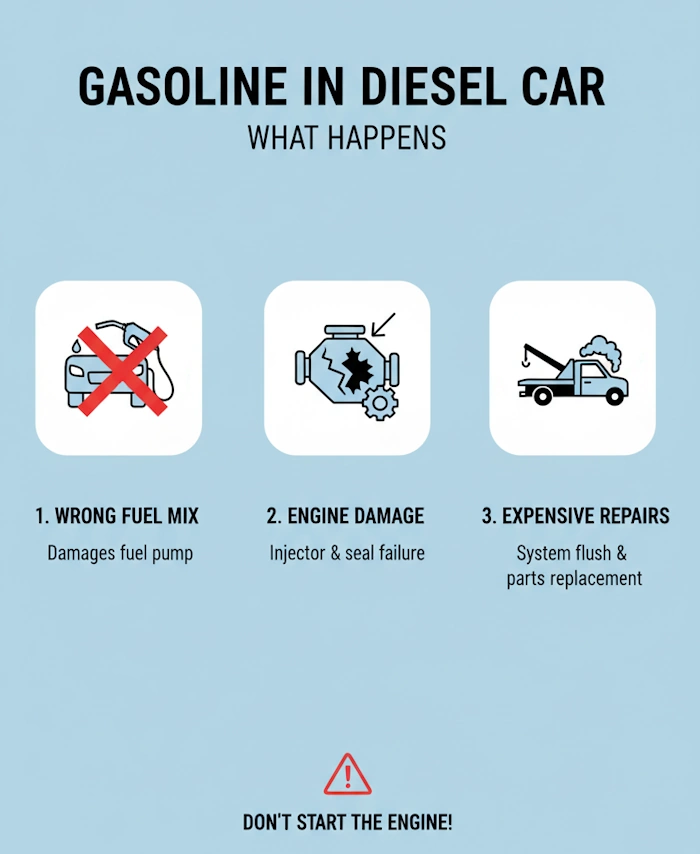
Diesel engines rely on the lubricating properties of diesel fuel to protect the high-pressure fuel injection system. Modern diesel engines, in particular, use extremely sophisticated common-rail injection systems that operate at pressures exceeding 30,000 PSI. These precision components require the natural lubricity of diesel fuel to function without excessive wear.
Gasoline, being a solvent, lacks these lubricating properties. When gasoline enters a diesel fuel system, it acts as a degreaser, stripping away the protective fuel film from metal surfaces. This creates metal-on-metal contact in the injection pump and injectors, components that operate with tolerances measured in microns. The friction produced in the process creates heat and leads to accelerated deterioration of the parts.
Immediate effects on the engine
If you start a diesel engine with gasoline in the fuel system, the initial symptoms might not be immediately obvious. Unlike a gasoline engine running on diesel, which fails almost immediately, a diesel engine might actually run on gasoline for a short period, especially if there’s still some diesel fuel mixed in the system.
However, as the gasoline concentration increases, you’ll start to notice problems. The engine may produce unusual knocking sounds different from normal diesel clatter. This occurs because gasoline ignites differently under compression than diesel fuel. Gasoline has a lower cetane rating (the diesel equivalent of octane), meaning it’s more prone to premature ignition and detonation in a high-compression environment.
You might also notice excessive white or blue smoke from the exhaust as the gasoline burns improperly in the diesel combustion process. The engine may lose power and run rough as the fuel fails to ignite at the optimal moment in the compression cycle.
Catastrophic damage potential
The real danger from gasoline in a diesel engine occurs in the fuel injection system. As the gasoline circulates through the high-pressure injection pump, it begins destroying the internal components. The lack of lubrication causes the pump’s precision-machined parts to wear rapidly, generating metal particles that then circulate throughout the fuel system.
These metal particles act like sandpaper, scoring the internal surfaces of fuel injectors and further damaging the injection pump. The injectors themselves can seize or fail completely as their internal components wear beyond acceptable tolerances. This damage typically happens quickly, often within minutes of the engine running.
Modern common-rail diesel injection systems are particularly vulnerable because of their extreme operating pressures and incredibly tight tolerances. The injection pump, fuel rail, and all injectors may require replacement if gasoline has circulated through the system under pressure. This repair can easily cost thousands of dollars, sometimes exceeding the value of older vehicles.
Beyond the fuel system, gasoline in a diesel engine can cause combustion issues that damage pistons, rings, and cylinder walls. The improper ignition characteristics of gasoline in a high-compression environment can lead to excessive heat and pressure spikes that exceed what the engine components were designed to handle.
Immediate action is critical
If you realize you’ve put gasoline in a diesel vehicle before starting the engine, you have a chance to avoid catastrophic damage. Do not start the vehicle under any circumstances. Even running the engine for a few seconds can cause thousands of dollars in damage to the injection system.
Have the vehicle towed to a repair facility where the fuel tank can be drained and the fuel lines purged before any gasoline reaches the injection pump. This precautionary service is relatively inexpensive compared to replacing injection system components.
If the engine is already running, turn it off right away. Every second the engine runs with gasoline in the fuel system increases the damage exponentially. Continuing to drive “just to get home” or “to the nearest station” virtually guarantees complete injection system failure.
The repair process after gasoline has run through a diesel injection system is extensive. Beyond draining the tank and flushing fuel lines, the mechanic will need to inspect the injection pump, fuel rail, and all injectors for damage. In many cases, these components will need replacement. The fuel filter will definitely need changing, as it will contain contaminated fuel and possibly metal particles from damaged components.
Diesel in a gasoline car versus gasoline in a diesel car
Understanding the relative severity of these two scenarios can help drivers prioritize their response and understand the potential costs involved.
The diesel-in-gasoline scenario is generally the less severe of the two mistakes. While it causes the engine to run terribly or not at all, the immediate catastrophic damage potential is lower. The main risks are to spark plugs, fuel injectors, and potentially the catalytic converter. If caught early and the engine isn’t run extensively, a thorough drain and flush often resolves the problem with minimal additional repairs needed.
The gasoline-in-diesel scenario is far more serious because of the damage to the high-pressure injection system. This damage happens quickly and can easily result in repair bills of five to ten thousand dollars or more, depending on the vehicle. The precision components in modern diesel injection systems are extremely expensive, and if the injection pump fails while running, it can send metal particles throughout the system, contaminating every component.
From a safety perspective, both scenarios can potentially strand you unexpectedly, but the diesel engine running on gasoline might actually be more dangerous because it may seem to run somewhat normally at first, encouraging the driver to continue operating the vehicle while invisible damage accumulates rapidly in the injection system.
Putting liquid fuel in a natural gas vehicle
Vehicles designed to run on compressed natural gas or liquefied petroleum gas (propane) represent another category of specialized fuel systems. These vehicles are less common than traditional gasoline or diesel vehicles, but misfueling them presents unique problems.
How natural gas vehicles differ
Natural gas vehicles can be factory-built or converted from gasoline engines. They use fuel stored as a compressed gas (CNG) at around 3,600 PSI or as a liquefied gas (LPG/propane) at much lower pressure. The fuel system includes specialized high-pressure tanks, pressure regulators to reduce the gas to usable pressure, and modified fuel injectors or mixer systems designed to handle gaseous fuel.
These vehicles often have distinctly different fueling connections that make accidental misfueling difficult. CNG stations use specialized nozzles that require specific adapters, and LPG systems typically use unique fittings as well. However, bi-fuel vehicles that can run on both gasoline and natural gas might have conventional fuel fillers alongside their gas fuel ports.
What happens if you put gasoline or diesel in a natural gas vehicle
For a dedicated natural gas vehicle without gasoline capability, putting liquid fuel into the system would likely be mechanically prevented by the fuel port design. However, if liquid fuel somehow entered the system, it would cause immediate and serious problems.
The high-pressure gas storage tanks aren’t designed to handle liquids. Gasoline or diesel in these tanks would fail to pressurize properly and wouldn’t flow correctly through the pressure regulators designed for gaseous fuel. The liquid fuel wouldn’t vaporize properly in the gas injection system, preventing the engine from running.
If liquid fuel reached the engine, it would flood the combustion chambers designed for precisely metered amounts of gaseous fuel. The engine wouldn’t start or would run extremely poorly for a brief moment before stalling. The risk of damage would depend on how much liquid fuel entered the system and whether any unusual pressure or mechanical issues occurred.
For bi-fuel vehicles, the consequences depend on which fuel system was contaminated. If gasoline is accidentally added to the natural gas side, the physical incompatibility of liquid in a gas system would prevent normal operation. Conversely, attempting to fill the gasoline tank side with natural gas would be prevented by the connection differences and the fact that gas wouldn’t flow properly through liquid fuel pump systems.
Repair
If liquid fuel contaminates a natural gas fuel system, the repair process would involve draining any accessible liquid fuel, purging the gas lines and regulators, and potentially replacing fuel system components that were damaged by exposure to liquid fuel. The specialized nature of natural gas fuel systems means repairs might require technicians specifically trained in alternative fuel vehicles.
The gas storage tanks would need careful inspection to ensure no damage occurred from the incompatible fuel. Pressure regulators, gas injectors or mixer systems, and associated sensors would all require checking and possible replacement.
Mixed fuel scenarios and diluted contamination
Not every misfueling incident involves completely filling a tank with the wrong fuel. Sometimes drivers catch their mistake after pumping just a small amount, leading to questions about what happens when fuels are mixed or diluted.
Small amounts of diesel in gasoline
If you’ve added only a small amount of diesel to a mostly full tank of gasoline, the severity depends on the concentration. Adding a gallon or two of diesel to a 15-gallon tank of gasoline will likely cause the engine to run poorly, but probably won’t cause immediate catastrophic failure.
The mixture will still ignite in a gasoline engine, though not optimally. You may experience rough running, reduced power, excessive smoke, and possible misfires. The check engine light will likely illuminate. If the contamination is truly minor (less than 10% of the tank volume), some mechanics suggest adding more gasoline to further dilute the diesel and then running the tank as low as possible before refilling with pure gasoline.
However, this approach carries risks. The diluted diesel mixture will still coat fuel system components with oily residue and may foul spark plugs. For peace of mind and to avoid potential damage, having the tank drained and the system flushed is still the safest approach.
Small amounts of gasoline in diesel
This scenario is more concerning even with small quantities because of how quickly gasoline damages diesel injection systems. While a very small amount of gasoline in a large tank of diesel will have its harmful effects diluted, any gasoline in a diesel fuel system compromises its lubricating properties.
Some diesel injection systems might tolerate up to 5% gasoline contamination without immediate failure, but this isn’t guaranteed and depends on the specific vehicle and injection system design. Modern common-rail diesel systems with their extreme pressures are particularly vulnerable and may begin suffering damage even with small amounts of gasoline present.
If you’ve added only a small amount of gasoline to diesel, it’s still advisable to have the tank drained rather than risk expensive injection system damage. The cost of prevention is always less than the cost of repairing a failed injection pump and replacing injectors.
Ethanol and biodiesel
Modern fuels often contain additives that affect compatibility. Most gasoline in the United States contains up to 10% ethanol (E10), while higher blends like E85 (85% ethanol) are available for flex-fuel vehicles. Similarly, diesel fuel often contains up to 5% biodiesel (B5), with higher blends available.
These additives add another layer of complexity to misfueling scenarios. Ethanol-blended gasoline in a diesel engine carries all the same risks as pure gasoline, plus ethanol’s affinity for water can introduce additional corrosion concerns in diesel fuel systems not designed for it.
Biodiesel-blended diesel in a gasoline engine combines the problems of diesel contamination with potential issues from biodiesel’s different chemical properties. Higher biodiesel blends are more viscous and may cause even more severe clogging in gasoline fuel systems.
Long term consequences
Even after addressing an immediate misfueling incident through tank draining and system flushing, there may be long-term consequences that aren’t immediately apparent.
Fuel system component degradation
Fuel injectors are precision components with extremely tight tolerances. After exposure to incompatible fuel, they may continue functioning but with reduced efficiency or reliability. Injectors that were coated with diesel in a gasoline system might develop spray pattern irregularities that affect fuel economy and emissions over time.
Similarly, a diesel injection pump that was briefly exposed to gasoline but didn’t suffer immediate catastrophic failure might have accelerated wear that leads to premature failure months or years later. The initial exposure stripped protective fuel films and may have caused microscopic surface damage that progressively worsens under normal operation.
Fuel pumps in both gasoline and diesel systems can suffer reduced lifespan after misfueling incidents. The stress of attempting to move incompatible fuel can damage pump components or contaminate internal filters and screens with debris.
Sensor and emissions system impacts
Modern vehicles have numerous fuel system sensors monitoring everything from fuel pressure and temperature to oxygen content in the exhaust. These sensors can be damaged or fouled by incorrect fuel types.
Oxygen sensors in the exhaust system are particularly vulnerable to contamination from improperly burned fuel. If diesel was burned in a gasoline engine or gasoline in a diesel engine, the unusual exhaust composition can damage or poison these sensors, leading to check engine lights and failed emissions tests even after the fuel contamination has been resolved.
The catalytic converter or diesel particulate filter can suffer long-term damage from a misfueling incident. These emissions control devices are calibrated for specific combustion byproducts. Exposure to the wrong fuel type can deposit contaminants that reduce their efficiency or cause premature failure.
Carbon buildup and combustion chamber deposits
When the wrong fuel burns incompletely in an engine, it leaves behind more carbon deposits than normal combustion. These deposits accumulate on valves, piston crowns, and cylinder walls. Over time, this carbon buildup can cause hot spots in the combustion chamber, increase the likelihood of pre-ignition or detonation, and reduce engine efficiency.
In direct-injection engines, both gasoline and diesel, carbon buildup on intake valves is already a concern. A misfueling incident that causes incomplete combustion accelerates this problem significantly.
Prevention strategies and design features
Automotive manufacturers and fuel industry organizations have implemented various strategies to prevent misfueling incidents, though none are completely foolproof.
Physical prevention through nozzle design
The most common prevention method is the size difference between fuel nozzles. In many countries, diesel nozzles are larger in diameter than gasoline nozzles, making it physically difficult to insert a diesel nozzle into a gasoline vehicle’s filler neck. However, this only prevents one direction of misfueling—gasoline nozzles still fit into diesel filler necks.
Some modern vehicles feature capless fuel fillers with spring-loaded flappers that are calibrated for specific nozzle sizes and shapes. These systems can provide additional protection against incorrect nozzle types, though determined effort can sometimes overcome these barriers.
Natural gas vehicles typically use completely different fueling connectors that are mechanically incompatible with liquid fuel nozzles, making accidental misfueling nearly impossible.
Warning labels and color coding
Fuel caps and filler doors almost always include labels indicating the correct fuel type. Diesel vehicles often have yellow or green filler caps or labels, while gasoline vehicles typically use black or silver. However, these visual cues are only effective if the driver is paying attention.
Many European diesel vehicles include additional warnings in multiple locations, including on the fuel cap, filler door, and dashboard. Some display a warning message on the instrument cluster when the fuel door is opened.
Misfuel prevention devices
Aftermarket devices are available that physically prevent the wrong nozzle type from being inserted into the fuel filler. These are particularly popular for diesel vehicles, as they prevent the smaller gasoline nozzle from entering. The device typically includes a collar or insert that requires the larger diesel nozzle to open it, while smaller nozzles are blocked.
These prevention devices are relatively inexpensive and can be installed at repair shops or even by vehicle owners. For anyone who has experienced a costly misfueling incident, the small investment in such a device is worthwhile insurance against repeat mistakes.
Driver awareness
Ultimately, prevention relies primarily on driver attention. Developing consistent habits at the fuel pump can reduce misfueling risk. Some helpful practices include always checking the pump label before removing the nozzle, verifying the fuel type shown on the pump display before authorizing payment, and making it a habit to check your fuel cap label before pumping.
For households with multiple vehicles using different fuel types, extra vigilance is necessary. Establishing clear mental associations between specific vehicles and their fuel types can help prevent autopilot mistakes.
Cost and insurance coverage
Understanding the financial implications of misfueling can help drivers appreciate the importance of prevention and quick action when mistakes occur.
Typical repair costs
A simple tank drain and fuel system flush after catching a misfueling mistake before starting the engine typically costs between $400 and $800, depending on the vehicle and labor rates in your area. This includes draining the tank, flushing the fuel lines, replacing the fuel filter, and refilling with correct fuel.
If the engine was started and run briefly with contaminated fuel, costs increase significantly. For diesel in a gasoline vehicle, you might face $1,000 to $3,000 in repairs including fuel system flushing, spark plug replacement, injector cleaning or replacement, and catalytic converter service if needed.
For gasoline in a diesel vehicle after the engine has run, repair costs typically start at $3,000 and can easily exceed $10,000 or more for modern common-rail diesel systems. Replacing an injection pump alone often costs $2,000 to $4,000, and injectors can cost $300 to $800 each. With four to eight injectors in most diesel engines, the math gets painful quickly.
These costs don’t include consequential damage such as towing fees, rental car expenses while repairs are being made, or the value of time lost dealing with the situation.
Insurance coverage
Whether insurance covers misfueling damage depends on your specific policy. Most standard auto insurance policies don’t cover misfueling because it’s considered an operational error rather than an accident or covered peril.
Some comprehensive coverage policies might include protection for misfueling under mechanical breakdown coverage or as an optional add-on. Extended warranty products sometimes cover misfueling incidents, though usually with deductibles and coverage limits that may not cover the entire repair cost.
Some specialty policies or premium coverage packages specifically include misfueling protection, which might be worthwhile if you regularly drive different vehicle types or operate company vehicles.
Special cases and unusual situations
Beyond the common misfueling scenarios, there are some unusual situations worth understanding.
E85 in regular gasoline vehicles
E85 fuel comprises 85% ethanol combined with 15% gasoline. While it’s a gasoline product, it’s only intended for flex-fuel vehicles specifically designed to handle high ethanol concentrations. Putting E85 in a regular gasoline vehicle can cause problems.
Ethanol is more corrosive than gasoline and can damage fuel system components not designed for it, including rubber seals, gaskets, and some plastic components. E85 also burns differently than gasoline, requiring different fuel mapping in the engine computer. A standard gasoline engine will run poorly on E85, potentially with rough idle, misfires, and check engine lights.
The high ethanol content also means less energy per gallon compared to gasoline, resulting in significantly reduced fuel economy. If you accidentally fill with E85, diluting it by adding regular gasoline can help, but it’s better to drain and refill if possible.
Diesel exhaust fluid in the fuel tank
Modern diesel vehicles with emissions controls often use diesel exhaust fluid (DEF), also called AdBlue, which is stored in a separate tank. DEF is a urea-based solution that’s injected into the exhaust system to reduce nitrogen oxide emissions.
Accidentally putting DEF in the diesel fuel tank is a serious mistake. DEF is highly corrosive to the fuel system components and will cause rapid crystallization when mixed with diesel fuel. This contamination can destroy the fuel injection system and require extensive repairs.
Conversely, putting diesel fuel in the DEF tank will damage the selective catalytic reduction (SCR) system. Both scenarios require immediate draining and flushing, and professional inspection for damage.
Aviation fuel in automotive engines
Occasionally, someone with access to aviation fuel might wonder about using it in a car. Aviation gasoline (avgas) has a very high octane rating but contains lead, which will immediately destroy catalytic converters and oxygen sensors in modern vehicles. Jet fuel (which is essentially kerosene) in a gasoline engine would cause similar problems to diesel contamination but with even worse performance.
These specialty fuels should never be used in automotive engines under any circumstances.
Conclusion
Putting the wrong fuel in your vehicle is a mistake that can range from a minor inconvenience to a catastrophically expensive repair, depending on the specific scenario and how quickly it’s caught. Gasoline in a diesel vehicle presents the most serious risk because of the rapid damage to high-pressure injection systems, potentially causing repair bills exceeding ten thousand dollars. Diesel in a gasoline vehicle, while certainly problematic, generally results in less severe and less expensive damage if addressed promptly.
The key to minimizing damage in any misfueling scenario is immediate recognition and action. If you catch the mistake before starting the engine, have the vehicle towed for tank draining and fuel system flushing. If you’ve already started the engine, shut it off immediately and arrange for towing to a repair facility. Continuing to drive with contaminated fuel exponentially increases the damage and repair costs.
Prevention is always preferable to even the least expensive repair. Taking an extra moment to verify the correct fuel type before pumping, installing misfuel prevention devices, and developing consistent fueling habits can save thousands of dollars and significant inconvenience. For anyone operating multiple vehicles with different fuel requirements, heightened awareness at the pump is essential.
Leave a Reply
You must be logged in to post a comment.